
ELV-330 · Lesson 5 of 12 · 20 min
Handrails and handrail drives
The call from the transit station came in at four in the afternoon: the street entrance up escalator had stopped itself twice during the lunch hour, and the station attendant had restarted it both times with the key. The controller's fault log, which Tamsin read on the service tool when she and Nell arrived, showed the same fault both times: left handrail speed low. Outside, the morning's rain had turned to a cold drizzle, and the left handrail, which faces the street, was wet. "Handrails are the part passengers hold onto, and they are the part that slips first," Nell said. "If the steps go on and the handrail lags, people get pulled backward. So the controller watches it, and so do we." This lesson covers handrails, the drives that move them, the guides they run in, and the devices that watch their speed and guard the places where they enter the balustrade.
What a handrail is made of
An escalator handrail is a continuous loop of molded rubber or thermoplastic, roughly C-shaped in section, that slides around a guide on top of the balustrade. Inside it are layers that give it strength and let it slide: a set of steel wires or a steel band that carries the tension and keeps the handrail from stretching, fabric plies that hold its shape, and a low-friction slider fabric on the inside surface that runs on the guide. The outer cover is the part passengers touch, and it must be smooth, unbroken and clean. A handrail is made to the exact length of its loop and joined on site by vulcanizing or by a molded splice, so a new handrail is a planned job with special equipment rather than a quick repair. Transit guidelines ask for steel tension members strong enough to carry a large load across the splice.
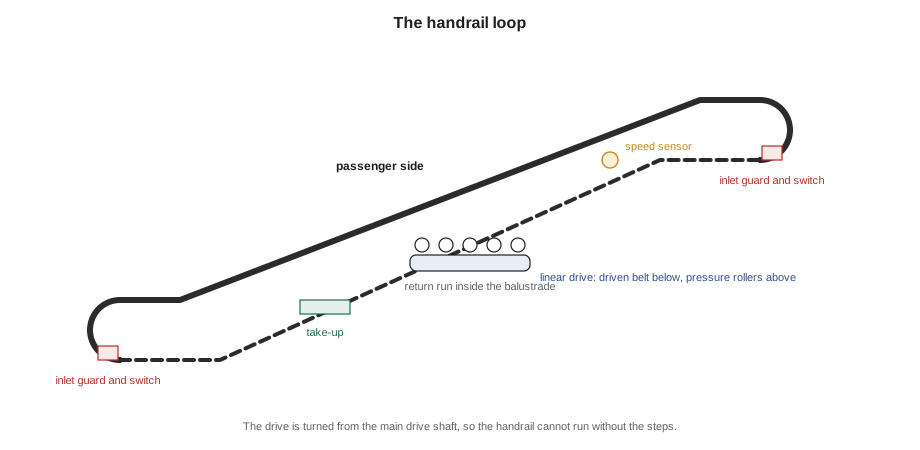
The handrail runs along the top of the balustrade on the passenger side, turns around the newel at each end, and returns inside the balustrade or under the truss, where the drive and the tensioning devices are. The code sets the height of the handrail above the step noses, between 35 in and 39 in, the clearance between the handrail and anything beside it, and how far the handrail must extend beyond the comb at each landing, at least 12 in, so that a passenger still has something to hold while stepping off.
Handrail drives
The handrail must move in the same direction as the steps and at substantially the same speed. On most escalators it is driven from the main drive shaft, through a chain to a handrail drive shaft, so that it can never run without the steps. Two kinds of drive are common. A sheave or wheel drive wraps the handrail around a large drive wheel near the upper newel, with a pressure belt or rollers holding it against the wheel. A linear or friction drive grips a straight section of the handrail between a driven belt or a row of driven rollers and a row of pressure rollers, pushing the handrail along. Linear drives are gentler on the handrail because they do not bend it around a tight radius, and many modern units use them.
Every drive works by friction, so it depends on the pressure between the handrail and the drive surface and on the condition of both. Worn drive rollers, glazed or contaminated drive belts, pressure rollers out of adjustment, a handrail that has stretched or swollen, and water, oil or ice on the handrail all reduce the grip. When the grip is not enough, the handrail slips: it runs slower than the steps, and under a heavy passenger load it can almost stop. Passengers holding a slipping handrail are pulled backward relative to their feet, which is why handrail slip is a safety problem and not only a comfort complaint.
Handrail speed: the target and the limit
Makers set the handrail to run at the step speed or very slightly faster, so that a passenger's hand is drawn forward rather than backward. The European standard EN 115 states this directly as a tolerance of zero to plus two percent of the step speed, and North American makers use similar settings. A handrail running slightly faster also stays tight on the passenger side of its loop. The code's own requirement is that the handrail moves with the steps, and it backs that up with a handrail speed monitoring device: if the handrail speed differs from the step speed by 15 % or more, the device stops the escalator after a short delay, between 2 and 6 seconds, so that a moment's slip as a crowd grabs the rail does not stop the unit every time. Some controllers also log a warning at a smaller difference, which is how Nell's crew finds a slipping drive before it causes a stop.
# Handrail and step speed check from tachometer readings
step_speed = 98.8                 # measured at the step nose, ft/min
handrails = {"left": 95.7, "right": 99.8}   # measured on the handrail, ft/min
for side, v in handrails.items():
    diff = 100 * (v - step_speed) / step_speed
    if 0 <= diff <= 2:
        verdict = "within the maker's target of 0 to +2 %"
    elif diff <= -15:
        verdict = "at or beyond the 15 % shutdown limit"
    elif diff < 0:
        verdict = "slow: adjust or repair the drive"
    else:
        verdict = "too fast: check the drive setting"
print(f"{side:>5}: {v} ft/min, {diff:+.1f} % against the steps, {verdict}")left: 95.7 ft/min, -3.1 % against the steps, slow: adjust or repair the drive right: 99.8 ft/min, +1.0 % against the steps, within the maker's target of 0 to +2 %
With no load the left handrail at the station was running about three percent slow, and it was much slower under the lunch-hour crowd, enough to trip the monitor. The right handrail was within the target. Nell's measurements are taken with a hand tachometer and a contact wheel, at the step nose for the steps and on the top of the handrail at the same point; the readings are repeated in both directions and at both ends, because a handrail that stretches can run at different speeds along its length.
Why handrails slip and how they are fixed
At the station, the cause of the slip was a combination that Nell had seen many times on outdoor units. The pressure rollers on the left drive had worn smooth, the drive belt had glazed, and the wet handrail had lost the rest of its grip. The fix was to replace the pressure rollers and the drive belt with the maker's parts, set the roller pressure to the maker's figure, clean the handrail and the drive surfaces with the maker's cleaner, and check the handrail tension. After the work, the left handrail ran at the step speed plus about one percent, and a load test with the station staff leaning on the rail, as a crowd would, showed no slip. Nell added a note to shorten the drive inspection interval on the street entrance units during the wet months.
| Cause of slip | Sign | Fix |
|---|---|---|
| Worn or glazed drive rollers or belt | shiny, smooth drive surfaces | replace with maker's parts, set pressure |
| Low pressure roller force | rollers turn freely by hand with the handrail in place | adjust to the maker's setting |
| Handrail stretched | slack loop, take-up at the end of its range | re-tension or shorten; replace if beyond limits |
| Water, oil or ice on the handrail | slip in wet or cold weather | clean, check covers and heaters on outdoor units |
| Wrong cleaning product | sticky or swollen cover | use only the maker's handrail cleaner |
| Guide friction too high | handrail warm, squealing at the newels | clean guides, check slider fabric and guide wear |
The opposite fault, a handrail that runs too fast or is too tight, wears the handrail and the drive quickly and makes the handrail run hot at the newels. Tension is set with the take-up device on the return side so that the loop is snug on its guides without dragging; the maker gives the setting, often as a measured sag or a spring length.
Handrail inlets and other guards
Where the handrail turns into the balustrade at each newel, it passes through an inlet, the most dangerous point on the handrail. A child's hand resting on the handrail can be carried into the inlet. The inlet is shaped and fitted with a flexible guard or brush to keep fingers out, and behind it a handrail entry device, a switch, stops the escalator if anything pushes the guard inward. The code also limits how high the handrail enters the balustrade above the floor, so that small children's hands are less likely to reach it. The inlet devices are tested at every maintenance visit by pushing the guard with a test tool until the switch opens, and the escalator must stop.
Above the handrail, the code requires guards where the handrail passes close to a ceiling, a floor edge or a wall, so that a passenger leaning out cannot be trapped between the moving handrail and the building. Deck barricades on wide outer decks stop people, usually children, from climbing onto the deck and sliding. Anti-slide knobs on wide decks between escalators stop people sliding down them. All of these are checked during periodic inspections because building changes, such as a new ceiling, a new shop front or a sign, can create a new trap point after the escalator was approved.
Handrail care on a busy site
Handrails wear at the cover, crack at the edges where they bend around the newels, and lose their gloss and grip. Graffiti, gum and stickers are a constant problem at the transit station. Nell's crew cleans handrails with the maker's cleaner only, because solvents and some building cleaners swell the rubber or attack the slider fabric. Small cover cuts can be repaired, but a handrail with cracks that reach the tension members, a broken steel band or a failing splice is replaced. In cold weather, outdoor handrails stiffen, and some outdoor units have handrail heaters or covers; at the station, the agency's specification for the replacement escalators asks for heated handrails at the street entrance.
Worked problem
Interpreting a handrail fault log
The controller at Brackenridge E1 has logged nine handrail speed warnings for the right handrail in a week but no shutdowns. The warnings all occurred on Saturday afternoons. Tamsin is asked what they suggest and what to do.
Show solution
- Warnings without shutdowns mean the handrail is slipping by less than the 15 % shutdown limit, but by more than the controller's warning setting.
- Saturday afternoons are the mall's busiest times, so the slip appears only under heavy passenger load, when many people hold the rail.
- That points to a drive with marginal grip: worn rollers, low pressure or a glazed belt, rather than a sensor fault, which would not follow the crowds.
- Measure the handrail and step speeds, inspect and adjust the drive, and repeat the measurement under a simulated load before the next weekend.
Answer: The warnings show a drive slipping under heavy load; inspect and adjust the right handrail drive and recheck its speed before the next busy period.
Common mistakes
MistakeRestarting an escalator repeatedly after handrail speed stops.
InsteadFind out why the handrail is slipping; repeated restarts leave passengers holding a lagging rail.
MistakeMeasuring handrail speed at only one point.
InsteadMeasure at both ends and in both directions; a stretched handrail can run at different speeds along its length.
MistakeCleaning handrails with any solvent at hand.
InsteadUse only the maker's cleaner; solvents swell the cover and damage the slider.
MistakeTesting the inlet device by looking at it.
InsteadPush the guard with the test tool until the switch opens, and confirm the escalator stops.
MistakeSetting the handrail tight to cure slip.
InsteadOver-tension wears the handrail and guides; fix the drive grip and set tension to the maker's figure.
Summary and key terms
- A handrail is a molded loop with steel tension members, fabric plies and a slider, spliced on site to its exact length.
- The handrail is driven from the main drive shaft by a wheel or linear friction drive, so it cannot run without the steps.
- Makers aim for the step speed or up to about 2 % faster; the speed monitor stops the escalator at a 15 % difference lasting 2 to 6 seconds.
- Slip comes from worn or glazed drives, low roller pressure, stretched handrails, contamination and wet or icy weather.
- Handrail inlets have guards and entry devices that must stop the escalator when pushed; ceiling guards and deck barricades protect passengers beside the handrail.
- Handrails are cleaned only with the maker's products and replaced when cracks reach the tension members or the splice fails.
- Handrail speed monitor
- A device that stops the escalator when the handrail and step speeds differ by 15 % or more for a set time.
- Linear drive
- A handrail drive that grips a straight section of handrail between driven and pressure rollers.
- Newel
- The curved end of the balustrade where the handrail turns.
- Handrail inlet
- The opening where the handrail enters the balustrade at the newel.
- Slider
- The low-friction fabric inside the handrail that runs on the guide.
- Take-up
- The device that sets the tension of the handrail loop.
Practice problems
Work each problem on paper first, then reveal the answer to check.
The steps run at 100 ft/min and the handrail at 98 ft/min. Is the handrail within the maker's target?
Show answer
No; it is 2 % slow, and the target is 0 to +2 % against the steps.
At what difference does the speed monitor stop the escalator?
Show answer
15 % or more, after a delay of 2 to 6 seconds.
Why does a slow handrail endanger passengers?
Show answer
Their hands lag behind their feet and they are pulled backward.
How is a handrail inlet device tested?
Show answer
By pushing the inlet guard with a test tool until the switch opens and confirming the escalator stops.
Name two causes of handrail slip on an outdoor unit.
Show answer
Water or ice on the handrail and worn or glazed drive rollers or belts.
Lesson quiz · 5 questions
Score 60% or more to complete this lesson.
Create a free account to save your progress, take quizzes and earn a certificate.