
ELEC-410 · Lesson 9 of 12 · 25 min
Battery energy storage systems
Battery energy storage systems (BESS or ESS) store electrical energy for later use. Homes pair them with PV for backup power and self-consumption; businesses use them to reduce demand charges; utilities use large containerized systems to balance renewable generation and support the grid; and data centers, telecom sites and industrial plants have long relied on batteries in UPS systems and DC plants. This lesson covers battery chemistries and their hazards, key ratings and sizing calculations, battery management systems, system architectures, code and fire safety requirements, and safe installation and maintenance practices.
Battery fundamentals
A battery stores energy chemically in cells, each with a characteristic nominal voltage: about 2 V for lead-acid, 3.2 V for lithium iron phosphate (LFP) and 3.6 to 3.7 V for nickel manganese cobalt (NMC) lithium-ion. Cells are connected in series to raise voltage and in parallel to raise capacity, assembled into modules and racks. Important ratings include:
- Capacity in ampere-hours (Ah) at a specified discharge rate, and energy in kilowatt-hours (kWh), the product of capacity and nominal voltage.
- Power rating in kW, the rate at which energy can be delivered, often expressed as a C-rate: 1C discharges the full capacity in one hour, 0.5C in two hours.
- Depth of discharge (DoD), the fraction of capacity used; usable energy is less than nameplate energy.
- State of charge (SoC), the remaining charge as a percentage of full.
- Round-trip efficiency, the ratio of energy out to energy in, typically 85 to 95 % for lithium-ion systems including the inverter.
- Cycle life, the number of charge–discharge cycles before capacity falls to a stated level, often 80 %.
Chemistries
Lead-acid batteries, both flooded (vented) and valve-regulated (VRLA, including AGM and gel), are mature, recyclable and inexpensive, and remain common in UPS systems and standby DC plants. They are heavy, have limited cycle life at deep discharge, and flooded types release hydrogen during charging, requiring ventilation, and contain acid electrolyte requiring eyewash facilities and spill containment.
Lithium-ion batteries dominate new storage because of high energy density, long cycle life and high efficiency. LFP chemistry has lower energy density but excellent thermal stability and cycle life, and is now the most common choice for stationary storage. NMC offers higher energy density and is used where space is limited. Lithium-ion cells can suffer thermal runaway: an internal short, overcharge, physical damage or external heat causes self-heating that accelerates, releasing flammable and toxic gases and potentially spreading to neighboring cells. LFP is far more resistant but not immune. Other technologies include nickel-cadmium for harsh environments, flow batteries (vanadium redox) for long durations, and emerging sodium-ion cells.
| Chemistry | Cell voltage | Strengths | Main hazards |
|---|---|---|---|
| Flooded lead-acid | 2.0 V | Low cost, mature, recyclable | Hydrogen, acid, weight |
| VRLA (AGM, gel) | 2.0 V | Sealed, low maintenance | Thermal runaway if overcharged hot |
| Lithium iron phosphate | 3.2 V | Stable, long cycle life | Thermal runaway (less severe), off-gas |
| NMC lithium-ion | 3.6–3.7 V | High energy density | Thermal runaway, flammable gases |
| Vanadium flow | 1.2–1.4 V | Long duration, no runaway | Acidic electrolyte, size |
Battery management systems
Lithium-ion batteries require a battery management system (BMS) that monitors every cell or cell group for voltage, temperature and current, balances cells so they stay at similar states of charge, estimates SoC and state of health, and protects the battery by opening contactors if any cell goes outside safe limits for voltage, current or temperature. The BMS communicates with the inverter or power conversion system, typically over CAN bus, Modbus or a manufacturer's protocol, to set charge and discharge limits. A BMS is a safety system: it must not be bypassed, and communication between the battery and inverter must be configured and tested so the inverter respects the battery's limits.
System architectures
Storage connects to the electrical system in several ways:
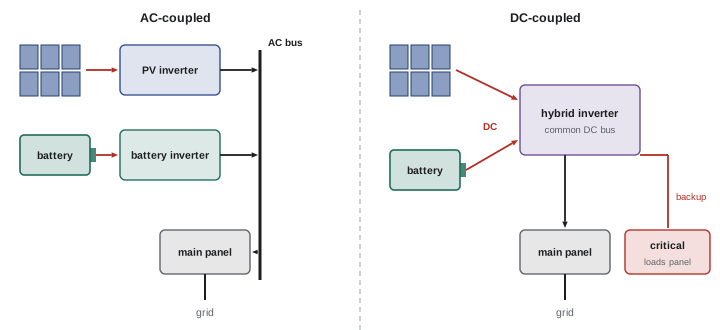
- AC-coupled systems use a separate battery inverter on the AC side, alongside an existing PV inverter; simple to retrofit, with some conversion losses when charging from PV.
- DC-coupled systems connect PV and batteries on a common DC bus through a hybrid inverter, reducing conversions and allowing PV energy that exceeds the inverter's AC rating to charge the battery.
- Backup systems include an automatic transfer function that isolates the building, or selected loads in a critical loads panel, from the grid during an outage and forms an island powered by the inverter and battery.
- UPS and DC plants in critical facilities keep batteries floating on a charger or rectifier and deliver power instantly on mains failure.
- Utility-scale BESS use containerized racks with power conversion systems, medium-voltage transformers and plant controllers.
Sizing storage
Sizing starts with what the system must do. For backup, list the loads to be supplied, their power and the hours of runtime needed; the inverter must supply the peak load including motor starting currents, and the battery must supply the energy. Usable energy must account for depth of discharge, inverter efficiency, temperature and aging:
Worked problem
Sizing a backup battery
A house needs to power critical loads averaging 1.5 kW for 10 hours during an outage, with a peak of 5 kW when the well pump starts. The battery allows 90 % depth of discharge, and inverter efficiency is 94 %. Find the minimum nameplate battery energy and inverter rating.
Show solution
- Energy delivered to loads = 1.5 kW × 10 h = 15 kWh.
- Nameplate energy = 15 / (0.90 × 0.94) = 17.7 kWh.
- Add margin for aging (for example 10 to 20 %): about 20 kWh.
- Inverter continuous rating at least 1.5 kW average, but it must handle the 5 kW peak and the pump's starting surge; choose an inverter rated about 5 kW continuous with adequate surge capability.
- Check the battery's maximum discharge power also supports 5 kW.
Answer: About 18 kWh minimum (20 kWh with aging margin) and an inverter of about 5 kW with surge capacity.
For demand charge reduction, sizing depends on the facility's load profile: the battery discharges during peaks to cap demand at a target, so both power (kW above the target) and energy (area of the peaks above the target) must be met. For UPS systems, battery sizing follows standards such as IEEE 485 for lead-acid and IEEE 1679 for other chemistries, accounting for load profile, temperature, aging factor and design margin.
Code and fire safety requirements
Energy storage is regulated by electrical codes, fire codes and product standards. Product standards include UL 9540 for energy storage systems, UL 1973 for batteries and UL 9540A, a test method that characterizes how thermal runaway propagates and which fire codes use to set spacing and protection requirements. Fire codes, and NFPA 855 in particular, limit the energy in a single unit and room, require separation between units and from walls and openings, set requirements for locations in dwellings (for example garages, utility rooms or outdoors, not living spaces), and require explosion control, ventilation, gas detection or fire suppression for larger systems.
In the United States, NEC Article 706 covers energy storage systems, Article 480 covers stationary storage batteries, and Article 710 covers stand-alone systems; the International Fire Code and NFPA 855 govern location, separation, size limits and fire protection, and residential ESS must be listed to UL 9540.
Installation and maintenance safety
Batteries cannot be fully de-energized: the cells always hold voltage and can deliver enormous fault currents, tens of kiloamperes for large banks, so short circuits can cause severe arc flash and burns. Safe practices include:
- Using insulated tools and removing jewelry; covering terminals not being worked on.
- Opening battery disconnects and BMS contactors, and verifying that DC bus capacitors have discharged before work on inverters.
- Following the manufacturer's torque specifications for connections; loose terminals cause heating and fires.
- Wearing face shields, gloves and aprons for lead-acid work, with eyewash available, and ensuring ventilation for hydrogen.
- Assessing DC arc flash hazards and labeling equipment.
- Never installing damaged lithium-ion modules; quarantining swollen or damaged batteries and following the manufacturer's procedures for handling and shipping.
Maintenance includes periodic inspection, cleaning and torque checks, monitoring BMS alarms and cell imbalance trends, capacity testing at intervals for critical applications, and for lead-acid, measuring float voltages, specific gravity (flooded) and internal resistance or conductance to detect weak cells before they fail when needed most.
Self-consumption, time-of-use and grid services
Behind-the-meter storage earns its value in several ways. Self-consumption stores midday PV production for use in the evening, which matters where export credits are lower than the retail price of electricity. Time-of-use arbitrage charges the battery when electricity is cheap and discharges when it is expensive. Demand charge management, important for commercial customers whose bills include a charge based on the highest 15-minute demand in a month, discharges the battery during peaks. Backup power keeps critical loads running during outages. Increasingly, aggregated home and business batteries also provide grid services, such as frequency regulation or peak reduction, under utility programs that pay for the capacity or remotely dispatch the batteries, sometimes called virtual power plants. The control settings for each application differ, and a battery configured for maximum self-consumption may be nearly empty when an outage occurs, so owners must choose how much reserve to keep for backup.
UPS systems and DC plants
Uninterruptible power supplies protect sensitive loads from interruptions and disturbances. A double-conversion (online) UPS continuously rectifies incoming AC to DC, keeps batteries charged on the DC bus, and inverts back to AC for the load, so the load never sees a break when the utility fails. Line-interactive and standby UPS units are cheaper and more efficient but switch to battery only when a disturbance occurs. Large UPS systems include static bypass switches that transfer the load directly to the utility if the inverter fails, and maintenance bypass switches that allow the UPS to be isolated for service. Telecommunication and utility substations use 48 V or 125 V DC plants with rectifiers and battery strings that supply protective relays, breaker trip coils and communications equipment. In each case, the batteries are only useful if they are maintained: a battery string with one failed cell may fail completely at the moment it is needed, which is why monitoring and periodic testing are essential.
Commissioning a storage system
Commissioning verifies that the installation matches the design and certification, that all connections are torqued and labeled, that the BMS communicates correctly with the inverter and reports every module, that charge and discharge limits are respected, and that protective functions work. Functional tests include charging and discharging at rated power, transferring to backup mode by opening the grid supply and confirming critical loads stay powered, returning to grid-connected mode, and verifying emergency shutdown and disconnecting means. The owner receives documentation of settings, warranty registration and instructions for safe operation and emergency response, and the local fire service may need information about the system's location and shutdown procedures.
Battery rooms and enclosures also need environmental control. Lithium-ion and lead-acid batteries both lose life rapidly at high temperatures: a common rule of thumb is that lead-acid life halves for every 8 to 10 °C above 25 °C. Batteries installed in unheated garages or outdoor enclosures in cold climates lose available capacity and may be prevented from charging below freezing by the BMS, so manufacturers specify operating temperature ranges and may include heaters. Signage identifying the battery chemistry, energy, emergency contacts and shutdown procedure helps responders deal safely with an incident.
When comparing storage products, look beyond nameplate kilowatt-hours to the warranty terms, which typically guarantee a minimum remaining capacity, such as 70 % after ten years or a stated energy throughput, whichever comes first. Throughput warranties matter for systems that cycle daily, because a battery used for time-of-use shifting may reach its throughput limit well before its calendar warranty expires.
Common mistakes
MistakeSizing a battery on nameplate energy alone.
InsteadAccount for depth of discharge, efficiency, temperature and aging.
MistakeBypassing or ignoring BMS communication.
InsteadConfigure and test BMS-to-inverter limits.
MistakeInstalling an ESS in a living space or bedroom.
InsteadFollow fire code location and separation rules.
MistakeTreating a battery as de-energized when disconnected.
InsteadCells always hold voltage; use insulated tools.
MistakeIgnoring inverter surge rating.
InsteadCheck motor starting and peak loads.
Summary and key terms
- Battery ratings include Ah, kWh, kW, C-rate, DoD, SoC and cycle life.
- Lead-acid is mature; lithium-ion dominates new storage; LFP is most stable.
- Thermal runaway is the key lithium-ion hazard.
- The BMS monitors cells and must control inverter charge and discharge.
- AC-coupled, DC-coupled and backup architectures suit different needs.
- Size energy for load × time ÷ (DoD × efficiency), plus aging margin.
- UL 9540, UL 9540A, NFPA 855 and electrical codes govern installations.
- Ampere-hour
- Battery capacity unit.
- C-rate
- Discharge rate relative to capacity.
- Depth of discharge
- Fraction of capacity used.
- State of charge
- Remaining charge as a percentage.
- Round-trip efficiency
- Energy out divided by energy in.
- Thermal runaway
- Self-accelerating cell heating and failure.
- BMS
- Battery management system.
- AC-coupled
- Battery with its own inverter on the AC side.
- DC-coupled
- PV and battery sharing a DC bus.
- UL 9540A
- Test method for thermal runaway propagation.
Practice problems
Work each problem on paper first, then reveal the answer to check.
A 51.2 V battery has 100 Ah. Energy?
Show answer
5.12 kWh.
What is a 0.5C discharge for 200 Ah?
Show answer
100 A, about two hours.
Nominal voltage of an LFP cell?
Show answer
3.2 V.
What gas do flooded lead-acid batteries release?
Show answer
Hydrogen.
What causes thermal runaway?
Show answer
Internal short, overcharge, damage or external heat.
Name three BMS functions.
Show answer
Monitor cells, balance, estimate SoC, open contactors.
Advantage of DC coupling?
Show answer
Fewer conversions; clipped PV can charge the battery.
2 kW for 6 h, 80 % DoD, 95 % efficiency: nameplate?
Show answer
12 / 0.76 = 15.8 kWh.
What does UL 9540A characterize?
Show answer
Thermal runaway propagation.
Why use insulated tools on batteries?
Show answer
Cells cannot be de-energized and fault currents are huge.
Lesson quiz · 5 questions
Score 60% or more to complete this lesson.
Create a free account to save your progress, take quizzes and earn a certificate.