
DCE-499 · Lesson 8 of 12 · 22 min
Fire protection and life safety concept
Fires in data centers are rare, but their consequences are severe: loss of customer equipment and data, long outages, damage to reputation, and risks to the people who work there. Several widely reported data center fires in recent years, involving electrical equipment and lithium-ion batteries, have shown that a fire in one room can take down an entire campus if fire separations, suppression and electrical design do not contain it. Fire protection design must also balance competing goals: water extinguishes fires but damages electronics; clean agents protect equipment but have limits; and emergency shutdowns protect firefighters but can cause outages. This lesson develops the fire protection and life safety concept for Aurora: applicable codes and standards, fire risk assessment, compartmentation, detection, suppression options for each space, lithium-ion battery hazards, liquid cooling fluids, emergency power off and firefighter safety, and life safety and egress.
Codes and standards
Fire protection is governed by the building and fire codes adopted in the jurisdiction, which reference standards for specific systems. For data centers, the most relevant standards include NFPA 75 (Fire Protection of Information Technology Equipment), NFPA 76 (Fire Protection of Telecommunications Facilities), NFPA 13 (sprinkler systems), NFPA 72 (fire alarm and signaling), NFPA 2001 (clean agent systems) and NFPA 855 (stationary energy storage systems). Insurers such as FM Global publish their own data sheets, which owners often follow because they affect insurance terms. The authority having jurisdiction, usually the fire marshal, must accept the design.
In the United States, the International Building Code and International Fire Code (or NFPA 1 and NFPA 5000 where adopted) govern, referencing NFPA 13, NFPA 72 and NFPA 2001. The IFC includes specific requirements for energy storage systems, aligned with NFPA 855, and the NEC Article 645 provisions apply only if the owner elects to use them for IT equipment rooms.
Fire risk assessment
A fire risk assessment identifies ignition sources, fuels and consequences in each space. In data centers, the main ignition sources are electrical: failures in switchgear, transformers, UPS, batteries, busway and power supplies. Fuel loads include cable insulation, plastics in IT equipment, battery electrolytes, diesel fuel, lubricating oils, packaging materials in staging areas, and some immersion cooling fluids. Consequences depend on the space: a fire in a battery room might threaten an entire electrical gallery, while a fire in a single server usually remains small if detected early. The assessment drives the choice of separation, detection and suppression for each space, and the owner's risk tolerance and insurer requirements shape the result.
Compartmentation
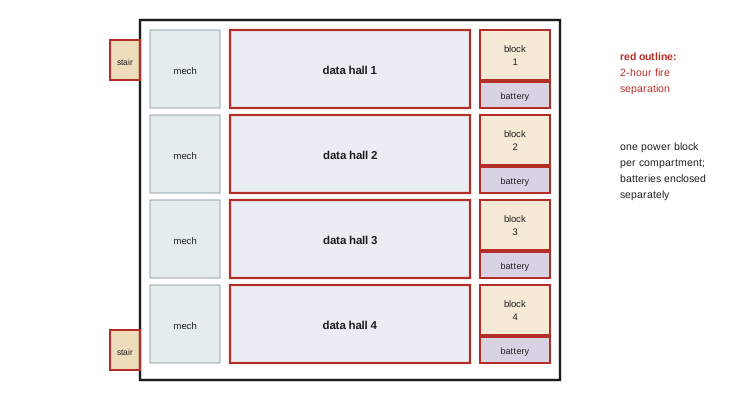
Fire-rated separations contain fires and smoke so that one event cannot spread across the facility. Typical arrangements include separating each data hall from adjacent halls, separating electrical rooms and battery rooms from data halls and from each other, separating generator rooms and fuel storage, and enclosing exit stairs and corridors. Separations commonly have 1- or 2-hour ratings, with fire-rated doors, fire dampers in ducts, and firestopping at every penetration by cables, busways and pipes. Aurora's concept separates each of the four power blocks serving a hall into its own fire compartment, so that a battery or UPS fire in one block affects only that block, and the distributed redundant topology (Lesson 5) keeps the hall running on the other three.
Detection
Early detection is the most effective fire protection measure in data centers, because it allows staff to find and isolate a failing component before a fire develops. Aspirating smoke detection (ASD) systems draw air continuously through sampling pipes to a sensitive detector, detecting smoke at concentrations far below those of conventional spot detectors. They are typically installed in data halls (sampling at return air paths, ceilings and within containment), electrical rooms, battery rooms and under raised floors where present. Detection is staged: alert and action levels notify staff to investigate, while fire levels trigger alarms and release of suppression systems. Battery rooms may add off-gas detection, which senses electrolyte vapors released before lithium-ion thermal runaway, and some designs use heat or flame detection where smoke detection is unsuitable.
Suppression options
- Preaction sprinklers: pipes filled with air until a detection system opens a valve, then water flows only from sprinklers whose heads have fused. Double-interlock preaction systems require both detection and a fused head before water enters the pipes, minimizing accidental discharge. They are the most common suppression in data halls and are favored by many insurers.
- Wet-pipe sprinklers: always filled with water; simple and reliable, used in offices, storage, loading docks and some electrical rooms.
- Clean agents: gaseous agents such as FK-5-1-12, HFC-227ea or inert gases (IG-541, IG-55) that extinguish fires without residue. Used in meet-me rooms, network rooms and sometimes electrical rooms, where water damage would be particularly costly. Rooms must be tightly sealed to hold the agent concentration for the required time, and inert gas systems need pressure relief venting.
- Water mist: fine droplets that cool and displace oxygen using little water, used in some electrical rooms and turbine or generator enclosures.
Many data centers use preaction sprinklers throughout as the primary protection, with clean agents as supplemental protection in critical rooms. Insurers often require sprinklers even where clean agents are installed, because clean agents cannot provide cooling for deep-seated fires and are lost if the room enclosure is breached.
# Clean agent quantity for a meet-me room and sprinkler water supply for a data hall
# FK-5-1-12 total flooding: W = (V / S) x C / (100 - C), S = k1 + k2 T  (NFPA 2001 form)
k1, k2 = 0.0664, 0.000274
length, width, height = 15.0, 10.0, 4.0
volume = length * width * height
t_min = 18.0                 # minimum expected room temperature, C
conc = 4.7                   # design concentration, percent by volume
s = k1 + k2 * t_min
agent = volume / s * conc / (100 - conc)
print(f"room volume {volume:.0f} m3, specific vapor volume {s:.4f} m3/kg")
print(f"FK-5-1-12 required: {agent:.0f} kg at {conc} %")

# Preaction sprinkler water supply for the hall
density_mm_min = 8.1         # about 0.2 gpm per square foot
area_m2 = 232                # about 2,500 square feet design area
hose_l_min = 950             # about 250 gpm hose allowance
duration_min = 60
sprinkler = density_mm_min * area_m2
total = sprinkler + hose_l_min
print(f"sprinkler demand {sprinkler:,.0f} L/min plus hose {hose_l_min} L/min = {total:,.0f} L/min")
print(f"water storage for {duration_min} min: {total * duration_min / 1000:,.0f} m3")room volume 600 m3, specific vapor volume 0.0713 m3/kg FK-5-1-12 required: 415 kg at 4.7 % sprinkler demand 1,879 L/min plus hose 950 L/min = 2,829 L/min water storage for 60 min: 170 m3
The calculation shows two typical numbers in a concept design: about 415 kg of FK-5-1-12 to protect a 600 m³ meet-me room at a 4.7 % design concentration, and roughly 170 m³ of stored water for an hour of sprinkler and hose demand where the municipal supply is insufficient. Final values depend on the listed agent and system, the hazard classification, the room integrity test, and the water supply analysis, but concept values allow space for agent cylinders, tanks and fire pumps to be reserved early.
Lithium-ion batteries
Lithium-ion batteries are now standard for UPS systems and are increasingly used for larger energy storage. A cell that fails internally or is damaged can enter thermal runaway, releasing flammable and toxic gases and heat that can spread to neighboring cells. Such fires are difficult to extinguish, can reignite hours later, and the released gases can accumulate and explode in enclosed rooms. Design measures include:
- Selecting battery systems tested to UL 9540A, which characterizes thermal runaway propagation, and listed to UL 9540 or equivalent standards.
- Limiting the energy in each room or fire area and maintaining required separation between battery cabinets.
- Fire-rated rooms dedicated to batteries, separated from UPS modules and other equipment.
- Off-gas and smoke detection with automatic disconnection of affected strings.
- Sprinklers or other suppression designed for the large volumes of water needed to cool battery fires.
- Explosion prevention by ventilation that removes flammable gases, or deflagration venting to a safe location.
- Battery management systems that monitor temperature and voltage and isolate faults early.
- Emergency response plans and pre-incident planning with the fire department.
Liquid cooling and fuels
Liquid cooling introduces new fluids into white space. Water-glycol mixtures in direct-to-chip systems are not flammable, but leaks can damage equipment, so leak detection, drip containment and isolation valves are needed. Some immersion fluids are combustible hydrocarbons or synthetic oils with flash points that must be considered in the fire risk assessment, while others are non-flammable engineered fluids. Diesel fuel for generators is stored in double-walled tanks with spill containment, overfill protection and separation from buildings, and day tanks inside generator enclosures have their own fire protection.
Emergency power off and firefighter safety
Firefighters must be able to make an area electrically safe before applying water to energized equipment, but an emergency power off (EPO) button that shuts down an entire data hall can cause a large outage if pressed accidentally. Designs therefore aim to give firefighters the information and means to de-energize only what is needed, through clear electrical zoning that matches fire compartments, labeled disconnects, and procedures agreed with the fire department. Where EPO systems are required, they are protected against accidental operation with covers and alarms. Pre-incident planning with the local fire department, site familiarization visits and clear signage of battery rooms and electrical hazards are essential.
Life safety and egress
Data centers have low occupancy but large floor areas, long travel distances and complex layouts, so egress design ensures that exits are within code-limited travel distances, that containment systems and locked security doors do not trap occupants (security doors must release for egress during alarms while maintaining security), that emergency lighting and exit signs are provided, and that clean agent spaces have pre-discharge alarms, time delays and abort switches so occupants can leave before discharge. Inert gas systems lower oxygen concentration, so occupant exposure limits in NFPA 2001 apply.
Testing and maintaining fire systems
Fire protection systems must be tested at acceptance and maintained throughout the life of the facility: sprinkler systems according to NFPA 25 or equivalent, fire alarm systems according to the applicable standard, and clean agent systems with periodic enclosure integrity tests to confirm the room can still hold the agent. Changes to the building, such as new cable penetrations or altered ceilings, can compromise fire separations and agent enclosures, so operations procedures must include fire protection checks for every change.
Common mistakes
MistakePlacing batteries in the same room as UPS modules and switchgear.
InsteadUse dedicated, fire-rated battery rooms with separation.
MistakeRelying only on clean agents.
InsteadProvide sprinklers as primary protection where required by code and insurers.
MistakeFire compartments that do not match power blocks.
InsteadAlign compartments with redundant blocks so one fire affects one block.
MistakeUnprotected EPO buttons that shut down whole halls.
InsteadZone de-energization and protect EPO against accidental use.
MistakeIgnoring explosion hazards from battery off-gas.
InsteadProvide gas detection and ventilation or deflagration venting.
Summary and key terms
- NFPA 75, 76, 13, 72, 2001 and 855, adopted codes and insurer standards govern data center fire protection.
- Fire risk assessment identifies electrical ignition sources, fuels and consequences.
- Compartmentation aligned with power blocks limits a fire to one block.
- Aspirating smoke detection gives very early warning; battery rooms add off-gas detection.
- Double-interlock preaction sprinklers protect halls; clean agents supplement critical rooms.
- Lithium-ion batteries need tested systems, separation, detection, suppression and explosion control.
- Plan EPO, firefighter access and egress with the fire department.
- Compartmentation
- Dividing a building with fire-rated separations.
- Aspirating smoke detection
- Detection that samples air through pipes to a sensitive detector.
- Preaction sprinkler
- A dry-pipe system that fills with water only after detection.
- Double interlock
- Requires detection and a fused head before water flows.
- Clean agent
- A gaseous suppressant leaving no residue.
- Design concentration
- The agent concentration required to extinguish the hazard.
- Thermal runaway
- Self-heating failure of a battery cell releasing heat and gas.
- UL 9540A
- A test method characterizing battery thermal runaway propagation.
- Deflagration venting
- Panels that relieve explosion pressure to a safe area.
- Emergency power off
- A control that de-energizes equipment in an emergency.
Practice problems
Work each problem on paper first, then reveal the answer to check.
Which NFPA standard covers IT equipment fire protection?
Show answer
NFPA 75.
What are the main ignition sources in data centers?
Show answer
Electrical failures in switchgear, UPS, batteries, busway and power supplies.
Why align fire compartments with power blocks?
Show answer
So a fire takes out only one block, which redundancy can cover.
What is the advantage of aspirating smoke detection?
Show answer
Very early detection of tiny smoke concentrations.
How does a double-interlock preaction system work?
Show answer
Water enters pipes only after both detection and a fused head.
Why do insurers often require sprinklers even with clean agents?
Show answer
Agents cannot cool deep-seated fires and leak if enclosures fail.
Compute FK-5-1-12 for 300 m³ at 4.7 % with S = 0.0713.
Show answer
About 207 kg.
Name four lithium-ion battery fire measures.
Show answer
UL 9540A tested systems, separation, off-gas detection, ventilation or venting, suppression.
What hazard do some immersion fluids add?
Show answer
They may be combustible.
How can EPO risks be reduced?
Show answer
Zoning, covers and alarms, and procedures agreed with firefighters.
Lesson quiz · 5 questions
Score 60% or more to complete this lesson.
Create a free account to save your progress, take quizzes and earn a certificate.