
DCE-499 · Lesson 2 of 12 · 25 min
Site selection and due diligence
The site decides much of a data center's cost, risk and performance before any engineering begins. Power availability determines when the campus can open and how large it can grow; climate determines how much energy and water the cooling system uses; fiber routes determine network latency and resilience; hazards such as floods, earthquakes and wildfires determine risk and construction cost; and local permitting, tax and workforce conditions determine schedule and operating cost. In recent years, power availability has become the dominant constraint: in many established markets, utilities quote years of waiting for new large connections, and site selection now often starts with the question "where can we get power, and when?" This lesson sets out the main site selection criteria, the data sources and studies used to evaluate them, a weighted scoring method with sensitivity testing, and the due diligence that follows a preferred site choice.
Selection criteria
- Power: available transmission or distribution capacity, the time and cost to connect, the utility's reliability record, the possibility of two independent supply paths, the energy price and tariff structure, and access to carbon-free electricity through the grid mix or power purchase agreements.
- Fiber and network: proximity to long-haul fiber routes, the number of independent carriers, diverse path options into the site, latency to major population centers and cloud regions, and cost of dark fiber or wavelengths.
- Land: area for the ultimate campus plus setbacks, substation, stormwater and future expansion; shape and topography; zoning; ownership and price; and road access for heavy equipment deliveries.
- Natural hazards: flooding (including future climate projections), seismic hazard, wildfire, severe wind and tornadoes, hail, ice storms, and geotechnical conditions such as soft soils or karst.
- Human-made hazards: proximity to airports and flight paths, rail lines carrying hazardous goods, pipelines, chemical plants, and other facilities that could cause fires, explosions or evacuations.
- Water: availability and cost of water for cooling (if evaporative cooling is used) and of sewer capacity for blowdown, plus regulatory and community attitudes to water use.
- Climate: dry-bulb and wet-bulb temperature profiles, which determine economizer hours, cooling energy and water use (Lesson 6).
- Workforce: availability of construction trades and of skilled operations staff within commuting distance.
- Incentives and costs: property tax, sales tax exemptions on equipment, economic development incentives, and construction cost levels.
- Community and approvals: zoning compatibility, community attitudes to data centers, noise sensitivity of neighbors, and the expected permitting timeline (Lesson 3).
Data sources and studies
Site evaluation draws on many sources. Utilities publish or provide on request information about substation and transmission capacity; for large loads, a formal load study or interconnection request gives binding answers. Flood maps, seismic hazard maps and wildfire risk maps come from government agencies. Fiber maps are available from carriers and commercial databases. Climate data comes from weather stations, with design values in the ASHRAE Handbook. Desktop studies are followed by site visits and, for shortlisted sites, by geotechnical investigations, environmental site assessments, surveys and title searches.
In the United States, sources include utility and regional transmission organization interconnection queues (for example, PJM, ERCOT or MISO), FEMA flood insurance rate maps, USGS seismic hazard maps and the ASCE 7 hazard tool for design values, and NOAA climate data.
Comparing the three candidate sites
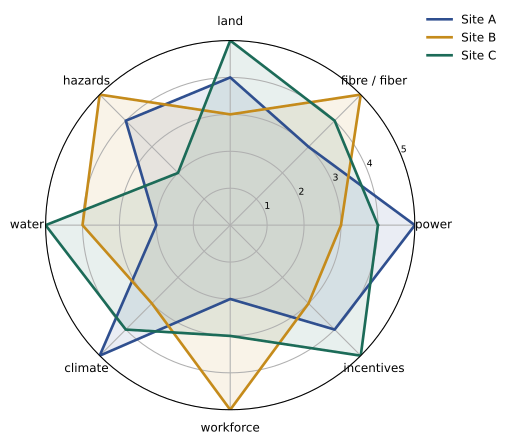
The Aurora team has three candidates, summarized below. Scores range from 1 (poor) to 5 (excellent) and are based on the team's research.
| Criterion | Site A | Site B | Site C |
|---|---|---|---|
| Power | 5: 230 kV substation adjacent, 24 months | 3: 48 months for full capacity | 4: 30 months, second feed later |
| Fiber | 3: two carriers | 5: five carriers, metro latency | 4: three carriers |
| Land | 4: 40 ha, flat | 3: 22 ha, constrained | 5: 55 ha, room for phase 3 |
| Hazards | 4: low flood and seismic | 5: very low | 2: part of site in a floodplain |
| Water | 2: limited municipal supply | 4: adequate | 5: ample, reclaimed water available |
| Climate | 5: cool and dry | 3: warm, humid summers | 4: cool, moderately humid |
| Workforce | 2: rural, small labor pool | 5: metro area | 3: regional city |
| Incentives | 4: equipment tax exemption | 3: limited | 5: strong local incentives |
Weighted scoring and sensitivity
A weighted score combines the criteria. Weights reflect the client's priorities; for Aurora, power carries the largest weight because of its impact on schedule and growth. Because weights are judgments, the team tests how sensitive the result is to them, varying each weight randomly within a plausible range and counting how often each site ranks first.
import numpy as np
# Weighted site scoring with a sensitivity test on the weights
criteria = ["power", "fiber", "land", "hazards", "water", "climate", "workforce", "incentives"]
weights = np.array([0.25, 0.12, 0.10, 0.12, 0.08, 0.13, 0.10, 0.10])
scores = {   # 1 (poor) to 5 (excellent)
    "Site A": [5, 3, 4, 4, 2, 5, 2, 4],
    "Site B": [3, 5, 3, 5, 4, 3, 5, 3],
    "Site C": [4, 4, 5, 2, 5, 4, 3, 5],
}
for site, s in scores.items():
    print(f"{site}: weighted score {np.dot(weights, s):.2f}")

rng = np.random.default_rng(2)
wins = {site: 0 for site in scores}
trials = 20_000
for _ in range(trials):
    w = weights * rng.uniform(0.7, 1.3, len(weights))   # each weight varies by up to 30 %
    w = w / w.sum()
    best = max(scores, key=lambda k: np.dot(w, scores[k]))
    wins[best] += 1
for site, n in wins.items():
print(f"{site} ranks first in {n / trials:.0%} of weight scenarios")Site A: weighted score 3.90 Site B: weighted score 3.76 Site C: weighted score 3.94 Site A ranks first in 32% of weight scenarios Site B ranks first in 3% of weight scenarios Site C ranks first in 65% of weight scenarios
The base scores are close: Site C leads narrowly with 3.94, followed by Site A at 3.90 and Site B at 3.76. The sensitivity test shows that Site C ranks first in about two-thirds of weight scenarios, Site A in about one-third, and Site B rarely. This tells the team that the choice between A and C depends on how the client values power timing, climate and workforce against land, water and incentives, and that Site C's main weakness, the partial floodplain, deserves close attention: if the flood risk can be engineered away by placing buildings on the higher part of the site, its hazard score improves and its lead becomes robust.
Fatal flaws and screening
Scoring compares sites that are all acceptable. Before scoring, sites must be screened for fatal flaws: conditions that rule a site out regardless of other strengths. Typical fatal flaws include no feasible power connection within the required schedule, zoning that prohibits data centers with no realistic path to rezoning, contamination requiring remediation beyond the budget, a buildable area too small for the minimum campus, or a regulatory moratorium on new large loads. Screening first saves effort and prevents a high score on other criteria from hiding a disqualifying problem.
Power deep dive
Because power is so critical, the team examines it in detail for the shortlisted sites:
- Capacity: how much load can the nearest substation and transmission lines carry, now and after planned upgrades?
- Timeline: how long will interconnection studies, utility approvals, substation construction and transmission upgrades take?
- Cost: who pays for the substation and upgrades, and what security deposits or contributions are required?
- Redundancy: can the site be served from two independent substations or transmission paths, or by a ring bus with multiple sources?
- Tariffs and contracts: energy rates, demand charges, minimum take-or-pay commitments for large loads, and any special tariffs for data centers.
- Carbon and on-site options: grid emissions intensity, availability of renewable energy contracts, and space for on-site generation or battery storage that could support grid services or bridge delays in utility capacity.
Many utilities now require large-load customers to sign agreements that commit them to minimum payments for a number of years, protecting other ratepayers if the data center does not materialize. These commitments affect project finance and should be identified early.
Due diligence on the preferred site
Once a preferred site is chosen, due diligence confirms that it can deliver what the scoring assumed before the client commits to purchase. Typical activities include:
- Title search, surveys and review of easements, rights of way and restrictions.
- Phase I environmental site assessment, and Phase II sampling if the Phase I identifies potential contamination.
- Geotechnical investigation with boreholes to determine soil bearing capacity, groundwater, and rock depth.
- Flood, drainage and stormwater studies, including future climate scenarios.
- Utility confirmation letters or agreements for power, water, sewer and gas.
- Zoning and permitting review with the municipality (Lesson 3).
- Traffic and access review for construction and operations.
- Ecological surveys for protected species and wetlands.
- Archaeological or heritage assessments where required.
Findings feed back into the design and cost estimate. A geotechnical report showing soft clay, for example, may require piled foundations that add significant cost and schedule.
Worked problem
Testing Site C's flood risk
About 20 % of Site C lies within the mapped 1 % annual exceedance probability (100-year) floodplain. The buildable area outside the floodplain is 44 ha, and the ultimate campus needs 35 ha including setbacks and stormwater. Should the floodplain disqualify Site C?
Show solution
- Area check: 44 ha outside the floodplain exceeds the 35 ha needed, so all buildings and critical equipment can be placed outside it.
- Margin: design ground floor and equipment levels above the flood level with freeboard, and consider climate-adjusted flood levels, which may be higher than current maps.
- Access: confirm that at least one access road remains usable during a flood, so staff and fuel can reach the site.
- Use the floodplain portion for landscaping, stormwater ponds or parking, which tolerate occasional flooding and may also be what local rules require.
- Re-score: with buildings outside the floodplain and dry access confirmed, the hazard score may rise from 2 to 3 or 4.
Answer: The floodplain does not disqualify Site C if the campus fits outside it with freeboard and dry access. With an improved hazard score, Site C becomes the clear preferred site, subject to due diligence.
Presenting the site recommendation
The site selection report presents the recommendation in a form the client can act on. It summarizes the brief's site requirements, the long list of candidates and the screening results, the scoring method and weights agreed with the client, the scores with supporting evidence, the sensitivity analysis, and the risks and mitigations for the preferred site. It also lists the due diligence still required and the decisions the client must make, such as authorizing a land option agreement or a utility load study deposit. Including the runner-up site, with the conditions under which it would become preferable, gives the client a fallback if due diligence uncovers a problem.
Teams sometimes fall in love with a site early and present the analysis as a justification rather than a comparison. Reviewers notice. A balanced report that shows the weaknesses of the preferred site alongside its strengths, and explains how they will be managed, is more persuasive and more useful.
The team should also record how the site decision could be revisited. If the utility later offers Site A an earlier connection date, or Site C's due diligence finds poor soils, the scoring model can be rerun quickly with updated inputs, and the client can see whether the recommendation changes.
Common mistakes
MistakeScoring sites before screening for fatal flaws.
InsteadScreen out disqualified sites first.
MistakeRelying on informal utility estimates of capacity and timing.
InsteadObtain formal load studies or written confirmations.
MistakeTreating weights as objective facts.
InsteadTest sensitivity and present it to the client.
MistakeUsing only current flood maps.
InsteadConsider climate-adjusted flood levels and dry access.
MistakeCommitting to purchase before due diligence.
InsteadConfirm title, environment, geotechnics and utilities first.
Summary and key terms
- Site choice drives cost, risk, schedule and performance; power availability is now often decisive.
- Criteria include power, fiber, land, hazards, water, climate, workforce, incentives and community.
- Data comes from utilities, hazard maps, fiber maps, climate data and site investigations.
- Screen for fatal flaws, then compare acceptable sites with weighted scoring.
- Sensitivity testing shows how robust the ranking is to weight choices.
- Examine power capacity, timeline, cost, redundancy, tariffs and carbon in detail.
- Due diligence confirms title, environment, geotechnics, flooding, utilities and approvals.
- Site selection
- Choosing a location by comparing candidates against criteria.
- Fatal flaw
- A condition that disqualifies a site regardless of other strengths.
- Weighted scoring
- Combining criterion scores with weights reflecting priorities.
- Sensitivity analysis
- Testing how results change when inputs vary.
- Interconnection request
- A formal application to connect a large load to the grid.
- Floodplain
- Land subject to flooding at a stated probability.
- Freeboard
- Extra height above a design flood level.
- Phase I ESA
- A desktop and site review for potential contamination.
- Geotechnical investigation
- Boreholes and tests to characterize soil and rock.
- Due diligence
- Investigation confirming a site before purchase.
Practice problems
Work each problem on paper first, then reveal the answer to check.
Why has power become the dominant site selection constraint?
Show answer
Utilities in many markets quote multi-year waits for large connections.
Name six site selection criteria.
Show answer
Power, fiber, land, hazards, water, climate, workforce, incentives, community.
Give three examples of fatal flaws.
Show answer
No feasible power, prohibitive zoning, excessive contamination, insufficient area.
Compute a weighted score: weights 0.5, 0.3, 0.2; scores 4, 2, 5.
Show answer
2.0 + 0.6 + 1.0 = 3.6.
What did the sensitivity test show for Aurora?
Show answer
Site C first in about two-thirds of scenarios, Site A in about one-third.
What power questions should be examined in detail?
Show answer
Capacity, timeline, cost, redundancy, tariffs, carbon and on-site options.
Why do utilities require minimum payment commitments?
Show answer
To protect other ratepayers if the load does not materialize.
What is a Phase I environmental site assessment?
Show answer
A review of records and site conditions for potential contamination.
How can a site with a partial floodplain still be acceptable?
Show answer
If the campus fits outside it with freeboard and dry access.
Why should the client not purchase before due diligence?
Show answer
Unknown conditions could add major cost or make the site unworkable.
Lesson quiz · 5 questions
Score 60% or more to complete this lesson.
Create a free account to save your progress, take quizzes and earn a certificate.