
DCE-499 · Lesson 10 of 12 · 25 min
Controls, security, commissioning and operations readiness
A data center is not finished when the last cable is pulled. It must be monitored and controlled around the clock, protected against physical intrusion and cyberattack, proven to work through rigorous commissioning, and handed over to an operations team that has the people, procedures, spares and tools to run it safely for decades. Many outages are caused not by equipment design but by operational errors, incomplete commissioning or poorly integrated controls. Designers therefore include operations requirements in the concept from the start: the monitoring and control architecture, the security design, the commissioning plan and the operating model. This lesson covers building management and power monitoring systems, DCIM and integration, operational technology cybersecurity, physical security, the five levels of commissioning, and operations readiness, including staffing.
Monitoring and control systems
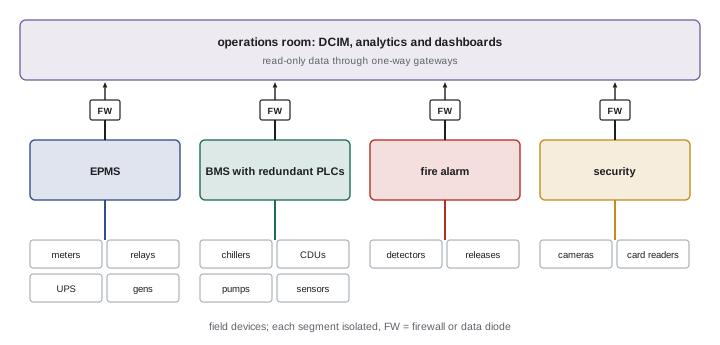
- Building management system (BMS) or building automation system: monitors and controls mechanical systems (chillers, dry coolers, pumps, fan walls, CDUs, valves), environmental conditions in halls, leak detection and other building systems. Critical cooling controls often use redundant programmable logic controllers (PLCs) rather than ordinary building controllers, because cooling failures can cause outages within minutes.
- Electrical power monitoring system (EPMS): collects data from meters, protective relays, breakers, UPS and generators at high speed, recording power quality, waveforms and sequences of events, and providing alarms and trending. It supports troubleshooting after events and capacity management.
- Fire alarm and suppression panels, which report to the BMS and security systems but operate independently as life safety systems.
- Data center infrastructure management (DCIM): software that combines asset records, rack and space capacity, power chain data, environmental data and cabling records, used for capacity planning, change management and customer reporting.
Integration is both valuable and risky. Linking systems allows coordinated responses, such as staging chiller restarts with generator loading, and gives operators a single view. But poorly designed integration can spread failures or create cyber vulnerabilities. The concept should define which systems are independent, which share data, and which can issue commands to others.
Operational technology cybersecurity
Monitoring and control systems are operational technology (OT): computers and networks that control physical equipment. Attacks on OT could shut down cooling or power, causing outages or damage. Data center OT security follows frameworks such as the ISA/IEC 62443 series, applying principles including:
- Network segmentation into zones (for example EPMS, BMS, security, fire) connected only through controlled conduits with firewalls, and separation from corporate IT and customer networks.
- One-way data flows (data diodes or tightly restricted firewalls) for sending data to analytics and DCIM without allowing commands back.
- Strict control of remote access, with multi-factor authentication and monitored sessions for vendors.
- Hardening of controllers and servers, change management, patching programs suited to OT, and backups of controller configurations.
- Monitoring for anomalies and incident response plans that include manual operation of critical systems.
The design team specifies these requirements in the concept so that vendors' systems are selected and configured accordingly, rather than retrofitting security after installation.
Physical security
Physical security protects customer equipment and data, and is a key part of what colocation customers buy. Layers of protection follow the security zones (Lesson 7):
- Perimeter: fencing, vehicle barriers rated against ramming, controlled gates, lighting and perimeter intrusion detection.
- Site and building: guarded entry, visitor management, CCTV with analytics covering approaches, entrances, yards and roofs.
- Building interior: card and biometric access control at each zone, mantraps at data hall entries, anti-tailgating measures, and alarms on doors.
- White space: customer cages or suites with their own access control, cameras covering aisles, and controlled loading and removal of equipment.
- Procedures: background checks, escort rules, shipping and receiving controls, media destruction, and regular audits.
Operators often certify their security and operations against standards such as ISO/IEC 27001 and SOC 2 reports, which customers require; the design must support the controls these audits test.
Commissioning
Commissioning verifies that every component and system is installed correctly and performs as designed, individually and together, before customers depend on it. Data center commissioning is usually organized in five levels:
| Level | Name | Activities |
|---|---|---|
| L1 | Factory witness testing | Witnessing tests of major equipment (UPS, generators, switchgear, chillers) at the factory |
| L2 | Site acceptance and installation checks | Delivery inspection, installation verification, pre-functional checklists |
| L3 | Start-up and component testing | Energizing and starting each component, manufacturer start-up, setting verification |
| L4 | Functional performance testing | Testing each system through all modes and failure scenarios |
| L5 | Integrated systems testing | Testing all systems together under load, including utility failure and recovery |
Level 5 integrated systems testing (IST) is the climax of commissioning. Load banks simulate the full IT heat and electrical load in each hall, and the team pulls the utility supply, fails generators, UPS modules, chillers and pumps, and verifies that the systems respond as designed while temperatures and power stay within limits. IST requires detailed scripts, careful safety planning and several days or weeks per phase. Problems found in IST are far cheaper to fix before customers move in than after.
A commissioning authority, independent of the designer and contractor, is typically appointed early in design to review the basis of design and drawings for commissionability, write the commissioning plan, and lead testing. ASHRAE Guideline 0 and ASHRAE Standard 202 describe the commissioning process for buildings; data center owners usually add their own requirements.
Operations readiness
Operations readiness ensures that the operations team can run the facility from day one. It includes:
- Procedures: standard operating procedures (SOPs) for routine tasks, methods of procedure (MOPs) for planned work on critical systems with step-by-step instructions and rollback plans, and emergency operating procedures (EOPs) for failures and incidents.
- Computerized maintenance management system (CMMS) loaded with all assets, maintenance plans and spare parts.
- Spare parts strategy: critical spares on site for items with long lead times or high failure impact.
- Training: classroom and hands-on training for operators on each system, ideally including participation in commissioning.
- Documentation: as-built drawings, operation and maintenance manuals, sequences of operation, test reports and warranties.
- Staffing: an organization that provides round-the-clock coverage with appropriate skills.
import math
# Operations staffing for phase 1: 24/7 coverage plus planned maintenance workload
productive_hours = 1800        # hours per staff member per year after leave and training
post_hours = 24 * 365          # one position covered around the clock
relief = post_hours / productive_hours
print(f"staff needed to cover one 24/7 position: {relief:.1f}")

positions_24x7 = {"critical facilities technician": 3, "security officer": 3, "network operations": 1}
equipment = {  # count, maintenance hours per unit per year (in-house share)
    "generators": (20, 40),
    "UPS modules": (40, 12),
    "switchboards and MV gear": (30, 16),
    "chillers and dry coolers": (12, 30),
    "CDUs": (48, 10),
    "fan walls": (64, 6),
    "pumps": (24, 8),
}
pm_hours = sum(n * h for n, h in equipment.values())
print(f"planned maintenance workload: {pm_hours:,} hours per year")

shift_staff = {k: math.ceil(v * relief) for k, v in positions_24x7.items()}
for k, v in shift_staff.items():
    print(f"{k:32s} {positions_24x7[k]} per shift -> {v} staff")
# assume 30 % of a shift technician time is available for planned maintenance
available = shift_staff["critical facilities technician"] * productive_hours * 0.30
extra = max(0, math.ceil((pm_hours - available) / productive_hours))
print(f"maintenance hours covered by shift technicians: {available:,.0f}; extra day-shift technicians: {extra}")
print(f"total operations staff: {sum(shift_staff.values()) + extra + 4} including 4 managers and engineers")staff needed to cover one 24/7 position: 4.9 planned maintenance workload: 3,176 hours per year critical facilities technician 3 per shift -> 15 staff security officer 3 per shift -> 15 staff network operations 1 per shift -> 5 staff maintenance hours covered by shift technicians: 8,100; extra day-shift technicians: 0 total operations staff: 39 including 4 managers and engineers
The staffing model shows that round-the-clock coverage, not maintenance hours, drives headcount. Covering one position 24 hours a day, every day, requires about five people once leave, training and shift patterns are considered, so three technicians per shift become about fifteen staff. The planned maintenance workload for phase 1 fits within the time available to shift technicians, with specialist work (major generator overhauls, breaker testing) contracted to vendors. As phase 2 opens, the maintenance load doubles but shift coverage may increase only modestly, improving staff efficiency per megawatt.
Worked problem
Writing a method of procedure
Outline the key sections of a MOP for taking UPS module 3 in block B offline for annual maintenance in a distributed redundant system.
Show solution
- Scope and risk: describe the work, the systems affected and the redundancy remaining (blocks A, C and D can carry the load), with a risk assessment and approvals.
- Prerequisites: confirm all other blocks are healthy, no other work is under way, weather and grid conditions are normal, and customers have been notified if required.
- Step-by-step actions: each switching step with the device name, expected indication and a check box, performed by one person and verified by another.
- Hold points and rollback: points at which the work stops if conditions are not as expected, and steps to return to normal.
- Return to service: steps to restore the module, verify its operation and close out the work.
Answer: A MOP with scope, risk assessment, prerequisites, verified steps, hold points, rollback and return to service makes planned work on critical systems predictable and safe.
Alarm management
A large data center can generate thousands of alarms from its monitoring systems, and too many alarms are almost as dangerous as too few: operators faced with floods of low-priority messages can miss the one that matters. Good alarm management, following principles such as those in ISA-18.2, defines alarm priorities, removes nuisance and duplicate alarms, groups related alarms, and ensures every alarm has a defined operator response. The concept design should require an alarm philosophy document and allow time during commissioning to tune alarms before handover.
Handover and the first year
Handover from the construction team to operations is a period of elevated risk. Equipment is new, procedures are untested in real operation, and the operations team is still learning the facility. Good practice includes involving operators in commissioning, a formal handover with documentation and training sign-offs, a period in which the contractor and commissioning authority remain available, and a warranty and defects process to track and close issues. A review after the first year captures lessons for the next phase, including changes to procedures, spares and design details.
Operations readiness also covers relationships with external parties: the utility, the fire department, fuel suppliers, equipment service providers and customers. Contracts, contact lists and escalation procedures should be in place before the first customer moves in, and joint exercises such as a simulated utility outage or fire response help everyone understand their roles.
For the capstone, the operations concept should include a monitoring and control architecture diagram, a summary of OT and physical security measures, the commissioning plan with the five levels and the IST scenarios, the staffing model, and a list of the procedures that must exist before handover. Together these show the client that the design has been planned to be operated, not just built.
Finally, operations readiness should be measured. Useful indicators in the first year include the number of unplanned events and their causes, the percentage of planned maintenance completed on time, the number of procedures written and approved versus those needed, training completion for each operator, and the time taken to respond to alarms. Reviewing these indicators monthly shows where the team needs support before small gaps become incidents.
Common mistakes
MistakeConnecting all control systems on one flat network.
InsteadSegment OT networks with controlled conduits and one-way data flows.
MistakeUsing ordinary building controllers for critical cooling.
InsteadUse redundant PLC-based controls where failure is critical.
MistakeSkipping integrated systems testing to meet the schedule.
InsteadProtect IST time; it finds failures before customers arrive.
MistakePerforming critical switching without a MOP.
InsteadUse verified step-by-step MOPs with rollback.
MistakeStaffing from maintenance hours alone.
InsteadAccount for 24/7 coverage at about five staff per position.
Summary and key terms
- BMS, EPMS, fire and security systems monitor and control the facility; DCIM manages capacity and assets.
- Integration helps operations but must be designed to avoid spreading failures.
- OT cybersecurity uses segmentation, one-way flows, controlled remote access and hardening.
- Physical security layers run from perimeter to customer cages, supported by procedures and audits.
- Commissioning proceeds through five levels, culminating in integrated systems testing.
- Operations readiness requires procedures, CMMS, spares, training, documentation and staffing.
- Round-the-clock coverage drives staffing at about five people per 24/7 position.
- BMS
- Building management system for mechanical and environmental control.
- EPMS
- Electrical power monitoring system.
- DCIM
- Data center infrastructure management software.
- Operational technology
- Systems that monitor and control physical equipment.
- Data diode
- A device allowing data to flow in one direction only.
- Integrated systems testing
- Testing all systems together under load and failure scenarios.
- Commissioning authority
- An independent party leading commissioning.
- Method of procedure
- A step-by-step plan for planned work on critical systems.
- CMMS
- Computerized maintenance management system.
- Shift relief factor
- Staff needed to cover one continuous position.
Practice problems
Work each problem on paper first, then reveal the answer to check.
What does an EPMS record?
Show answer
Power quality, waveforms, events and energy data.
Why use redundant PLCs for critical cooling?
Show answer
Cooling failures can cause outages within minutes.
Name three OT cybersecurity measures.
Show answer
Segmentation, one-way data flows, MFA for remote access, hardening.
What standards do customers commonly require for security?
Show answer
ISO/IEC 27001 certification and SOC 2 reports.
List the five commissioning levels.
Show answer
Factory witness, site acceptance, start-up, functional testing, integrated systems testing.
What does IST typically involve?
Show answer
Load banks, utility pulls and failure tests across all systems.
Distinguish SOPs, MOPs and EOPs.
Show answer
Routine tasks, planned critical work, and emergencies.
How many staff cover one 24/7 position at 1,800 productive hours each?
Show answer
About 4.9.
Why include a rollback plan in a MOP?
Show answer
To return safely to normal if conditions are unexpected.
Why appoint a commissioning authority early?
Show answer
To review design for commissionability and plan testing.
Lesson quiz · 5 questions
Score 60% or more to complete this lesson.
Create a free account to save your progress, take quizzes and earn a certificate.