
DCE-499 · Lesson 3 of 12 · 25 min
Permits, approvals, environment and community
A data center cannot be built until it has the necessary approvals, and permitting has become one of the most common causes of delay on large campuses. As data centers have grown to hundreds of megawatts, communities and regulators have paid more attention to their land use, noise, diesel generators, water use, electricity demand and visual impact. Some jurisdictions have welcomed them with incentives; others have introduced moratoriums, special zoning rules or stricter environmental reviews. The design team must understand which approvals are required, how long they take, what information they need, and how design choices can make approval easier or harder. This lesson covers land use and zoning, building and trade permits, environmental approvals with a focus on generator air permits, water and stormwater, noise, other environmental reviews, community engagement, and how to build a permitting plan into the project schedule.
Land use and zoning
Municipal land use rules determine what can be built where. A site may already be zoned for industrial or business park use that permits data centers, or it may need rezoning, a conditional or special use permit, or a variance. Zoning rules also set limits on building height, setbacks from property lines, lot coverage, parking, landscaping, fencing and signage, and some municipalities have adopted specific data center standards covering noise, screening of equipment, generator placement and architectural treatment. Rezoning typically requires public notice, hearings and council decisions, and can take from a few months to more than a year; it can also be refused.
After zoning, most jurisdictions require site plan or development plan approval, which reviews the detailed layout: building positions, access roads, fire department access, stormwater management, landscaping, lighting and utilities. Engaging with municipal planning staff early, before formal submission, helps identify issues and shortens the process.
Building and trade permits
Building permits confirm that the design complies with the building and fire codes. They require stamped drawings by licensed professionals and are reviewed by the building department, the fire marshal or fire department, and sometimes other agencies. Large projects often obtain permits in packages (site work and foundations first, then structure, then building systems) so construction can start before the full design is complete. Electrical, plumbing, mechanical and fire protection work usually need their own permits and inspections.
In the United States, building permits are issued by the local building department under the adopted International Building Code. Electrical, mechanical, plumbing and fire protection permits are usually issued locally as well, with inspections by local inspectors or approved third parties, and the fire marshal reviews fire protection and hazardous materials such as fuel and batteries.
Air permits for generators
Standby diesel generators are often the most significant environmental permit issue for data centers. A large campus may have dozens of multi-megawatt engines, and although they run only for testing and during utility outages, regulators assess their potential emissions of nitrogen oxides (NOx), particulate matter, carbon monoxide and other pollutants. Permits typically limit operating hours for testing and maintenance, set emission standards, and may require aftertreatment such as selective catalytic reduction (SCR) and diesel particulate filters, stack heights that disperse emissions, and records of operation.
# Annual NOx from standby generators: testing plus a possible extended outage
units = 20                 # 3,000 kWe diesel generators for phase 1
kw = 3000
nox_g_per_kwh = 6.0        # typical for large Tier 2 diesel engines without aftertreatment
scr_reduction = 0.90       # selective catalytic reduction, if fitted

def tonnes(hours, load):
    return units * kw * load * hours * nox_g_per_kwh / 1e6

monthly = tonnes(12 * 0.5, 0.30)      # 30 minute monthly test at 30 % load
annual = tonnes(2.0, 0.75)             # yearly 2 hour load test at 75 % load
outage = tonnes(24.0, 0.60)            # one 24 hour utility outage at 60 % load
for label, t in [("monthly tests", monthly), ("annual load tests", annual), ("one 24 h outage", outage)]:
    print(f"{label:20s} {t:6.1f} t NOx")
total = monthly + annual + outage
label = "total"
print(f"{label:20s} {total:6.1f} t NOx ({total * 1.1023:.1f} short tons)")
print(f"with SCR:            {total * (1 - scr_reduction):6.1f} t NOx")
per_hour_full = units * kw * 1.0 * nox_g_per_kwh / 1e6
print(f"all units at full load emit {per_hour_full:.2f} t per hour")
print(f"hours at full load to reach 90 t without SCR: {90 / per_hour_full:.0f} h")
pte = per_hour_full * 500
print(f"potential to emit at 500 h per year: {pte:.0f} t, so permit limits on hours or SCR are needed")monthly tests 0.6 t NOx annual load tests 0.5 t NOx one 24 h outage 5.2 t NOx total 6.4 t NOx (7.0 short tons) with SCR: 0.6 t NOx all units at full load emit 0.36 t per hour hours at full load to reach 90 t without SCR: 250 h potential to emit at 500 h per year: 180 t, so permit limits on hours or SCR are needed
Actual annual emissions from testing are small, a few metric tons even including a long outage. But permitting often uses the potential to emit, based on assumed maximum operating hours (500 hours per year is a common default for emergency generators). At that level, the 20 phase 1 generators would have a potential to emit of about 180 metric tons of NOx per year, which in many jurisdictions would trigger more stringent major source requirements. Design and permitting responses include accepting enforceable limits on hours, specifying cleaner engines or SCR, using natural gas generators or fuel cells where reliability and fuel supply allow, adding battery storage to cover short outages without starting engines, and spreading testing so fewer engines run at once.
In the United States, air permits are issued by state or local air agencies under the Clean Air Act. Facilities with potential emissions above major source thresholds (100 tons per year of a pollutant for Title V operating permits, and lower thresholds in nonattainment areas) face more stringent requirements, so many data centers accept federally enforceable limits to remain synthetic minor sources. EPA standards (40 CFR Part 60 Subpart IIII) apply to the engines themselves.
Water and stormwater
Water approvals cover the supply of water for cooling and domestic use, discharge of cooling tower blowdown and other wastewater to sewers, and management of stormwater from roofs and paved areas. Municipal utilities must confirm they can supply the peak water demand, which for evaporative cooling can be large on hot days, and may impose conditions or charges. Sewer discharge permits may limit the quantity and quality (temperature, dissolved solids, chemicals) of blowdown. Stormwater management plans, required for almost all large developments, show how runoff will be controlled through ponds, swales, infiltration and green roofs so that peak flows and pollutants leaving the site do not exceed pre-development levels or local limits. During construction, erosion and sediment control plans are required.
In the United States, construction disturbing one acre or more requires coverage under a National Pollutant Discharge Elimination System (NPDES) stormwater permit, typically the EPA or state Construction General Permit, and filling wetlands or waters requires a Clean Water Act Section 404 permit from the U.S. Army Corps of Engineers.
Noise
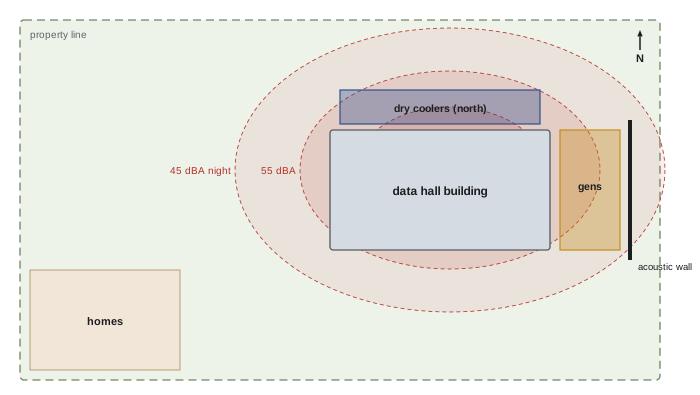
Data centers produce continuous noise from cooling equipment (fans, chillers, dry coolers and cooling towers) and intermittent noise from generators. Low-frequency hum from large fans and transformers carries far and has prompted complaints and regulations in several communities. Noise limits are set by municipal bylaws or ordinances, often lower at night and at residential property lines. The design response, developed with an acoustic consultant, includes a noise model of all sources, selection of low-noise equipment, placing noisy equipment away from sensitive neighbors and behind the building, acoustic screens and enclosures, and limiting generator testing to daytime hours. Noise studies are often a condition of zoning or site plan approval.
Other environmental reviews
Depending on the site and jurisdiction, other reviews may apply: ecological surveys and approvals for protected species and habitats, wetlands, archaeological and heritage assessments, traffic impact studies, visual impact assessments, and reviews of fuel storage (diesel tanks are regulated for spill prevention and fire safety) and of large battery systems. Large projects requiring new transmission lines or substations may trigger additional environmental assessments for those facilities, often handled by the utility but on the project's critical path.
In the United States, the National Environmental Policy Act (NEPA) applies only where there is a federal nexus, such as federal land, funding or permits (for example a Section 404 wetlands permit), but many states have their own environmental review laws, such as California's CEQA, that may apply to the project or associated utility facilities.
Community engagement
Community support can make the difference between a smooth approval and a long, contentious one. Concerns typically include noise, diesel emissions, water use, electricity prices and grid reliability, traffic during construction, visual impact, loss of farmland or green space, and whether the jobs and tax revenue justify the impacts. Effective engagement starts early, before formal applications, and includes meetings with neighbors, local officials and community groups; clear information about what will be built and how impacts will be managed; and commitments such as noise limits, landscaping buffers, water-efficient cooling, local hiring and contributions to community projects. The design team supports engagement with accurate information, renderings, noise and traffic studies, and design changes that address legitimate concerns. Promises made to the community must be achievable and should be written into the design criteria.
The permitting plan
A permitting plan lists every approval, the responsible agency, the information required, the expected review time and the dependencies between them, and places them on the project schedule. Typical critical path items include rezoning, utility interconnection agreements, air permits, wetland permits and building permits for early packages. The plan should identify which design decisions must be made early to support applications, such as generator type and number for the air permit, or building height and setbacks for zoning.
Worked problem
Building the permitting timeline
For Site C, the team expects: rezoning 9 months; site plan approval 4 months after rezoning; air permit 8 months (can run in parallel once generator selection is fixed, 2 months after project start); early works building permit 3 months after site plan approval; utility interconnection agreement 12 months from start. When can site work begin, and which item is critical?
Show solution
- Rezoning: months 0 to 9.
- Site plan approval: months 9 to 13.
- Early works building permit: months 13 to 16.
- Air permit: months 2 to 10, finishing before it is needed.
- Utility agreement: months 0 to 12, also before month 16.
Answer: Site work can begin around month 16. The zoning, site plan and building permit sequence is the critical path; starting pre-application meetings early or seeking concurrent review of site plan and rezoning could shorten it.
Permitting conditions, once granted, become design requirements. Noise limits, generator hour limits, landscaping commitments and stormwater rules should be entered into the basis of design and the requirements matrix so they are carried through design, construction and operation.
Common mistakes
MistakeAssuming zoning permits data centers without checking.
InsteadConfirm zoning and engage planning staff early.
MistakeEstimating generator permits from actual expected hours only.
InsteadAssess potential to emit and plan limits or controls.
MistakeLeaving noise studies until late in design.
InsteadModel noise early and place equipment accordingly.
MistakeEngaging the community only at public hearings.
InsteadStart engagement before formal applications.
MistakeNot scheduling permits.
InsteadBuild a permitting plan into the critical path.
Summary and key terms
- Permitting is a frequent cause of delay; design choices affect approvals.
- Zoning, conditional use and site plan approvals control land use and layout.
- Building and trade permits confirm code compliance, often issued in packages.
- Generator air permits depend on potential to emit; hour limits, SCR, cleaner engines or batteries help.
- Water supply, sewer discharge and stormwater approvals are required.
- Noise from cooling and generators must meet bylaws; model and mitigate early.
- Community engagement and a scheduled permitting plan reduce risk.
- Zoning
- Municipal rules on land use and building form.
- Conditional use permit
- Approval for a use allowed only under conditions.
- Site plan approval
- Review of detailed site layout.
- Potential to emit
- Maximum emissions assumed for permitting.
- Major source
- A facility above air permit emission thresholds.
- Selective catalytic reduction
- Aftertreatment that reduces NOx emissions.
- Blowdown
- Water discharged from cooling towers to control dissolved solids.
- Stormwater management plan
- A plan for controlling runoff from a site.
- Noise contour
- A line of equal sound level around a source.
- Permitting plan
- A schedule of required approvals and dependencies.
Practice problems
Work each problem on paper first, then reveal the answer to check.
Why has data center permitting become more difficult?
Show answer
Larger campuses raise concerns about land, noise, generators, water and power.
What does site plan approval review?
Show answer
Building positions, access, stormwater, landscaping, lighting and utilities.
Why are permits often issued in packages?
Show answer
So construction can start before the full design is complete.
What emissions do generator permits address?
Show answer
NOx, particulates, carbon monoxide and others.
What is the potential to emit at 500 h for 60 MW of engines at 6 g/kWh?
Show answer
60,000 kW × 500 h × 6 g = 180 t.
Name three ways to reduce generator permit burden.
Show answer
Hour limits, SCR, cleaner engines, batteries, gas or fuel cells.
What is blowdown and why is it regulated?
Show answer
Cooling tower discharge; its quantity and quality affect sewers.
Name three noise mitigation measures.
Show answer
Low-noise equipment, placement away from neighbors, screens, daytime testing.
What are common community concerns?
Show answer
Noise, emissions, water, electricity prices, traffic, visual impact, jobs.
In the example, what is the critical path?
Show answer
Rezoning, then site plan approval, then the early works building permit.
Lesson quiz · 5 questions
Score 60% or more to complete this lesson.
Create a free account to save your progress, take quizzes and earn a certificate.