
DCE-330 · Lesson 9 of 12 · 32 min
Direct-to-chip and immersion liquid cooling
A single AI accelerator now dissipates around 1000 W from a package the size of a palm, and a rack of them 100 kW or more. As Lesson 1 showed, air cannot carry that much heat through a rack at reasonable speeds, and fan power alone would become a large fraction of the load. Liquid cooling brings a liquid, which carries about 3500 times as much heat per unit volume as air, to the chips themselves. Once confined to supercomputers, it has become the default for AI training clusters and is reshaping how data centers are designed: warmer water, fewer chillers, new plumbing on the data hall floor, and new opportunities to reuse the heat.
This lesson covers direct-to-chip cooling with cold plates, coolant distribution units and the secondary loop, ASHRAE's liquid cooling classes and the temperature chain from chip to atmosphere, immersion cooling, the practical issues of leaks, water quality, materials and serviceability, and heat reuse.
Direct-to-chip cooling
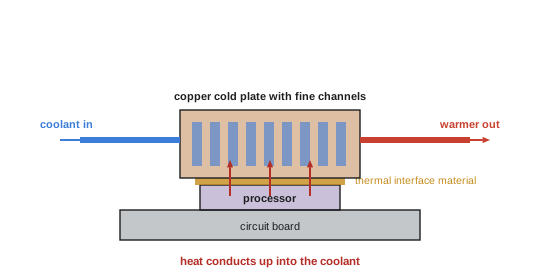
In direct-to-chip (DTC) cooling, a cold plate, a metal block (usually copper) with internal channels or microfins, is clamped onto each processor or accelerator with a thermal interface material. Coolant flows through the cold plates, absorbing heat by conduction and convection, and carries it out of the server through flexible hoses, manifolds on the rack and quick-disconnect couplings.
- Single-phase DTC circulates water or a water-glycol mixture (often 25% propylene glycol, PG25, for freeze and biological protection) that stays liquid. It is the most common approach.
- Two-phase DTC pumps a dielectric refrigerant to the cold plates, where it boils; the latent heat of boiling absorbs large heat fluxes at a nearly constant temperature, and the vapor is condensed in a heat exchanger. It handles very high heat fluxes with low flow, and a leak of dielectric fluid does not short-circuit electronics, but the fluids and systems are more complex.
Cold plates typically capture 70 to 85% of a server's heat (the processors, accelerators and sometimes memory and voltage regulators). The remainder, from power supplies, network cards, storage and other components, still goes to air, so a liquid-cooled hall still needs air cooling, at a much lower density. Some designs extend cold plates to nearly every component to capture 95% or more.
Worked problem
Splitting a rack's heat between liquid and air
A 130 kW AI rack captures 80% of its heat in cold plates. The secondary coolant is PG25 (specific heat 3.9 kJ/kg·K, density 1020 kg/m³) with a 10 K temperature rise. The remaining heat goes to air with a 12 K rise. Find the coolant flow and the airflow.
Show solution
- Liquid heat: \(0.8 \times 130 = 104\) kW. Mass flow: \(104/(3.9 \times 10) = 2.67\) kg/s; volume flow \(2.67/1020 = 2.61 \times 10^{-3}\) m³/s = 2.6 L/s (about 41 US gal/min).
- Air heat: 26 kW. Airflow: \(26/(1.21 \times 12) = 1.79\) m³/s (about 3800 CFM).
Answer: About 2.6 L/s of coolant and 1.8 m³/s of air. The air load per rack, 26 kW, is still more than a traditional rack produced, so liquid-cooled halls still need substantial air handling, often with rear-door heat exchangers or containment.
Coolant distribution units and the secondary loop
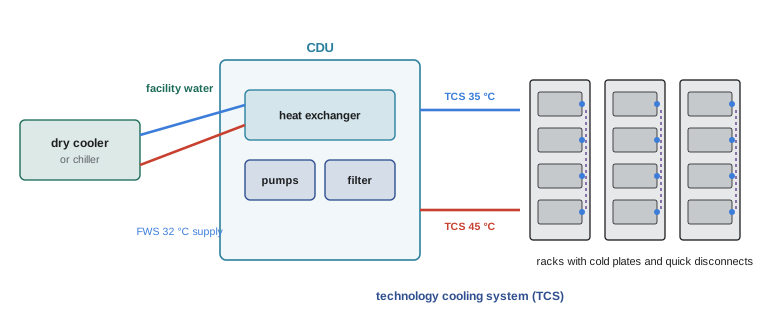
IT equipment is not connected directly to the building's facility water. A coolant distribution unit (CDU) separates the two:
- The facility water system (FWS, or primary loop) connects the CDU to the plant: chillers, dry coolers or towers.
- The technology cooling system (TCS, or secondary loop) runs from the CDU to the racks and cold plates, with tightly controlled temperature, pressure, flow, filtration and fluid chemistry.
The CDU contains a liquid-to-liquid heat exchanger, pumps (usually redundant), filters (commonly 25 to 50 µm to protect the fine channels of cold plates), expansion and make-up provisions, and controls that hold the TCS supply temperature and pressure. In-rack CDUs serve one rack; in-row or floor-mounted CDUs serve a row or a group of racks, typically 500 kW to several megawatts each. Where no facility water is available, liquid-to-air CDUs (sometimes called sidecars) reject the heat from the TCS into the room air through a coil and fans, which lets a few liquid-cooled racks be added to an air-cooled hall, at the cost of a large local air load.
Worked problem
CDU and pumping for a row
A row of 20 racks like the one in the previous example is served by one CDU. Find the total coolant flow, the CDU capacity, and the pump power if the TCS pressure drop (CDU, piping, manifolds, hoses and cold plates) is 250 kPa and pump efficiency is 70%.
Show solution
- Flow: \(20 \times 2.61 = 52.2\) L/s = 0.0522 m³/s.
- Heat: \(20 \times 104 = 2080\) kW, so a CDU of at least 2.1 MW (plus margin and redundancy).
- Pump power: \(0.0522 \times 250/0.70 = 18.6\) kW.
Answer: 52 L/s, a CDU of over 2 MW, and about 19 kW of pump power, under 1% of the heat moved. Removing the same 2.08 MW with air would need fan power several times larger.
The temperature chain
Chip vendors specify the maximum coolant temperature at the cold plate inlet that keeps their silicon within limits at full power. Working backward from that limit through each heat exchanger's approach temperature determines the facility water temperature, and from it whether chillers are needed. ASHRAE TC 9.9 classifies liquid-cooled environments by the maximum facility water supply temperature:
| Class | Facility water supply (max) | Typical heat rejection |
|---|---|---|
| W17 | 17 °C | Chillers, with economizer |
| W27 | 27 °C | Chillers or economizer |
| W32 | 32 °C | Mostly economizer, chillers for peaks |
| W40 | 40 °C | Dry coolers or towers, little or no chiller use |
| W45 | 45 °C | Dry coolers in nearly all climates |
| W+ | Above 45 °C | Dry coolers; heat reuse |
Worked problem
Working the temperature chain
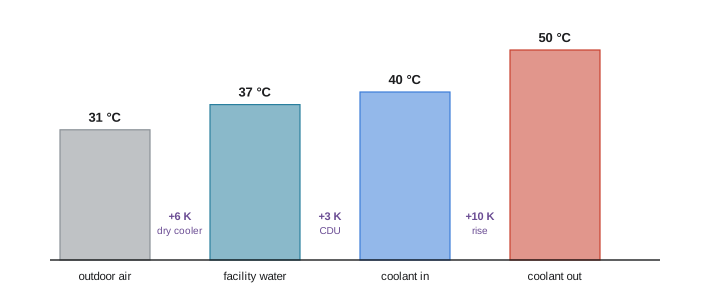
An accelerator vendor allows coolant at up to 40 °C entering the cold plates. The CDU heat exchanger has a 3 K approach, and dry coolers have a 6 K approach to outdoor dry-bulb temperature. Up to what outdoor temperature can dry coolers alone do the job? What if the vendor allowed 45 °C?
Show solution
- Maximum facility water supply: \(40 - 3 = 37\) °C.
- Dry coolers can supply 37 °C water when the dry-bulb is at or below \(37 - 6 = 31\) °C.
- With 45 °C allowed: facility water 42 °C, dry-bulb up to 36 °C.
Answer: Chiller-free operation up to 31 °C outdoors with a 40 °C limit, or 36 °C with a 45 °C limit. Above that, adiabatic pre-cooling or a small trim chiller covers the remaining hours. Every kelvin of approach saved in the CDU or dry cooler, and every kelvin allowed by the chip vendor, extends chiller-free hours.
Immersion cooling
In immersion cooling, entire servers are submerged in a dielectric (electrically non-conducting) liquid in a tank. Fans are removed, and the liquid contacts every component, capturing essentially all the heat.
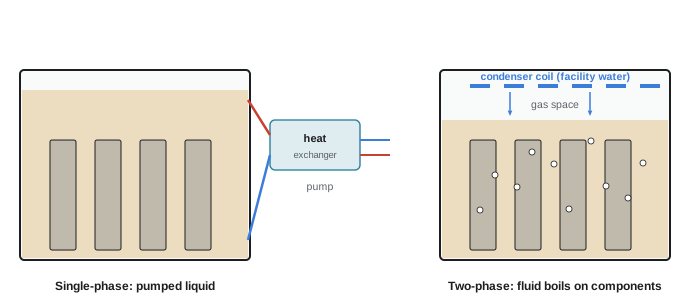
- Single-phase immersion uses hydrocarbon or synthetic oils that stay liquid. Pumps circulate the fluid through a heat exchanger that transfers the heat to facility water. The fluids are relatively inexpensive and stable, but viscous, and servers emerge coated in oil for maintenance.
- Two-phase immersion uses engineered fluids, historically fluorocarbons, that boil at around 50 °C on hot components. The vapor rises, condenses on a water-cooled coil at the top of the tank and drips back, giving very high heat transfer with no pumps in the tank. The fluids are expensive, must be kept from escaping (vapor losses), and many are per- and polyfluoroalkyl substances (PFAS), which face increasing regulation; a major manufacturer of such fluids announced it would exit PFAS manufacturing by the end of 2025, pushing the industry toward alternative fluids.
Immersion changes the facility: tanks are heavy (a tank holding about a cubic meter of fluid can weigh well over a metric ton with its servers) and lie horizontally, so floor loading and layout differ from rack rows; servers must be lifted out with hoists for service; and server vendors must support and warrant their equipment for immersion. It is used in some cryptocurrency mining, edge and high-performance computing installations, while direct-to-chip has become the mainstream choice for AI clusters because it fits existing rack and server designs.
In the US, the EPA has issued reporting requirements for PFAS under the Toxic Substances Control Act, and several states, including Maine and Minnesota, have enacted laws restricting PFAS in products with phased deadlines; operators considering fluorinated immersion or two-phase fluids should check the current federal and state requirements.
Practical issues
Bringing liquid onto the data hall floor raises concerns that air cooling never had:
- Leaks: dripless quick-disconnect couplings, leak detection cable or sensors under racks and CDUs, drip trays, and controls that isolate a leaking branch. Negative-pressure TCS designs, which hold the loop below atmospheric pressure so that a breach draws air in rather than spraying coolant, are also offered.
- Fluid quality: cold plate channels are fine and easily fouled, so the TCS is filled with treated, filtered coolant and monitored for conductivity, pH, inhibitor levels and biological growth. Mixing incompatible metals (such as copper and aluminum) in one loop causes galvanic corrosion.
- Materials compatibility: hoses, seals and plastics must suit the coolant; dielectric fluids in immersion can swell or leach some cable jackets and labels.
- Redundancy and resilience: a liquid-cooled accelerator can overheat in seconds without flow, so CDU pumps are redundant and often on UPS power, and the TCS has little thermal mass to ride through interruptions.
- Commissioning and operations: flushing new loops, venting air, balancing flow between racks, and training staff in a discipline closer to plumbing than to traditional IT work.
Heat reuse
Liquid cooling returns heat at useful temperatures, 40 to 60 °C or more, compared with the 30 to 40 °C of air-cooled return air. That is warm enough for low-temperature district heating networks, greenhouses, aquaculture and some industrial processes directly, and a heat pump can raise it further for conventional heating networks very efficiently because the lift is small. Data centers in Northern Europe have heated thousands of homes this way. The obstacles are usually not technical: a heat customer must be nearby, the demand must match the supply across seasons (heating demand falls in summer when cooling demand rises), and the commercial arrangements must outlast both parties' plans.
Worked problem
Upgrading waste heat with a heat pump
A data center returns 10 MW of heat in facility water at 45 °C. A heat pump with a COP (heating) of 4.0 raises it to 75 °C for a district heating network. How much heat is delivered and how much electricity does the heat pump use?
Show solution
- For a heat pump, heat delivered = heat absorbed + work, and COP = delivered/work = 4, so work = delivered/4 and absorbed = 3/4 of delivered.
- Delivered heat: \(10/(3/4) = 13.3\) MW. Electricity: \(13.3/4 = 3.33\) MW.
Answer: 13.3 MW of heat at 75 °C for 3.3 MW of electricity, while also removing the data center's need to reject that 10 MW through its own coolers. The Energy Reuse Effectiveness (ERE) metric, \(\text{ERE} = (\text{total facility energy} - \text{reused energy})/\text{IT energy}\), credits such reuse; unlike PUE it can fall below 1.
Lesson 10 scales liquid cooling to whole AI halls, with CDU sizing, the temperature chain, transient loads and commissioning of liquid systems.
Common mistakes
MistakeAssuming a liquid-cooled hall needs no air cooling.
InsteadCold plates capture about 70–85% of the heat; the rest still goes to air and must be handled.
MistakeConnecting cold plates directly to facility water.
InsteadUse a CDU to isolate a clean, controlled technology loop from the facility system.
MistakeDesigning facility water for traditional chilled-water temperatures.
InsteadWork the temperature chain back from the chip vendor's limit; warm water (W32–W45) minimizes chillers and water use.
MistakeNeglecting coolant chemistry and filtration.
InsteadTreat, filter and monitor the TCS fluid; avoid mixed metals that cause galvanic corrosion.
MistakeTreating CDU pumps as non-critical.
InsteadLiquid-cooled chips overheat in seconds without flow; provide redundant pumps with UPS power.
MistakeChoosing a two-phase or immersion fluid without checking regulation and supply.
InsteadCheck PFAS status, fluid availability, vendor support and warranty terms.
Summary and key terms
- AI accelerators (around 1 kW each) and racks of 100 kW or more require liquid cooling.
- Direct-to-chip cold plates (single-phase water/glycol or two-phase dielectric) capture about 70–85% of server heat; the rest goes to air.
- CDUs separate the facility water system from the technology cooling system and provide heat exchange, pumping, filtration and control.
- Coolant flow = Q/(c_p ΔT); pumping power is a small fraction of the heat moved.
- ASHRAE classes W17 to W+ define facility water temperatures; the temperature chain from the chip limit through each approach sets chiller-free hours.
- Immersion submerges servers in dielectric fluid: single-phase (pumped oils) or two-phase (boiling engineered fluids, often PFAS).
- Leaks, fluid quality, materials, redundancy and serviceability are the key practical concerns.
- Warm return water enables heat reuse directly or via heat pumps; ERE credits reused energy.
- Direct-to-chip cooling
- Liquid cooling through cold plates attached to processors.
- Cold plate
- A metal block with internal channels through which coolant flows to cool a chip.
- Thermal interface material
- A material that fills gaps between a chip and its cold plate or heat sink.
- Single-phase cooling
- Liquid cooling in which the coolant does not boil.
- Two-phase cooling
- Liquid cooling in which the coolant boils, absorbing latent heat.
- Coolant distribution unit (CDU)
- A unit with heat exchanger, pumps and filters that serves a technology cooling loop.
- Technology cooling system (TCS)
- The secondary loop from the CDU to the IT equipment.
- Facility water system (FWS)
- The primary loop from the CDU to the heat-rejection plant.
- Quick disconnect
- A coupling that connects and disconnects a liquid line without significant spillage.
- Immersion cooling
- Cooling by submerging electronics in a dielectric liquid.
- Dielectric fluid
- An electrically non-conducting liquid.
- PFAS
- Per- and polyfluoroalkyl substances, a class of persistent fluorinated chemicals.
- Energy Reuse Effectiveness (ERE)
- (Total facility energy − reused energy)/IT energy.
Practice problems
Work each problem on paper first, then reveal the answer to check.
A 90 kW rack captures 75% of its heat in cold plates using water (4.19 kJ/kg·K) with a 12 K rise. What water flow is needed?
Show answer
67.5/(4.19 × 12) = 1.34 kg/s ≈ 1.34 L/s.
What airflow handles the remaining heat of that rack with a 15 K rise?
Show answer
22.5/(1.21 × 15) = 1.24 m³/s.
A CDU serves 3 MW with a 10 K TCS rise using PG25 (3.9 kJ/kg·K). What mass flow is required?
Show answer
3000/(3.9 × 10) = 76.9 kg/s.
A chip allows 35 °C coolant inlet; the CDU approach is 2 K and dry coolers have a 5 K approach. Up to what dry-bulb can dry coolers alone serve it?
Show answer
Facility water ≤ 33 °C; dry-bulb ≤ 28 °C.
Which ASHRAE liquid cooling class allows facility water up to 40 °C?
Show answer
W40.
Name two advantages and two disadvantages of two-phase immersion.
Show answer
Advantages: very high heat transfer, no fans, uniform cooling, no pumps in the tank. Disadvantages: expensive fluids with vapor losses, PFAS regulatory risk, heavy tanks, difficult servicing and warranty issues.
Why should copper and aluminum not be mixed in one coolant loop?
Show answer
They form a galvanic couple in the conductive coolant, corroding the aluminum and fouling the loop.
A heat pump with heating COP 3.5 delivers 7 MW. How much heat does it take from the data center, and how much electricity does it use?
Show answer
Electricity 7/3.5 = 2 MW; heat absorbed 5 MW.
A facility uses 60 GWh in total, of which 40 GWh is IT, and exports 12 GWh of heat for reuse. Find its PUE and ERE.
Show answer
PUE = 60/40 = 1.5; ERE = (60 − 12)/40 = 1.2.
Why is a negative-pressure technology cooling loop attractive?
Show answer
A breach draws air into the loop instead of spraying coolant onto electronics.
Lesson quiz · 5 questions
Score 60% or more to complete this lesson.
Create a free account to save your progress, take quizzes and earn a certificate.