
DCE-330 · Lesson 5 of 12 · 33 min
Chilled-water plants and heat rejection
In most large data centers, the heat collected by air handlers or coolant distribution units ends up in a water loop, and a central plant moves it out of the building. When the outdoor air is cool enough, the plant can reject the heat directly; when it is not, chillers use mechanical refrigeration to pump the heat "uphill" from the cool loop to a warmer condenser loop that can reject it to hot summer air. The plant is the largest single consumer of energy after the IT load, and its reliability determines whether the facility can keep running through equipment failures and power interruptions.
This lesson explains the refrigeration cycle and what sets a chiller's efficiency, the main chiller types, how heat leaves the site through cooling towers and dry coolers, how the water loops and pumps are arranged, how plants are made redundant and how they ride through a power failure, and the regulations affecting refrigerants.
The vapor-compression cycle
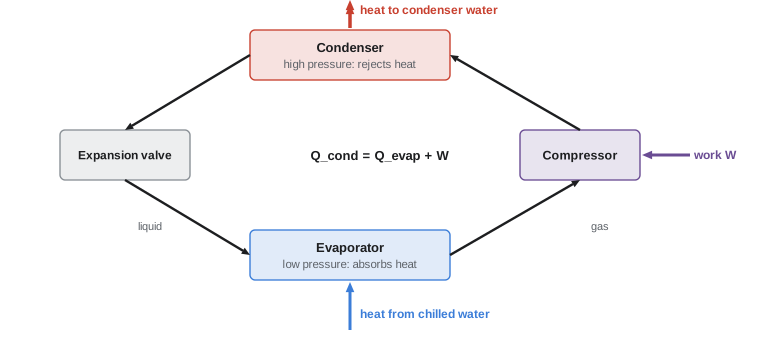
A chiller is a heat pump. Its refrigerant circulates through four components:
- Evaporator: a heat exchanger in which the refrigerant boils at low pressure and low temperature, absorbing heat from the chilled water.
- Compressor: raises the pressure (and therefore the condensing temperature) of the refrigerant vapor, using electrical energy.
- Condenser: a heat exchanger in which the hot, high-pressure vapor condenses, rejecting heat to condenser water or outdoor air.
- Expansion valve: drops the liquid refrigerant back to low pressure, completing the cycle.
Energy balance requires that the heat rejected at the condenser equals the heat absorbed at the evaporator plus the compressor work: \(\dot Q_{\text{cond}} = \dot Q_{\text{evap}} + W\). A chiller removing 5 MW from the data hall with 0.8 MW of compressor power rejects 5.8 MW outdoors.
What limits efficiency
The ideal (Carnot) coefficient of performance of a refrigerator depends only on the absolute temperatures at which it absorbs and rejects heat:
Real chillers achieve perhaps 50 to 65% of the Carnot value at full load. The key quantity is the lift, the difference between condensing and evaporating temperatures: the smaller the lift, the higher the COP. Lift falls when the chilled water is warmer (raising the evaporating temperature) and when the condenser water or outdoor air is cooler (lowering the condensing temperature). This is the thermodynamic reason behind the trend, discussed in Lesson 1, toward warmer chilled water.
Worked problem
Lift and COP
A chiller evaporates at 5 °C and condenses at 35 °C. Find its Carnot COP and estimate its actual COP at 55% of Carnot. Repeat with the evaporating temperature raised to 15 °C.
Show solution
- At 5 °C: \(T_{\text{evap}} = 278.15\) K, lift 30 K; \(\text{COP}_{\text{Carnot}} = 278.15/30 = 9.27\); actual \(\approx 0.55 \times 9.27 = 5.1\).
- At 15 °C: \(288.15/20 = 14.4\); actual \(\approx 7.9\).
Answer: Raising the evaporating temperature by 10 K raises the estimated COP from 5.1 to 7.9, cutting compressor energy by about a third. When the lift falls to near zero, the chiller is no longer needed at all, and the plant can economize (Lesson 7).
Chiller types
Chillers are classified by compressor and by how they reject heat:
- Centrifugal chillers: a high-speed impeller compresses the refrigerant. They suit large capacities (about 1 to 10 MW per machine, 300 to 3000 tons) and achieve the best full-load efficiencies. Oil-free designs with magnetic bearings and variable-speed drives are very efficient at part load and low lift.
- Screw chillers: two meshing rotors compress the refrigerant; common from about 0.5 to 2 MW.
- Scroll chillers: orbiting scrolls, for smaller capacities, often packaged in modular units.
A water-cooled chiller rejects heat to a condenser water loop connected to cooling towers. An air-cooled chiller has its condenser coils and fans built in and rejects heat directly to outdoor air. Air-cooled chillers are simpler and use no water on site, but their condensing temperature follows the outdoor dry-bulb temperature, which is higher than the wet-bulb temperature a cooling tower can approach, so they are typically 30 to 50% less efficient at peak conditions. Many recent data centers use air-cooled chillers with integral free-cooling coils to avoid water use (Lesson 7).
Heat rejection
Cooling towers
A cooling tower rejects heat by evaporating a small fraction of the condenser water into the air passing through it. Because evaporation removes heat, the water can be cooled below the outdoor dry-bulb temperature, toward the wet-bulb temperature, which is the lowest temperature reachable by evaporation and on a humid summer day may be 8 to 10 K below the dry-bulb. Two quantities describe tower performance:
- Range: the temperature drop of the water through the tower (entering minus leaving), equal to the heat rejected divided by \(\dot m c_p\).
- Approach: how close the leaving water gets to the ambient wet-bulb temperature, typically 3 to 5 K for a well-sized tower. A smaller approach needs a larger tower.
Open towers expose the condenser water to the air, so water treatment and blowdown are needed to control scale, corrosion and biological growth, including Legionella bacteria, which can cause outbreaks of Legionnaires' disease from poorly maintained towers. Closed-circuit fluid coolers keep the process water in a coil, with a separate spray water circuit outside it, at some loss of efficiency.
Worked problem
Sizing condenser water and the tower
A water-cooled chiller plant removes 5000 kW from the data hall with chillers drawing 833 kW. The design wet-bulb temperature is 24 °C, the tower approach is 4 K and the range is 6 K. Find the heat rejected, the tower water temperatures and the condenser water flow.
Show solution
- Heat rejected: \(5000 + 833 = 5833\) kW.
- Leaving tower (condenser water supply): \(24 + 4 = 28\) °C; entering tower: \(28 + 6 = 34\) °C.
- Flow: \(5833/(4.19 \times 6) = 232\) L/s (about 3680 US gal/min).
Answer: The towers reject 5.8 MW, supplying condenser water at 28 °C and receiving it at 34 °C, with 232 L/s of flow. The chillers' condensing temperature will be a few kelvin above 34 °C, which sets their lift on a design day.
Dry coolers and adiabatic coolers
A dry cooler is a large finned coil with fans, rejecting heat from a closed water or glycol loop directly to the air, without evaporation. It uses no water but can only cool the loop to some approach above the dry-bulb temperature, perhaps 5 to 10 K. Adiabatic coolers add pads or sprays that pre-cool the entering air by evaporation on hot days, using water only for the hottest hours. Where the facility water is warm, as with liquid cooling (Lesson 9), dry coolers alone can reject heat for most or all of the year in many climates.
Water loops and pumping
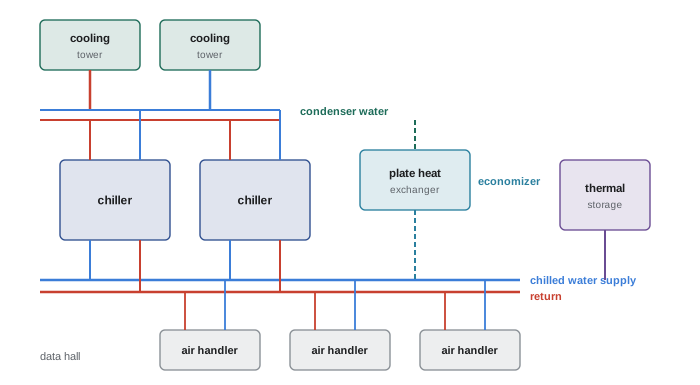
A typical chilled-water plant has two or three water loops: chilled water from the chillers to the air handlers or CDUs, condenser water from the chillers to the towers, and in many plants a separate loop through plate heat exchangers for economizing. Two pumping arrangements are common for the chilled-water loop:
- Primary-secondary: constant-speed primary pumps circulate water through each chiller; variable-speed secondary pumps distribute water to the loads. A decoupling bypass between them lets the two flows differ.
- Variable primary flow: variable-speed pumps send water through both chillers and loads, with a small bypass to maintain the minimum flow through each chiller. It uses fewer pumps and less energy, but needs careful control.
Pump power for a flow \(\dot V\) against a pressure rise \(\Delta p\) is
where \(\eta\) is the combined pump and motor efficiency. Because flow for a given load is inversely proportional to the water temperature difference, designing for a larger ΔT shrinks pipes and pumps dramatically: at a fixed system, pump power varies roughly with the cube of flow, as with fans.
Worked problem
Effect of ΔT on pumping
A 2000 kW chilled-water load is designed for a 6 K ΔT with a loop pressure drop of 300 kPa and pump efficiency of 75%. Find the flow and pump power. Estimate both if the same pipes carry a 10 K ΔT.
Show solution
- Flow at 6 K: \(2000/(4.19 \times 6) = 79.6\) L/s = 0.0796 m³/s.
- Pump power: \(0.0796 \times 300/0.75 = 31.8\) kW.
- Flow at 10 K: \(2000/(4.19 \times 10) = 47.7\) L/s, 60% of the original.
- In the same pipes, pressure drop scales with flow squared and power with flow cubed: \(31.8 \times 0.6^3 = 6.9\) kW.
Answer: Raising the design ΔT from 6 K to 10 K cuts flow by 40% and pump power by almost 80%, or allows smaller pipes and pumps in a new design. Low ΔT syndrome, in which coils return water cooler than designed (often because of bypass or dirty coils), forces plants to pump extra water and run extra chillers, and is a common operational problem.
Redundancy and ride-through
Chillers, towers and pumps are installed with redundancy, commonly N+1 (one spare of each type) or N+2 for large plants, and with dual piping paths or loops for higher reliability tiers. Concurrent maintainability, the ability to take any component out of service for maintenance without affecting cooling, usually requires valves arranged so that any chiller, pump or pipe section can be isolated, and sometimes a second, independent distribution path.
A power failure poses a special problem. The UPS keeps the IT equipment running, so the heat keeps coming, but chillers stop and take several minutes to restart once generators are online (often 5 to 15 minutes before full capacity returns). Without cooling, a dense hall can heat up beyond allowable limits in well under that time. Three measures bridge the gap:
- UPS-backed pumps and air handler fans, so that water and air keep circulating.
- Chillers with fast-restart capability.
- Thermal storage: an insulated tank of chilled water that the pumps draw from while chillers restart.
Worked problem
Sizing thermal storage
A 5 MW hall must ride through 10 minutes without chillers. The storage tank holds water at 12 °C, and the loop can accept a return temperature 10 K higher. How much water is needed? Allow 30% extra for mixing in the tank.
Show solution
- Heat to absorb: \(5000\ \text{kW} \times 600\ \text{s} = 3.0 \times 10^6\) kJ.
- Mass: \(3.0 \times 10^6/(4.19 \times 10) = 71{,}600\) kg, about 72 m³.
- With 30% allowance: about 93 m³.
Answer: About 93 m³ of water, for example a tank about 5 m in diameter and 5 m high. The calculation must use the full heat load including fans and UPS losses, and the storage must be connected so that pumps on UPS power can draw from it.
Refrigerants
Chillers use refrigerants with suitable boiling points and pressures. Older plants used CFCs and HCFCs, which deplete stratospheric ozone and have been phased out under the Montreal Protocol. Their replacements, hydrofluorocarbons (HFCs) such as R-134a and R-410A, do not deplete ozone but are powerful greenhouse gases: one kilogram of R-134a released has a global warming potential (GWP) of about 1430 kg of CO₂ over 100 years. The 2016 Kigali Amendment commits countries to phase down HFC production and consumption by about 85% by the mid-2030s. Newer chillers use low-GWP hydrofluoroolefins (HFOs) such as R-1234ze and R-1233zd, blends such as R-513A, or natural refrigerants such as ammonia, CO₂ and propane, each with trade-offs in flammability, toxicity, pressure and efficiency.
In the US, the American Innovation and Manufacturing (AIM) Act of 2020 directs the EPA to phase down HFC production and consumption by 85% by 2036, and the EPA's Technology Transitions rule sets GWP limits for refrigerants in many categories of new equipment, including chillers, with compliance dates phased in from 2025 (some data center cooling equipment has later dates). EPA rules under the Clean Air Act also govern refrigerant handling, leak repair and technician certification. Designers should check the limit and date that apply to each equipment category.
Many low-GWP refrigerants are mildly flammable (ASHRAE safety class A2L), which brings new requirements for machinery room ventilation, leak detection and equipment location under the mechanical refrigeration safety standards (ASHRAE 15 and, in Canada, CSA B52).
Lesson 6 follows the water from the plant to the coils: pump and system curves, pipe sizing, pumping arrangements, low ΔT and water quality.
Common mistakes
MistakeSizing heat rejection for the IT load only.
InsteadTowers and dry coolers reject the load plus compressor (and pump) energy: Q_cond = Q_evap + W.
MistakeDesigning chilled water at 6–7 °C by habit.
InsteadUse the warmest supply temperature the air handlers or CDUs allow; every kelvin reduces lift and increases economizer hours.
MistakeDesigning for a small water ΔT.
InsteadA larger ΔT reduces flow, pipe sizes and pump power; prevent low ΔT syndrome in operation.
MistakeAssuming the UPS covers cooling during a power failure.
InsteadPut pumps and fans on UPS, use fast-restart chillers, and size thermal storage for the restart time.
MistakeNeglecting cooling tower water treatment.
InsteadTreat and monitor water to control scale, corrosion and Legionella, and keep a water management plan.
Summary and key terms
- A chiller moves heat from the evaporator to the condenser using compressor work; Q_cond = Q_evap + W.
- Carnot COP = T_evap/(T_cond − T_evap); real chillers reach about 50–65% of it. Smaller lift means higher COP.
- Centrifugal chillers suit large plants; screw and scroll smaller ones; oil-free magnetic-bearing designs excel at part load.
- Water-cooled chillers reject heat to cooling towers (approaching wet-bulb); air-cooled chillers to outdoor air (dry-bulb), using no water but more energy.
- Tower range = ΔT of the water; approach = leaving water minus wet-bulb.
- Pump power = V̇Δp/η; larger ΔT reduces flow and pump power sharply.
- Plants are N+1 or better and concurrently maintainable; pumps on UPS and thermal storage bridge chiller restart after power failures.
- HFCs are being phased down under the Kigali Amendment; low-GWP HFOs and natural refrigerants bring flammability and safety requirements.
- Chiller
- A machine that produces chilled water by vapor-compression refrigeration.
- Evaporator
- The heat exchanger in which refrigerant boils, absorbing heat from chilled water.
- Condenser
- The heat exchanger in which refrigerant condenses, rejecting heat.
- Lift
- The difference between condensing and evaporating temperatures.
- Carnot COP
- The ideal COP of a refrigerator between two temperatures.
- Centrifugal chiller
- A chiller with a high-speed impeller compressor, for large capacities.
- Cooling tower
- A device that cools water by evaporating part of it into air.
- Wet-bulb temperature
- The lowest temperature reachable by evaporative cooling at the current air conditions.
- Range
- The water temperature drop through a cooling tower.
- Approach
- The difference between the leaving water temperature and the wet-bulb temperature.
- Dry cooler
- A finned coil and fans that reject heat from a closed loop to air without evaporation.
- Variable primary flow
- A pumping arrangement with variable-speed pumps serving both chillers and loads.
- Low ΔT syndrome
- A plant condition in which return water is cooler than designed, forcing excess flow.
- Thermal storage
- A tank of chilled water used to carry the load while chillers restart.
- GWP
- Global warming potential: the warming effect of a gas relative to CO₂ over a time horizon.
Practice problems
Work each problem on paper first, then reveal the answer to check.
A chiller removes 3 MW with a COP of 6. How much heat does its condenser reject?
Show answer
W = 3/6 = 0.5 MW; Q_cond = 3.5 MW.
Find the Carnot COP between 10 °C and 30 °C.
Show answer
283.15/20 = 14.2.
A tower cools water from 35 °C to 29 °C on a day with a 25 °C wet bulb. What are the range and approach?
Show answer
Range 6 K; approach 4 K.
What condenser water flow is needed to reject 4 MW with a 5.5 K range?
Show answer
4000/(4.19 × 5.5) = 174 L/s.
A pump moves 0.1 m³/s against 250 kPa at 70% efficiency. What power does it draw?
Show answer
0.1 × 250/0.7 = 35.7 kW.
A plant designed for 8 K ΔT runs at 5 K because of low ΔT syndrome. By what factor does the flow rise for the same load?
Show answer
8/5 = 1.6 times the flow (and roughly 4 times the pump power in the same system).
How much water is needed to carry 3 MW for 8 minutes with a 12 K usable rise?
Show answer
3000 × 480/(4.19 × 12) = 28,640 kg, about 29 m³ (about 37 m³ with 30% allowance).
Why does an air-cooled chiller use more energy than a water-cooled one on a hot day?
Show answer
Its condenser rejects heat to the dry-bulb temperature, which is higher than the wet-bulb that a tower approaches, so its lift is larger.
How many kilograms of CO₂-equivalent is the release of 200 kg of R-134a (GWP 1430)?
Show answer
286,000 kg, about 286 metric tons of CO₂e.
Name two hazards or burdens that cooling towers bring compared with dry coolers.
Show answer
Water consumption and treatment; Legionella risk; visible plume and drift; chemical handling.
Lesson quiz · 5 questions
Score 60% or more to complete this lesson.
Create a free account to save your progress, take quizzes and earn a certificate.