
DCE-330 · Lesson 7 of 12 · 37 min
Economizers, evaporative cooling and water use
Chillers are needed only when the outdoor environment is too warm to absorb the heat directly. For much of the year in most of North America, outdoor air or water cooled by evaporation is colder than the 18 to 27 °C air that servers need, or the 20 to 40 °C water that liquid-cooled equipment can accept. Economizers exploit that, cooling with outdoor conditions instead of compressors, and they are the main reason modern facilities achieve PUEs of 1.1 to 1.2. Evaporation is the most powerful way to extend economizer hours, but it consumes water, which in many regions is scarcer, and more politically sensitive, than electricity.
This lesson covers air-side and water-side economizers, evaporative cooling, how climate determines economizer hours, how much water evaporative systems use and how it is measured, and the trade-off between water and energy.
Air-side economizers
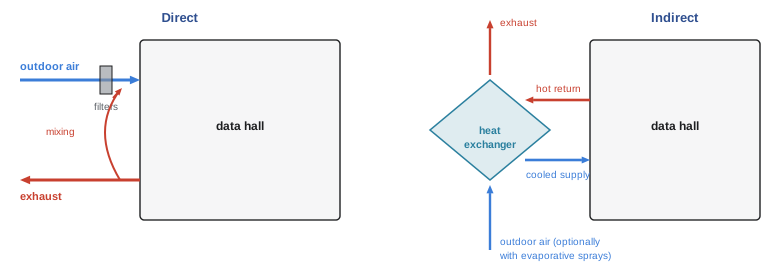
A direct air-side economizer brings filtered outdoor air into the data hall and exhausts the hot return air, mixing in return air when the outdoor air is too cold. When outdoor air is cooler than the required supply temperature, no mechanical cooling is needed at all. Direct systems are simple and very efficient, and several large operators use them in suitable climates, but they expose IT equipment to outdoor contaminants (dust, salt, corrosive gases, wildfire smoke) and humidity swings, so they need good filtration (commonly MERV 13 or better), humidity control, monitoring, and a way to close the dampers and switch to recirculation and mechanical cooling during smoke or pollution events.
An indirect air-side economizer keeps outdoor and indoor air separate, transferring heat through an air-to-air heat exchanger, such as a plate heat exchanger, heat pipe or rotating heat wheel. Indoor air never mixes with outdoor air, which avoids contamination at the cost of a temperature approach across the exchanger (a few kelvin). Many indirect units add evaporative cooling of the outdoor airstream (indirect evaporative cooling), which lets them cool below the outdoor dry-bulb temperature without adding moisture to the hall.
Water-side economizers
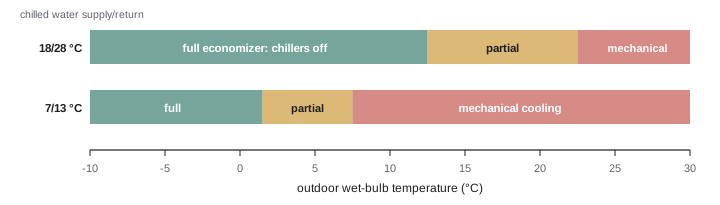
In a chilled-water plant, a water-side economizer is a plate heat exchanger between the condenser water loop and the chilled-water loop. When the cooling towers (or dry coolers) can produce water cold enough, it cools the chilled water directly and the chillers turn off. Operation has three modes:
- Full economizer: tower water alone, through the heat exchanger, meets the chilled-water supply temperature. Chillers are off.
- Partial (integrated) economizer: the heat exchanger pre-cools the return chilled water and the chillers finish the job, with a reduced lift.
- Mechanical cooling: outdoor conditions are too warm for the heat exchanger to help; chillers carry the full load.
The temperatures at which the modes change follow from the approaches of each component. With a tower approach \(a_t\) and a heat exchanger approach \(a_{hx}\), full economizing is possible when the wet-bulb temperature is at or below \(T_{\text{chws}} - a_{hx} - a_t\), and partial economizing when it is below \(T_{\text{chwr}} - a_{hx} - a_t\), where \(T_{\text{chws}}\) and \(T_{\text{chwr}}\) are the chilled-water supply and return temperatures.
Worked problem
Economizer changeover temperatures
A plant supplies chilled water at 18 °C and receives it back at 28 °C. The plate heat exchanger approach is 1.5 K and the tower approach is 4 K. Up to what wet-bulb temperatures is full and partial economizing possible? Repeat for an older plant at 7 °C supply and 13 °C return.
Show solution
- Modern plant, full: \(18 - 1.5 - 4 = 12.5\) °C wet bulb. Partial: \(28 - 1.5 - 4 = 22.5\) °C.
- Older plant, full: \(7 - 5.5 = 1.5\) °C. Partial: \(13 - 5.5 = 7.5\) °C.
Answer: The modern plant runs chiller-free whenever the wet bulb is below 12.5 °C and gets some help up to 22.5 °C, which in most North American climates covers most of the year. The older plant economizes fully only below 1.5 °C. Warmer chilled water, enabled by containment and the ASHRAE envelope, is what makes economizers effective.
Air-cooled chillers with integral free-cooling coils work the same way using dry-bulb temperature: when outdoor air is cool enough, glycol from the loop passes through the free-cooling coils and the compressors stop. With liquid-cooled IT equipment accepting facility water at 30 °C or more (Lesson 9), dry coolers can provide all the cooling, without chillers or water, in most climates for all or nearly all hours.
Evaporative cooling
Evaporating water absorbs about 2400 kJ per kilogram at typical conditions, so a little water removes a lot of heat. Direct evaporative cooling passes air through wetted media: the air is cooled toward its wet-bulb temperature and gains moisture. The effectiveness of the media (typically 80 to 90%) gives the leaving temperature:
Indirect evaporative cooling cools a secondary airstream or water that then cools the supply air through a heat exchanger, so no moisture is added to the hall. Cooling towers are evaporative heat rejection for water loops.
Worked problem
Evaporative supply temperature
Outdoor air is at 35 °C dry bulb and 20 °C wet bulb. A direct evaporative cooler has 85% effectiveness. What supply temperature does it produce? What about on a humid day at 33 °C dry bulb and 26 °C wet bulb?
Show solution
- Dry day: \(35 - 0.85 \times (35 - 20) = 35 - 12.75 = 22.3\) °C.
- Humid day: \(33 - 0.85 \times 7 = 27.1\) °C.
Answer: On the dry day the cooler supplies 22 °C air, within the recommended envelope without any compressor. On the humid day it reaches only 27 °C, at the edge of the envelope, with very high humidity. Evaporative cooling works best in dry climates and needs mechanical backup in humid ones.
Climate and economizer hours
The value of an economizer depends on how many hours per year the outdoor wet-bulb (for evaporative and tower systems) or dry-bulb (for dry systems) temperature is below the changeover points. Designers use hourly weather data for the site, often typical meteorological year files, sorted into temperature bins, and simulate the plant's energy hour by hour. Both the typical year and the extremes matter: the plant must still meet the load on the hottest, most humid design day, often taken as the conditions exceeded only 0.4% of hours (about 35 hours a year) or, for critical facilities, the extreme recorded values.
Worked problem
Estimating economizer hours from bin data
For an illustrative site, a year of hourly data gives these wet-bulb hours: below 2.5 °C, 3200 h; 2.5–7.5 °C, 1500 h; 7.5–12.5 °C, 1600 h; 12.5–17.5 °C, 1500 h; 17.5–22.5 °C, 850 h; above 22.5 °C, 110 h. Using the changeover points of the modern plant (12.5 °C and 22.5 °C), find the hours in each mode.
Show solution
- Check the total: \(3200 + 1500 + 1600 + 1500 + 850 + 110 = 8760\) h.
- Full economizer (below 12.5 °C): \(3200 + 1500 + 1600 = 6300\) h (72%).
- Partial (12.5–22.5 °C): \(1500 + 850 = 2350\) h (27%).
- Mechanical (above 22.5 °C): 110 h (1%).
Answer: Chillers would be off for 72% of the year and fully loaded for only about 1%. The chillers are still needed, and sized for the design day, but they run so little that their efficiency matters less than the efficiency of the economizer path (pumps, towers and heat exchangers).
US climates vary widely: in the Pacific Northwest and the northern states, outdoor conditions allow economizing for most of the year, while hot, humid regions such as the Gulf Coast and the Southeast have long periods with high wet-bulb temperatures, and hot, dry regions such as Arizona have high dry-bulb but often low wet-bulb temperatures that favor evaporative cooling but put pressure on scarce water. Northern Virginia, the largest data center market, has humid summers but cool conditions for much of the year.
Water use
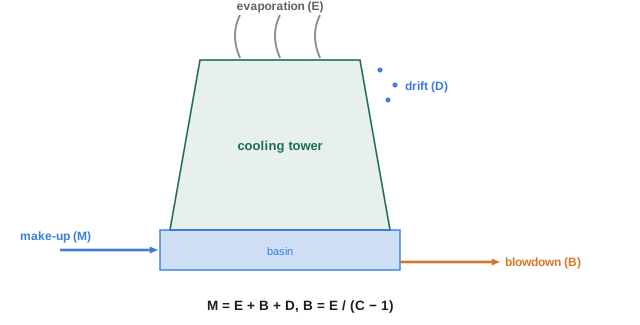
Evaporative systems consume water in three ways. Evaporation is the water that actually removes heat: about 1.5 liters per kWh of heat rejected by evaporation (3600 kJ divided by 2400 kJ/kg). Blowdown is water deliberately drained to stop dissolved minerals from concentrating as water evaporates. Drift is the small fraction carried out of a tower as droplets, typically under 0.005% of circulating flow with modern eliminators. Blowdown is set by the cycles of concentration \(C\), the ratio of dissolved solids in the tower water to those in the make-up water:
where \(E\) is evaporation, \(B\) blowdown, \(D\) drift and \(M\) make-up. Raising the cycles from 3 to 6 cuts blowdown from half the evaporation to a fifth, which is why water treatment matters for water use, not just equipment protection.
Worked problem
Cooling tower water consumption
Towers reject 5800 kW at full load. Evaporation is 1.5 L per kWh of heat, the cycles of concentration are 4, and drift is negligible. Find the hourly make-up at full load, and the annual make-up if the towers reject an average of 55% of full load over the year.
Show solution
- Evaporation: \(5800 \times 1.5 = 8700\) L/h.
- Blowdown: \(8700/(4 - 1) = 2900\) L/h. Make-up: \(8700 + 2900 = 11{,}600\) L/h.
- Annual: \(11{,}600 \times 0.55 \times 8760 = 55.9\) million liters, about 56,000 m³.
Answer: About 11.6 m³ per hour at full load and about 56,000 m³ per year, the annual consumption of a few hundred households. Raising the cycles of concentration to 6 would cut make-up to about 10,400 L/h.
Water usage effectiveness
The Green Grid's water usage effectiveness (WUE) metric, standardized as ISO/IEC 30134-9, is the annual site water use divided by the IT energy:
Facilities with water-cooled chillers and towers commonly report WUE between about 1 and 2 L/kWh; those using evaporative cooling only on the hottest days report a few tenths; and those with air-cooled chillers, dry coolers or closed-loop liquid cooling can approach zero. A source-based version also counts the water consumed in generating the electricity, which for thermal power plants can be of the same order as on-site water use, and near zero for wind and solar.
Worked problem
Calculating WUE
A facility with an average IT load of 8 MW uses the 56,000 m³ of tower make-up from the previous example plus 4000 m³ for humidification and domestic use. Find its WUE.
Show solution
- Water: 60,000 m³ = 60 million liters.
- IT energy: \(8000 \times 8760 = 70.08\) million kWh.
- WUE \(= 60/70.08 = 0.86\) L/kWh.
Answer: A WUE of about 0.86 L/kWh. Switching to dry coolers with liquid cooling might bring it below 0.1 L/kWh, at the cost of some extra fan energy on hot days.
The water-energy trade-off
Evaporative cooling saves energy: a water-cooled plant uses less electricity than an air-cooled one on hot days, and evaporative pre-cooling lets dry coolers meet loads they otherwise could not. Removing water from the design therefore usually raises PUE somewhat. Whether that is the right choice depends on the local water situation (drought risk, competing uses, groundwater depletion), the carbon intensity and water intensity of the grid, and community expectations. Strategies that reduce the trade-off include warmer facility water (so dry coolers suffice for more hours), hybrid systems that evaporate only on the hottest days, use of non-potable sources such as treated municipal wastewater or harvested rainwater, and heat reuse, which replaces heat rejection altogether by sending warm water to district heating networks, greenhouses or industrial users.
In the US, water rights and withdrawal permits are governed by the states, under prior-appropriation systems in much of the West and riparian systems in much of the East, and data centers usually buy water from municipal utilities whose supply agreements may cap consumption or impose drought restrictions. Discharge of blowdown to sewers must meet the local pretreatment limits under the Clean Water Act. Several water-stressed communities have scrutinized or restricted water-intensive data center cooling.
Worked problem
Comparing water and energy
Replacing evaporative towers with dry coolers would save the 56,000 m³ per year of the earlier example but add 2.5 GWh per year of fan and compressor energy. If the grid's generation consumes about 1.5 L of water per kWh, does the switch reduce total (site plus source) water use?
Show solution
- Source water for the extra energy: \(2.5 \times 10^6 \times 1.5 = 3.75\) million L = 3750 m³.
- Net water saving: \(56{,}000 - 3750 = 52{,}250\) m³ per year.
Answer: Yes: about 52,000 m³ per year saved overall, though the extra 2.5 GWh carries its own carbon emissions and cost. The answer depends strongly on the grid: where generation is largely hydro, wind or solar, the source-water term differs, and hydro reservoirs have their own evaporation losses that some analyses count.
Lesson 2 explains the psychrometrics behind economizer and evaporative performance, and Lesson 12 shows how climate data turn these modes into annual energy and water use.
Common mistakes
MistakeDesigning an economizer around a cold chilled-water temperature.
InsteadEconomizer hours depend on supply and return temperatures; warmer water dramatically extends them.
MistakeUsing direct outdoor air without contamination controls.
InsteadProvide high-grade filtration, humidity limits, gas and smoke monitoring, and automatic switch to recirculation.
MistakeAssuming evaporative cooling works equally well everywhere.
InsteadIts benefit depends on wet-bulb depression; humid climates need mechanical backup.
MistakeCounting only evaporation in water use.
InsteadMake-up = evaporation + blowdown + drift; cycles of concentration control blowdown.
MistakeOptimizing PUE alone.
InsteadConsider water (WUE), carbon and local water stress together; a slightly higher PUE may be the better design.
MistakeForgetting freeze protection in cold climates.
InsteadProtect towers, coils and outdoor piping with glycol loops, heat tracing or drain-down.
Summary and key terms
- Economizers cool with outdoor conditions instead of compressors and are the main route to low PUE.
- Direct air-side economizers bring filtered outdoor air in; indirect ones transfer heat through an exchanger, often with evaporative pre-cooling.
- Water-side economizers use a plate heat exchanger between tower and chilled water: full below T_chws − a_hx − a_t, partial below T_chwr − a_hx − a_t (wet bulb).
- Warmer chilled or facility water extends economizer hours; with warm liquid cooling, dry coolers may suffice year-round.
- Direct evaporative cooling: T_out = T_db − ε(T_db − T_wb); best in dry climates.
- Economizer hours are estimated from hourly or binned weather data; plants are still sized for the design day.
- Tower water: evaporation ≈ 1.5 L/kWh of heat; blowdown = E/(C − 1); make-up = E + B + D.
- WUE = site water (L)/IT energy (kWh); evaporative plants about 1–2 L/kWh, dry systems near zero.
- Water and energy trade off; warmer water, hybrid systems, non-potable sources and heat reuse reduce the conflict.
- Economizer
- A mode or device that cools using outdoor conditions instead of mechanical refrigeration.
- Direct air-side economizer
- A system that supplies filtered outdoor air to the data hall.
- Indirect air-side economizer
- A system that cools hall air through a heat exchanger with outdoor air.
- Water-side economizer
- A heat exchanger that cools chilled water with tower or dry-cooler water.
- Integrated economizer
- Operation in which the economizer pre-cools and chillers trim the remaining load.
- Direct evaporative cooling
- Cooling air by evaporating water into it.
- Effectiveness (evaporative)
- The fraction of the wet-bulb depression achieved by an evaporative cooler.
- Wet-bulb depression
- The difference between dry-bulb and wet-bulb temperatures.
- Blowdown
- Water drained from a tower to limit dissolved solids.
- Cycles of concentration
- The ratio of dissolved solids in tower water to those in make-up water.
- Make-up water
- Water added to replace evaporation, blowdown and drift.
- WUE
- Water usage effectiveness: site water use divided by IT energy.
- Heat reuse
- Using data center waste heat for heating or industrial purposes.
Practice problems
Work each problem on paper first, then reveal the answer to check.
A plant supplies chilled water at 20 °C and returns it at 30 °C, with a 2 K heat exchanger approach and a 4 K tower approach. Find the full and partial economizer limits.
Show answer
Full ≤ 14 °C wet bulb; partial ≤ 24 °C wet bulb.
A direct evaporative cooler with 90% effectiveness treats air at 38 °C dry bulb and 18 °C wet bulb. What is the leaving temperature?
Show answer
38 − 0.9 × 20 = 20 °C.
How much water does a tower evaporate rejecting 3 MW for 24 hours?
Show answer
3000 kW × 24 h × 1.5 L/kWh = 108,000 L.
With evaporation of 6000 L/h and 5 cycles of concentration, find blowdown and make-up.
Show answer
B = 6000/4 = 1500 L/h; M = 7500 L/h.
By what percentage does make-up fall if cycles rise from 3 to 6 (same evaporation)?
Show answer
Make-up = E(1 + 1/(C − 1)): 1.5E vs 1.2E, a 20% reduction.
A facility uses 25,000 m³ of water per year with an average IT load of 4 MW. What is its WUE?
Show answer
25,000,000 L / 35,040,000 kWh = 0.71 L/kWh.
Why does direct outdoor-air cooling need smoke detection at the intakes?
Show answer
Wildfire or nearby smoke would be drawn into the hall, contaminating equipment and triggering fire detection; dampers must close and the system switch to recirculation.
Give two reasons warm-water liquid cooling reduces water use.
Show answer
Dry coolers can reject heat at facility water temperatures above outdoor dry-bulb for most hours, so no evaporation is needed; and chillers (whose towers evaporate water) are rarely or never needed.
A site has 7200 hours with wet bulb below its full-economizer limit. What fraction of the year is that?
Show answer
7200/8760 = 82%.
What does source-based WUE add to site WUE?
Show answer
The water consumed in generating the electricity the facility uses.
Lesson quiz · 5 questions
Score 60% or more to complete this lesson.
Create a free account to save your progress, take quizzes and earn a certificate.