
CON-140 · Lesson 2 of 12 · 27 min
The US code system: model codes, state adoption and local amendments
The United States has no national building code. Building regulation is a power of the states, which may set a statewide code, delegate the choice to cities and counties, or both. In practice almost every jurisdiction bases its rules on the model codes published by the International Code Council, but the edition adopted and the local amendments vary widely. A construction manager working in several states quickly learns that the same building may face different rules in Austin, Denver, Chicago and New York City. This lesson maps the US system: who writes the model codes, how states and local governments adopt and amend them, and how federal rules and other model codes fit around them.
Knowing the system matters for practical reasons. It tells you where to find the code that applies, who can interpret it, who can grant a modification or approve an alternative, and when a new edition will take effect. It also explains why a code question that seems simple, such as whether a building needs sprinklers, can have different answers in neighboring cities.
The International Code Council and the I-codes
The International Code Council is a non-profit membership association formed in 1994 from the three regional code bodies. It publishes a coordinated family of model codes, called the I-codes, on a three-year cycle: 2015, 2018, 2021, 2024 and so on. Code changes are proposed by anyone, debated at public hearings and decided by votes, with final votes cast by governmental members such as building and fire officials. The ICC also certifies code officials, runs the ICC Evaluation Service, which evaluates new products, and publishes commentary that explains the intent of provisions.
The main I-codes are listed below. The 2024 editions are the newest full set; adoption of each edition takes years, so in any given year jurisdictions across the country are using the 2015, 2018, 2021 and 2024 editions.
| Model code | Scope | Notes |
|---|---|---|
| International Building Code (IBC) | All buildings except detached one- and two-family dwellings and townhouses within the IRC scope | Core document for commercial projects |
| International Residential Code (IRC) | Detached one- and two-family dwellings and townhouses up to three stories | Combines building, plumbing, mechanical, electrical and energy rules |
| International Fire Code (IFC) | Fire safety in buildings in use, fire protection systems, hazardous materials | Enforced by fire officials |
| International Energy Conservation Code (IECC) | Energy efficiency, commercial and residential provisions | ASHRAE 90.1 is an alternative path for commercial buildings |
| International Existing Building Code (IEBC) | Repairs, alterations, additions and changes of occupancy | Used for renovations |
| International Plumbing and Mechanical Codes (IPC, IMC) | Plumbing and mechanical systems | Some states use the Uniform Plumbing and Mechanical Codes instead |
| National Electrical Code (NFPA 70) | Electrical installations | Published by NFPA; the 2026 edition is the newest |
State adoption
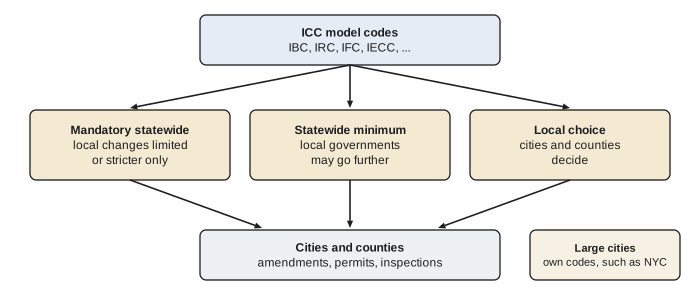
Each state decides how building codes are adopted, and the approaches fall into three broad patterns.
- Mandatory statewide codes: the state adopts a code that applies everywhere and local governments may not weaken it. Some allow local amendments that make it stricter; others allow no local changes at all.
- Statewide minimum codes: the state sets a minimum code and local governments may adopt stricter rules or more recent editions.
- Local choice: in a few states, mostly in rural areas, there is no statewide building code for some or all building types, and cities and counties decide whether to adopt a code at all. Some unincorporated areas have no building code for houses.
Most states use a statewide building code based on the IBC, but the edition varies. In recent years some states have adopted the 2024 IBC while others remain on the 2018 or 2021 editions, and a few still use older editions for some building types. States also amend the model code. California publishes its own California Building Standards Code, Title 24 of the California Code of Regulations, which is based on the IBC but has extensive state changes. New York State has its own Uniform Fire Prevention and Building Code, and New York City has its own construction codes based on the IBC but heavily modified. Florida publishes the Florida Building Code, with special high-velocity hurricane zone provisions for Miami-Dade and Broward counties.
Local adoption and amendments
Cities and counties usually enforce the building code through a building department headed by a building official. Where state law allows, they adopt the model code by ordinance, often with local amendments that respond to local conditions such as high wind, seismic risk, wildfire, flooding or local fire department equipment. Local amendments can be extensive: some cities require sprinklers in buildings smaller than the IBC threshold, require higher roof live loads in snow country or limit combustible construction. A construction manager must obtain the adopting ordinance and the list of amendments, not just the model code, because the amendments are often where the surprises lie. Many building departments publish their amendments and code interpretations on their websites.
Because each local government enforces the code, interpretations can differ. Building officials may read a provision differently, and the IBC requires a board of appeals to hear appeals of the building official's decisions on the interpretation of the code. The ICC publishes official interpretations and commentary, and building departments often issue their own written policies for common questions.
Federal rules and other model codes
The federal government does not regulate private building construction generally, but several federal laws apply to buildings. The Americans with Disabilities Act requires accessible design in public accommodations, commercial facilities and state and local government buildings, as Lesson 9 explains. The Fair Housing Act requires accessible design in many multifamily dwellings. Federal agencies follow their own standards for federal buildings, and federal funding often carries requirements, such as energy standards or flood plain rules. Workplace safety on construction sites is regulated by OSHA, and environmental laws such as the Clean Water Act and NEPA affect many sites.
Other model codes also appear in US projects. NFPA 101, the Life Safety Code, is adopted in some states and is required for hospitals and nursing homes that receive Medicare and Medicaid funding, so health care projects often must satisfy both the IBC and NFPA 101. NFPA 1, the Fire Code, is used instead of the IFC in some states. State elevator, boiler and electrical regulations often have their own permits and inspectors. A construction manager on a hospital project must coordinate the local building official, the state health department and sometimes federal surveyors.
Worked problem
Finding the code for a project in a new city
A contractor based in Texas wins a contract for a two-story medical office in Fort Collins, Colorado. The project manager wants to know which documents to obtain before preconstruction meetings.
Show solution
- Building code: the state of Colorado does not mandate a single building code for most private buildings, so check the City of Fort Collins adopting ordinance for the IBC edition and local amendments.
- Energy: confirm the IECC edition the city has adopted and any local amendments; Colorado law requires local governments that update their codes to adopt at least a recent IECC edition and model electric-ready and solar-ready provisions.
- Fire: the IFC edition adopted by the local fire authority, with local amendments.
- Electrical: Colorado adopts the NEC statewide through the State Electrical Board, so the electrical code edition may differ from the building code edition.
- Plumbing: Colorado adopts a state plumbing code, with permits and inspections by local or state inspectors.
- Accessibility: the ADA 2010 Standards apply in addition to the IBC Chapter 11 and ICC A117.1 edition referenced by the adopted IBC.
Answer: Obtain the city's adopting ordinances for the building, energy and fire codes with local amendments, the state electrical and plumbing codes, and the ADA 2010 Standards.
Uniformity and its limits
The ICC model codes give the United States a common technical basis, but differences remain large. Editions lag by years in many places, local amendments are common and some states write their own codes based on the I-codes. Federal programs have encouraged adoption of current codes, particularly energy codes and hazard-resistant provisions, through grants and disaster mitigation funding. Insurance ratings also matter: the ISO Building Code Effectiveness Grading Schedule rates how well communities adopt and enforce codes, and better ratings can lower property insurance premiums.
For construction managers the lesson is simple: never assume the rules from your last project apply to the next one. Build a short code summary at the start of each project listing the adopted codes, editions, amendments, referenced standards that matter most and the authorities responsible for each permit.
Worked problem
Building a project code summary
Prepare a one-page code summary for a three-story mixed-use building with shops at grade and apartments above, to be built in a city you know. What headings should it contain?
Show solution
- Project data: address, legal description, zoning, permit application date.
- Governing codes: building code and edition with local amendments, IRC or IBC scope, fire code, energy code, plumbing, mechanical and electrical codes.
- Key standards: sprinklers, fire alarm, accessibility, structural materials, with editions.
- Authorities: building department, fire marshal, state electrical board or local electrical inspector, health department, utilities.
- Special conditions: flood plain, heritage designation, airport zoning, wildfire interface, seismic or high-wind zone.
- Transition rules and any variances, alternative solutions or approvals already obtained.
Answer: A one-page summary listing codes and editions, key standards, authorities, special conditions and approvals, kept at the front of the project file and updated as permits are issued.
Reading an adopting ordinance
An adopting ordinance usually has three parts: a section adopting the model code by title and edition, a list of amendments, often as insertions, deletions and replacements of specific sections, and administrative provisions, such as fee schedules and effective dates. Read the amendments carefully against the model code text, because a one-line change can alter a threshold, for example lowering the area at which sprinklers are required or adding a requirement for a local fire department connection type. Check whether the jurisdiction also adopts appendices, which are not part of the code unless specifically adopted, and whether state amendments apply before local ones. Many departments publish code interpretations and policy memos explaining how they apply particular provisions. A short note in the project code summary recording each of these sources saves time when a question arises on site.
Common mistakes
MistakeAssuming the code from your last state applies in the next one.
InsteadCheck the state and local adoption, edition and amendments for every project.
MistakeReading the model code without the local amendments.
InsteadObtain the adopting legislation or ordinance and the list of amendments.
MistakeForgetting that electrical, plumbing, elevator and gas work have separate codes and permits.
InsteadList every permit and authority in the project code summary.
MistakeThinking every city may freely amend the code.
InsteadSome states prohibit local amendments or allow only stricter ones; check state law.
MistakeIgnoring adoption dates and transition periods.
InsteadConfirm the edition in force on the permit application date and any transition rules.
Summary and key terms
- Building regulation is a state responsibility; cities and counties usually enforce it.
- The ICC publishes the I-codes on a three-year cycle; the 2024 editions are the newest.
- States adopt mandatory statewide codes, minimum codes or leave the choice to local governments.
- The National Electrical Code is an NFPA standard adopted by states and cities.
- Editions and amendments differ widely between jurisdictions.
- Federal laws such as the ADA and the Fair Housing Act add accessibility requirements.
- A one-page project code summary prevents costly assumptions.
- NRC
- National Research Council of Canada, publisher of the Canadian model codes.
- CBHCC
- Canadian board overseeing national code development in Canada.
- ICC
- International Code Council, publisher of the I-codes.
- Code cycle
- The regular interval between new editions of a model code.
- Amendment
- A change made to a model code when it is adopted.
- Adopting ordinance
- A local law that adopts a code and its amendments.
- Chief building official
- The official responsible for enforcing the building code in a municipality.
- Board of appeals
- A body that hears appeals of building official decisions.
- Intent statement
- An explanation of the purpose of a code provision.
- Harmonization
- Reducing differences between jurisdictions' codes.
Practice problems
Work each problem on paper first, then reveal the answer to check.
Which level of government holds the power to regulate building construction in the US?
Show answer
The states, which may delegate to local governments.
Name two states that publish their own building codes based on the IBC.
Show answer
California (Title 24) and Florida (the Florida Building Code); New York also has its own uniform code.
Which document governs detached houses under the I-codes?
Show answer
The International Residential Code.
Why must you check electrical code editions separately?
Show answer
Electrical codes are published by different bodies and adopted on their own schedules, often by a different authority.
Why does a 2026 project in one state possibly use the 2018 IBC?
Show answer
Each state adopts editions on its own schedule, and some remain on older editions for years.
What is the role of a board of appeals under the IBC?
Show answer
It hears appeals of the building official's decisions on code interpretation.
List four headings of a project code summary.
Show answer
Governing codes and editions, key standards, authorities and special conditions; also approvals obtained.
Why might a hospital project need to meet NFPA 101 as well as the IBC?
Show answer
Federal Medicare and Medicaid rules require compliance with NFPA 101 for health care facilities.
Who sets ISO Building Code Effectiveness Grading ratings and why do they matter?
Show answer
ISO rates communities' code adoption and enforcement; better ratings can lower insurance premiums.
Why should you not assume your last project's rules apply?
Show answer
Editions, amendments and authorities differ between jurisdictions and change over time.
Lesson quiz · 5 questions
Score 60% or more to complete this lesson.
Create a free account to save your progress, take quizzes and earn a certificate.