
CON-140 · Lesson 2 of 12 · 27 min
The Canadian code system: national model codes and provincial adoption
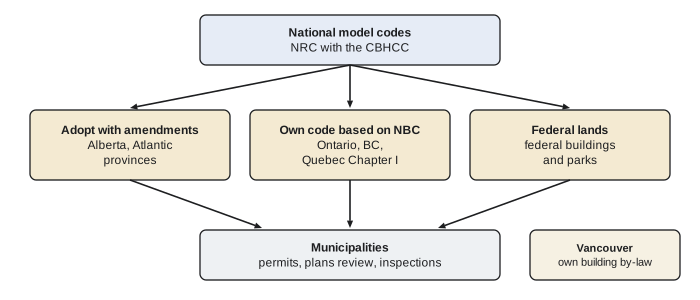
Canada has no single national building law. Under the Constitution, building regulation falls to the provinces and territories, which may delegate enforcement to municipalities. What Canada does have is a set of national model codes that most jurisdictions adopt, with changes, as their own. A construction manager working in more than one province quickly learns that the same building may face different rules in Vancouver, Calgary, Toronto and Montréal, even though all of those rules grow from the same national documents. This lesson maps the Canadian system: who writes the model codes, how they are adopted, how provinces and cities change them, and how federal and other regulations fit around them.
Knowing the system matters for practical reasons. It tells you where to find the code that applies, who can interpret it, who can grant a variance or approve an alternative solution, and when a new edition will take effect. It also explains why a code question that seems simple, such as how high a guard must be, can have different answers in neighbouring provinces.
The national model codes
The National Research Council of Canada publishes the national model codes, which are developed through a consensus process overseen by the Canadian Board for Harmonized Construction Codes (CBHCC). The board, created in 2020 in response to efforts to reduce differences between provinces, includes representatives of the provinces and territories, and its standing committees of volunteers from industry, government and the public review and approve technical changes. New editions have appeared roughly every five years, and the governments have committed to adopting the national codes more consistently and with fewer variations.
The main national model codes are listed below. The 2025 editions were released at the end of 2025, after the 2020 editions, and provinces will adopt them on their own schedules over the following years.
| Model code | Scope | Notes |
|---|---|---|
| National Building Code of Canada (NBC) | Design and construction of new buildings and many alterations | Parts 3 and 9 are the core of most code reviews |
| National Fire Code of Canada (NFC) | Fire safety in buildings in use, fire protection system maintenance, hazardous materials | Enforced by fire officials; overlaps with HSE-105 |
| National Plumbing Code of Canada (NPC) | Plumbing systems: drainage, venting and water supply | Adopted directly or through provincial plumbing codes |
| National Energy Code of Canada for Buildings (NECB) | Energy efficiency of buildings other than houses and small buildings | Tiered performance levels since 2020 |
| Canadian Electrical Code (CSA C22.1) | Electrical installations | Published by CSA Group and adopted by provinces, not part of the NRC set |
Provincial and territorial adoption
Each province and territory adopts building codes through its own legislation, and the approach varies.
- Some provinces adopt the NBC with provincial amendments by regulation and publish their own edition: Alberta publishes the National Building Code (Alberta Edition), and Saskatchewan, Manitoba and the Atlantic provinces adopt the national codes with amendments.
- Some provinces write their own code based on the NBC. The Ontario Building Code, a regulation under the Building Code Act, 1992, follows the NBC's structure but contains many Ontario-specific provisions. The British Columbia Building Code follows the NBC closely with BC changes, and Quebec adopts the NBC with its own amendments as Chapter I of the Quebec Construction Code.
- Some cities have their own authority. The City of Vancouver adopts its own Vancouver Building By-law under the Vancouver Charter, and federal lands, such as national parks and some federal buildings, follow federal rules rather than provincial codes.
Adoption dates differ too. After the 2020 national codes were published, provinces adopted them between 2022 and 2025, often with transition periods during which designers could use either edition. British Columbia's 2024 code took effect on 8 March 2024, Alberta's 2023 edition on 1 May 2024, and Ontario's 2024 code, filed as O. Reg. 163/24, on 1 January 2025, with a transition to the end of March 2025 for designs substantially complete before that date. Quebec's Chapter I, based on an amended NBC 2015, took effect in 2022 after a transition period, so a Quebec project in 2026 may still be governed by an older base edition than one in Alberta.
Municipal enforcement
In most provinces, municipalities enforce the building code. They appoint a chief building official and inspectors, review applications, issue permits, carry out inspections and issue occupancy permits. Municipalities generally cannot change the technical requirements of the provincial code, which applies uniformly across the province, although they set fees, administrative procedures and, through separate by-laws, zoning and other local rules. In Ontario, for example, section 35 of the Building Code Act says the code supersedes municipal by-laws respecting the construction or demolition of buildings, so a city may not impose a stricter energy or fire requirement through a building by-law, but it may regulate land use through zoning. Some smaller municipalities contract inspection services from neighbouring municipalities or from private agencies, and Alberta allows accredited private safety codes agencies to provide permitting and inspection services.
Because each municipality enforces the code, interpretations can still differ. Officials may read a provision differently, and some provinces provide formal routes for resolving disputes, such as Ontario's Building Code Commission, which hears disputes about the technical sufficiency of compliance, and binding rulings from the provincial minister on new materials. Most provinces also issue interpretations and bulletins, and the NRC publishes intent statements explaining the purpose of NBC provisions.
Federal and other regulations
The federal government has no general power over building construction in the provinces, but several federal laws affect buildings. Federal buildings and lands follow federal requirements, which are usually based on the national codes. The Accessible Canada Act applies to federally regulated organizations and is supported by accessibility standards from Accessibility Standards Canada, discussed in Lesson 9. Federal environmental and transport laws, such as the Impact Assessment Act and the Fisheries Act, can affect sites, as Lesson 11 explains. Labour codes set requirements for workplaces, including construction sites, and the provinces enforce occupational health and safety laws on site.
Other provincial rules sit alongside the building code: electrical safety regulations based on CSA C22.1, gas and boiler and pressure vessel regulations, elevator regulations based on CSA B44, fire codes, plumbing codes and, in several provinces, separate energy regulations. Each may have its own permit and inspection, often enforced by a different authority. In Ontario, for example, the Electrical Safety Authority enforces electrical rules, and the Technical Standards and Safety Authority regulates elevators, fuels and boilers.
Worked problem
Finding the code for a project in Alberta
A contractor based in Ontario wins a contract for a two-storey medical office in Red Deer, Alberta. The project manager wants to know which documents to obtain before preconstruction meetings.
Show solution
- Building code: the National Building Code (Alberta Edition) currently in force, adopted under the Safety Codes Act; confirm the edition the permit was applied under.
- Energy: Alberta adopts the NECB and Section 9.36 for houses; confirm the energy code edition and tier requirements, if any.
- Fire: the National Fire Code (Alberta Edition) for the building in use and for fire safety during construction.
- Electrical, plumbing and gas: the Canadian Electrical Code with Alberta amendments, the National Plumbing Code and the gas code, each with separate permits.
- Local: the City of Red Deer's permit procedures, fees and zoning by-law; check whether the city or an accredited agency issues permits.
- Health: no separate provincial building code applies to private medical offices, but owner standards and accreditation bodies may add requirements.
Answer: Obtain the provincial building, fire, energy, electrical, plumbing and gas codes in force with Alberta amendments, plus the city's permit procedures and zoning by-law.
Harmonization and its limits
Differences between provinces add cost, because manufacturers, designers and builders must learn and comply with several versions of the same rules. In 2020 the federal, provincial and territorial governments signed an agreement under the Canadian Free Trade Agreement framework to reduce variations, adopt the national codes more quickly and align adoption dates. The CBHCC was created as part of that effort. Progress has been real but incomplete: provinces still add their own requirements, especially for energy, accessibility and mass timber, and adoption dates still differ by years. British Columbia, for example, allowed encapsulated mass timber construction up to 18 storeys in its 2024 code, while the national code keeps a 12-storey limit for most occupancies and has raised the height limit to 50 m in the 2025 edition.
For construction managers the lesson is simple: never assume the rules from your last project apply to the next one. Build a short code summary at the start of each project listing the adopted codes, editions, amendments, referenced standards that matter most and the authorities responsible for each permit.
Worked problem
Building a project code summary
Prepare a one-page code summary for a three-storey mixed-use building with shops at grade and apartments above, to be built in a city you know. What headings should it contain?
Show solution
- Project data: address, legal description, zoning, permit application date.
- Governing codes: provincial building code and edition, fire code, energy code and edition, plumbing code, electrical code, with amendments.
- Key standards: sprinklers, fire alarm, accessibility, structural materials, with editions.
- Authorities: municipal building department, fire department, electrical safety authority, plumbing inspector, provincial approvals.
- Special conditions: flood plain, heritage designation, airport zoning, wildfire interface, seismic or high-wind zone.
- Transition rules and any variances, alternative solutions or approvals already obtained.
Answer: A one-page summary listing codes and editions, key standards, authorities, special conditions and approvals, kept at the front of the project file and updated as permits are issued.
Reading a provincial code and its amendments
When you open a provincial code, read its introductory pages first. They state which national code edition it is based on, list the provincial changes, and explain how provincial articles are marked. The Alberta and Quebec editions print the NBC text with provincial amendments built in, while Ontario's code has its own numbering in places and should never be read as if it were the NBC. Check the table of revisions for amendments made after first publication: provinces often amend their codes between editions, for example to respond to housing policy, mass timber or energy targets. Finally, check the province's code interpretation bulletins, advisories and any ministerial rulings, which explain how officials apply particular provisions. A short note in the project code summary recording each of these sources saves time when a question arises on site.
Common mistakes
MistakeAssuming the Ontario Building Code applies in other provinces.
InsteadEach province adopts or writes its own code; check the provincial code and edition for every project.
MistakeReading the model code without the local amendments.
InsteadObtain the adopting legislation or ordinance and the list of amendments.
MistakeForgetting that electrical, plumbing, elevator and gas work have separate codes and permits.
InsteadList every permit and authority in the project code summary.
MistakeThinking a city can make the building code stricter through a building by-law.
InsteadIn most provinces the provincial code applies uniformly; cities regulate land use, not technical building requirements.
MistakeIgnoring adoption dates and transition periods.
InsteadConfirm the edition in force on the permit application date and any transition rules.
Summary and key terms
- Building regulation is a provincial and territorial responsibility; municipalities usually enforce it.
- NRC publishes the national model codes under the CBHCC; the 2025 editions followed the 2020 editions.
- Provinces adopt the NBC with amendments or write their own codes based on it, such as the Ontario and British Columbia codes and Quebec's Chapter I.
- The Canadian Electrical Code is a CSA standard adopted by provinces.
- Adoption dates differ by years, with transition periods.
- Federal laws such as the Accessible Canada Act and environmental laws affect some projects.
- A one-page project code summary prevents costly assumptions.
- NRC
- National Research Council of Canada, publisher of the national model codes.
- CBHCC
- Canadian Board for Harmonized Construction Codes, which oversees national code development.
- ICC
- International Code Council, publisher of the I-codes used throughout the US.
- Code cycle
- The regular interval between new editions of a model code.
- Amendment
- A change made to a model code when it is adopted.
- Adopting ordinance
- A local law that adopts a code and its amendments.
- Chief building official
- The official responsible for enforcing the building code in a municipality.
- Board of appeals
- A body that hears appeals of building official decisions.
- Intent statement
- An explanation of the purpose of a code provision.
- Harmonization
- Reducing differences between jurisdictions' codes.
Practice problems
Work each problem on paper first, then reveal the answer to check.
Which level of government is constitutionally responsible for building regulation in Canada?
Show answer
The provinces and territories.
Name two provinces that write their own codes based on the NBC.
Show answer
Ontario and British Columbia; Quebec adopts the NBC with amendments as Chapter I of its Construction Code.
Which city in Canada has its own building by-law?
Show answer
Vancouver.
Why must you check electrical code editions separately?
Show answer
Electrical codes are published by different bodies and adopted on their own schedules, often by a different authority.
What did Ontario's 2024 code change about the governing edition for permits applied for in February 2025?
Show answer
The 2024 code applied from 1 January 2025, but designs substantially complete before then could use the 2012 code during the transition to the end of March 2025.
What does section 35 of Ontario's Building Code Act do?
Show answer
It makes the building code supersede municipal by-laws about construction or demolition.
List four headings of a project code summary.
Show answer
Governing codes and editions, key standards, authorities and special conditions; also approvals obtained.
What is the current mass timber height limit difference between BC and the NBC?
Show answer
BC allows EMTC up to 18 storeys; the NBC keeps 12 storeys for most occupancies, with a 50 m height limit in 2025.
Who regulates elevators in Ontario?
Show answer
The Technical Standards and Safety Authority.
Why should you not assume your last project's rules apply?
Show answer
Editions, amendments and authorities differ between jurisdictions and change over time.
Lesson quiz · 5 questions
Score 60% or more to complete this lesson.
Create a free account to save your progress, take quizzes and earn a certificate.