
CIV-224 · Lesson 3 of 12 · 28 min
Stability, determinacy and support reactions
Before computing a single member force, an engineer asks two questions about the model. Is it stable, meaning that it can resist any set of loads without moving as a mechanism? And is it statically determinate, meaning that the equations of equilibrium alone are enough to find all the reactions and internal forces? The answers decide which methods apply. A determinate structure can be solved by statics in a few lines. An indeterminate structure needs extra equations from compatibility of deformations, the subject of lesson 12. An unstable structure cannot be built as modeled, and spotting one on paper is far cheaper than finding out on site.
Equilibrium of a plane structure
A rigid body loaded in its own plane has three independent equations of equilibrium. The usual set is
where O is any point. Equivalent sets use two or three moment equations, provided the moment centers are not all on one line. Choosing moment centers wisely is the main skill in finding reactions: take moments about a point where two unknown forces intersect, and the equation contains only the third unknown. You can solve for each reaction directly instead of solving simultaneous equations.
Every calculation starts with a free-body diagram. Draw the structure, or the part of it you are isolating, remove the supports, and replace each by the reaction components it provides. Show the applied loads with their magnitudes and positions. Assume a direction for each unknown; a negative answer simply means the actual direction is opposite. Replace distributed loads by their resultants for the purpose of finding reactions, but remember that the resultant is only a convenience for whole-body equilibrium.
Equations of condition: internal hinges
Many structures include internal hinges, where two parts are pinned together so that no moment passes between them. Long-span steel roofs sometimes use cantilevered beams with hinges near the points of zero moment, an arrangement called a Gerber system, and three-hinged arches and frames are common for long spans. Each internal hinge provides one extra equation, because the bending moment there is zero. This equation of condition lets you find one extra reaction. A hinge joining more than two members provides more conditions: a hinge joining n members gives \(n - 1\) equations.
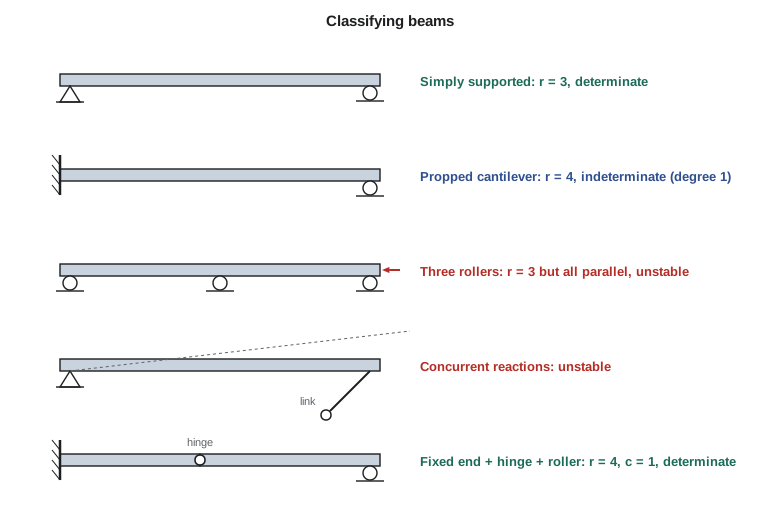
Determinacy of beams and frames
Let r be the number of reaction components and c the number of equations of condition from internal hinges. For a structure made of one or more rigid parts in a plane:
The degree of indeterminacy is \(r - (3 + c)\). A propped cantilever (fixed at one end, roller at the other) has four reactions and no hinges, so it is indeterminate to the first degree. A beam fixed at both ends has six reactions, but if all loads are vertical the horizontal reactions are zero and three of them do not matter, leaving it indeterminate to the second degree for bending.
For frames with rigid joints, the counting is easier if you think of cutting the structure into a tree. Each closed loop of rigidly connected members adds three degrees of indeterminacy, because cutting a member in the loop releases an axial force, a shear and a moment. A single-bay portal frame with fixed bases is indeterminate to the third degree; with pinned bases it is indeterminate to the first degree; and with pinned bases and a hinge at the ridge (a three-hinged frame) it is determinate. A more formal count for frames uses \(3b + r\) unknowns (three internal forces per member plus reactions) against \(3j + c\) equations (three per joint plus conditions), where b is the number of members and j the number of joints.
Geometric instability
Counting is not enough. A structure with enough reactions can still be unstable if they are badly arranged. Two arrangements are always unstable.
- All reactions are parallel. Three rollers on a horizontal surface supply three vertical forces but nothing to resist a horizontal load, so the beam slides away.
- All reactions are concurrent, meaning their lines of action pass through one point. They can resist forces but not a moment about that point, so the structure rotates.
Internal mechanisms are the other trap. If hinges are placed so that part of a structure can move without straining any member, the structure is unstable even though its overall count looks fine. Three hinges in a line within one span, or a hinge with nothing to stop one side from rotating, are typical errors. The test is to imagine the structure made of rigid pieces connected by the hinges and supports, and ask whether any piece can move. If it can, the structure is a mechanism.
Worked problem
Classifying four structures
Classify each structure: (a) a beam with a pin at A and rollers at B and C; (b) a beam fixed at A with an internal hinge at B and a roller at C; (c) a portal frame with fixed bases and rigid knee joints; (d) a beam with pins at both ends and an internal hinge at midspan.
Show solution
- (a) \(r = 2 + 1 + 1 = 4\), \(c = 0\): indeterminate to the first degree (a two-span continuous beam).
- (b) \(r = 3 + 1 = 4\), \(c = 1\): \(r = 3 + c\), so determinate. It is also stable: AB is a cantilever and BC is a simply supported piece hung from it.
- (c) \(r = 3 + 3 = 6\), \(c = 0\): indeterminate to the third degree, consistent with one closed loop.
- (d) \(r = 2 + 2 = 4\), \(c = 1\): count says determinate. Check stability: with pins at both ends the beam is stable under vertical load only through the horizontal reactions, which produce a shallow three-hinged arch with zero rise, so the geometry is unstable in practice (any vertical load at the hinge causes very large deflection and horizontal thrust).
Answer: (a) indeterminate to degree 1; (b) determinate and stable; (c) indeterminate to degree 3; (d) passes the count but is geometrically unstable because the three hinges lie on a straight line.
Finding reactions of determinate structures
With stability and determinacy confirmed, finding reactions is a matter of choosing good equations. Start with a moment equation about a point where as many unknowns as possible pass, then use force equations. For structures with internal hinges, split the structure at the hinge, draw a free body of the simpler part, and use the zero-moment condition there.
Worked problem
Beam with an inclined load and an overhang
Beam ABC has a pin at A, a roller at B 20 ft to the right, and an overhang BC of 6 ft. It carries a uniform load of 0.8 kip/ft over AB and an inclined load of 5 kips at C, acting downward to the left at 60° to the horizontal. Find the reactions.
Show solution
- Resolve the inclined load: vertical \(5 \sin 60° = 4.33\ \text{kips}\) down, horizontal \(5 \cos 60° = 2.50\ \text{kips}\) to the left.
- Moments about A (counterclockwise positive): \(20B_y - 16(10) - 4.33(26) = 0\), so \(B_y = (160 + 112.6)/20 = 13.6\ \text{kips}\).
- Vertical forces: \(A_y = 16 + 4.33 - 13.6 = 6.7\ \text{kips}\).
- Horizontal forces: \(A_x = 2.50\ \text{kips}\) to the right.
- Check with moments about B: \(-20(6.7) + 16(10) - 4.33(6) = -134 + 160 - 26 = 0\). Good.
Answer: \(A_x = 2.50\ \text{kips}\) right, \(A_y = 6.7\ \text{kips}\) up, \(B_y = 13.6\ \text{kips}\) up. The overhang load increases the reaction at B and reduces the one at A.
Worked problem
A Gerber beam with an internal hinge
Beam ABCD is fixed at A, has an internal hinge at B (12 ft from A), and rests on a roller at D. BC is 10 ft and CD is 10 ft, with an 8-kip point load at C. Find all reactions.
Show solution
- Free body of BD (hinge at B transmits shear but no moment): moments about B give \(20D_y = 8(10)\), so \(D_y = 4\ \text{kips}\), and the hinge shear is \(V_B = 8 - 4 = 4\ \text{kips}\).
- Free body of AB: the cantilever carries the hinge force of 4 kips downward at its tip. So \(A_y = 4\ \text{kips}\) up and \(M_A = 4 \times 12 = 48\ \text{kip·ft}\) (counterclockwise on the beam, resisting the clockwise tip load).
- No horizontal loads act, so \(A_x = 0\).
Answer: \(A_y = 4\ \text{kips}\), \(M_A = 48\ \text{kip·ft}\), \(D_y = 4\ \text{kips}\). Splitting at the hinge turned one problem with four unknowns into two easy ones.
Three-hinged frames and arches
A three-hinged frame has pin supports at both bases and a hinge at the crown. It has four reactions (two at each base) and one equation of condition, so it is determinate. It is a popular form for long-span garages and storage buildings because it is determinate, so it does not develop stresses from support settlement or temperature change, and because the horizontal thrusts at the bases reduce the bending moments in the rafters compared with a simple beam.
Worked problem
Reactions of a three-hinged frame
The operations center's salt storage shed uses three-hinged frames. Each has pinned bases A and E 50 ft apart at the same level, a crown hinge C at midspan, and knee points B and D 16 ft above the bases. The rafters BC and CD rise 10 ft to the crown. Under snow, each frame carries 1.0 kip/ft over the full horizontal span. Find the reactions.
Show solution
- Whole frame, moments about A: \(50E_y = 1.0 \times 50 \times 25\), so \(E_y = 25\ \text{kips}\), and by vertical equilibrium \(A_y = 25\ \text{kips}\) (symmetry).
- Free body of the left half ABC, moments about the crown hinge C (25 ft right of A, 26 ft above it): \(A_y(25) - A_x(26) - 1.0 \times 25 \times 12.5 = 0\), with \(A_x\) taken as acting inward.
- \[A_x = \frac{25(25) - 312.5}{26} = 12.0\ \text{kips}\]
- By horizontal equilibrium of the whole frame, \(E_x = 12.0\ \text{kips}\) acting inward.
Answer: Vertical reactions 25 kips and inward thrusts 12.0 kips at each base. The footings must resist that thrust, often with a tie rod buried in the floor slab between them.
A determinacy and reaction calculator
For checking, Sofia writes a small program that classifies a structure from its counts and then solves the three equilibrium equations for a determinate beam with any set of point loads. It uses Gaussian elimination, the same method that structural software uses on a much larger scale.
def classify(r, c, kind="beam/frame", b=0, j=0):
    if kind == "truss":
        n = b + r - 2 * j
    else:
        n = r - (3 + c)
    if n < 0:
        return "unstable (too few restraints)"
    return "determinate" if n == 0 else f"indeterminate to degree {n}"

print("pin + 2 rollers:", classify(4, 0))
print("fixed + hinge + roller:", classify(4, 1))
print("fixed-base portal:", classify(6, 0))
print("truss b=13, r=3, j=8:", classify(3, 0, "truss", 13, 8))

def solve(A, b):
    n = len(b); M = [row[:] + [b[i]] for i, row in enumerate(A)]
    for k in range(n):
        p = max(range(k, n), key=lambda i: abs(M[i][k])); M[k], M[p] = M[p], M[k]
        for i in range(k + 1, n):
            f = M[i][k] / M[k][k]
            for jj in range(k, n + 1): M[i][jj] -= f * M[k][jj]
    x = [0.0] * n
    for i in reversed(range(n)):
        x[i] = (M[i][n] - sum(M[i][jj] * x[jj] for jj in range(i + 1, n))) / M[i][i]
    return x

# Beam: pin at A (x=0) gives Ax, Ay; roller at B (x=6) gives By. Loads (x, Fx, Fy).
loads = [(3.0, 0.0, -72.0), (8.0, -10.0, -17.32)]
A = [[1, 0, 0],          # sum Fx: Ax
     [0, 1, 1],          # sum Fy: Ay + By
     [0, 0, 6.0]]        # sum M about A: 6*By
rhs = [-sum(f[1] for f in loads), -sum(f[2] for f in loads), -sum(f[0] * f[2] for f in loads)]
Ax, Ay, By = solve(A, rhs)
print(f"Ax = {Ax:.2f} kN, Ay = {Ay:.2f} kN, By = {By:.2f} kN")pin + 2 rollers: indeterminate to degree 1 fixed + hinge + roller: determinate fixed-base portal: indeterminate to degree 3 truss b=13, r=3, j=8: determinate Ax = 10.00 kN, Ay = 30.23 kN, By = 59.09 kN
The output matches the overhanging beam example. The same three-equation system, generalized to thousands of equations, is what a frame analysis program solves when you press the run button.
Common mistakes
MistakeConcluding that a structure is stable because \(r \ge 3 + c\).
InsteadAlso check that the reactions are neither all parallel nor all concurrent, and that no part can move as a mechanism.
MistakeTaking moments about a point and including the moment of a force that passes through it.
InsteadA force whose line of action passes through the moment center has zero moment about it.
MistakeForgetting that an internal hinge transmits shear and axial force.
InsteadOnly the moment is zero at a hinge; show the shear and axial force on both free bodies, equal and opposite.
MistakeNot checking reactions with an independent equation.
InsteadTake moments about a second point; it costs a minute and catches most errors.
Summary and key terms
- A plane rigid body has three equilibrium equations; choose moment centers where unknowns intersect.
- Each internal hinge joining two members adds one equation of condition (zero moment).
- For beams and frames: \(r < 3 + c\) unstable, \(r = 3 + c\) determinate, \(r > 3 + c\) indeterminate.
- Parallel or concurrent reactions, and internal mechanisms, make a structure unstable regardless of the count.
- Each closed loop of rigidly connected members adds three degrees of indeterminacy.
- Three-hinged frames and arches are determinate and develop horizontal thrust at their supports.
- Statically determinate
- A structure whose reactions and internal forces follow from equilibrium alone.
- Statically indeterminate
- A structure with more unknown forces than independent equilibrium equations.
- Degree of indeterminacy
- The number of unknowns in excess of the available equilibrium equations.
- Equation of condition
- An extra equation from a release, such as zero moment at an internal hinge.
- Geometric instability
- Instability caused by the arrangement of supports or members rather than their number.
- Mechanism
- A structure, or part of one, that can move without deforming its members.
- Three-hinged frame
- A frame with pinned supports and a crown hinge, making it determinate.
- Gerber beam
- A continuous-looking beam made determinate by internal hinges.
Practice problems
Work each problem on paper first, then reveal the answer to check.
A beam has a fixed support and two rollers. Classify it.
Show answer
\(r = 5\), \(c = 0\): indeterminate to degree 2.
A portal frame has pinned bases and rigid knees. What is its degree of indeterminacy?
Show answer
\(r = 4\), \(c = 0\): degree 1.
Why is a beam on three rollers on a level surface unstable?
Show answer
All reactions are vertical (parallel), so nothing resists a horizontal force.
How many equations of condition does a hinge joining three members provide?
Show answer
Two (one fewer than the number of members joined).
A simply supported 30 ft beam carries a 12-kip load 9 ft from A. Find the reactions.
Show answer
\(B_y = 12(9)/30 = 3.6\ \text{kips}\); \(A_y = 8.4\ \text{kips}\).
What advantage does a three-hinged frame have over a fixed-base portal with respect to settlement?
Show answer
Being determinate, it can accommodate small support movements without developing extra internal forces.
Lesson quiz · 5 questions
Score 60% or more to complete this lesson.
Create a free account to save your progress, take quizzes and earn a certificate.