
CHEM-211 · Lesson 9 of 12 · 24 min
Complexation equilibria and EDTA titrations
Water hardness, the calcium and magnesium that leave scale in kettles and stop soap from lathering, is measured in laboratories across the world by a single reagent: EDTA. The same reagent determines metals in alloys, pharmaceuticals and foods, preserves salad dressings and canned seafood by binding trace metals, treats lead poisoning in medicine, and appears in detergents and photographic chemistry. EDTA titrations are the most important application of complex formation in analytical chemistry. This lesson develops the equilibrium theory of metal complexes, explains why EDTA is so effective and why pH controls everything about its titrations, and shows how hardness and other metals are determined.
Metal–ligand complexes
A metal ion in water is a Lewis acid: it accepts electron pairs. A ligand is a Lewis base that donates one or more electron pairs to the metal to form a complex, or coordination compound. Water itself is a ligand, so Cu²⁺ in water is really Cu(H₂O)₆²⁺, and complex formation is the replacement of water molecules by other ligands. A ligand that binds through one atom is monodentate (NH₃, Cl⁻, CN⁻); one that binds through two or more atoms is multidentate, or a chelating agent, from the Greek for claw.
Complex formation can be described by stepwise formation constants, K₁, K₂, … for adding one ligand at a time, or by overall formation constants βₙ = K₁K₂…Kₙ. For copper(II) and ammonia, four stepwise constants of decreasing size lead to Cu(NH₃)₄²⁺. Because the steps overlap, titrating a metal with a monodentate ligand gives a gradual, poorly defined endpoint, and such titrations are rarely useful. A multidentate ligand that binds in a single step gives one large constant and a sharp endpoint.
The chelate effect
Multidentate ligands form far more stable complexes than equivalent sets of monodentate ligands. Ni²⁺ with one molecule of ethylenediamine (two nitrogen donors) forms a complex about 10⁵ times more stable than with two separate molecules of methylamine, even though the bonds are similar. This chelate effect is largely entropic: binding one multidentate ligand releases several water molecules, increasing the number of free particles. Once one end of a chelate is attached, the other donor atoms are held close to the metal, so they bind readily.
EDTA
Ethylenediaminetetraacetic acid (EDTA) has six potential donor atoms: two amine nitrogens and four carboxylate oxygens. It wraps around a metal ion to form a cage with five-membered chelate rings, binding nearly every metal ion in a 1:1 ratio regardless of the metal's charge. Gerold Schwarzenbach and his colleagues in Zurich developed EDTA titrations in the 1940s, and they rapidly replaced older, cumbersome methods for calcium and magnesium.
The fully protonated acid, H₆Y²⁺, has six acid dissociation constants: pK₁ = 0.0, pK₂ = 1.5, pK₃ = 2.00, pK₄ = 2.69 (the four carboxyl groups) and pK₅ = 6.13, pK₆ = 10.37 (the two ammonium groups). The reagent is usually sold as the disodium salt dihydrate, Na₂H₂Y·2H₂O, which can be dried at 80 °C and used as a primary standard, although many laboratories standardize EDTA against calcium carbonate.
The formation constant Kf refers to the reaction of the metal with the fully deprotonated form Y⁴⁻:
| Metal ion | log Kf | Metal ion | log Kf |
|---|---|---|---|
| Mg²⁺ | 8.79 | Zn²⁺ | 16.50 |
| Ca²⁺ | 10.65 | Pb²⁺ | 18.04 |
| Mn²⁺ | 13.89 | Ni²⁺ | 18.52 |
| Fe²⁺ | 14.30 | Cu²⁺ | 18.78 |
| Al³⁺ | 16.4 | Hg²⁺ | 21.5 |
| Cd²⁺ | 16.5 | Fe³⁺ | 25.1 |
Fraction of EDTA as Y⁴⁻
Only a small fraction of EDTA exists as Y⁴⁻ except at high pH. Using the fractional composition from lesson 7 for a hexaprotic acid,
At pH 10, α_Y⁴⁻ = 0.30; at pH 7, 3.8 × 10⁻⁴; at pH 4, 3.0 × 10⁻⁹. Protons compete with metal ions for EDTA, and at low pH they win.
The conditional formation constant
In a buffered solution, the analyst cares about total free EDTA, [EDTA], not [Y⁴⁻]. Writing [Y⁴⁻] = α_Y⁴⁻[EDTA] gives the conditional (effective) formation constant:
Kf′ applies at a fixed pH and tells us how complete the reaction is under titration conditions. For a sharp endpoint, Kf′ should be at least about 10⁸. Calcium at pH 10 has log Kf′ = 10.65 + log 0.30 = 10.13, comfortably enough. At pH 7 it would be 10.65 − 3.42 = 7.23, marginal. Metals with very large Kf, such as Fe³⁺, Hg²⁺ and Bi³⁺, can be titrated in acidic solution, which provides selectivity: at pH 2 they react completely while calcium and magnesium do not react at all.
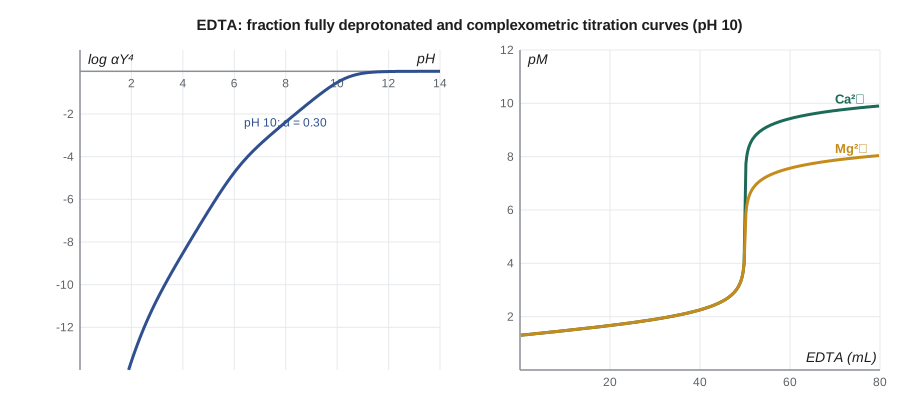
Titration curves
An EDTA titration curve plots pM = −log[M] against volume of EDTA. It has three regions, calculated with Kf′. Before the equivalence point, excess metal remains, and [M] is just the unreacted metal (dissociation of MY is negligible). At the equivalence point, all metal is complexed, and the tiny free [M] comes from the dissociation of MY: [M] = [EDTA] = x, and Kf′ = (C_MY − x)/x². After the equivalence point, there is excess EDTA, and [M] = [MY]/(Kf′[EDTA]). The size of the jump grows with Kf′, which is why it is larger for calcium than for magnesium at the same pH, and larger at higher pH for both.
Worked problem
pCa at the equivalence point
50.00 mL of 0.0500 M Ca²⁺ buffered at pH 10 is titrated with 0.0500 M EDTA. Find pCa at the equivalence point.
Show solution
- Equivalence at 50.00 mL; C_CaY = 0.0500 × 50/100 = 0.0250 M.
- Kf′ = 0.30 × 10^10.65 = 1.34 × 10¹⁰.
- (0.0250 − x)/x² = 1.34 × 10¹⁰, so x ≈ √(0.0250/1.34 × 10¹⁰) = 1.37 × 10⁻⁶ M.
Answer: pCa = 5.86 at the equivalence point; it rises from 3.6 at 49.5 mL to 8.1 at 50.5 mL, a jump of four and a half units for 1 mL of titrant.
import math
pKa = [0.0, 1.5, 2.00, 2.69, 6.13, 10.37]
Ka = [10 ** -p for p in pKa]

def alpha_Y4(pH):
    h = 10 ** -pH
    terms, p = [1.0], 1.0
    for K in Ka:
        p *= K / h
        terms.append(p)
    return terms[-1] / sum(terms)

for pH in (2, 4, 6, 7, 8, 10, 12):
    print(f"pH {pH:2d}: alpha(Y4-) = {alpha_Y4(pH):.2e}, log K' for Ca = {10.65 + math.log10(alpha_Y4(pH)):5.2f}, for Fe(III) = {25.1 + math.log10(alpha_Y4(pH)):5.2f}")

def pM(V, logKf, pH, CM=0.0500, VM=50.0, CY=0.0500):
    Kp = 10 ** logKf * alpha_Y4(pH)
    Vt = VM + V
    cm, cy = CM * VM / Vt, CY * V / Vt
    b = Kp * (cy - cm) + 1                 # Kp M^2 + b M - cm = 0
    M = 2 * cm / (b + math.sqrt(b * b + 4 * Kp * cm))
    return -math.log10(M)

print("V(mL)   pCa    pMg   (pH 10)")
for V in (10, 25, 45, 49.5, 49.9, 50.0, 50.1, 50.5, 55, 70):
print(f"{V:5.1f} {pM(V, 10.65, 10):5.2f} {pM(V, 8.79, 10):5.2f}")pH 2: alpha(Y4-) = 2.56e-14, log K' for Ca = -2.94, for Fe(III) = 11.51 pH 4: alpha(Y4-) = 2.99e-09, log K' for Ca = 2.13, for Fe(III) = 16.58 pH 6: alpha(Y4-) = 1.82e-05, log K' for Ca = 5.91, for Fe(III) = 20.36 pH 7: alpha(Y4-) = 3.76e-04, log K' for Ca = 7.22, for Fe(III) = 21.67 pH 8: alpha(Y4-) = 4.19e-03, log K' for Ca = 8.27, for Fe(III) = 22.72 pH 10: alpha(Y4-) = 2.99e-01, log K' for Ca = 10.13, for Fe(III) = 24.58 pH 12: alpha(Y4-) = 9.77e-01, log K' for Ca = 10.64, for Fe(III) = 25.09 V(mL) pCa pMg (pH 10) 10.0 1.48 1.48 25.0 1.78 1.78 45.0 2.58 2.58 49.5 3.60 3.60 49.9 4.30 4.28 50.0 5.86 4.93 50.1 7.43 5.59 50.5 8.13 6.27 55.0 9.13 7.27 70.0 9.73 7.87
Auxiliary complexing agents
Many metals precipitate as hydroxides at the high pH needed for complete reaction with EDTA. An auxiliary complexing agent, such as ammonia, tartrate or triethanolamine, binds the metal weakly enough to be displaced by EDTA but strongly enough to keep it in solution. The ammonia–ammonium chloride buffer used at pH 10 does double duty, controlling the pH and holding zinc, copper and nickel as ammine complexes. The free metal is then only a fraction α_M of the total metal not bound to EDTA, and a further conditional constant, Kf″ = α_M α_Y⁴⁻ Kf, applies.
Metal ion indicators
A metal ion indicator is a dye that changes color when it binds a metal ion. For a useful endpoint, the metal–indicator complex must be less stable than the metal–EDTA complex, so that EDTA removes the metal from the indicator at the equivalence point, but stable enough that the color change is sharp. Eriochrome Black T (EBT), the classic indicator for hardness, is wine red when bound to Mg²⁺ or Ca²⁺ and blue when free at pH 10:
Calcium binds EBT too weakly for a sharp change on its own, so a little Mg–EDTA is often added to the titrant or buffer: calcium displaces magnesium from the Mg–EDTA, the freed magnesium binds the indicator, and the sharp Mg–EBT endpoint appears exactly when all the calcium and magnesium have been titrated. Calmagite behaves similarly and its solutions are more stable. Murexide and hydroxynaphthol blue are used for calcium alone at pH 12 to 13. Some metals, such as Cu²⁺, Ni²⁺, Co²⁺ and Fe³⁺, bind EBT so strongly that EDTA cannot displace them; they block the indicator, and must be masked or titrated by another technique.
Titration techniques
- Direct titration: the metal, buffered at a suitable pH, is titrated with EDTA to an indicator endpoint. Used for Ca²⁺, Mg²⁺, Zn²⁺ and many others.
- Back titration: a known excess of EDTA is added, and the unreacted EDTA is titrated with a standard Mg²⁺ or Zn²⁺ solution. Used when the analyte reacts slowly (Cr³⁺, Al³⁺), blocks the indicator, or would precipitate at the titration pH before EDTA is added.
- Displacement titration: excess Mg–EDTA is added; the analyte, which forms a more stable EDTA complex, displaces Mg²⁺, which is then titrated. Used for metals without good indicators.
- Indirect titration: anions that precipitate with a metal, such as sulfate with Ba²⁺, can be determined by titrating the excess metal or the metal recovered from the precipitate.
- Masking: a masking agent forms complexes with interfering ions so that they do not react with EDTA. Cyanide masks Cu²⁺, Ni²⁺, Zn²⁺ and Cd²⁺ (with strict safety precautions in a fume hood and at high pH, because acid releases toxic HCN); triethanolamine masks Al³⁺ and Fe³⁺; fluoride masks Al³⁺. Raising the pH to 12 to 13 masks magnesium in a different way, by precipitating it as Mg(OH)₂.
Application: water hardness
Total hardness is the sum of calcium and magnesium, reported as mg/L CaCO₃. A sample is buffered at pH 10 with ammonia–ammonium chloride, EBT or calmagite is added, and the sample is titrated with standard EDTA (typically 0.01 M) from wine red to pure blue. Calcium hardness is found on a separate portion made strongly basic (pH 12 to 13) with NaOH, which precipitates Mg(OH)₂, and titrated with a calcium-selective indicator. Magnesium hardness is the difference.
Worked problem
Total and calcium hardness
A 50.00 mL sample of groundwater from near Mankato, Minnesota, requires 18.62 mL of 0.01000 M EDTA at pH 10 (EBT) and a second 50.00 mL portion requires 12.84 mL at pH 12.5 (hydroxynaphthol blue). Find total, calcium and magnesium hardness as mg/L CaCO₃, and the Ca and Mg concentrations.
Show solution
- Total: 18.62 × 0.01000 = 0.1862 mmol in 50.00 mL = 3.724 mM; × 100.09 = 372.7 mg/L as CaCO₃.
- Calcium: 12.84 × 0.01000 = 0.1284 mmol; 2.568 mM; 257.0 mg/L as CaCO₃, or 2.568 × 40.08 = 102.9 mg/L Ca.
- Magnesium: 3.724 − 2.568 = 1.156 mM; 115.7 mg/L as CaCO₃, or 1.156 × 24.305 = 28.1 mg/L Mg.
Answer: Total hardness 373 mg/L as CaCO₃ (very hard): 257 from calcium and 116 from magnesium.
Hardness has no health-based limit, but it matters for taste, scale, soap use and corrosion. A common classification puts waters below 60 mg/L as CaCO₃ in the soft range, 61 to 120 moderately hard, 121 to 180 hard and above 180 very hard. Many groundwaters on the Canadian Prairies and in Minnesota fall in the hard to very hard range, while surface waters from the Canadian Shield, such as Winnipeg's supply from Shoal Lake, are much softer.
Other applications
EDTA titrations determine zinc in supplements and ointments, calcium in milk, cement and blood serum, aluminum in antacids (by back titration), nickel in plating baths, and sulfate (indirectly through barium). Before automated instruments, clinical laboratories measured serum calcium this way. Today, EDTA is also central to analytical chemistry in less obvious ways: it is the anticoagulant in the lavender-top blood collection tubes used for complete blood counts, because it binds the calcium needed for clotting.
Common mistakes
MistakeUse Kf directly at any pH.
InsteadUse Kf′ = α_Y⁴⁻Kf at the buffer pH; at pH 7 Kf′ for calcium is about 3 × 10³ times smaller than Kf.
MistakeTitrate calcium hardness at pH 10 with EBT alone and expect a sharp endpoint.
InsteadCalcium binds EBT weakly; add Mg–EDTA or titrate total hardness, where magnesium sharpens the endpoint.
MistakeEDTA reacts with M²⁺ and M³⁺ in different ratios.
InsteadEDTA forms 1:1 complexes with nearly all metal ions regardless of charge.
MistakeA metal that blocks the indicator can be titrated directly.
InsteadMask it, use a back titration, or choose another indicator.
MistakeAdd cyanide as a masking agent in acidic solution.
InsteadCyanide must only be used in strongly basic solution in a fume hood; acid releases highly toxic HCN.
MistakeReport hardness as mg/L of Ca + Mg.
InsteadHardness is reported as mg/L CaCO₃, counting each mole of Ca²⁺ or Mg²⁺ as one mole of CaCO₃.
Summary and key terms
- Metal ions are Lewis acids; ligands donate electron pairs; multidentate ligands form chelates.
- The chelate effect, largely entropic, makes multidentate complexes much more stable.
- EDTA forms 1:1 complexes with nearly all metal ions; only the Y⁴⁻ form binds.
- The conditional constant Kf′ = α_Y⁴⁻Kf sets the completeness of the titration at a given pH; log Kf′ ≥ 8 is needed.
- Metal ion indicators such as EBT change color when EDTA removes the metal; some metals block them.
- Direct, back, displacement and indirect titrations and masking extend EDTA methods to many analytes.
- Total hardness is titrated at pH 10 and calcium hardness at pH 12 to 13.
- Ligand
- A molecule or ion that donates an electron pair to a metal ion.
- Chelating agent
- A multidentate ligand that binds a metal through two or more atoms.
- Chelate effect
- The extra stability of complexes with multidentate ligands.
- Formation constant
- The equilibrium constant for formation of a complex from a metal and ligands.
- Conditional formation constant
- The effective formation constant at a particular pH, Kf′ = α_Y⁴⁻Kf.
- Metal ion indicator
- A dye whose color depends on whether it is bound to a metal ion.
- Masking agent
- A reagent that prevents an interfering species from reacting.
- Back titration
- Adding an excess of reagent and titrating the unreacted excess.
Practice problems
Work each problem on paper first, then reveal the answer to check.
Find log Kf′ for Mg²⁺ at pH 10 (α = 0.30) and say whether a direct titration is feasible.
Show answer
log Kf′ = 8.79 − 0.52 = 8.27 ≥ 8; feasible, though the break is smaller than for calcium.
Why can Fe³⁺ be titrated with EDTA at pH 2 in the presence of Ca²⁺?
Show answer
log Kf′ for Fe³⁺ at pH 2 is still above 10, while for Ca²⁺ it is about −3; calcium does not react.
A 25.00 mL Zn²⁺ solution needs 21.36 mL of 0.02000 M EDTA. Find [Zn²⁺].
Show answer
0.4272 mmol/25.00 mL = 0.01709 M.
Aluminum is determined by adding 25.00 mL of 0.05000 M EDTA to the sample and back-titrating with 6.25 mL of 0.05000 M Zn²⁺. Find mmol Al.
Show answer
1.2500 − 0.3125 = 0.9375 mmol Al (25.3 mg).
A 100.0 mL sample needs 9.80 mL of 0.01000 M EDTA for total hardness. Find the hardness and classify the water.
Show answer
0.0980 mmol/0.100 L = 0.980 mM × 100.09 = 98.1 mg/L as CaCO₃; moderately hard.
Why is the calcium hardness titration done above pH 12?
Show answer
Magnesium precipitates as Mg(OH)₂ and no longer reacts, so only calcium is titrated.
Lesson quiz · 5 questions
Score 60% or more to complete this lesson.
Create a free account to save your progress, take quizzes and earn a certificate.