
CHEM-211 · Lesson 11 of 12 · 26 min
Redox titrations and an introduction to electrochemical measurement
Oxidation–reduction reactions give analytical chemistry some of its most versatile titrations. Dissolved oxygen in rivers and lakes, vitamin C in juice, iron in ore and in supplements, the water content of solvents and pharmaceuticals, hydrogen peroxide in disinfectants and available chlorine in bleach are all determined by redox titrations. Electrochemical measurements also give analysts their most common instrument, the pH meter, and a family of ion-selective electrodes. This lesson extends the electrochemistry of CHEM-102 to formal potentials, redox titration curves and indicators, the main redox titrants, and the principles of potentiometry.
Electrode potentials and formal potentials
Recall that the Nernst equation relates the potential of a half-reaction to the activities of the species involved. For aOx + ne⁻ ⇌ bRed at 25 °C,
In real titration media, activity coefficients, complex formation and acid–base reactions shift the effective potential. Iron(III) is complexed by sulfate and chloride more strongly than iron(II), so the Fe³⁺/Fe²⁺ couple in 1 M H₂SO₄ has an effective potential of 0.68 V instead of the standard 0.771 V. The formal potential E°′ is the potential observed when the formal concentrations of oxidized and reduced forms are equal under specified conditions (acid, ionic strength, complexing agents). Analysts use formal potentials with concentrations in the Nernst equation, much as they use conditional constants for EDTA.
| Half-reaction | E° (V) | E°′ (V) and medium |
|---|---|---|
| Ce⁴⁺ + e⁻ ⇌ Ce³⁺ | 1.72 | 1.44 in 1 M H₂SO₄; 1.70 in 1 M HClO₄ |
| MnO₄⁻ + 8H⁺ + 5e⁻ ⇌ Mn²⁺ + 4H₂O | 1.507 | about 1.51 in strong acid |
| Cr₂O₇²⁻ + 14H⁺ + 6e⁻ ⇌ 2Cr³⁺ + 7H₂O | 1.36 | 1.00 in 1 M HCl |
| Fe³⁺ + e⁻ ⇌ Fe²⁺ | 0.771 | 0.68 in 1 M H₂SO₄; 0.70 in 1 M HCl |
| I₃⁻ + 2e⁻ ⇌ 3I⁻ | 0.536 | 0.545 in 0.5 M H₂SO₄ |
| S₄O₆²⁻ + 2e⁻ ⇌ 2S₂O₃²⁻ | 0.08 |
Redox titration curves
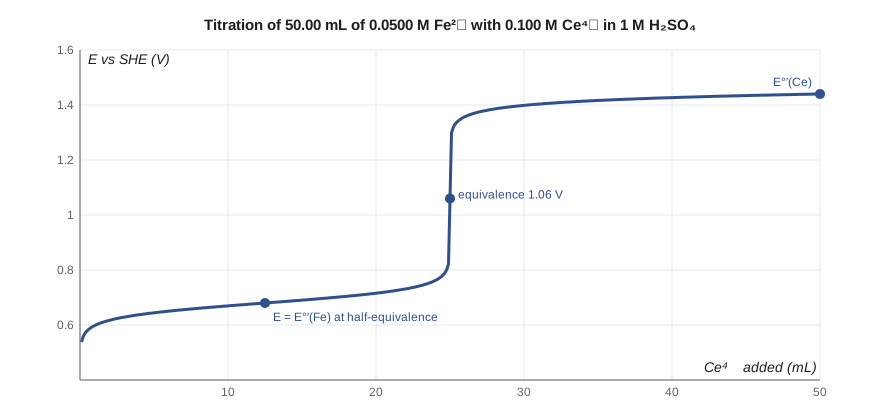
Consider titrating Fe²⁺ with Ce⁴⁺ in 1 M H₂SO₄: Fe²⁺ + Ce⁴⁺ → Fe³⁺ + Ce³⁺, with K = 10^((1.44 − 0.68)/0.05916) ≈ 7 × 10¹², essentially complete. The potential of a platinum electrode in the solution can be calculated from either couple, because at equilibrium they have the same potential.
Before the equivalence point, it is convenient to use the iron couple, because both Fe²⁺ and Fe³⁺ are present in known amounts. At a fraction f of the way to equivalence, [Fe³⁺]/[Fe²⁺] = f/(1 − f), so E = 0.68 − 0.05916 log((1 − f)/f). At the half-equivalence point, E = E°′(Fe) = 0.68 V, the redox analog of pH = pKa.
After the equivalence point, use the cerium couple: all Ce³⁺ formed equals the iron titrated, and the excess Ce⁴⁺ is known, so E = 1.44 − 0.05916 log([Ce³⁺]/[Ce⁴⁺]). At twice the equivalence volume, E = E°′(Ce) = 1.44 V.
At the equivalence point, neither couple alone is convenient, but adding their Nernst equations works because [Fe²⁺] = [Ce⁴⁺] and [Fe³⁺] = [Ce³⁺] there, so the log terms cancel:
The curve is symmetric about the equivalence point when n₁ = n₂, as here, and it is independent of dilution, because only concentration ratios appear. For reactions in which the numbers of electrons differ (such as permanganate, n = 5, with iron, n = 1) or in which H⁺ participates, the equivalence potential is weighted toward the couple with more electrons and depends on pH.
import math
E_Fe, E_Ce = 0.68, 1.44           # formal potentials in 1 M H2SO4 (V vs SHE)
C_Fe, V_Fe, C_Ce = 0.0500, 50.0, 0.100
Veq = C_Fe * V_Fe / C_Ce
for V in (5.0, 12.5, 20.0, 24.0, 24.9, 25.0, 25.1, 26.0, 37.5, 50.0):
    f = V / Veq
    if f < 1:
        E = E_Fe - 0.05916 * math.log10((1 - f) / f)
    elif f > 1:
        E = E_Ce - 0.05916 * math.log10(1 / (f - 1))
    else:
        E = (E_Fe + E_Ce) / 2
    print(f"{V:5.1f} mL Ce(IV): E = {E:.3f} V vs SHE ({E - 0.197:.3f} V vs Ag/AgCl, saturated KCl)")
K = 10 ** ((E_Ce - E_Fe) / 0.05916)
print(f"equilibrium constant = {K:.1e}")
# fraction of Fe2+ left untitrated at the equivalence point
print(f"fraction of Fe2+ unreacted at equivalence = {10 ** ((E_Fe - (E_Fe + E_Ce) / 2) / 0.05916):.1e}")5.0 mL Ce(IV): E = 0.644 V vs SHE (0.447 V vs Ag/AgCl, saturated KCl) 12.5 mL Ce(IV): E = 0.680 V vs SHE (0.483 V vs Ag/AgCl, saturated KCl) 20.0 mL Ce(IV): E = 0.716 V vs SHE (0.519 V vs Ag/AgCl, saturated KCl) 24.0 mL Ce(IV): E = 0.762 V vs SHE (0.565 V vs Ag/AgCl, saturated KCl) 24.9 mL Ce(IV): E = 0.822 V vs SHE (0.625 V vs Ag/AgCl, saturated KCl) 25.0 mL Ce(IV): E = 1.060 V vs SHE (0.863 V vs Ag/AgCl, saturated KCl) 25.1 mL Ce(IV): E = 1.298 V vs SHE (1.101 V vs Ag/AgCl, saturated KCl) 26.0 mL Ce(IV): E = 1.357 V vs SHE (1.160 V vs Ag/AgCl, saturated KCl) 37.5 mL Ce(IV): E = 1.422 V vs SHE (1.225 V vs Ag/AgCl, saturated KCl) 50.0 mL Ce(IV): E = 1.440 V vs SHE (1.243 V vs Ag/AgCl, saturated KCl) equilibrium constant = 7.0e+12 fraction of Fe2+ unreacted at equivalence = 3.8e-07
Detecting the endpoint
The endpoint can be detected potentiometrically with a platinum indicator electrode and a reference electrode, exactly as a pH titration uses a glass electrode, and the derivative and Gran methods of lesson 8 apply. With a color indicator, the indicator is itself a redox couple, In(ox) + ne⁻ ⇌ In(red), whose two forms have different colors; its color changes over about E°′(In) ± 0.05916/n V. The transition range must fall within the steep part of the curve.
| Indicator | Color change (oxidized / reduced) | Transition potential (V) |
|---|---|---|
| Ferroin (tris(1,10-phenanthroline)iron) | pale blue / red | 1.11 (1 M H₂SO₄) |
| Diphenylamine sulfonic acid | red-violet / colorless | 0.85 |
| Methylene blue | blue / colorless | 0.53 (1 M acid) |
| Starch (for iodine) | dark blue complex with I₃⁻ / colorless | specific for iodine |
Ferroin is ideal for the cerium–iron titration, changing at 1.11 V close to the equivalence potential of 1.06 V. Potassium permanganate needs no indicator at all: its intense purple disappears as long as reducing agent remains, and the first excess drop gives a persistent faint pink. Iodine titrations use starch, which forms an intense blue complex with triiodide.
Preparing the analyte
The analyte must be entirely in one oxidation state before the titration. Iron from an ore dissolved in HCl is partly Fe³⁺, so it is pre-reduced to Fe²⁺, classically with tin(II) chloride followed by mercury(II) chloride to remove the excess, a method now avoided because of mercury waste, or with a Jones reductor (amalgamated zinc) or a Walden reductor (silver in HCl) through which the solution is passed. Pre-oxidants such as peroxydisulfate and sodium bismuthate convert manganese, chromium and cerium to their higher states. Any excess pre-reductant or pre-oxidant must be destroyed or removed, because it would react with the titrant.
The main titrants
Potassium permanganate is a powerful, inexpensive oxidant and its own indicator. It is not a primary standard, because it contains traces of MnO₂, which catalyzes its decomposition; solutions are boiled, filtered through sintered glass and standardized against sodium oxalate: 2MnO₄⁻ + 5H₂C₂O₄ + 6H⁺ → 2Mn²⁺ + 10CO₂ + 8H₂O, at about 60 °C. Permanganate titrates Fe²⁺, H₂O₂, oxalate, nitrite and many organic compounds. In chloride solutions it oxidizes some chloride, so iron titrations in HCl add the Zimmermann–Reinhardt reagent (manganese(II) sulfate, phosphoric acid and sulfuric acid) to prevent this.
Cerium(IV), usually as cerium(IV) ammonium sulfate in sulfuric acid, is stable for years, has a single one-electron reduction and does not oxidize chloride readily, making it a versatile replacement for permanganate. Potassium dichromate was once popular because it is a primary standard, but chromium(VI) is a carcinogen, and modern laboratories avoid it where possible.
Iodometry and iodimetry
Iodine is a mild oxidant, and iodide is a mild reductant, which makes the iodine–iodide couple central to a large family of methods. In iodimetry, a reducing analyte, such as ascorbic acid (vitamin C), sulfite or arsenic(III), is titrated directly with a standard triiodide solution (iodine dissolved in KI, because I₂ itself is poorly soluble): I₃⁻ + 2e⁻ → 3I⁻. In iodometry, an oxidizing analyte, such as hypochlorite, copper(II), hydrogen peroxide or dissolved oxygen, is treated with excess iodide, and the iodine released is titrated with standard sodium thiosulfate:
Starch indicator is added near the end of an iodometric titration, when the solution is pale yellow, because a large amount of iodine bound to starch is released only slowly. Thiosulfate is standardized against potassium iodate, a primary standard: IO₃⁻ + 8I⁻ + 6H⁺ → 3I₃⁻ + 3H₂O, so each mole of iodate yields three moles of triiodide and consumes six moles of thiosulfate.
Worked problem
Vitamin C in juice
A 25.00 mL sample of orange juice is titrated with 0.005120 M I₃⁻ to a starch endpoint, requiring 13.84 mL. Ascorbic acid (176.12 g/mol) reacts 1:1 with I₃⁻. Find the vitamin C content in mg per 100 mL.
Show solution
- mol I₃⁻ = 0.01384 × 0.005120 = 7.086 × 10⁻⁵ mol = mol ascorbic acid.
- Mass = 7.086 × 10⁻⁵ × 176.12 = 0.01248 g = 12.48 mg in 25.00 mL.
Answer: 49.9 mg per 100 mL, typical of fresh orange juice.
Dissolved oxygen: the Winkler method
Lajos Winkler published his method for dissolved oxygen in 1888, and it remains the reference against which oxygen sensors are calibrated. A sample bottle is filled without trapping air, and manganese(II) sulfate and an alkaline iodide–azide reagent are added. Oxygen oxidizes the Mn(OH)₂ precipitate to a brown manganese(III) or (IV) oxide hydroxide. The solution is acidified, the oxidized manganese oxidizes iodide to iodine, and the iodine is titrated with thiosulfate. Overall, each O₂ releases two I₂ (as I₃⁻), consuming four thiosulfate ions. The azide destroys nitrite, which would otherwise also oxidize iodide.
Worked problem
Dissolved oxygen
A 200.0 mL portion of a Winkler-treated sample from the Mississippi River requires 9.45 mL of 0.02500 M Na₂S₂O₃. Find the dissolved oxygen in mg/L.
Show solution
- mol S₂O₃²⁻ = 9.45 × 10⁻³ × 0.02500 = 2.363 × 10⁻⁴ mol.
- mol O₂ = ¼ × 2.363 × 10⁻⁴ = 5.906 × 10⁻⁵ mol = 1.890 mg.
- In 0.2000 L: 9.45 mg/L.
Answer: 9.45 mg/L O₂, a healthy level for fish; many aquatic life guidelines set minimums near 5 to 6.5 mg/L for warm water and higher for cold-water species.
# Iodometric calculations: standardization, vitamin C, Winkler dissolved oxygen
M_KIO3, M_asc, M_O2 = 214.00, 176.12, 31.998

# 1. standardize thiosulfate: 0.1070 g KIO3 in 250.0 mL; 25.00 mL aliquot + excess KI + acid
n_IO3 = 0.1070 / M_KIO3 * 25.00 / 250.0          # mol iodate in the aliquot
n_thio = 6 * n_IO3                               # IO3- -> 3 I3- -> 6 S2O3 2-
V = 19.87e-3                                     # L of thiosulfate used
c_thio = n_thio / V
print(f"thiosulfate concentration = {c_thio:.5f} M")

# 2. vitamin C with triiodide (1:1)
c_I3, V_I3, V_juice = 0.005120, 13.84e-3, 25.00e-3
mg_per_100mL = c_I3 * V_I3 * M_asc * 1000 / V_juice * 0.100
print(f"vitamin C = {mg_per_100mL:.1f} mg per 100 mL")

# 3. Winkler: 4 thiosulfate per O2
for V_t in (9.45, 6.10, 3.20):
    mg_L = V_t * 1e-3 * 0.02500 / 4 * M_O2 * 1000 / 0.2000
print(f"{V_t:5.2f} mL titrant -> DO = {mg_L:.2f} mg/L")thiosulfate concentration = 0.01510 M vitamin C = 49.9 mg per 100 mL 9.45 mL titrant -> DO = 9.45 mg/L 6.10 mL titrant -> DO = 6.10 mg/L 3.20 mL titrant -> DO = 3.20 mg/L
The last three lines reveal a deliberate design choice in standard methods: with 0.0250 M thiosulfate and a 200 mL portion, each milliliter of titrant corresponds to almost exactly 1 mg/L of dissolved oxygen, so field staff can read the result directly from the burette.
Karl Fischer titration of water
Karl Fischer introduced his reagent for water in 1935, and it is now the standard method for moisture in pharmaceuticals, foods, oils, plastics and solvents. In an alcohol solvent with a base, iodine oxidizes sulfur dioxide in a reaction that consumes exactly one mole of water per mole of iodine. In volumetric Karl Fischer titration the reagent contains iodine; in coulometric titration iodine is generated electrically at an electrode, and the charge passed, through Faraday's law, gives the water content down to micrograms. The endpoint is detected electrochemically by the first excess of iodine. Modern reagents replaced the original pyridine with less toxic imidazole.
Potentiometry: measuring with electrodes
Potentiometry measures the potential of an electrochemical cell with almost no current flowing. The cell consists of a reference electrode, whose potential is constant, and an indicator electrode, whose potential depends on the activity of the analyte. The standard hydrogen electrode defines zero but is impractical, so laboratories use the silver–silver chloride electrode (0.197 V versus SHE in saturated KCl) or the saturated calomel electrode (0.241 V, now less common because it contains mercury). A salt bridge or porous junction connects the reference electrode to the sample.
Indicator electrodes are of two kinds. Metallic electrodes, such as platinum, respond to the ratio of oxidized and reduced species in solution and are used for redox titrations; a silver wire responds to Ag⁺ and is used for argentometric titrations. Ion-selective electrodes (ISEs) respond selectively to one ion through a membrane. The glass pH electrode, the most widely used ISE, has a thin glass membrane whose surfaces exchange H⁺ with the solutions on each side; the potential difference across it depends on the ratio of hydrogen-ion activities. Its response follows
at 25 °C, where β, the electromotive efficiency, is close to 1. The constant and β are found by calibrating with two or more standard buffers that bracket the sample pH. Common errors include an alkaline (sodium) error above about pH 11, an acid error below pH 1, drifting junction potentials in samples of very different ionic strength, and slow response in cold or poorly buffered samples such as rainwater.
The fluoride electrode, with a lanthanum fluoride crystal membrane, is used to monitor fluoride in drinking water. A total ionic strength adjustment buffer (TISAB) is added to standards and samples alike: it fixes the ionic strength, so the electrode responds in proportion to concentration, buffers the pH near 5.5 to prevent formation of HF and interference from OH⁻, and contains a complexing agent that releases fluoride bound to aluminum and iron.
The EPA maximum contaminant level for fluoride is 4.0 mg/L, with a secondary standard of 2.0 mg/L; the U.S. Public Health Service has recommended 0.7 mg/L for community fluoridation since 2015. In January 2026 the EPA announced an expedited review of its fluoride assessment. Laboratories measure fluoride by ion-selective electrode or ion chromatography.
Common mistakes
MistakeUse E° for iron in sulfuric acid titrations.
InsteadUse the formal potential, 0.68 V in 1 M H₂SO₄, which includes complexation.
MistakeThe equivalence potential is always the average of the two E°′ values.
InsteadOnly when n₁ = n₂; otherwise weight each by its number of electrons.
MistakeAdd starch at the start of an iodometric titration.
InsteadAdd it near the end, when the iodine color is faint, or iodine binds strongly and releases slowly.
MistakeUse permanganate as a primary standard.
InsteadIt contains MnO₂ and decomposes; standardize against sodium oxalate.
MistakeCalibrate a pH meter with one buffer far from the sample pH.
InsteadUse at least two buffers bracketing the sample pH.
MistakeMeasure fluoride with an ISE without TISAB.
InsteadTISAB fixes ionic strength and pH and frees complexed fluoride.
Summary and key terms
- Formal potentials include the effects of the medium and are used with concentrations in the Nernst equation.
- Before equivalence the analyte couple sets E; after, the titrant couple; at equivalence E = (n₁E₁°′ + n₂E₂°′)/(n₁ + n₂).
- Redox indicators change over about E°′ ± 0.059/n V; permanganate is self-indicating and starch detects iodine.
- Permanganate (standardized with oxalate), cerium(IV) and iodine/thiosulfate (standardized with iodate) are the main titrants.
- The Winkler method determines dissolved oxygen; Karl Fischer titration determines water.
- Potentiometry uses a reference electrode and an indicator electrode; the glass pH electrode and fluoride ISE are calibrated with standards.
- Formal potential
- The potential of a half-reaction when oxidized and reduced forms are at equal formal concentration in a specified medium.
- Redox indicator
- A compound whose oxidized and reduced forms have different colors.
- Iodimetry
- Direct titration of a reducing analyte with standard iodine (triiodide).
- Iodometry
- Titration with thiosulfate of the iodine released when an oxidizing analyte reacts with excess iodide.
- Pre-reduction
- Converting the analyte completely to its lower oxidation state before titration.
- Reference electrode
- An electrode with a constant, known potential.
- Ion-selective electrode
- An indicator electrode that responds selectively to one ion through a membrane.
- TISAB
- Total ionic strength adjustment buffer, used with fluoride electrodes.
Practice problems
Work each problem on paper first, then reveal the answer to check.
Find E when 10.00 mL of 0.100 M Ce⁴⁺ has been added to 50.00 mL of 0.0500 M Fe²⁺.
Show answer
f = 0.40; E = 0.68 − 0.05916 log(0.60/0.40) = 0.670 V.
Find the equivalence potential for MnO₄⁻ (E°′ 1.51 V, n = 5) titrating Fe²⁺ (0.68 V, n = 1), ignoring pH effects.
Show answer
(5 × 1.51 + 0.68)/6 = 1.37 V.
0.1510 g Na₂C₂O₄ requires 24.62 mL KMnO₄. Find c(KMnO₄).
Show answer
mol oxalate = 1.1269 × 10⁻³; mol MnO₄⁻ = 2/5 of that = 4.507 × 10⁻⁴; ÷ 0.02462 L = 0.01831 M.
A 2.000 g bleach sample is treated with excess KI and acid; the iodine requires 32.40 mL of 0.1000 M thiosulfate. Find the mass fraction of NaOCl.
Show answer
OCl⁻ → I₃⁻ → 2S₂O₃²⁻; mol OCl⁻ = 1.620 × 10⁻³; × 74.44 = 0.1206 g; 6.03 %.
Why does the Winkler reagent contain azide?
Show answer
To destroy nitrite, which would otherwise oxidize iodide and give high results.
A pH electrode reads 177.0 mV in pH 4.00 buffer and 0.0 mV in pH 7.00 buffer. Find β and the pH of a sample at 52.0 mV.
Show answer
Slope 59.0 mV/pH; β = 59.0/59.16 = 0.997; pH = 7.00 − 52.0/59.0 = 6.12.
Lesson quiz · 5 questions
Score 60% or more to complete this lesson.
Create a free account to save your progress, take quizzes and earn a certificate.