
CHEM-211 · Lesson 10 of 12 · 29 min
Precipitation titrations and gravimetric analysis
Some of the most accurate measurements in chemistry are made by forming an insoluble compound. In gravimetric analysis, the analyte is converted to a pure precipitate of known composition, which is filtered, dried and weighed; the result depends only on masses and atomic weights. In a precipitation titration, the analyte is titrated with a reagent that forms an insoluble product, and the endpoint is detected when precipitation is complete. Theodore Richards's atomic weight determinations, which earned the 1914 Nobel Prize in Chemistry, were gravimetric and precipitation measurements of extraordinary care, and the chloride content of seawater was for decades defined by titration with silver nitrate. This lesson builds on the solubility equilibria from CHEM-102 and the activity and systematic treatment from lesson 6.
Precipitation titrations with silver
Silver nitrate titrations of halides and thiocyanate are known collectively as argentometric titrations. The reaction Ag⁺ + Cl⁻ → AgCl(s) has an equilibrium constant of 1/Ksp = 5.6 × 10⁹, large enough for a sharp endpoint. A titration curve plots pX = −log[X⁻] (or pAg) against the volume of titrant. Before the equivalence point, [Cl⁻] is the unreacted chloride (diluted); at the equivalence point, [Ag⁺] = [Cl⁻] = √Ksp; after it, [Cl⁻] = Ksp/[Ag⁺], where [Ag⁺] is the excess silver. An exact single expression comes from the mass balance on silver and chloride together with Ksp, as in the code below.
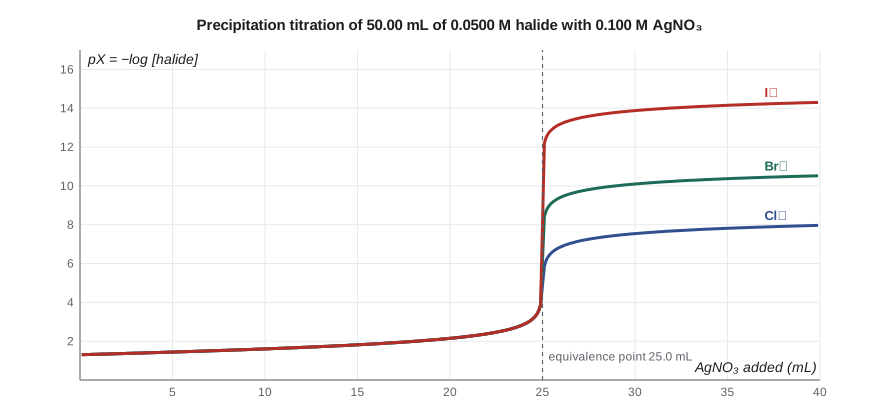
The size of the break depends on Ksp: AgI (Ksp = 8.3 × 10⁻¹⁷) gives a much larger break than AgCl (1.8 × 10⁻¹⁰). In a mixture of iodide and chloride, iodide precipitates first, and the titration curve shows two breaks. Because some chloride coprecipitates with AgI near the first equivalence point, the first break is slightly blurred, but potentiometric titration with a silver electrode separates the two well enough for many purposes.
Worked problem
pCl during a titration
50.00 mL of 0.0500 M NaCl is titrated with 0.100 M AgNO₃. Find pCl after 10.00, 25.00 and 30.00 mL.
Show solution
- 10.00 mL: Cl⁻ left = 2.500 − 1.000 = 1.500 mmol in 60.00 mL = 0.0250 M; pCl = 1.60.
- 25.00 mL (equivalence): [Cl⁻] = √(1.8 × 10⁻¹⁰) = 1.34 × 10⁻⁵ M; pCl = 4.87.
- 30.00 mL: excess Ag⁺ = 0.500 mmol in 80.00 mL = 6.25 × 10⁻³ M; [Cl⁻] = 1.8 × 10⁻¹⁰/6.25 × 10⁻³ = 2.9 × 10⁻⁸ M; pCl = 7.54.
Answer: pCl 1.60, 4.87 and 7.54.
Endpoints in argentometry
Three classic methods detect the endpoint of silver titrations, each named after its inventor.
The Mohr method (Karl Friedrich Mohr, 1856) adds a little chromate to the chloride solution. After all the chloride has precipitated, the first excess of silver forms red-brown silver chromate, Ag₂CrO₄, which is more soluble than AgCl. The titration must be done near neutral pH (about 7 to 10): in acid, chromate converts to dichromate and the endpoint is late; in base, silver hydroxide precipitates. Because a small excess of silver is needed to form visible Ag₂CrO₄, an indicator blank (for example, titrating calcium carbonate suspension with the same chromate) is subtracted. Chromate is a carcinogen, so the Mohr method is increasingly replaced by potentiometric or adsorption-indicator endpoints, and chromate wastes must be collected separately.
The Volhard method (Jacob Volhard, 1874) is a back titration in acidic solution. A measured excess of standard AgNO₃ is added to the chloride, and the excess silver is titrated with standard potassium thiocyanate, KSCN, using iron(III) as the indicator. The first excess of thiocyanate forms the deep red complex FeSCN²⁺. Because AgSCN is less soluble than AgCl, thiocyanate can slowly react with the AgCl precipitate itself and cause a late endpoint; the AgCl is therefore filtered off, or coated, before the back titration. Bromide and iodide, whose silver salts are less soluble than AgSCN, need no such precaution. The acidic conditions are an advantage: carbonate, phosphate and other anions that would precipitate silver in neutral solution do not interfere.
The Fajans method (Kazimierz Fajans, 1920s) uses an adsorption indicator, such as dichlorofluorescein, an anionic dye. Before the equivalence point, AgCl particles adsorb excess Cl⁻ on their surface and carry a negative charge, repelling the dye anion. After the equivalence point, the particles adsorb excess Ag⁺ and become positively charged; the dye anion is attracted to the surface, where it binds silver and changes from yellow-green to pink. Dextrin is added to keep the precipitate in a finely divided, high-surface-area colloidal form.
Worked problem
Chloride by Volhard
A 0.2500 g sample of a salt mixture is dissolved, acidified with nitric acid, and treated with 50.00 mL of 0.1000 M AgNO₃. After filtering off the AgCl, the excess silver requires 12.35 mL of 0.1012 M KSCN. Find the mass fraction of chloride.
Show solution
- Ag⁺ added = 5.000 mmol; excess Ag⁺ = 12.35 × 0.1012 = 1.250 mmol.
- Ag⁺ consumed by Cl⁻ = 3.750 mmol = mmol Cl⁻.
- Mass Cl = 3.750 × 35.453 = 132.9 mg; mass fraction = 132.9/250.0 = 53.2 %.
Answer: 53.2 % chloride (pure NaCl is 60.7 % chloride, so the mixture contains other salts).
import math

def pX(V, Ksp, CX=0.0500, VX=50.0, CAg=0.100):
    """pX after adding V mL of Ag+; exact from mass balance and Ksp."""
    Vt = VX + V
    cx, cag = CX * VX / Vt, CAg * V / Vt
    d = cx - cag                     # [X-] - [Ag+] = cx - cag and [X-][Ag+] = Ksp
    X = (d + math.sqrt(d * d + 4 * Ksp)) / 2
    return -math.log10(X)

salts = {'AgCl': 1.8e-10, 'AgBr': 5.0e-13, 'AgI': 8.3e-17}
print("V(mL)  " + "  ".join(f"{k:>6s}" for k in salts))
for V in (10.0, 20.0, 24.0, 24.9, 25.0, 25.1, 26.0, 30.0):
    print(f"{V:5.1f}  " + "  ".join(f"{pX(V, K):6.2f}" for K in salts.values()))

# Mohr: [Ag+] needed to start Ag2CrO4 (Ksp 1.1e-12) with 2.5 mM chromate, vs [Ag+] at equivalence
Ksp_chromate, CrO4 = 1.1e-12, 2.5e-3
ag_needed = math.sqrt(Ksp_chromate / CrO4)
ag_eq = math.sqrt(1.8e-10)
Vt = 75.0                           # mL near the endpoint
extra_mmol = (ag_needed - ag_eq) * Vt
print(f"Ag+ to start Ag2CrO4: {ag_needed:.2e} M; at equivalence {ag_eq:.2e} M")
print(f"theoretical overshoot = {extra_mmol / 0.100 * 1000:.0f} uL of 0.100 M AgNO3 (before any visibility allowance)")V(mL) AgCl AgBr AgI 10.0 1.60 1.60 1.60 20.0 2.15 2.15 2.15 24.0 2.87 2.87 2.87 24.9 3.87 3.87 3.87 25.0 4.87 6.15 8.04 25.1 5.87 8.43 12.21 26.0 6.86 9.42 13.20 30.0 7.54 10.10 13.88 Ag+ to start Ag2CrO4: 2.10e-05 M; at equivalence 1.34e-05 M theoretical overshoot = 6 uL of 0.100 M AgNO3 (before any visibility allowance)
Gravimetric analysis
A gravimetric procedure has five stages: precipitate the analyte as a sparingly soluble compound, digest and filter the precipitate, wash it free of impurities, convert it to a product of known composition by drying or ignition, and weigh it. The precipitating reagent should ideally react only with the analyte. A good precipitate is sparingly soluble (so losses are negligible), easily filtered and washed (large particles), pure, and of known, stable composition after drying.
| Analyte | Precipitated as | Weighed as | Notes |
|---|---|---|---|
| Chloride | AgCl | AgCl (dried at 110 °C) | Protect from light, which decomposes AgCl |
| Sulfate | BaSO₄ | BaSO₄ (ignited at about 800 °C) | Coprecipitation is a major concern |
| Nickel | Ni(dimethylglyoxime)₂ | Ni(C₄H₇N₂O₂)₂ (dried at 110 °C) | Highly selective organic precipitant |
| Iron | Fe(OH)₃ (hydrous oxide) | Fe₂O₃ (ignited) | Gelatinous precipitate, needs ignition |
| Calcium | CaC₂O₄·H₂O | CaCO₃ or CaO (ignited) | Composition depends on ignition temperature |
| Phosphate | MgNH₄PO₄·6H₂O | Mg₂P₂O₇ (ignited) | Classic fertilizer method |
Particle size and supersaturation
Whether a precipitate forms large, filterable crystals or a colloidal suspension depends on the competition between nucleation, the formation of new tiny particles, and particle growth, the deposition of more material on existing ones. Around 1906, Peter von Weimarn related particle size to the relative supersaturation:
where Q is the momentary concentration of solute and S its equilibrium solubility. When relative supersaturation is high, nucleation dominates and many tiny particles form; when it is low, growth dominates and fewer, larger crystals result. Analysts keep it low by precipitating from dilute, hot solutions (raising S), adding the reagent slowly with stirring (keeping Q low), and adjusting pH so that the precipitate is slightly soluble at first.
Precipitation from homogeneous solution takes this to its logical end: the precipitating reagent is generated slowly and uniformly throughout the solution by a chemical reaction, so local high concentrations never occur. A classic example uses urea, which hydrolyzes slowly in hot water to produce ammonia and raise the pH gradually and evenly: CO(NH₂)₂ + 3H₂O → CO₂ + 2NH₄⁺ + 2OH⁻. Aluminum and iron hydrous oxides precipitated this way are dense and easily filtered instead of gelatinous.
Colloids, digestion and washing
Many precipitates first form as colloids, particles 1 to 1,000 nm across that pass through filters and stay suspended because each particle carries a layer of adsorbed ions that repels the others. For silver chloride formed in excess chloride, the primary adsorbed layer is Cl⁻, with a counter-ion layer (for example Na⁺ or H⁺) farther out. Heating, stirring and adding an electrolyte compress the counter-ion layer, allowing particles to collide and coagulate into filterable masses.
Digestion, holding the precipitate in its hot mother liquor for an hour or more, lets small particles dissolve and recrystallize onto larger ones (Ostwald ripening), producing larger, purer crystals. Coagulated colloids must be washed with a solution of a volatile electrolyte, such as dilute nitric acid for AgCl, rather than pure water. Washing with water would remove the electrolyte that holds the particles together, and the precipitate would revert to a colloid and pass through the filter, a process called peptization.
Impurities: coprecipitation
Coprecipitation is the carrying down of normally soluble substances with a precipitate. It takes several forms. Surface adsorption traps ions on the surface of the particles, a serious problem for colloids with their huge surface areas; washing with a volatile electrolyte replaces adsorbed impurity ions with ones that are removed on drying. Occlusion traps impurities inside a growing crystal; slow precipitation and digestion reduce it. Mixed-crystal formation (inclusion) replaces lattice ions with impurity ions of similar size and charge, as when lead or strontium substitutes for barium in BaSO₄; it can be avoided only by removing the interfering ion beforehand. Post-precipitation, the slow formation of a second precipitate on the first, occurs when the solution is supersaturated with another compound and is avoided by filtering promptly.
Drying and ignition
The precipitate is collected in a weighed filter crucible (sintered glass or porcelain) or on ashless filter paper that is burned off. It is dried at about 110 °C if it has a definite composition at that temperature, or ignited at 500 to 1,000 °C to convert it to a stable form, and heated, cooled in a desiccator and weighed repeatedly until it reaches constant mass. Thermogravimetric analysis (TGA), which records mass continuously while heating, shows the stages: calcium oxalate monohydrate loses water near 200 °C to give CaC₂O₄, loses CO near 500 °C to give CaCO₃, and loses CO₂ near 800 °C to give CaO. The weighing form must be chosen to match a stable plateau.
Calculations
The gravimetric factor converts the mass of the weighed product into the mass of analyte:
where a and b are the numbers that balance the analyte element between the two formulas. For sulfur weighed as BaSO₄, the factor is M_S/M_BaSO₄ = 32.06/233.39 = 0.1374; for iron weighed as Fe₂O₃ and reported as Fe, it is 2 × 55.845/159.69 = 0.6994.
Worked problem
Sulfate in a fertilizer
A 0.5682 g sample of fertilizer is dissolved and the sulfate precipitated as BaSO₄, which after ignition weighs 0.6118 g. Find the mass fraction of sulfur and of sulfate.
Show solution
- Mass S = 0.6118 × 32.06/233.39 = 0.08404 g; mass fraction S = 0.08404/0.5682 = 14.79 %.
- As sulfate: 0.6118 × 96.06/233.39 = 0.2518 g; 44.32 % SO₄.
Answer: 14.8 % S, or 44.3 % sulfate.
Worked problem
Nickel with dimethylglyoxime
Nickel in a 1.1653 g steel sample is precipitated with dimethylglyoxime (DMG), and the red Ni(DMG)₂ (288.91 g/mol) weighs 0.1752 g after drying. Find the mass fraction of nickel.
Show solution
- Mass Ni = 0.1752 × 58.693/288.91 = 0.03559 g.
- Mass fraction = 0.03559/1.1653 = 3.054 %.
Answer: 3.05 % Ni. The large molar mass of the organic precipitate is an advantage: each milligram of nickel gives about five milligrams of precipitate, so weighing errors matter less.
Dimethylglyoxime, introduced by Lev Chugaev in 1905, illustrates the selectivity of organic precipitants: in a slightly basic ammonia solution it precipitates nickel almost alone, even in steel full of iron (which is kept in solution with tartrate). Similar reagents include 8-hydroxyquinoline for aluminum and magnesium and sodium tetraphenylborate for potassium.
# Gravimetric factors and results
M = {'S': 32.06, 'SO4': 96.06, 'BaSO4': 233.39, 'Fe': 55.845, 'Fe2O3': 159.69,
     'Ni': 58.693, 'NiDMG2': 288.91, 'Cl': 35.453, 'AgCl': 143.32, 'P': 30.974, 'Mg2P2O7': 222.55}

def factor(analyte, product, a=1, b=1):
    return a * M[analyte] / (b * M[product])

cases = [('S', 'BaSO4', 1, 1, 0.6118, 0.5682),
         ('Fe', 'Fe2O3', 2, 1, 0.2543, 1.0021),
         ('Ni', 'NiDMG2', 1, 1, 0.1752, 1.1653),
         ('Cl', 'AgCl', 1, 1, 0.3317, 0.2047),
         ('P', 'Mg2P2O7', 2, 1, 0.4127, 1.2350)]
for an, pr, a, b, m_ppt, m_samp in cases:
    f = factor(an, pr, a, b)
    print(f"{an:3s} as {pr:8s}: factor {f:.4f}; {m_ppt:.4f} g -> {m_ppt * f:.4f} g {an} = {m_ppt * f / m_samp * 100:.2f} % of sample")

# effect of a 0.2 mg weighing error on each result
for an, pr, a, b, m_ppt, m_samp in cases:
print(f"{an:3s}: relative error from 0.2 mg = {0.0002 / m_ppt * 100:.3f} %")S as BaSO4 : factor 0.1374; 0.6118 g -> 0.0840 g S = 14.79 % of sample Fe as Fe2O3 : factor 0.6994; 0.2543 g -> 0.1779 g Fe = 17.75 % of sample Ni as NiDMG2 : factor 0.2032; 0.1752 g -> 0.0356 g Ni = 3.05 % of sample Cl as AgCl : factor 0.2474; 0.3317 g -> 0.0821 g Cl = 40.08 % of sample P as Mg2P2O7 : factor 0.2784; 0.4127 g -> 0.1149 g P = 9.30 % of sample S : relative error from 0.2 mg = 0.033 % Fe : relative error from 0.2 mg = 0.079 % Ni : relative error from 0.2 mg = 0.114 % Cl : relative error from 0.2 mg = 0.060 % P : relative error from 0.2 mg = 0.048 %
Combustion analysis and moisture
Gravimetry includes any method that ends in a weighing. Combustion analysis, developed by Justus von Liebig in the 1830s, burned organic compounds and weighed the CO₂ and H₂O absorbed in tubes of base and drying agent; modern CHN analyzers detect the gases instrumentally but rest on the same stoichiometry. Loss on drying, the mass lost when a sample is heated to constant mass, measures moisture in grain, food and soil; ash, the residue after ignition, measures total mineral content. Both are routine in food and agricultural laboratories.
Common mistakes
MistakeWash a coagulated AgCl precipitate with pure water.
InsteadUse dilute nitric acid; water peptizes the colloid and it passes through the filter.
MistakeAdd the precipitating reagent quickly to save time.
InsteadRapid addition creates high supersaturation and tiny, impure particles.
MistakeRun a Mohr titration in acidic solution.
InsteadChromate becomes dichromate in acid and the endpoint is late; keep the pH near 7 to 10.
MistakeBack-titrate chloride by Volhard without removing AgCl.
InsteadAgSCN is less soluble than AgCl, so thiocyanate slowly reacts with the precipitate; filter or coat it first.
MistakeForget the stoichiometric ratio in the gravimetric factor.
InsteadFe₂O₃ contains two Fe: the factor is 2M_Fe/M_Fe₂O₃.
MistakeWeigh after one drying.
InsteadHeat, cool and weigh repeatedly until the mass is constant.
Summary and key terms
- Argentometric titrations of halides give breaks whose size increases as Ksp decreases.
- Mohr (chromate), Volhard (back titration with thiocyanate and Fe³⁺) and Fajans (adsorption indicator) methods detect the endpoint.
- Gravimetry precipitates, digests, filters, washes, dries or ignites and weighs the analyte in a pure, stable form.
- Low relative supersaturation gives larger, purer crystals; precipitation from homogeneous solution minimizes it.
- Colloids are coagulated with heat and electrolyte and washed with a volatile electrolyte to avoid peptization.
- Coprecipitation (adsorption, occlusion, mixed crystals) is the main source of impurities.
- The gravimetric factor converts precipitate mass to analyte mass.
- Argentometric titration
- A titration using silver ion, usually for halides.
- Adsorption indicator
- A dye whose color changes when it is adsorbed on a charged precipitate surface.
- Relative supersaturation
- The quantity (Q − S)/S, which controls particle size.
- Digestion
- Heating a precipitate in its mother liquor to enlarge and purify the particles.
- Peptization
- The return of a coagulated colloid to a dispersed state, typically on washing with water.
- Coprecipitation
- The carrying down of normally soluble impurities with a precipitate.
- Gravimetric factor
- The ratio converting mass of weighed product to mass of analyte.
- Precipitation from homogeneous solution
- Generating the precipitant slowly in solution to keep supersaturation low.
Practice problems
Work each problem on paper first, then reveal the answer to check.
Find pBr at the equivalence point of a bromide titration with Ag⁺ (Ksp AgBr = 5.0 × 10⁻¹³).
Show answer
[Br⁻] = √(5.0 × 10⁻¹³) = 7.1 × 10⁻⁷ M; pBr = 6.15.
Why is the Volhard method suitable for chloride in solutions containing carbonate and phosphate?
Show answer
It works in nitric acid, where carbonate and phosphate do not precipitate silver.
A 0.4000 g sample gives 0.3518 g AgCl. Find the mass fraction of Cl.
Show answer
0.3518 × 35.453/143.32 = 0.08702 g; 21.76 %.
Iron in a 0.8000 g ore gives 0.2810 g Fe₂O₃. Find % Fe.
Show answer
0.2810 × 0.6994 = 0.1965 g; 24.57 %.
Why are BaSO₄ precipitations done from hot, dilute, slightly acidic solution with slow addition of BaCl₂?
Show answer
To raise solubility S and keep Q low, lowering relative supersaturation for larger, purer crystals.
Calcium oxalate monohydrate is ignited at 500 °C. What is weighed, and what is the factor for Ca?
Show answer
CaCO₃; factor 40.078/100.09 = 0.4004.
Lesson quiz · 5 questions
Score 60% or more to complete this lesson.
Create a free account to save your progress, take quizzes and earn a certificate.