
BUS-450 · Lesson 9 of 12 · 25 min
Global strategy
Most large firms, and many small ones, now buy, sell or produce across borders. Going international can extend the life of a product, spread fixed costs over more customers, give access to cheaper inputs or scarce talent, and help a firm learn from demanding markets. It also adds risks: foreign customers may want different things, distance raises costs, governments impose tariffs and rules, currencies move, and political relations can change abruptly, as the trade disputes of 2025 and 2026 showed. This lesson examines why and where firms go abroad, how distance shapes the choice, the trade-off between global integration and local responsiveness, entry modes and the strategic implications of trade policy. BUS-230 lesson 12 covered supply chains and tariffs from an operations angle, and ECON-102 lesson 11 covered exchange rates and the balance of payments; here we look at the strategic choices.
Why go international?
Firms internationalize to pursue growth when home markets are saturated or small, to exploit economies of scale and scope by spreading fixed costs of product development, brands and technology, to follow key customers abroad, to access resources such as raw materials, talent and technology, to reduce costs through cheaper labor or energy, to learn from leading markets and competitors, and to diversify risk across economies. For firms in a smaller economy, international expansion often comes earlier in the firm's life, because the home market cannot support the scale needed to compete.
Not all internationalization pays. Research on the relationship between international diversification and performance suggests benefits up to a point, then declining returns as coordination costs, cultural complexity and managerial strain rise. Many firms have retreated from markets they entered with high hopes, especially in retail, where local tastes and competitors are strong. The question is not whether to be global but where, in what activities and to what degree.
The CAGE distance framework
Pankaj Ghemawat argued that distance between countries still matters a great deal, despite talk of a flat world. His CAGE framework identifies four dimensions of distance. Cultural distance includes differences in language, religion, social norms and values. Administrative distance includes differences in legal systems, colonial ties, trade agreements, currencies and political relations. Geographic distance includes physical distance, time zones, climate and transport links. Economic distance includes differences in income levels, costs, infrastructure and the quality of resources. Different industries are sensitive to different dimensions: food and media are sensitive to culture, heavy goods to geography, regulated industries to administrative distance, and labor-intensive manufacturing to economic differences.
| Dimension | Examples of distance | Industries most affected |
|---|---|---|
| Cultural | Language, religion, norms, tastes | Food, media, consumer products, services |
| Administrative | Legal systems, trade agreements, currency, politics | Regulated industries, government procurement, strategic sectors |
| Geographic | Physical distance, time zones, climate, transport links | Heavy or perishable goods, services needing proximity |
| Economic | Income, cost of labor, infrastructure, skills | Labor-intensive goods, products sensitive to income |
Gravity models of trade find that bilateral trade falls sharply with distance and rises with shared language, common borders, trade agreements and historical ties. That pattern explains why Canada and the United States are each other's largest trading partners: they share a long border, largely a common language and legal tradition, and a trade agreement. Ghemawat used the framework to adjust market-size estimates: a large market that is distant on several dimensions may be less attractive than a smaller but closer one.
# Distance-adjusted attractiveness of candidate markets (illustrative scores)
# Distance scores: 0 = very close, 1 = very distant. Market size in $ billions of relevant demand.
markets = {
    "Market A": {"size": 120, "C": 0.1, "A": 0.1, "G": 0.1, "E": 0.1},
    "Market B": {"size": 400, "C": 0.7, "A": 0.6, "G": 0.8, "E": 0.5},
    "Market C": {"size": 180, "C": 0.3, "A": 0.4, "G": 0.6, "E": 0.2},
}
weights = {"C": 0.35, "A": 0.25, "G": 0.25, "E": 0.15}   # sensitivity of our industry to each dimension
for name, m in markets.items():
    distance = sum(weights[k] * m[k] for k in weights)
    adjusted = m["size"] * (1 - distance) ** 2           # attractiveness falls steeply with distance
print(f"{name}: size {m['size']:>4} weighted distance {distance:.2f} adjusted size {adjusted:6.1f}")Market A: size 120 weighted distance 0.10 adjusted size 97.2 Market B: size 400 weighted distance 0.67 adjusted size 43.6 Market C: size 180 weighted distance 0.39 adjusted size 68.1
In this illustrative example the largest market, B, shrinks to about 44 billion dollars of effective attractiveness once distance is accounted for, below the much smaller but closer market A at about 97 billion. The squared term reflects evidence that the effect of distance on trade is strong; the exact functional form and weights are judgments, so the tool is best used to structure discussion and challenge naive market-size comparisons.
Integration versus responsiveness
International firms face two opposing pressures. Pressures for global integration come from economies of scale, global customers who want consistent products and service, the need to share technology and knowledge, and competitors that operate globally. Pressures for local responsiveness come from differences in customer tastes, distribution channels, regulations, infrastructure and government demands for local content or employment. Bartlett and Ghoshal used these pressures to identify four strategies.
| Strategy | Integration pressure | Responsiveness pressure | Typical structure | Example industries |
|---|---|---|---|---|
| International (export) | Low | Low | Home country develops products, subsidiaries sell them | Niche industrial products, early-stage exporters |
| Multidomestic | Low | High | Largely independent national subsidiaries | Packaged food, retail, media |
| Global | High | Low | Centralized, standardized products and operations | Semiconductors, aircraft engines, commodity chemicals |
| Transnational | High | High | Network of specialized, interdependent units | Consumer electronics, pharmaceuticals, automotive |
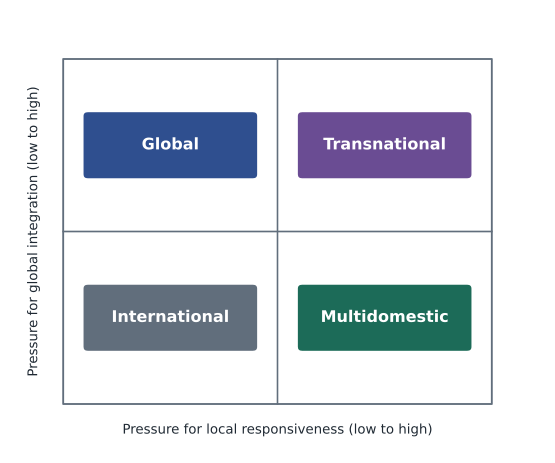
The transnational strategy aims to achieve efficiency, responsiveness and worldwide learning at the same time, through a network in which different subsidiaries lead on different products or capabilities. It is the most demanding strategy to manage, requiring sophisticated coordination, shared values and managers comfortable with matrix relationships. In practice, firms often differ by activity: research and development and brand strategy may be global, while marketing and some product features are local.
Entry modes
Firms can enter foreign markets in several ways, which differ in commitment, control, risk and potential return. Exporting requires the least investment, using agents, distributors or online channels. Licensing and franchising let a foreign partner use the firm's technology or brand in exchange for royalties, with low investment but limited control and a risk of creating a future competitor. Contract manufacturing outsources production abroad. Strategic alliances and joint ventures share ownership and knowledge with a local partner (lesson 8). Wholly owned subsidiaries, either acquired or built from scratch (greenfield investments), give the most control but require the most investment and carry the most risk.
The choice depends on transaction-cost logic (lesson 7), the need to protect proprietary knowledge, the firm's experience in the market, the market's size and risk, and host-country rules, which in some countries require local partners or restrict foreign ownership in sectors such as telecommunications, media, airlines and banking. The Uppsala model of internationalization suggests firms often move step by step, starting with exports to psychically close markets and increasing commitment as they learn. Born-global firms, common in software and online services, sell internationally from their founding.
| Entry mode | Investment | Control | Risk of knowledge loss | Speed |
|---|---|---|---|---|
| Exporting | Low | Low over local marketing | Low | Fast |
| Licensing or franchising | Low | Low to moderate | High | Fast |
| Joint venture | Moderate | Shared | Moderate | Moderate |
| Acquisition | High | High | Low | Fast |
| Greenfield subsidiary | High | High | Low | Slow |
Trade policy as a strategic variable
Trade agreements and tariffs shape where firms locate production and how they serve markets. The Canada–United States–Mexico Agreement (CUSMA, known in the United States as USMCA) replaced NAFTA in 2020 and sets rules of origin that determine which goods qualify for tariff-free treatment, along with rules on services, investment, intellectual property and digital trade. The agreement required a joint review on its sixth anniversary, 1 July 2026. At that review, the United States declined to confirm renewal, which under the agreement triggers annual joint reviews; the agreement remains in force until at least July 2036 unless the parties agree to extend it. Separately, the United States imposed tariffs on many imports from Canada and other countries in 2025 under several legal authorities, some of which were struck down by the Supreme Court in February 2026, while others, including sectoral tariffs on steel, aluminum and automobiles, remained. BUS-230 lesson 12 covers the operational effects. Check current sources before relying on any tariff rate.
For American firms, trade policy changes cut both ways. Tariffs on imports raise the cost of foreign inputs and invite retaliation against US exports, as with Canadian counter-tariffs applied to many US goods, while also offering protection to some domestic producers. Responses include reshoring or near-shoring production, qualifying goods under USMCA rules of origin, diversifying suppliers across countries, and adjusting prices. The annual USMCA reviews that began in July 2026 keep the future of North American trade rules uncertain, which affects investment decisions in automotive, agriculture, energy and manufacturing. Federal programs such as those of the Export-Import Bank and the Commercial Service of the Department of Commerce offer export support.
Managing currency and political risk
International firms face exchange-rate risk: a stronger home currency makes exports more expensive abroad and reduces the home-currency value of foreign profits. Firms manage this through operational hedging (matching costs and revenues in the same currency, for example by producing where they sell), financial hedging with forwards and options (covered in FIN-301), pricing strategies and diversification. Political risk includes expropriation, sanctions, sudden regulatory changes, conflict and trade disputes. Firms assess political risk with country analysis and scenarios (lesson 3), structure investments to reduce exposure (joint ventures with local partners, insurance from export credit agencies, staged commitments) and maintain relationships with governments and communities.
Worked problem
Choosing an entry mode
An invented maker of specialized water-filtration systems for municipalities has 70 % of sales in its home country and wants to enter Germany. The technology is patented but installation requires local engineering and knowledge of procurement rules. A German engineering firm has offered a joint venture; a distributor has offered to sell the systems under license. Compare the options using CAGE and entry-mode logic.
Show solution
- CAGE: administrative distance is significant (EU procurement and certification rules), cultural distance moderate (language, business norms), geographic distance high for after-sales service, economic distance low.
- Licensing: fast and cheap, but risks the know-how embedded in installation and weakens control over quality, which matters for municipal reputations.
- Joint venture: gives local engineering capability and procurement knowledge, shares risk, but requires governance to protect patents and to settle disputes.
- Alternative: export with a small sales and service office first, partnering for installation on a project basis, then decide on deeper commitment after two or three contracts.
Answer: A joint venture with strong governance, or a staged entry beginning with export and project partnerships, fits better than licensing, because control of quality and know-how is central.
Common mistakes
MistakeThe world is flat, so distance no longer matters for strategy.
InsteadTrade and investment still fall sharply with cultural, administrative, geographic and economic distance.
MistakeThe largest foreign market is always the most attractive.
InsteadAdjust market size for distance; a smaller, closer market may offer more.
MistakeA transnational strategy is always best.
InsteadIt is the hardest to manage; the right strategy depends on the pressures in the industry.
MistakeLicensing is a risk-free way to enter foreign markets.
InsteadLicensing can create competitors by transferring know-how and gives limited control.
MistakeTrade agreements, once signed, remove trade policy risk.
InsteadAgreements can be reviewed, renegotiated or overridden by tariffs, as the 2025–2026 disputes showed.
Summary and key terms
- Firms go international for growth, scale, resources, customers, cost and learning, with returns that diminish as complexity rises.
- The CAGE framework shows that cultural, administrative, geographic and economic distance still shape trade and investment.
- Global integration and local responsiveness pressures define international, multidomestic, global and transnational strategies.
- Entry modes range from exporting and licensing to joint ventures, acquisitions and greenfield subsidiaries, trading off control, risk and speed.
- CUSMA remains in force after the United States declined renewal at the July 2026 review, triggering annual reviews.
- Tariff changes in 2025 and 2026 made trade policy a central strategic variable for North American firms.
- Currency and political risks are managed through operational and financial hedging, structure and scenarios.
- CAGE framework
- Cultural, administrative, geographic and economic dimensions of distance between countries.
- Gravity model
- A model predicting trade from economic size and distance between countries.
- Global integration
- Coordinating activities across countries for efficiency and consistency.
- Local responsiveness
- Adapting products and practices to local conditions.
- Multidomestic strategy
- Independent national subsidiaries adapting to local markets.
- Transnational strategy
- A network seeking efficiency, responsiveness and learning simultaneously.
- Greenfield investment
- Building a new foreign subsidiary from scratch.
- Rules of origin
- Criteria determining whether goods qualify for preferential tariff treatment.
- Born-global firm
- A firm that sells internationally from or near its founding.
- Operational hedging
- Reducing currency exposure by matching costs and revenues in the same currency.
Practice problems
Work each problem on paper first, then reveal the answer to check.
Name the four CAGE dimensions.
Show answer
Cultural, administrative, geographic and economic.
Which CAGE dimension most affects a cement maker?
Show answer
Geographic, because transport costs are high relative to value.
Which strategy suits high integration and low responsiveness pressure?
Show answer
Global.
Give a risk of licensing.
Show answer
The licensee learns the technology and becomes a competitor.
Why might a firm choose a joint venture?
Show answer
To gain local knowledge, share risk or meet host-country ownership rules.
What happened at the July 2026 CUSMA joint review?
Show answer
The United States declined to confirm renewal, triggering annual reviews; the agreement stays in force until at least 2036.
How can operational hedging reduce currency risk?
Show answer
By producing and incurring costs in the same currency as sales.
What does the Uppsala model predict?
Show answer
Gradual internationalization, starting with close markets and low commitment.
Market size 300 with weighted distance 0.5 using the lesson's formula. Adjusted size?
Show answer
300 × 0.5² = 75.
Portfolio task: recommend an entry mode for a firm of your choice entering a new country, justifying it with CAGE and transaction-cost reasoning.
Show answer
Answers vary; address control, risk, speed and knowledge protection.
Lesson quiz · 5 questions
Score 60% or more to complete this lesson.
Create a free account to save your progress, take quizzes and earn a certificate.