
BUS-450 · Lesson 7 of 12 · 25 min
Corporate strategy: scope, diversification and vertical integration
Business-level strategy asks how to compete in a market. Corporate strategy asks a prior question: which markets should the firm be in at all? It covers three dimensions of scope: vertical scope (how many stages of the value system the firm performs itself), horizontal or product scope (how many related or unrelated businesses it owns) and geographic scope (where it operates, the subject of lesson 9). The central test of any corporate strategy is whether the parent company adds value to its businesses beyond what they could achieve on their own, or what investors could achieve by holding the businesses separately in a portfolio. This lesson examines vertical integration and outsourcing, diversification, portfolio management and the role of the corporate parent. Lesson 8 then looks at the main tools for changing scope: acquisitions, alliances and divestitures.
The value system and vertical scope
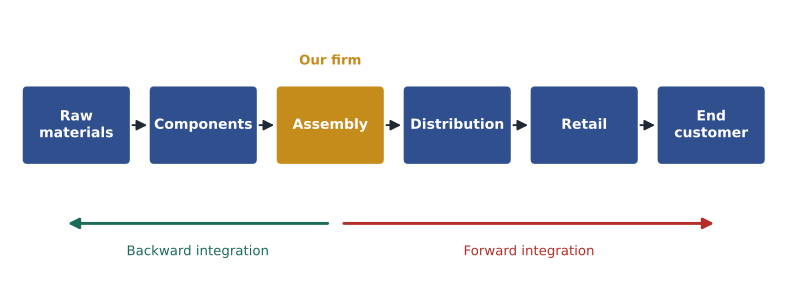
Lesson 4 described the value chain inside a firm. Firms sit within a larger value system that runs from raw materials through components, manufacturing, distribution and retail to the end customer. Vertical integration means owning more stages of that system. Backward integration moves toward inputs (an automaker making its own batteries); forward integration moves toward customers (a manufacturer opening its own stores). Firms can also use intermediate forms, such as long-term contracts, joint ventures, franchising and strategic alliances, that sit between full ownership and buying on the open market.
Why integrate? Transaction cost economics
Ronald Coase asked in 1937 why firms exist at all if markets allocate resources efficiently. His answer, developed by Oliver Williamson into transaction cost economics, is that using markets has costs: searching for suppliers, negotiating and writing contracts, monitoring performance and enforcing agreements. When those costs are high, it can be cheaper to bring the activity inside the firm, where it is coordinated by managerial authority. Williamson identified three features of transactions that raise market costs. Asset specificity: when one party must invest in assets that are valuable only in the relationship, such as a parts plant built next to a single customer's factory, it becomes vulnerable to hold-up, the other side's renegotiation of terms once the investment is sunk. Uncertainty: when it is hard to specify all contingencies in a contract. Frequency: recurring transactions justify the fixed costs of building internal governance.
Integration has its own costs. Internal suppliers face weaker incentives because they have a guaranteed customer, a problem sometimes called the loss of market discipline. Bureaucracy and coordination costs rise. The firm loses the flexibility to switch suppliers when technology changes, and it must make capital investments that tie up funds. It may also lose economies of scale that a specialized supplier serving many customers could achieve. The make-or-buy decision weighs these costs against market transaction costs.
# Make-or-buy comparison for an invented component (annual, $ thousands)
volume = 50_000
buy = {"price per unit": 42.0, "contracting and monitoring": 180, "hold-up risk (expected)": 250}
make = {"variable cost per unit": 31.0, "fixed plant and staff": 520, "lost scale economies": 90,
        "weaker incentives (efficiency loss)": 110}
buy_total = buy["price per unit"] * volume / 1000 + buy["contracting and monitoring"] + buy["hold-up risk (expected)"]
make_total = make["variable cost per unit"] * volume / 1000 + sum(v for k, v in make.items() if k != "variable cost per unit")
print(f"Buy:  {buy_total:,.0f} thousand")
print(f"Make: {make_total:,.0f} thousand")
print("Decision:", "make" if make_total < buy_total else "buy")
# How sensitive is the decision to volume?
for v in (20_000, 35_000, 50_000, 80_000):
    b = 42.0 * v / 1000 + 180 + 250
    m = 31.0 * v / 1000 + 520 + 90 + 110
print(f"volume {v:>6}: buy {b:>7,.0f} make {m:>7,.0f} -> {'make' if m < b else 'buy'}")Buy: 2,530 thousand Make: 2,270 thousand Decision: make volume 20000: buy 1,270 make 1,340 -> buy volume 35000: buy 1,900 make 1,805 -> make volume 50000: buy 2,530 make 2,270 -> make volume 80000: buy 3,790 make 3,200 -> make
In this invented example making is cheaper at 50,000 units because the per-unit saving outweighs the fixed costs, but at low volumes buying wins. The hold-up risk is an estimate of expected losses from a supplier exploiting the firm's dependence; it rises with asset specificity. Real decisions also weigh strategic factors: control of a scarce or critical input, protection of proprietary know-how, quality control, and the risk of supply disruption, which many firms reassessed after the pandemic and the 2025–2026 tariff disputes.
| Factor | Favors integration (make) | Favors market (buy) |
|---|---|---|
| Asset specificity | High; specialized investments vulnerable to hold-up | Low; general-purpose assets |
| Uncertainty | High; hard to write complete contracts | Low; performance easy to specify and measure |
| Frequency and volume | High and steady | Low or variable |
| Supplier market | Few suppliers, concentrated power | Many competing suppliers |
| Strategic importance | Core capability or scarce input | Commodity or non-core activity |
| Technology change | Stable | Rapid; flexibility to switch matters |
Outsourcing and the modular value chain
Since the 1990s many firms have narrowed their vertical scope, outsourcing manufacturing, logistics, information technology and customer service to specialists. Contract manufacturers assemble most of the world's electronics; semiconductor design firms rely on foundries; consumer brands use co-packers. Outsourcing works best when interfaces between stages are standardized, so that work can be specified, measured and handed off cleanly. The risks include loss of know-how (a supplier learns the business and becomes a competitor), loss of control over quality and labor standards (BUS-230 lesson 12 and BUS-310 discuss supply chain responsibility), and supply disruption. Some firms have reintegrated activities they consider strategic, for example automakers investing in battery production and chips, and technology firms designing their own processors.
Diversification
Diversification means entering new product markets. Related diversification enters businesses that share resources, capabilities or markets with existing ones; unrelated diversification enters businesses with no meaningful operational links. The case for diversification rests on economies of scope: cost savings or revenue gains from doing two things together that would not arise separately. Scope economies can come from sharing tangible resources (plants, distribution, sales forces), transferring intangible capabilities (a brand, a technology, a management skill) or exercising market power across businesses.
Michael Porter proposed three tests for diversification. The attractiveness test: the industry entered must be structurally attractive or capable of being made so. The cost-of-entry test: the cost of entering must not capitalize all future profits, a frequent problem when firms overpay for acquisitions in attractive industries. The better-off test: either the new unit must gain advantage from its link with the corporation, or the corporation must gain from the unit. Diversification that fails the better-off test destroys value, because shareholders could diversify more cheaply themselves by buying shares of different companies.
Does diversification create value?
Research has found that, on average, highly diversified conglomerates have traded at a discount to the sum of the values of their parts, often estimated at around 10 to 15 percent in US studies from the 1990s, though the size and even the existence of the discount are debated because diversified firms may differ in other ways. Explanations include cross-subsidization of weak businesses, slower decision making, poor information for investors and managers' incentives to build empires. Related diversification has generally performed better than unrelated diversification, but the relationship is not linear: some diversification can help, especially when capabilities transfer, while extensive diversification tends to hurt. Conglomerates persist and sometimes thrive, particularly where capital markets are less developed, or where the parent has a distinctive capability in capital allocation and governance.
The United States offers examples of both. Berkshire Hathaway, which owns insurance, railways, utilities, manufacturers and retailers, has long been cited as a conglomerate that adds value through disciplined capital allocation and decentralized management, though its performance relative to the market has varied over time. General Electric, once the model diversified company, split itself into three separate public companies, completing the separation in 2024, after years of underperformance that investors attributed partly to complexity and cross-subsidization. 3M spun off its health-care business as Solventum in 2024. Such break-ups reflect investor pressure for focused companies.
Portfolio planning tools and their limits
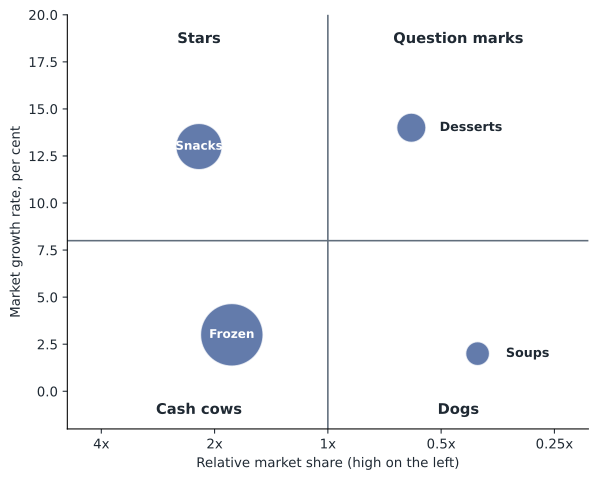
In the 1970s, consulting firms developed portfolio matrices to help diversified firms allocate resources. The Boston Consulting Group's growth-share matrix classified businesses by market growth and relative market share: stars (high growth, high share), cash cows (low growth, high share), question marks (high growth, low share) and dogs (low growth, low share). Cash from cows was to fund stars and selected question marks, while dogs were divested. BUS-220 lesson 2 introduced the matrix for product portfolios. The GE–McKinsey matrix used broader measures of industry attractiveness and business strength.
These tools have limits. Relative share is a crude proxy for competitive advantage, especially in industries without strong experience effects; low-growth businesses can be highly profitable; the matrices ignore links between businesses; and the idea that the corporation should act as an internal capital market, moving cash between businesses, assumes that headquarters allocates capital better than external investors would. Modern practice evaluates each business by its value creation, using the economic value and NPV tools from FIN-201, and asks what the parent specifically contributes.
Parenting advantage
Goold, Campbell and Alexander argued that a corporate parent should own a business only if it adds more value to that business than any other potential owner could, a test called parenting advantage. Parents add value through stand-alone influence (improving each business, for example through better planning or talent), linkage influence (encouraging sharing between businesses), central functions and services, and corporate development (buying and selling businesses well). Parents also destroy value through misguided interference, slow approvals and inappropriate targets. The test implies that the best owner of a business can change over time, and that divestiture is a normal part of corporate strategy, not an admission of failure.
Worked problem
Applying the better-off test
An invented food company with strong brands in snacks and frozen foods and a national grocery distribution network is considering three moves: (A) acquiring a premium frozen-dessert brand; (B) starting a chain of restaurants; (C) acquiring a packaging supplier that sells 15 % of its output to the company. Apply Porter's three tests and the transaction-cost logic.
Show solution
- A: related diversification. Attractiveness: premium desserts are growing with good margins. Better-off: the brand gains distribution and freezer space through the existing network; the company gains a premium product. Cost of entry: must check that the acquisition price does not capture all synergies (lesson 8).
- B: weakly related. Restaurants need different capabilities (site selection, labor scheduling, service); the grocery network and brand skills transfer poorly. Fails the better-off test unless a specific link is identified.
- C: backward integration. The supplier is not specific to the company (85 % of sales go elsewhere), packaging is a competitive market, and hold-up risk is low. Integration would add capital needs and reduce flexibility; buying on the market is likely better.
Answer: Option A is the most promising if the price is right; B and C would likely destroy value.
Common mistakes
MistakeDiversification reduces risk, so it always benefits shareholders.
InsteadShareholders can diversify more cheaply themselves; corporate diversification must create value through links.
MistakeVertical integration always lowers costs by eliminating supplier margins.
InsteadIntegration adds bureaucracy, weakens incentives and loses supplier scale economies; the supplier margin is not pure profit.
MistakeDogs in the growth-share matrix should always be sold.
InsteadLow-growth, low-share businesses can be profitable; evaluate each by value creation.
MistakeOutsourcing is always cheaper.
InsteadOutsourcing can lose know-how, control and supply security; weigh transaction costs and strategic importance.
MistakeA parent adds value just by owning good businesses.
InsteadParenting advantage requires adding more value than any other owner could.
Summary and key terms
- Corporate strategy decides vertical, product and geographic scope; the parent must add value beyond what investors could achieve alone.
- Transaction cost economics explains integration: asset specificity, uncertainty and frequency raise market costs.
- Integration has costs: weaker incentives, bureaucracy, lost flexibility and lost supplier scale.
- Outsourcing works when interfaces are standardized but risks know-how, control and supply security.
- Related diversification based on scope economies tends to outperform unrelated diversification.
- Porter's attractiveness, cost-of-entry and better-off tests screen diversification moves.
- Portfolio matrices are discussion tools; parenting advantage is a stronger test of corporate value.
- Corporate strategy
- Choices about the scope of the firm and how the parent adds value.
- Vertical integration
- Owning more stages of the value system.
- Transaction cost economics
- The theory that firms exist when market transaction costs exceed internal coordination costs.
- Asset specificity
- The degree to which an investment is valuable only within a particular relationship.
- Hold-up
- Opportunistic renegotiation once a partner has made a relationship-specific investment.
- Related diversification
- Entering businesses that share resources, capabilities or markets.
- Economies of scope
- Savings or gains from doing two activities together.
- Conglomerate discount
- The tendency of diversified firms to be valued below the sum of their parts.
- Growth-share matrix
- The BCG tool classifying businesses by market growth and relative share.
- Parenting advantage
- Adding more value to a business than any other potential owner could.
Practice problems
Work each problem on paper first, then reveal the answer to check.
Distinguish forward from backward integration.
Show answer
Backward moves toward inputs; forward moves toward customers.
What is hold-up?
Show answer
Opportunistic renegotiation by a partner after the other side has made a specific investment.
Buy at $20 a unit plus $50,000 a year in contracting costs; make at $14 a unit plus $230,000 fixed. At what volume are they equal?
Show answer
20v + 50,000 = 14v + 230,000, so v = 30,000 units.
Name two costs of vertical integration.
Show answer
Weaker incentives for internal units; loss of flexibility and supplier scale economies.
State Porter's three diversification tests.
Show answer
Attractiveness, cost of entry, better off.
Why might a conglomerate trade at a discount?
Show answer
Cross-subsidization, complexity, poor information and empire-building incentives.
What is a cash cow in the BCG matrix?
Show answer
A high-share business in a low-growth market that generates cash.
Give one limitation of the BCG matrix.
Show answer
Relative share is a crude proxy for advantage, and it ignores links between businesses.
What does parenting advantage require?
Show answer
That the parent add more value than any other owner could.
Portfolio task: assess whether a diversified company you know passes the better-off test for one of its businesses.
Show answer
Answers vary; identify specific shared resources or transferred capabilities.
Lesson quiz · 5 questions
Score 60% or more to complete this lesson.
Create a free account to save your progress, take quizzes and earn a certificate.