
BUS-450 · Lesson 12 of 12 · 26 min
Capstone: a strategic analysis and plan
This final lesson brings the course together in a complete strategic analysis. Strategy courses traditionally use the case method: students read a detailed account of a company at a decision point, analyze its situation, develop and evaluate options, and defend a recommendation, much as a senior management team or consultant would. The lesson first sets out a practical process for case analysis and for writing a strategic plan, then works through an invented company, Ridgeline Cookware, from diagnosis to implementation and measurement. The company and its figures are invented for teaching; they are realistic but should not be read as describing any real firm. The portfolio task at the end asks you to apply the same process to a real company of your choice.
A process for strategic analysis
A strategic analysis moves through a sequence of questions, each building on the last. What is the situation and the decision to be made? What does the external environment look like, and how is it changing? What resources and capabilities does the firm have, and how do they compare with rivals'? What is the current strategy, and is it working? What are the realistic options? How do they compare, given uncertainty? What do we recommend, and how will it be implemented, measured and adjusted? The tools from earlier lessons fit at each step: PESTEL and the five forces for the environment (lesson 2 and BUS-220 lesson 2), competitive dynamics and life cycle (lesson 3), the value chain and VRIO (lesson 4), value created and generic strategies (lesson 5), technology and platforms (lesson 6), corporate and international scope (lessons 7 to 9), implementation (lesson 10) and measurement (lesson 11).
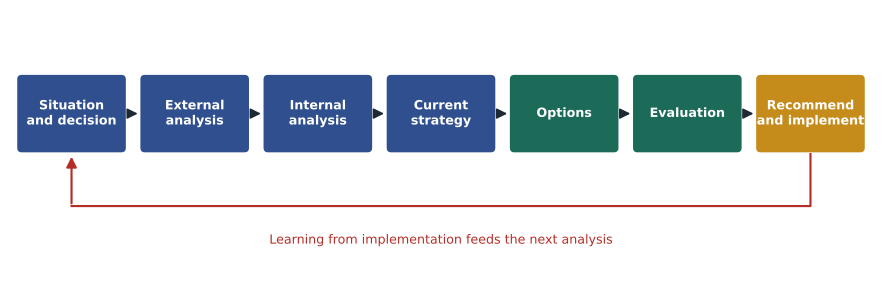
Good case analysis avoids several traps. Do not summarize the case back to the reader; analyze it. Do not apply every framework mechanically; choose the tools that illuminate the decision. Use numbers wherever possible: market sizes, margins, growth rates, break-evens and valuations make arguments testable. State assumptions explicitly. Consider at least three genuine options, including the status quo, and evaluate them against clear criteria. Make a decision; a recommendation that hedges every option is not a recommendation. And address implementation and risks, because a recommendation that cannot be executed is not useful.
The case: Ridgeline Cookware
Ridgeline Cookware is an invented, privately held manufacturer of premium cast-iron and carbon-steel cookware based in Minneapolis, Minnesota. Founded 28 years ago, it has annual revenue of about $96 million, an operating margin of 9 %, and 410 employees, most at a foundry and finishing plant outside the city. About 70 % of sales are in the United States, 25 % in Canada and 5 % elsewhere. Products are sold through specialty kitchen stores (35 % of revenue), department stores and big-box retailers (30 %), large online marketplaces (20 %) and its own website (15 %). The company's board, which includes the founding family and two independent directors, has asked management to recommend a strategy for the next five years.
Several developments prompted the review. Lower-priced imported cast iron has taken share in big-box channels, where Ridgeline's margins have fallen. Two direct-to-consumer start-ups selling stylish enameled cookware through social media have grown quickly among younger buyers. Raw material and energy costs rose over the past three years, and tariffs on steel and on some cross-border shipments have added cost and uncertainty since 2025. At the same time, Ridgeline's products have a strong reputation for durability, a lifetime warranty, a loyal following among serious home cooks and some restaurant chefs, and a recently launched restoration service that refurbishes old pans, which has a waiting list.
Step 1: Situation and decision
The decision is how Ridgeline should position itself for the next five years given margin pressure in mass channels, new digital competitors and trade uncertainty. The board has signaled that it wants growth but will not take on heavy debt, and that the family values keeping manufacturing in its home region. These constraints matter: a good recommendation must work within them or make a clear case for changing them.
Step 2: External analysis
A five-forces sketch for premium cookware in North America suggests moderate attractiveness overall, with sharp differences between segments. Rivalry is intense in mass channels, where products are compared on price, and moderate in the premium segment, where brands and quality matter. Entry is easier than it was: contract manufacturers and online marketing let start-ups launch brands without foundries. Substitutes include non-stick and stainless cookware, though serious cooks value cast iron's properties. Buyer power is high for big-box retailers and large online marketplaces, which control shelf space and search ranking; it is low for individual consumers buying direct. Supplier power is moderate: iron and steel are commodities, but energy costs and tariffs add volatility.
| Force | Mass channels | Premium and direct channels |
|---|---|---|
| Rivalry | High: many brands, price comparison | Moderate: brand, quality and story matter |
| Threat of entry | Moderate: imports and private labels | Moderate: digital brands launch easily |
| Substitutes | High: non-stick and stainless | Lower: serious cooks value cast iron |
| Buyer power | High: few large retailers and marketplaces | Low: individual consumers |
| Supplier power | Moderate: metals and energy volatility | Moderate: same inputs |
Trends from a PESTEL scan point the same way. Interest in home cooking and durable, repairable goods has grown, supported by concern about waste and chemicals in some non-stick coatings. Social media drives discovery for younger buyers. Trade policy has become volatile: the July 2026 CUSMA review ended without renewal, triggering annual reviews (lesson 9), and steel tariffs affect both inputs and finished goods. These trends favor brands with authentic stories, direct relationships and flexible supply.
Step 3: Internal analysis
Ridgeline's value chain shows strengths in operations (foundry know-how, finishing quality) and service (warranty, restoration), and weaknesses in marketing and sales (limited digital capability, heavy dependence on intermediaries) and technology development (few new product introductions). A VRIO screen identifies the foundry expertise and quality reputation as valuable, rare and costly to imitate, since they rest on decades of process learning, and the restoration service as valuable and rare, though imitable over time. The customer data from the website and warranty registrations are valuable but under-used: the firm is not organized to exploit them.
# Ridgeline: channel profitability (illustrative, $ millions)
channels = {
    "Specialty stores": {"revenue": 33.6, "gross_margin": 0.44, "channel_costs": 6.0},
    "Big-box retail":   {"revenue": 28.8, "gross_margin": 0.28, "channel_costs": 5.2},
    "Marketplaces":     {"revenue": 19.2, "gross_margin": 0.38, "channel_costs": 5.0},
    "Own website":      {"revenue": 14.4, "gross_margin": 0.58, "channel_costs": 3.9},
}
for name, c in channels.items():
    contribution = c["revenue"] * c["gross_margin"] - c["channel_costs"]
    print(f"{name:<17} revenue {c['revenue']:5.1f}  contribution {contribution:5.1f}  "
f"margin {contribution / c['revenue']:5.1%}")Specialty stores revenue 33.6 contribution 8.8 margin 26.1% Big-box retail revenue 28.8 contribution 2.9 margin 9.9% Marketplaces revenue 19.2 contribution 2.3 margin 12.0% Own website revenue 14.4 contribution 4.5 margin 30.9%
The channel analysis shows why the current mix is a problem. Big-box retail generates nearly a third of revenue but the lowest contribution margin, roughly 10 %, after promotional fees and markdowns. The firm's own website, though small, earns contribution margins above 30 %. Specialty stores remain solidly profitable and important for brand building. The pattern suggests shifting the mix toward direct and specialty channels without abandoning reach.
Step 4: Strategic options
Management developed four options. Option A, defend the core: stay in all channels, cut costs at the plant through automation, and match import prices in big-box retail with a lower-priced line. Option B, premium direct: reposition firmly as the premium, repairable, lifetime brand; grow direct-to-consumer sales and specialty retail; expand restoration into a subscription care program; introduce enameled products to compete with the digital start-ups; and gradually exit low-margin big-box accounts. Option C, scale through acquisition: acquire one of the digital start-ups to gain its brand and marketing capability, combining it with Ridgeline's manufacturing. Option D, sell the company to a large housewares group that has expressed interest.
| Criterion | A: Defend core | B: Premium direct | C: Acquire start-up | D: Sell |
|---|---|---|---|---|
| Fit with capabilities (VRIO) | Weak: competes on cost | Strong: builds on quality and service | Mixed: adds marketing, integration risk | Not applicable |
| Industry forces | Faces high buyer power | Reduces buyer power | Reduces buyer power | Not applicable |
| Financial risk | Moderate | Moderate: investment in marketing | High: premium paid, debt needed | Low for owners |
| Board constraints | Meets | Meets | Strains debt limit | Conflicts with family goals |
| Time to results | Fast but small | Two to three years | Fast if integration succeeds | Immediate |
Step 5: Evaluating options under uncertainty
The options' outcomes depend on uncertain factors, notably trade policy and the growth of direct-to-consumer demand. Management built three scenarios (lesson 3): a stable trade scenario, a tariff-escalation scenario and a direct-to-consumer boom scenario, assigned rough probabilities, and estimated the net present value of each option's incremental cash flows in each scenario using the tools of FIN-201. A simple simulation then varied key assumptions within ranges.
# Scenario and Monte Carlo evaluation of Ridgeline's options (NPV, $ millions, illustrative)
import random
random.seed(450)
scenarios = {"Stable trade": 0.45, "Tariff escalation": 0.30, "Direct boom": 0.25}
npv = {
    "A: Defend core":     {"Stable trade": 6,  "Tariff escalation": -9, "Direct boom": 2},
    "B: Premium direct":  {"Stable trade": 18, "Tariff escalation": 8,  "Direct boom": 31},
    "C: Acquire start-up": {"Stable trade": 14, "Tariff escalation": -6, "Direct boom": 38},
}
for option, values in npv.items():
    ev = sum(scenarios[s] * v for s, v in values.items())
    worst = min(values.values())
    print(f"{option:<21} expected NPV {ev:5.1f}  worst case {worst:4}")
# Monte Carlo: uncertainty within each scenario (+/- 40 % noise)
for option, values in npv.items():
    draws = []
    for _ in range(20_000):
        s = random.choices(list(scenarios), weights=list(scenarios.values()))[0]
        draws.append(values[s] * random.uniform(0.6, 1.4) - (3 if option.startswith("C") else 0) * random.random())
    loss = sum(d < 0 for d in draws) / len(draws)
print(f"{option:<21} mean {sum(draws)/len(draws):5.1f} probability of loss {loss:.0%}")A: Defend core expected NPV 0.5 worst case -9 B: Premium direct expected NPV 18.2 worst case 8 C: Acquire start-up expected NPV 14.0 worst case -6 A: Defend core mean 0.4 probability of loss 30% B: Premium direct mean 18.3 probability of loss 0% C: Acquire start-up mean 12.4 probability of loss 30%
Option B has the highest expected NPV in this illustration and a positive NPV in every scenario, which makes it robust. Option C has the highest upside if direct demand booms but loses value under tariff escalation and adds integration risk and debt that the board wants to avoid. Option A is weak in every scenario because it fights where the industry forces are strongest. Option D was evaluated separately: an indicative offer would give the family liquidity but conflicts with their stated goals, and the analysis suggests Option B could create more value over five years if executed well. The numbers are judgments, but they make the reasoning explicit and show which assumptions matter most, such as the growth rate of direct sales and the tariff outlook.
Step 6: Recommendation
Management recommends Option B, premium direct, with an option to revisit acquisition later. The diagnosis: Ridgeline's quality and service capabilities are valuable, rare and hard to imitate, but the company is spending them in channels where buyer power and price rivalry are strongest, while digital brands are capturing younger buyers. The guiding policy: compete as the premium, repairable, lifetime cookware brand, sold mainly through direct and specialty channels. Coherent actions: invest in digital marketing and content; launch an enameled line made in the home plant; turn restoration into a paid care program with subscriptions and trade-ins; build a customer data and analytics capability; reduce big-box exposure gradually over three years while offering selected retailers an exclusive premium range; diversify input sourcing and qualify products under CUSMA rules of origin to limit tariff exposure; and pilot a small showroom-and-restoration studio in one major city.
Step 7: Implementation, measurement and risks
Implementation requires changes across the star model (lesson 10). Structure: create a direct-to-consumer unit with its own leader, combining e-commerce, content and customer care, and a channel team to manage the transition with retailers. Processes: integrate warranty, restoration and website data into a single customer system. Rewards: tie sales incentives to contribution margin rather than volume. People: hire digital marketing and analytics talent, and train foundry and service staff to tell the brand's story. Culture: celebrate customer stories and repair, consistent with the family's values.
| Perspective | Objective | Measure | Year 3 target |
|---|---|---|---|
| Financial | Higher-quality growth | Operating margin; economic profit | 13 %; positive and rising |
| Customer | Win and keep serious cooks and younger buyers | Direct share of revenue; repeat purchase rate | 35 %; 40 % within two years |
| Internal process | Fast, reliable direct fulfillment and restoration | Order-to-delivery days; restoration turnaround | 3 days; 10 days |
| Learning and growth | Digital and data capability | Staff in digital roles; customer records with consent | 25; 300,000 |
Key risks and responses include: retailer retaliation as big-box exposure falls (manage with phased exits and exclusive ranges); higher marketing costs than expected (test channels with small budgets and scale what works, tracking customer acquisition cost against lifetime value); failure of the enameled line (pilot with limited colors, gather feedback); tariff escalation (maintain sourcing flexibility and price reviews); and execution capacity in a mid-sized firm (stage initiatives, hire experienced leaders, use premise control to revisit assumptions quarterly). The board should review the scorecard each quarter and the strategy's premises annually, with a pre-agreed trigger to reconsider an acquisition if direct demand grows faster than planned.
Writing and presenting your analysis
A strategic plan or case report typically follows the structure above: an executive summary that states the recommendation and its rationale in a page; the situation and decision; external and internal analysis; options and evaluation; the recommendation; and implementation, measures and risks, with exhibits for the numbers. Write for a busy reader who will act on it. Lead with the answer, support it with evidence, and keep frameworks in the background unless they clarify the argument. When presenting, expect challenges to your assumptions and be ready to show how the recommendation changes if they are wrong. Cite sources for facts about real companies, and date them, since market data and regulations change. Using AI tools to gather information or draft text is increasingly common; check every fact against primary sources, follow your institution's academic integrity rules, and make the analysis and judgment your own.
For the portfolio task, American companies that make rich cases include Netflix (from discs to streaming to content production and advertising), Walmart (cost leadership extended into e-commerce, advertising and marketplaces), Amazon (retail, marketplace, logistics and cloud platforms) and firms in industries reshaped by trade policy, such as autos, steel and agriculture. Use annual reports and 10-K filings on the SEC's EDGAR system, investor presentations and reputable news sources, and note the date of each figure.
Common mistakes
MistakeA case analysis should summarize the case facts.
InsteadAnalyze: use facts as evidence for a diagnosis, options and a recommendation.
MistakeUsing every framework shows thoroughness.
InsteadChoose the tools that illuminate the decision; mechanical lists add little.
MistakeA recommendation can hedge across all options.
InsteadMake a clear choice and explain how it would change if key assumptions prove wrong.
MistakeThe option with the highest expected NPV is always best.
InsteadConsider robustness across scenarios, risk, constraints and the firm's ability to execute.
MistakeImplementation can be left to managers once the strategy is chosen.
InsteadA plan must address structure, processes, rewards, people, measures and risks.
Summary and key terms
- Strategic analysis moves from situation and decision through external and internal analysis to options, evaluation and recommendation.
- Tools from every lesson fit specific steps; choose them to illuminate the decision.
- Numbers, explicit assumptions and at least three real options make an analysis testable.
- Scenarios and simulation reveal which options are robust under uncertainty.
- A recommendation should state a diagnosis, a guiding policy and coherent actions.
- Implementation plans align structure, processes, rewards, people and culture, with a scorecard and risk responses.
- Write for a busy decision-maker: lead with the answer, support it with evidence and date your sources.
- Case method
- Teaching through detailed accounts of real or realistic decisions.
- Executive summary
- A short statement of the recommendation and its rationale at the start of a report.
- Strategic option
- A distinct, feasible course of action for the firm.
- Evaluation criteria
- Standards used to compare options, such as fit, value, risk and feasibility.
- Robustness
- An option's ability to perform acceptably across many scenarios.
- Expected value
- The probability-weighted average of outcomes across scenarios.
- Contribution margin
- Revenue minus variable and channel-specific costs.
- Customer acquisition cost
- The marketing and sales cost of gaining a new customer.
- Trigger point
- A pre-agreed signal that prompts reconsideration of a strategy.
- Premise
- An assumption on which a strategy depends.
Practice problems
Work each problem on paper first, then reveal the answer to check.
List the seven steps of the analysis process.
Show answer
Situation and decision, external analysis, internal analysis, current strategy and performance, options, evaluation, recommendation with implementation.
Why include the status quo as an option?
Show answer
It provides a baseline; doing nothing also has consequences.
Ridgeline's big-box channel has revenue of $28.8 million, gross margin 28 % and channel costs $5.2 million. Contribution?
Show answer
28.8 × 0.28 − 5.2 = $2.86 million, about 10 % of revenue.
An option has NPVs of 10, −4 and 20 with probabilities 0.5, 0.3 and 0.2. Expected NPV?
Show answer
5 − 1.2 + 4 = 7.8.
Why might the highest expected NPV option not be chosen?
Show answer
It may be risky in bad scenarios, breach constraints or be hard to execute.
What makes Option B robust in the case?
Show answer
It has positive NPV in every scenario and builds on hard-to-imitate capabilities.
Name two structural changes Ridgeline needs.
Show answer
A direct-to-consumer unit and a channel transition team.
Give one leading indicator for Ridgeline's strategy.
Show answer
Repeat purchase rate or direct share of revenue.
What is a trigger point?
Show answer
A pre-agreed signal, such as faster direct growth, that prompts reconsidering the strategy.
Portfolio task: write a ten-page strategic analysis of a real company of your choice, following the seven steps, with dated sources and a one-page executive summary.
Show answer
Answers vary; assessed on diagnosis, use of evidence, quality of options, rigor of evaluation and realism of implementation.
Lesson quiz · 5 questions
Score 60% or more to complete this lesson.
Create a free account to save your progress, take quizzes and earn a certificate.