
BUS-450 · Lesson 10 of 12 · 26 min
Strategy execution: structure, culture, control and change
A brilliant strategy that is poorly executed is worth less than an ordinary strategy executed well. Surveys of executives regularly find that a large share believe their organizations are better at formulating strategy than at carrying it out, and studies of failed strategies often trace the problem not to the analysis but to misaligned structures, weak resource allocation, cultures that resist change and leaders who fail to communicate. This lesson turns from formulation to implementation. It examines how organizational structure, systems and processes, culture and leadership must align with strategy, how resources are allocated, and how leaders manage strategic change. BUS-130 covered organizational behavior, culture and change at the level of individuals and teams; here the focus is on the organization-wide choices that make a strategy happen.
Alignment: the star and 7-S models
Several frameworks emphasize that implementation requires alignment among many elements. Jay Galbraith's star model links strategy to structure (where decision power sits), processes (how information and decisions flow across units), rewards (what motivates behavior), and people (the skills and mind-sets the organization needs). McKinsey's 7-S framework, developed in the late 1970s, lists strategy, structure and systems as hard elements, and shared values, style, staff and skills as soft elements, with shared values at the center. The point of both is that changing strategy without changing the other elements usually fails: a firm that adopts a customer-intimacy strategy but keeps product-based structures, volume-based bonuses and a culture of internal competition will see little change in customer outcomes.
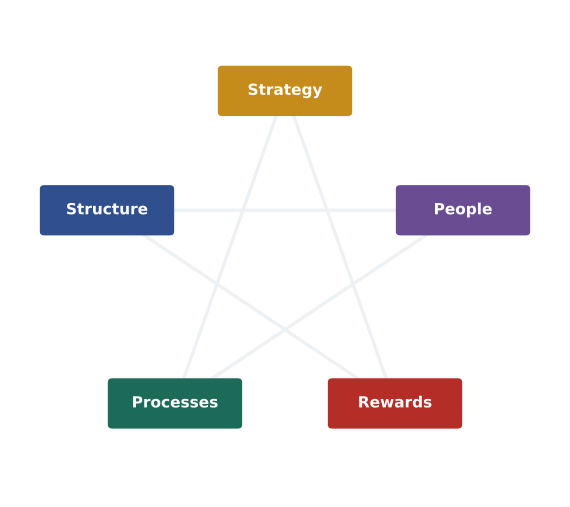
Organizational structure
Structure defines how work is divided, how units are grouped and how they are coordinated. Alfred Chandler's historical study of large American firms concluded that structure follows strategy: as firms diversified, they moved from centralized functional structures to multidivisional ones. Later research found the relationship runs both ways, since existing structures shape which strategies managers perceive and pursue.
| Structure | Grouping | Strengths | Weaknesses | Fits |
|---|---|---|---|---|
| Simple | Owner coordinates directly | Fast, flexible | Depends on one person; does not scale | Start-ups, small firms |
| Functional | By function (operations, marketing, finance) | Expertise, scale within functions | Slow cross-functional coordination | Single-business firms, cost focus |
| Multidivisional | By product, customer or region | Accountability, responsiveness | Duplication, divisional silos | Diversified or multinational firms |
| Matrix | Two dimensions at once (product and region) | Balances competing priorities | Dual reporting, conflict, slower decisions | Transnational firms, complex projects |
| Network or modular | Core firm coordinates partners | Flexibility, low fixed cost | Dependence on partners, weaker control | Firms that outsource heavily, platforms |
Other design choices matter as much as the shape of the chart. Centralization determines whether decisions are made at the top or pushed down; decentralization speeds responses to local conditions but risks inconsistency. Span of control, the number of people reporting to one manager, determines how many layers the hierarchy has. Formalization determines how much behavior is governed by written rules. Integrating mechanisms, such as cross-functional teams, liaison roles, shared information systems and product or customer managers, coordinate work across units without changing the formal structure.
# How span of control affects the number of management layers (illustrative)
import math
employees = 12_000
for span in (4, 6, 8, 10, 15):
    layers, people = 0, employees
    while people > 1:
        people = math.ceil(people / span)
        layers += 1
    managers = 0
    level = employees
    while level > 1:
        level = math.ceil(level / span)
        managers += level
print(f"span {span:>2}: about {layers} layers above front-line staff, {managers:,} managers")span 4: about 7 layers above front-line staff, 4,001 managers span 6: about 6 layers above front-line staff, 2,403 managers span 8: about 5 layers above front-line staff, 1,716 managers span 10: about 5 layers above front-line staff, 1,335 managers span 15: about 4 layers above front-line staff, 859 managers
Wider spans reduce layers and management cost and can speed decisions, but each manager has less time per person. Delayering programs have often widened spans dramatically; the right span depends on how routine the work is, how experienced the staff are and how much coaching they need. Hybrid and remote work, which became widespread after 2020, has changed how managers coordinate and has prompted many firms to rethink spans and the role of middle managers.
Systems, processes and resource allocation
Strategy is ultimately expressed in how resources are allocated: capital budgets, headcount, management attention and the time of the best people. Research by McKinsey on hundreds of firms found that many companies allocate capital almost identically from year to year, regardless of changing opportunities, and that firms that reallocate more actively tend to earn higher returns. Mechanisms that support strategic resource allocation include zero-based budgeting for selected areas, separate funding for strategic initiatives outside business-unit budgets, stage-gate processes for new ventures, and explicit criteria linked to strategy. FIN-201 lessons 7 to 9 covered the financial tools; the strategic issue is overcoming inertia and internal politics so resources follow the strategy.
Information and planning systems, performance management and incentive systems also shape behavior. Bonuses tied to short-term divisional profit can discourage investment in long-term capabilities or cooperation between divisions. Balanced measures, discussed in lesson 11, and incentives that reward contributions to the whole firm help. BUS-310 lesson 6 covered executive compensation; the same logic applies throughout the organization.
Culture and strategy
Organizational culture is the set of shared assumptions, values and norms that guide behavior, often summarized as how things are done around here. Edgar Schein described three levels: artifacts (visible structures, dress, office layout, rituals), espoused values (stated strategies, goals and philosophies) and basic underlying assumptions (unconscious, taken-for-granted beliefs). Culture can be a source of competitive advantage when it is valuable, rare and hard to imitate (lesson 4), as with a culture of operational discipline or customer service. But culture also constrains strategy: a culture built around engineering excellence may resist a strategy based on low cost, and a culture of risk avoidance may resist innovation. The saying attributed to Peter Drucker that culture eats strategy for breakfast captures the point.
Changing culture is slow and difficult because underlying assumptions are deeply held. Leaders influence culture through what they pay attention to, measure and control; how they react to crises; how they allocate resources and rewards; whom they hire, promote and dismiss; and the behavior they model. Stories, symbols and rituals reinforce the message. Cultural integration is also a central challenge after acquisitions (lesson 8). Research on culture and performance suggests that strong cultures help when they fit the strategy and environment, but can become liabilities when the environment changes and adaptability is low.
Leading strategic change
Strategic change, such as a shift in business model, a major restructuring, a digital transformation or an integration after a merger, faces resistance from people whose skills, status, routines and identities are threatened. BUS-130 lesson 12 introduced Lewin's unfreeze–change–refreeze model and Kotter's eight steps. At the strategic level, leaders must create a sense of urgency grounded in honest diagnosis, build a guiding coalition across levels and functions, communicate a clear vision and the reasons for change repeatedly, remove structural obstacles (such as reporting lines or incentives that reward the old behavior), generate visible short-term wins, and anchor changes in culture and systems so they persist when attention moves on.
Research on large transformations finds that many fall short of their goals, with failure rates often cited around 70 percent, though the figure is a rough estimate from consultants rather than rigorous measurement. Common causes include underestimating the scale of change required, launching too many initiatives at once, middle managers who are not engaged, and declaring victory too early. Successful transformations often combine top-down direction with bottom-up experimentation, use pilots to learn before scaling, and track leading indicators of progress.
Labor relations and strategic change in the United States
In the United States, about 10 percent of employees are union members, a much lower share than in Canada, though coverage is higher in the public sector, transportation, utilities and some manufacturing. Where unions exist, the National Labor Relations Act requires employers to bargain over mandatory subjects, which can include the effects of major changes on workers. The federal Worker Adjustment and Retraining Notification (WARN) Act requires 60 days' notice of plant closings and mass layoffs for covered employers, and some states have stricter versions. Most non-union employment is at will, which gives employers flexibility but does not remove the need to manage morale, reputation and talent retention during change. BUS-210 lesson 10 covers employment law.
Strategic leadership
The top management team sets direction, allocates resources, shapes culture and manages relationships with the board and stakeholders. Upper echelons theory, from Hambrick and Mason, holds that organizational outcomes reflect the experiences, values and cognitive biases of top managers. Diverse top teams can bring broader perspectives but may face more conflict; homogeneous teams decide faster but risk blind spots. Effective strategic leaders balance continuity and change, build the capabilities needed for the future while running today's business (sometimes called organizational ambidexterity), and create conditions for honest debate, since many strategic failures follow from leaders who did not hear bad news. BUS-130 lesson 10 covered leadership theories; BUS-310 covered the board's role in overseeing strategy.
Middle managers and the strategy-execution gap
Middle managers translate strategy into daily work, and research on strategy processes, including work by Floyd and Wooldridge, shows that they do more than implement: they synthesize information from the front line, champion new ideas upward and adapt plans to local conditions. Execution often breaks down when middle managers do not understand the strategy, see it as a threat to their units, or lack the authority and resources to act on it. Surveys that ask managers to name their company's top strategic priorities often find that only a minority can do so consistently, even in well-run firms. Practical remedies include translating the strategy into a few clear priorities for each unit, involving middle managers in shaping implementation plans, giving them decision rights matched to their accountability, holding regular reviews of progress on strategic initiatives separate from operational reviews, and promoting managers who execute strategic priorities well rather than only those who hit short-term numbers. Clarity about who decides what, sometimes recorded in a decision-rights matrix that names who recommends, agrees, performs, provides input and decides for key choices, reduces delays and conflict across units.
Worked problem
Diagnosing an implementation failure
An invented industrial-equipment maker adopted a strategy two years ago to shift from selling machines to selling outcomes: guaranteed uptime contracts priced per hour of operation. Revenue from service contracts has barely grown. Sales staff are still paid commission on equipment sales; the service division reports separately to the chief operating officer; data from connected machines sit in the engineering department; and the culture prizes engineering innovation over customer service. Use the star model to diagnose the problem and recommend changes.
Show solution
- Strategy: the outcome-based model is clear, but the other points of the star still support selling machines.
- Structure: service is a separate division with no link to sales or engineering; customer accounts lack a single owner. Recommendation: create account teams responsible for contract performance, combining sales, service and data specialists.
- Processes: machine data do not reach the people who manage contracts. Recommendation: build a shared data platform and a process for predictive maintenance linked to contracts.
- Rewards: commissions on equipment sales discourage selling contracts that lower upfront revenue. Recommendation: pay sales staff on contract lifetime value and customer retention.
- People and culture: recruit and develop service and analytics talent, celebrate customer uptime wins, and have senior leaders visibly prioritize contract outcomes.
Answer: The strategy failed because structure, processes, rewards and culture were left aligned with the old business; changing them together is the remedy.
Common mistakes
MistakeOnce a strategy is approved, implementation will follow.
InsteadExecution requires aligning structure, processes, rewards, people and culture with the strategy.
MistakeA new organization chart is enough to implement a new strategy.
InsteadStructure is one element; processes, incentives and culture must change too.
MistakeCulture can be changed quickly by announcing new values.
InsteadCulture rests on deep assumptions; it changes through sustained leadership actions, systems and rewards.
MistakeCapital should be allocated each year in proportion to last year's budgets.
InsteadActive reallocation toward strategic opportunities is associated with better performance.
MistakeResistance to change is irrational and should be overridden.
InsteadResistance often reflects real losses; understanding and addressing it improves implementation.
Summary and key terms
- Execution failures often stem from misalignment rather than flawed analysis.
- The star and 7-S models stress aligning strategy with structure, processes, rewards, people and culture.
- Structures include simple, functional, multidivisional, matrix and network forms, each with trade-offs.
- Centralization, span of control, formalization and integrating mechanisms shape how structures work.
- Resource allocation is where strategy becomes real; active reallocation overcomes inertia.
- Culture can be a source of advantage or a barrier; leaders shape it through attention, rewards and behavior.
- Strategic change requires urgency, coalitions, communication, removing obstacles, short-term wins and anchoring in culture.
- Implementation
- Turning strategic choices into action.
- Star model
- Galbraith's framework linking strategy, structure, processes, rewards and people.
- 7-S framework
- McKinsey's model of seven interdependent organizational elements.
- Multidivisional structure
- Grouping units by product, customer or region, each with its own functions.
- Matrix structure
- A structure with dual reporting along two dimensions.
- Span of control
- The number of people reporting to one manager.
- Integrating mechanism
- A device for coordinating work across units, such as a cross-functional team.
- Organizational culture
- Shared assumptions, values and norms that guide behavior.
- Organizational ambidexterity
- The ability to exploit current businesses while exploring new ones.
- Upper echelons theory
- The view that organizational outcomes reflect top managers' characteristics.
Practice problems
Work each problem on paper first, then reveal the answer to check.
Name the five points of Galbraith's star model.
Show answer
Strategy, structure, processes, rewards and people.
What did Chandler conclude about structure and strategy?
Show answer
Structure follows strategy; diversification led to multidivisional structures.
Give one weakness of a matrix structure.
Show answer
Dual reporting causes conflict and slower decisions.
With 1,000 employees and a span of 10, how many layers sit above front-line staff?
Show answer
Three (1,000 → 100 → 10 → 1).
Why does resource allocation matter for strategy?
Show answer
It is where strategic priorities are turned into investment, people and attention.
Name Schein's three levels of culture.
Show answer
Artifacts, espoused values and basic underlying assumptions.
How do leaders shape culture?
Show answer
Through attention, measurement, rewards, hiring and promotion, reactions to crises and modeling behavior.
List three of Kotter's steps.
Show answer
Create urgency, build a guiding coalition, communicate the vision, remove obstacles, generate short-term wins, anchor changes.
What is organizational ambidexterity?
Show answer
The ability to run today's business efficiently while building tomorrow's.
Portfolio task: use the 7-S framework to assess whether an organization you know is aligned with its stated strategy.
Show answer
Answers vary; identify specific misalignments and remedies.
Lesson quiz · 5 questions
Score 60% or more to complete this lesson.
Create a free account to save your progress, take quizzes and earn a certificate.