
BUS-450 · Lesson 6 of 12 · 26 min
Innovation, technology and platform strategy
Technology changes the rules of competition faster than almost anything else. It lowers entry barriers, creates substitutes, shifts power between buyers and suppliers, and can make long-standing capabilities obsolete. This lesson examines how firms compete through innovation: the types of innovation, technology S-curves, disruptive innovation, standards and network effects, platform business models and, most recently, the strategic implications of artificial intelligence. Earlier courses touched these themes from other angles: BUS-220 lesson 7 on new product development, ECON-101 on market structure, and the robotics and computing courses on specific technologies. Here the question is strategic: how should a firm decide when and how to innovate, and how can it capture the value its innovations create?
Types of innovation
Innovation is the commercial application of a new idea, not just invention. It takes many forms: product innovation (a new or improved offering), process innovation (a new way of making or delivering it), business model innovation (a new way of creating and capturing value, such as subscriptions instead of one-time sales) and organizational innovation. Henderson and Clark distinguished incremental innovation, which refines existing designs; radical innovation, which introduces new technology and new designs; modular innovation, which changes a component without changing how components fit together; and architectural innovation, which reconfigures existing components into a new system. Architectural innovations are dangerous for incumbents because they look familiar but require different knowledge about how parts interact, knowledge that existing organizational structures may not capture.
| Type | Core concepts | Links between components | Example |
|---|---|---|---|
| Incremental | Reinforced | Unchanged | A faster version of an existing processor |
| Modular | Overturned | Unchanged | Replacing a petrol engine with an electric motor in a similar car body |
| Architectural | Reinforced | Changed | Rearranging familiar components into a compact portable device |
| Radical | Overturned | Changed | Moving from film to digital imaging |
Technology S-curves
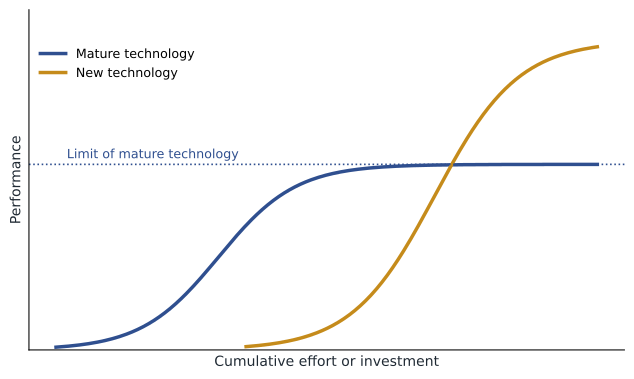
The performance of a technology typically improves along an S-curve when plotted against cumulative effort or investment. Early progress is slow while basic problems are solved, then rapid as the technology matures, then slow again as it approaches physical or practical limits. A new technology often starts below the old one in performance, but its S-curve can rise above the old curve's ceiling. Incumbents committed to the mature technology may keep investing in small improvements while an entrant rides the new curve. Examples include disk drives of successively smaller sizes, film versus digital photography, and internal combustion versus battery-electric drivetrains, where battery costs have fallen sharply over the past decade.
Disruptive innovation
Christensen's theory of disruptive innovation explains why well-managed incumbents often lose to entrants. Incumbents improve products along the dimensions their best customers value, and the improvement eventually overshoots what many customers need. An entrant introduces a simpler, cheaper or more convenient product that underperforms on traditional measures but appeals to overlooked or non-consuming customers (low-end disruption) or creates a new market (new-market disruption). Because the entrant's customers and margins are unattractive to incumbents, the incumbents rationally ignore it. The entrant improves, and eventually its product is good enough for mainstream customers, at which point incumbents struggle to respond because their cost structures, processes and values are built for the old business.
Christensen insisted the term be used precisely: not every successful newcomer is disruptive. A ride-hailing service that started by offering a better product to existing taxi customers in major cities was, in his view, not disruptive in the technical sense, whereas inexpensive cloud-based accounting software that first served micro-businesses using spreadsheets was. Critics have questioned how well the theory predicts outcomes, noting cases where incumbents responded successfully. The theory remains valuable as a warning: the customers and metrics that drive today's profits can blind a firm to tomorrow's threats. Common responses include setting up separate units with their own cost structures to pursue disruptive opportunities, and acquiring promising entrants early.
Standards, network effects and winner-take-most markets
Network effects exist when a product becomes more valuable as more people use it. Direct network effects arise in communication networks: a messaging app with more of your contacts is more useful. Indirect network effects arise through complements: more users of a game console attract more game developers, which attract more users. Strong network effects create demand-side economies of scale, tipping markets toward one or a few dominant standards. That makes early growth and standard-setting crucial and can produce winner-take-most outcomes. Standards battles, such as those over video recording formats, high-definition discs, electric vehicle charging connectors and mobile operating systems, are fought with pricing, alliances, licensing and investment in complements.
Metcalfe's law suggests a network's value grows with the square of the number of users, because the number of possible connections among n users is n(n − 1)/2. Many economists regard that as an overstatement for most networks, since not all connections are equally valuable; some propose growth closer to n log n. Either way, value grows faster than the number of users, which explains why platforms often subsidize early adopters.
# How network value might scale with users under different assumptions (illustrative units)
import math
print(f"{'Users':>8}{'Linear n':>12}{'n log n':>14}{'n(n-1)/2':>16}")
for n in (10, 100, 1_000, 10_000, 100_000):
    print(f"{n:>8}{n:>12,}{n * math.log(n):>14,.0f}{n * (n - 1) // 2:>16,}")
# A rival twice our size: how much more valuable is its network?
ours, theirs = 50_000, 100_000
print("Value ratio under n log n:", round((theirs * math.log(theirs)) / (ours * math.log(ours)), 2))
print("Value ratio under n^2: ", round((theirs ** 2) / (ours ** 2), 2)) Users Linear n n log n n(n-1)/2
10 10 23 45
100 100 461 4,950
1000 1,000 6,908 499,500
10000 10,000 92,103 49,995,000
100000 100,000 1,151,293 4,999,950,000
Value ratio under n log n: 2.13
Value ratio under n^2: 4.0Under the n log n assumption a network twice as large is worth about 2.1 times as much; under the n² assumption, four times as much. The steeper the curve, the stronger the pull toward the largest network and the harder it is for a smaller rival to compete on the same terms. Smaller networks survive when users multi-home (use several platforms at once), when niches have distinct needs, or when switching costs are low.
Platform business models
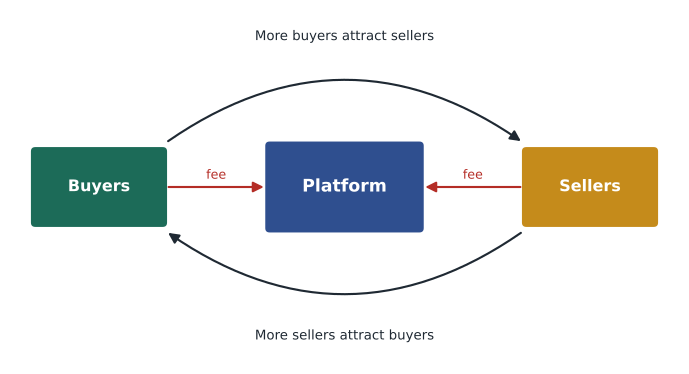
A platform creates value by facilitating interactions between two or more groups: buyers and sellers on a marketplace, riders and drivers, app developers and phone users, advertisers and viewers. Unlike a traditional pipeline business, which creates a product and pushes it to customers, a platform orchestrates an ecosystem it does not fully own. Key strategic questions include which side to subsidize (often the side whose participation attracts the other, or the more price-sensitive side), how to solve the chicken-and-egg problem of attracting both sides at launch, how to maintain quality and trust (ratings, curation, rules), how much value to capture through fees without driving participants to rivals, and how to manage multi-homing and disintermediation, when participants meet on the platform and then transact off it.
# Two-sided platform launch: subsidize buyers or sellers? (seeded simulation, illustrative)
import random
random.seed(42)
def simulate(buyer_fee, seller_fee, months=24):
    buyers, sellers = 100, 20
    revenue = 0.0
    for _ in range(months):
        # each side grows with the size of the other side and shrinks with its own fee
        buyers += int(0.04 * sellers * 10 * (1 - buyer_fee) + random.randint(0, 5))
        sellers += int(0.02 * buyers / 10 * (1 - seller_fee) + random.randint(0, 2))
        revenue += buyers * buyer_fee * 2 + sellers * seller_fee * 40
    return buyers, sellers, revenue
for label, fees in [("charge both", (0.5, 0.5)), ("subsidize buyers", (0.0, 0.6)), ("subsidize sellers", (0.6, 0.0))]:
    b, s, r = simulate(*fees)
print(f"{label:<18} buyers {b:>6} sellers {s:>5} cumulative revenue {r:>10,.0f}")charge both buyers 289 sellers 37 cumulative revenue 18,375 subsidize buyers buyers 469 sellers 46 cumulative revenue 19,896 subsidize sellers buyers 269 sellers 42 cumulative revenue 5,248
The simulation is a toy, but it illustrates the logic: subsidizing the side that most attracts the other can grow both sides and produce more revenue over time than charging both. Real platform pricing depends on elasticity of each side, the strength of cross-side effects, competition and regulation. Competition authorities in both countries now scrutinize platform conduct closely, including self-preferencing, data use and fees charged to business users.
Platform examples: Amazon and Netflix
Amazon illustrates a hybrid of pipeline and platform: it sells goods it buys (first-party retail) and hosts third-party sellers on its marketplace, who now account for a majority of units sold, while charging them fees for listing, fulfillment and advertising. Its cloud business, Amazon Web Services, began as an internal capability and became a separate platform serving other firms. Netflix illustrates how a firm can move from a business built on one technology (mailing discs) to another (streaming) and then integrate backward into producing its own content to reduce dependence on studios that became rivals. In 2025 the US Federal Trade Commission's antitrust case against Amazon continued in court, illustrating the legal scrutiny that comes with platform power.
Capturing value from innovation
Innovators do not always profit from their innovations. David Teece's profiting-from-innovation framework identifies two factors. The first is the appropriability regime: how easily the innovation can be imitated, which depends on patents, copyrights, trade secrets and the tacitness of the knowledge involved. The second is control of complementary assets: manufacturing, distribution, brand, service networks and other capabilities needed to commercialize the innovation. When appropriability is weak, the firm that owns the complementary assets often wins, even if it did not invent the product. That explains why large firms with distribution and brands frequently profit from innovations made by start-ups, and why start-ups often choose to license or sell rather than build complementary assets themselves.
Artificial intelligence and strategy
Artificial intelligence, particularly large language models and other generative systems that spread rapidly from late 2022, raises strategic questions for almost every industry. AI can lower the cost of prediction and content creation, automate parts of knowledge work, personalize products and services, and enable new products. Strategic questions include: Is AI a source of advantage or merely a new cost of doing business that every rival will adopt (operational effectiveness rather than strategy)? Which complementary assets, such as proprietary data, distribution, customer relationships and domain expertise, let a firm capture value from widely available models? How will AI shift the five forces in the firm's industry, for example by lowering entry barriers or creating substitutes? And what governance is needed to manage risks such as errors, bias, privacy breaches and intellectual property disputes, topics BUS-310 lesson 11 and PHOT-420 address?
Early evidence suggests AI tools raise productivity in some tasks, particularly for less experienced workers, while their effect on firm-level advantage depends on how they are combined with proprietary data and redesigned processes. Firms that simply add an AI feature that rivals can buy from the same vendor gain little lasting advantage; firms that use AI to strengthen an existing VRIO resource, such as unique data or deep customer relationships, may. Because the technology and its regulation are changing rapidly, any specific claims about capabilities or market shares should be checked against current sources.
Worked problem
Responding to a potential disruptor
An invented accounting software firm sells feature-rich desktop software to mid-sized companies at high prices. A start-up offers simple cloud bookkeeping for sole proprietors at a low monthly fee, with AI that categorizes transactions automatically. Its product cannot yet handle multi-entity accounting or payroll. Should the incumbent worry, and what should it do?
Show solution
- Is it disruptive? It targets customers the incumbent does not serve well (sole proprietors and non-consumers using spreadsheets), with a simpler, cheaper product: a classic low-end or new-market pattern.
- Trajectory: cloud delivery and AI let the start-up improve quickly; mid-sized features could follow within a few years.
- Incumbent constraints: its sales force, pricing and margins depend on large licenses; a cheap product would cannibalize revenue and look unattractive internally.
- Options: create a separate unit with its own pricing and targets to build a competing cloud product; acquire the start-up; or partner with it. Meanwhile, strengthen switching costs with integrations that mid-sized clients value.
Answer: The incumbent should treat the start-up as a serious threat and respond with an independent unit or acquisition rather than waiting until mainstream customers defect.
Common mistakes
MistakeEvery successful new entrant is a disruptive innovator.
InsteadDisruption refers specifically to entrants that start with overlooked or non-consuming customers using simpler, cheaper offerings.
MistakeThe inventor of a product always profits most from it.
InsteadWhen imitation is easy, owners of complementary assets such as distribution and brand often capture the value.
MistakeNetwork value always grows with the square of users.
InsteadMetcalfe's law overstates most networks; value grows faster than users but often closer to n log n.
MistakeA platform should charge both sides as much as possible.
InsteadPlatforms often subsidize the side that attracts the other to grow the network.
MistakeAdopting AI tools automatically creates competitive advantage.
InsteadWidely available tools give parity; advantage comes from combining them with rare resources and redesigned processes.
Summary and key terms
- Innovation includes product, process, business model and organizational forms; architectural innovations are especially dangerous for incumbents.
- Technologies improve along S-curves; new curves can overtake mature ones.
- Disruptive innovations start with overlooked customers and improve until they threaten incumbents, who rationally ignore them at first.
- Network effects create demand-side scale economies and can tip markets to a dominant standard.
- Platforms orchestrate interactions between groups; pricing, launch, quality and value capture are key choices.
- Profiting from innovation depends on appropriability and control of complementary assets.
- AI is a widespread capability; advantage depends on proprietary complements and governance.
- Architectural innovation
- Reconfiguring existing components into a new system.
- S-curve
- The pattern of slow, then rapid, then slow improvement in a technology's performance.
- Disruptive innovation
- A simpler, cheaper offering that starts with overlooked customers and later displaces incumbents.
- Network effect
- An increase in a product's value as more people use it.
- Indirect network effect
- Value that rises through more complements as the user base grows.
- Platform
- A business that creates value by facilitating interactions between groups.
- Multi-homing
- Using several competing platforms at the same time.
- Appropriability regime
- The conditions that determine how easily an innovation can be imitated.
- Complementary assets
- Capabilities such as distribution and brand needed to commercialize an innovation.
- Standards battle
- Competition between incompatible technologies to become the industry standard.
Practice problems
Work each problem on paper first, then reveal the answer to check.
Distinguish modular from architectural innovation.
Show answer
Modular changes a component's core concept; architectural changes how existing components link together.
Why might incumbents ignore a disruptive entrant?
Show answer
Its customers and margins look unattractive compared with the incumbent's best customers.
How many possible connections exist among 20 users?
Show answer
20 × 19 ÷ 2 = 190.
Give an example of an indirect network effect.
Show answer
More console owners attract more game developers, which attract more owners.
What is the chicken-and-egg problem for platforms?
Show answer
Each side wants the other side to be present before joining.
When do owners of complementary assets capture an innovation's value?
Show answer
When the innovation is easy to imitate and commercialization requires those assets.
Name two responses to disruption.
Show answer
A separate unit with its own cost structure; acquiring the entrant.
Why might AI not create lasting advantage?
Show answer
Rivals can buy the same tools; advantage requires rare complements.
What is disintermediation on a platform?
Show answer
Participants meet on the platform and then transact off it to avoid fees.
Portfolio task: analyze a platform business, identifying its sides, which side it subsidizes and how it captures value.
Show answer
Answers vary; support with evidence from company reports.
Lesson quiz · 5 questions
Score 60% or more to complete this lesson.
Create a free account to save your progress, take quizzes and earn a certificate.