
BLR-340 · Lesson 9 of 12 · 19 min
Tanks and field erection review
Bernie Thibault, the tank superintendent from Tank 15 in BLR-230, takes the tank night. Most of the group have built more boilers than tanks, and Bernie knows it. "On the test, tanks share their part with boilers, vessels and codes," he says. "That's twenty questions, and a fair few of them are tanks, stacks or bolting. You don't get to say you've never built one." Bolting also turns up in maintenance and testing questions. This lesson reviews tank types and standards, foundations and bottoms, shell erection, shell design and tolerances, roofs and seals, nozzles and appurtenances, stacks and ducts, bolting, and inspection and testing, as taught in BLR-230.
Tank types and standards
Large welded steel storage tanks for oil and petroleum products are built to API Standard 650, whose current edition was published in 2025, and inspected and repaired in service under API 653. Water tanks are usually built to AWWA D100. Tanks are grouped by their roofs. A fixed cone roof or dome roof tank has a roof attached to the shell and a vapor space that breathes through vents. An internal floating roof tank has a fixed roof with a floating deck inside it that rides on the liquid and cuts evaporation. An external floating roof tank has no fixed roof; the floating roof is the only cover, and it is sealed against the shell by a primary and a secondary seal. Bolted tanks, assembled from factory-coated panels, are used for smaller volumes such as oilfield production. BLR-230 lessons 1 and 2 cover tank types.
| Tank type | Typical use | Key features |
|---|---|---|
| Cone or dome roof | Low-volatility products, water | Roof fixed to the shell; vapor space vented |
| Internal floating roof | Volatile products where weather protection is needed | Floating deck under a fixed roof |
| External floating roof | Crude oil and volatile products in large tanks | Roof rides on the liquid; rim seals; roof drain |
| Bolted | Small production tanks | Coated panels bolted with gaskets |
Foundations and bottoms
A tank stands on a prepared foundation, usually a compacted granular pad inside a concrete ringwall under the shell, with the top built to a slight cone so that the bottom drains to the edge or to a sump. The ringwall's top must be level within the standard's tolerance around its whole circumference, because an uneven ringwall puts the shell out of plumb before the first course is set. Bottom plates are laid on the pad and lap-welded, with the laps arranged so that water drains off them; under the shell, thicker annular plates are butt-welded into a ring that carries the shell's weight. The shell-to-bottom joint is welded on both sides with fillets. BLR-230 lesson 3 covers foundations and bottoms.
Shell erection
Tank shells are erected in one of two ways. In conventional erection the first course is set on the bottom, then each course is lifted into place on top of the one below, with the crew working from scaffolds or climbing work platforms that are raised as the shell rises. In jacking erection the top course and the roof are built first, near the ground, and the whole assembly is lifted by hydraulic jacks set around the inside of the shell; each lower course is then wrapped around beneath and welded on, and the jacking repeats until the bottom course is reached. Jacking keeps most of the welding near the ground and is common for smaller and medium tanks. BLR-230 lesson 4 covers both methods, and the Tank 15 capstone used conventional erection.
Worked problem
Jacking a shell
A shell with its roof weighs 310,000 lb at the stage when the last course is to be added, and the jacks are rated at 26,000 lb each. With a 25 percent margin on the jack load, how many jacks are needed?
Show solution
- Apply the margin: each jack may carry 80 percent of its rating, so the usable capacity is 20,800 lb per jack.
- Divide the load by the usable capacity: 310,000 / 20,800 = 14.9.
- Round up, and use an even spacing around the shell.
Answer: 15 jacks, though in practice the next convenient even number, 16, would be used for equal spacing.
Shell design and tolerances
API 650 gives two methods for calculating the shell thickness of each course; the simpler, the one-foot method, can be used for tanks up to 200 ft in diameter. It calculates each course's thickness from the liquid height above a point 1 ft above the bottom of that course, which is where the method takes its name, the tank diameter, the liquid's specific gravity, the allowable stress and the corrosion allowance. Lower courses carry more liquid head, so the shell is thickest at the bottom. The standard also sets minimum thicknesses by diameter, which control the upper courses of large tanks.
Here t is in inches, D the diameter in feet, H the liquid height above the bottom of the course in feet, G the specific gravity, S the allowable stress in psi and CA the corrosion allowance in inches.
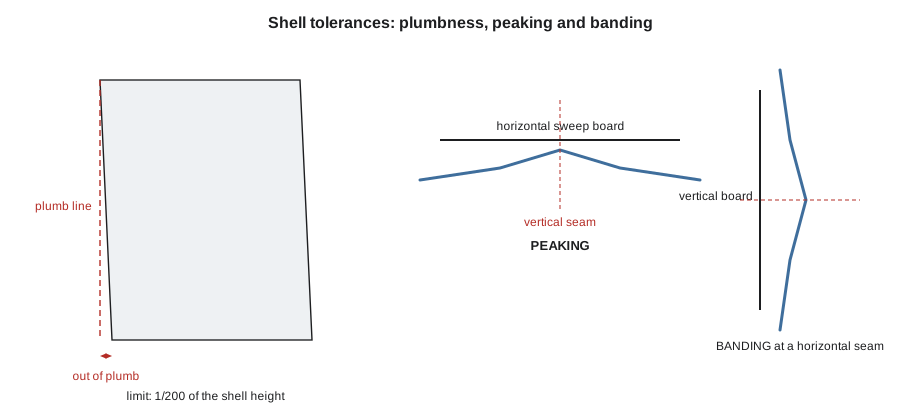
The shell must also be erected to tolerances that the standard sets. The plumbness of the shell, the amount by which its top is out of line with its bottom, must not exceed 1/200 of the shell height. The radius at the bottom of the shell must be within a tolerance that grows with the tank's diameter. Peaking, the inward or outward point at a vertical seam, and banding, the bulge or dent at a horizontal seam, are each limited, commonly to 1/2 in measured with a 36 in board or template. BLR-230 lesson 5 covers tolerances.
import math
# Tanks review: capacity, one-foot method shell thickness and plumbness
D, H = 100.0, 48.0                        # tank diameter and shell height
print(f"nominal capacity {math.pi * D ** 2 / 4 * H / 5.615:,.0f} barrels")
G, CA, S = 0.9, 0.0625, 23200               # specific gravity, corrosion allowance, allowable stress
for course in range(1, 4):
    Hc = H - (course - 1) * 8.0         # liquid height above the bottom of this course
    t = 2.6 * D * (Hc - 1) * G / S + CA
    print(f"course {course}: liquid above it {Hc:.1f} ft, design thickness {t:.3f} in")
for height, lean in [(576, 2.5), (576, 3.25)]:
    allowed = height / 200
print(f"plumbness at {height} in: {lean} out, allowed {allowed:.2f} ->", "ok" if lean <= allowed else "out of tolerance")nominal capacity 67,140 barrels course 1: liquid above it 48.0 ft, design thickness 0.537 in course 2: liquid above it 40.0 ft, design thickness 0.456 in course 3: liquid above it 32.0 ft, design thickness 0.375 in plumbness at 576 in: 2.5 out, allowed 2.88 -> ok plumbness at 576 in: 3.25 out, allowed 2.88 -> out of tolerance
The three bottom courses of the 100 ft tank come out at 0.537, 0.456 and 0.375 in for crude oil with a specific gravity of 0.9, which shows the thickness falling by about 0.08 in for each 8 ft course. The plumbness check allows 2.88 in over the 48 ft shell, so a reading of 2 1/2 in is acceptable and one of 3 1/4 in is not.
Roofs, seals and appurtenances
Fixed cone roofs are supported by rafters on a center column or are self-supporting, and many are built with a frangible roof-to-shell joint, a weak seam that is designed to fail first if the tank is over-pressured, so the roof lifts rather than the bottom tearing out. Floating roofs are pontoon or double-deck, with legs that support them when the tank is empty, a drain to carry rainwater away, and rim seals that are inspected for gaps; the US air rules under 40 CFR 60 subpart Kb and similar Canadian requirements limit the gaps for tanks storing volatile liquids. Nozzles, manways and clean-out doors are set into the shell with reinforcement, and the standard sets minimum spacing between openings and from shell seams. BLR-230 lessons 6 and 7 cover roofs and appurtenances.
Stacks, breeching and ducts
Stacks, breeching and ductwork carry flue gas and combustion air in boilers and process heaters. They are built of rolled and welded plate, often with stiffener rings, expansion joints to allow for thermal growth, and inside linings or outside insulation. Tall steel stacks are designed for wind, and some need devices such as helical strakes that break up the vortices wind sheds as it flows around them, which can otherwise shake the stack. Duct transitions, such as square-to-round sections, are developed by triangulation, as reviewed in lesson 6. BLR-230 lesson 8 covers stacks and ducts.
Bolting
Two kinds of bolting are on the exam. Structural bolting joins steel members with high-strength bolts, such as ASTM F3125 Grade A325 or A490, under the RCSC specification and, in Canada, CSA S16. Joints are snug-tight, which is the tightness from a few impacts of an impact wrench or the full effort of a worker on a spud wrench, or pretensioned, in which the bolts are brought to a minimum tension by an approved method: turn-of-nut, calibrated wrench, twist-off tension-control bolts or direct tension indicators. In turn-of-nut, the nut is turned a set amount beyond snug, such as one-third of a turn for bolts up to four diameters long. Flange bolting on pressure joints follows ASME PCC-1, with a set tightening pattern and passes at rising percentages of the target torque, as reviewed in lesson 11. BLR-230 lessons 9 and 10 cover bolting.
| Method | How the tension is controlled |
|---|---|
| Turn-of-nut | Snug, then a set rotation of the nut, marked on nut and bolt |
| Calibrated wrench | A wrench set daily on a tension-measuring device to reach the tension |
| Twist-off bolt | The spline snaps off at the design tension |
| Direct tension indicator | Bumps on a special washer flatten to a set gap |
Inspection and testing of tanks
Tank welds are inspected as the work goes on. Bottom welds are tested with a vacuum box: soapy solution is brushed on the weld, a box with a window is pressed over it and evacuated, commonly to about 3 psi below atmospheric, and bubbles show leaks. Shell butt welds are spot radiographed at a rate the standard sets, which depends on plate thickness and is higher in the lower courses. The shell-to-bottom weld may be tested with penetrant, magnetic particle or a vacuum box, or by pressurizing the space between the inside and outside fillets. Reinforcing pads are tested through their telltale holes. Finally, the tank is hydrotested by filling it with water to its design liquid level and holding it, while the foundation is surveyed at points around the shell for settlement and the shell is inspected for leaks. BLR-230 lesson 11 covers testing, and the Tank 15 capstone followed a hydrotest in which one settlement point went over its limit before leveling off.
Traps in tank questions
Bernie's traps: measuring the liquid height from the top of the course instead of from the bottom in the one-foot method; using the shell's full height for every course; confusing peaking, which is at vertical seams, with banding, at horizontal seams; thinking a frangible roof joint is a defect; and thinking a hydrotest is done with air. Tanks are always hydrotested with water.
Settlement during the hydrotest
The hydrotest of a new tank is also a test of its foundation. As the tank fills, the foundation compresses, and the shell settles. A tank that settles evenly is not a concern; uneven settlement around the shell, or between the shell and the center, can distort the shell, overstress the bottom and the shell-to-bottom weld, and jam a floating roof. Settlement is measured by surveying points equally spaced around the base of the shell, commonly every 30 ft or so and at least eight points, before filling, at intervals during filling, at full and after the hold. The engineer sets the acceptance limits for differential settlement between adjacent points and around the circumference, and the fill rate is slowed or stopped if the readings approach them.
On Tank 15 in BLR-230, one point near the water draw-off sump, where the backfill was looser, went past its limit at the 24-hour reading at full. The fill was held, readings were taken daily, and the settlement leveled off after two more days, so the engineer accepted the test. A question that asks what to do when a settlement reading exceeds its limit wants you to stop filling, keep the tank at its current level and inform the engineer, not to drain it immediately or carry on filling.
Common mistakes
MistakeUsing the same liquid height for every course.
InsteadEach course carries the liquid above its own bottom; lower courses are thicker.
MistakeCalling a seam bulge at a horizontal joint peaking.
InsteadPeaking is at vertical seams; banding is at horizontal seams.
MistakeTaking turn-of-nut rotation from finger tight.
InsteadRotation is counted from snug tight.
MistakeTesting tank bottom welds with a pressure test of the shell.
InsteadBottom lap welds are vacuum box tested before the hydrotest.
Summary and key terms
- Oil storage tanks are built to API 650 and inspected and repaired under API 653.
- Floating roofs reduce evaporation and are sealed to the shell with rim seals.
- Jacking builds the top first and lifts the shell; conventional erection builds from the bottom up.
- The one-foot method uses the liquid height above a point 1 ft above the bottom of each course.
- Plumbness is limited to 1/200 of the shell height; peaking and banding to about 1/2 in over a 36 in board.
- Structural bolts are snug-tight or pretensioned by an approved method; tank bottoms are vacuum box tested and tanks hydrotested.
- API 650
- The standard for welded steel tanks for oil storage.
- Annular plate
- A thicker butt-welded ring of bottom plate under the shell.
- Jacking erection
- Building a tank shell from the top down by lifting it on jacks and adding courses below.
- Plumbness
- How far the top of a shell is out of line with its bottom.
- Peaking
- An inward or outward point in a shell at a vertical seam.
- Frangible roof joint
- A weak roof-to-shell seam designed to fail first if a tank is over-pressured.
Practice problems
Work each problem on paper first, then reveal the answer to check.
A tank shell is 40 ft high. What plumbness is allowed?
Show answer
480 / 200 = 2.4 in, about 2 3/8 in.
Which erection method keeps most welding near the ground?
Show answer
Jacking erection.
How is a tank bottom lap weld tested?
Show answer
With a vacuum box and soap solution, looking for bubbles.
When is a structural bolt's turn-of-nut rotation counted from?
Show answer
From the snug-tight condition, with nut and bolt end marked.
Lesson quiz · 5 questions
Score 60% or more to complete this lesson.
Create a free account to save your progress, take quizzes and earn a certificate.