
BLR-340 · Lesson 4 of 12 · 19 min
Rigging and lifting review
Rigging and hoisting carry 25 percent of the committee's written test, and rigging also turns up in the practical test, where each candidate rigs and signals a lift in the training yard. Dale takes the rigging night himself, with Wade Kozak, the lift director from the Northgate coker drum lift in BLR-120, as a guest. "Rigging questions are mostly arithmetic and judgment," Wade says. "The arithmetic is three or four formulas. The judgment is knowing when the numbers say stop." This lesson reviews load weight and center of gravity, slings and hitches, sling angles and leg tensions, hardware, crane capacity and the critical lift, ground bearing, tandem lifts and signals.
Load weight and center of gravity
Every lift starts with the weight. For steel, the weight is the volume times the density, 490 pounds per cubic foot, and a plate's weight per unit area is a number worth remembering: about 40.8 pounds per square foot for every inch of thickness. Vessels and boiler components are built up from their parts: shell, heads, nozzles, internals, trays, insulation, refractory and anything left inside, such as water from a hydrotest or deposits. The manufacturer's data report or drawing gives an empty weight, but a vessel coming out of service can weigh much more than its nameplate. BLR-120 lesson 2 works through a full weight build-up.
The center of gravity is the point where the weight acts. A load lifted from a single hook point settles with its center of gravity directly below the hook, and a load whose pick points are not balanced about its center of gravity tilts until it is. For a load built up from parts, the center of gravity is found by taking moments: each part's weight times its distance from a reference line, added up and divided by the total weight. Exam questions often give a load with two parts and ask where its center of gravity is, or give the center of gravity and ask which leg of a bridle carries more load. The leg nearer the center of gravity always carries more.
Worked problem
Finding the center of gravity
A horizontal drum weighs 13,000 lb with its center of gravity at its middle, 10 ft from the left end. A 2,600 lb nozzle assembly is welded on 18 ft from the left end. Where is the center of gravity of the whole load?
Show solution
- Take moments about the left end: 13,000 × 10 = 130,000 and 2,600 × 18 = 46,800, total 176,800 lb·ft.
- Total weight 15,600 lb.
- Divide the total moment by the total weight.
Answer: 11.3 ft from the left end, moved toward the nozzle.
Slings, hitches and angles
A sling's rated capacity, or working load limit, is marked on its tag for each type of hitch. In a vertical hitch the sling takes the load straight. In a choker hitch the sling is wrapped round the load and passed through its own eye, and the bend at the choke reduces its capacity, typically to about three-quarters of the vertical rating for a choke angle of 120 degrees or more and less for a sharper choke. In a basket hitch the sling passes under the load with both eyes on the hook, and with the legs vertical it carries twice the vertical rating. A sling with no tag, or a tag that cannot be read, is removed from service, because its capacity cannot be known.
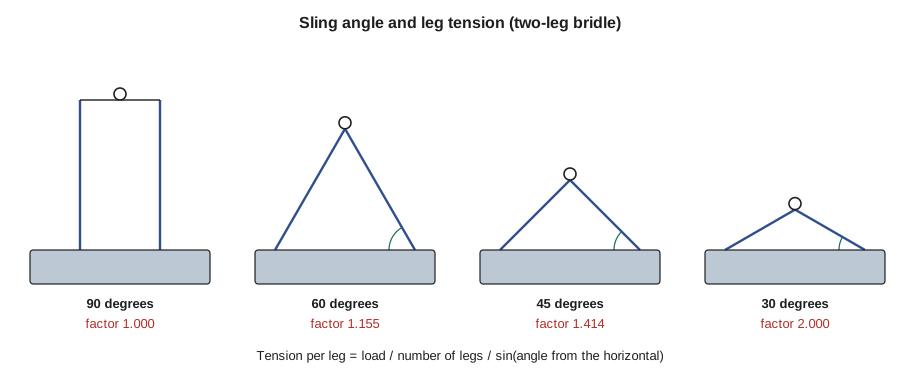
When two or more legs are used at an angle, each leg carries more than its share of the weight, because it pulls sideways as well as up. The angle is measured from the horizontal, and the tension in each leg of a symmetric bridle is the share of the load divided by the sine of that angle. At 60 degrees the factor is 1.155, at 45 degrees 1.414, and at 30 degrees 2.0, which means each leg carries the whole weight of the load. Below 30 degrees the factor climbs very fast, and most rigging practice does not allow sling angles below 30 degrees. This is the single most tested calculation in rigging, and the most common mistake is measuring the angle from the vertical.
Here T is the tension in each leg, W the load, n the number of legs carrying it, and θ the sling angle from the horizontal. When the legs are unequal, as with an off-center load, the vertical share of each leg is found by moments about the center of gravity, and each leg's tension is its vertical share times its length divided by the hook height above the pick points. The code below does both, then checks the gross load against the crane chart.
import math
# Rigging review: sling tension on a two-leg bridle and the crane's percent of capacity
LOAD = 40000          # load weight
U = "lb"
for angle in (90, 60, 45, 30):          # sling angle measured from the horizontal
    t = LOAD / 2 / math.sin(math.radians(angle))
    print(f"sling angle {angle:2d} deg  factor {1 / math.sin(math.radians(angle)):.3f}  tension per leg {t:7.0f} {U}")

# Unequal legs: the leg nearer the CG takes more of the load
a, b = 6.5, 10.0         # horizontal distances from the CG to each pick point
h = 13.0                 # height of the hook above the pick points
L1, L2 = math.hypot(a, h), math.hypot(b, h)
V1, V2 = LOAD * b / (a + b), LOAD * a / (a + b)
print(f"near leg: vertical {V1:.0f} {U}, tension {V1 * L1 / h:.0f} {U}")
print(f"far leg:  vertical {V2:.0f} {U}, tension {V2 * L2 / h:.0f} {U}")

RIG = 2100             # block, slings, shackles and spreader
CAP = 54000             # chart capacity at the planned radius
gross = LOAD + RIG
print(f"gross load {gross:.0f} {U} = {100 * gross / CAP:.1f} % of chart capacity",
"-> critical lift" if gross / CAP >= 75 / 100 else "")sling angle 90 deg factor 1.000 tension per leg 20000 lb sling angle 60 deg factor 1.155 tension per leg 23094 lb sling angle 45 deg factor 1.414 tension per leg 28284 lb sling angle 30 deg factor 2.000 tension per leg 40000 lb near leg: vertical 24242 lb, tension 27104 lb far leg: vertical 15758 lb, tension 19880 lb gross load 42100 lb = 78.0 % of chart capacity -> critical lift
At 45 degrees each leg of the bridle on the 40,000 lb drum carries 28,284 lb, so slings rated at less than about 14 tons in that hitch cannot be used even though the load per leg looks like 10 tons. The off-center case shows the leg nearer the center of gravity carrying 24,242 lb vertically and 27,104 lb along its length. And the gross load, which includes the block, slings, shackles and spreader, is 78 percent of the chart capacity, which makes it a critical lift under Ironbridge's rules.
Hardware and below-the-hook devices
Shackles, hooks, eyebolts, plate clamps and lifting lugs each have their own rules, covered in BLR-120 lesson 3. Shackles are rated for an in-line pull; a side load reduces the capacity, by half at 90 degrees under typical manufacturers' tables, and the pin must be fully screwed in or, for long-term use, a bolt-type shackle used. Eyebolts are rated for a straight pull; shoulder eyebolts can take an angled pull with a reduced rating, and plain-shank eyebolts should not be loaded at an angle at all. Hooks need a working safety latch, and the load must sit in the bowl of the hook, not on the tip. Below-the-hook devices such as spreader beams and lifting beams are marked with their rated load and their own weight, which is part of the rigging weight on the crane. Lifting lugs on vessels are designed by an engineer for a specific load and direction, and using a lug at a different angle from the one it was designed for is a common cause of failures.
Crane capacity, the lift plan and the critical lift
A crane's load chart gives the gross capacity at each radius and boom length, for the configuration stated: counterweight, outriggers fully extended or tracks, and the area over which the load is swung. The gross load includes the load, the hook block, the slings and hardware, the spreader, and any jib or attachment deductions stated on the chart. Radius is measured horizontally from the center of rotation to the center of the hook, and it grows when the boom deflects under load, so a lift planned at the edge of the chart can end up beyond it. BLR-120 lesson 4 covers charts in full.
OSHA's crane rule for construction requires a qualified rigger, a qualified signal person and an operator certified for the crane type, and requires a lift director and a written plan for lifts with more than one crane. Many companies, Ironbridge among them, treat any lift at 75 percent or more of the chart capacity as a critical lift needing a full critical lift plan. Other triggers for a critical lift include tandem lifts, lifts over operating plant or occupied areas, lifts of personnel, and lifts of unusual or high-value loads. The plan states the load and rigging weights, the crane configuration, radius and capacity at each stage of the lift, the ground preparation, the rigging arrangement, the people and their roles, the signals, and the conditions under which the lift stops, such as wind speed. It is reviewed and signed before the lift, and the crew is briefed on it. BLR-120 lesson 11 covers critical lift planning.
| Item | Included in the gross load? |
|---|---|
| The load itself, including contents | Yes |
| Hook block or headache ball | Yes |
| Slings, shackles, spreader beam | Yes |
| Stowed jib or attachments, as the chart states | Yes, as a deduction from capacity |
| Crane counterweight | No; it is part of the crane configuration |
| Outrigger mats | No; they support the crane |
Ground, tandem lifts and signals
The crane is only as stable as the ground under it. Outrigger loads on a large crane can be many times the bearing capacity of the soil, so mats spread the load over a larger area: the ground pressure is the outrigger load divided by the mat's effective area. Underground services, recent excavations and soft fill are the usual hazards. BLR-120 lesson 6 works through ground bearing.
A tandem lift uses two cranes, either to share a load or, when upending a vessel, with a tailing crane holding the bottom while the main crane raises the top. The load on each crane changes through the lift: as a vessel is upended the tailing crane's share falls and the main crane's rises until the main crane carries it all. Each crane must have capacity for its maximum share at the radius it will be at, plus a margin. BLR-120 lesson 7 covers tandem lifts.
Every lift has one designated signal person, who is the only person giving signals to the operator, except that anyone may give the emergency stop. Hand signals follow the standard chart in OSHA's crane rule; radios are used where the operator cannot see the signal person, with a dedicated channel and continuous talk during the lift. BLR-120 lesson 10 covers signals.
Traps in rigging questions
Wade's list of traps: measuring the sling angle from the vertical; forgetting the rigging weight in the gross load; using a sling's vertical rating for a choker hitch; dividing the load by four for a four-leg bridle when only two legs can be relied on to carry it, which is common practice because a rigid load rarely sits evenly on four legs; reading the chart at the planned radius instead of the radius after boom deflection; and assuming that the leg farther from the center of gravity carries more. Each of these appears as a distractor in practice questions, and each has caused real accidents.
Common mistakes
MistakeMeasuring the sling angle from the vertical.
InsteadMeasure from the horizontal; at 30 degrees the factor is 2.0.
MistakeChecking only the load weight against the chart.
InsteadAdd the block, slings, hardware and spreader; the chart gives gross capacity.
MistakeSharing a rigid load equally over four legs.
InsteadAssume two legs carry it unless the rigging is designed to equalize.
MistakeUsing a sling with a missing tag because it looks fine.
InsteadNo tag means no known capacity; remove it from service.
Summary and key terms
- Weight and center of gravity come first; the leg nearer the center of gravity carries more.
- Choker hitches reduce a sling's capacity; basket hitches with vertical legs double it.
- Leg tension is the load share divided by the sine of the angle from the horizontal.
- Below 30 degrees sling angles are not used in most rigging practice.
- The gross load includes all rigging and is checked against the chart at the real radius.
- Multi-crane lifts need a lift director and a plan under OSHA; many companies treat lifts at 75 percent or more as critical lifts.
- Working load limit
- The maximum load a sling or fitting is rated to carry in a stated hitch.
- Sling angle
- The angle between a sling leg and the horizontal.
- Gross load
- The load plus the hook block and all rigging, checked against the crane chart.
- Critical lift
- A lift that needs a full written plan because of its size, method or location.
- Tailing crane
- The crane that holds the bottom of a vessel while it is upended.
- Designated signal person
- The one person who gives signals to the crane operator during a lift.
Practice problems
Work each problem on paper first, then reveal the answer to check.
A two-leg bridle lifts 18,000 lb at 60 degrees. What is the tension in each leg?
Show answer
18,000 / 2 / 0.866 = 10,392 lb.
What is the load factor at a sling angle of 30 degrees?
Show answer
2.0: each leg carries the whole load.
A crane chart gives 66,000 lb at the planned radius. The load is 47,000 lb and the rigging 2,600 lb. Is this a critical lift under the 75 percent rule?
Show answer
Yes: 49,600 / 66,000 = 75.2 percent.
Why is the radius after boom deflection important?
Show answer
The boom bends under load, the radius grows and the capacity falls; the chart must be read at the real radius.
Lesson quiz · 5 questions
Score 60% or more to complete this lesson.
Create a free account to save your progress, take quizzes and earn a certificate.