
BLR-340 · Lesson 2 of 12 · 19 min
Study strategy and the apprenticeship standards
On the second study night Dale puts a thick binder on the table. "This is what the tests are written from," he says. "Not the old handouts, this." It holds the apprenticeship standards for Kiera's program, which list the work processes an apprentice must learn on the job and the classroom subjects she must cover, and the training center's curriculum, which follows NCCER's boilermaker modules. Tonight the group uses them to build a study plan: which topics to study, in what order, for how long, and how to make the studying stick. The plan has to fit around ten-hour shifts at the Port Allen yard, which means it has to use short sessions well rather than rely on long ones.
Apprenticeship standards and the curriculum
A registered apprenticeship is governed by its standards, a document approved by the Department of Labor or the state agency that registers the program. The standards set the length of the apprenticeship, the ratio of apprentices to journeymen, the wage progression, and two lists that matter for study: the work processes, which are the skills the apprentice must learn on the job with the approximate hours for each, and the related instruction, which is the classroom subjects. Joint programs under the Boilermakers National Apprenticeship Program use national standards adapted by each area. The training center's curriculum follows NCCER's boilermaker modules, organized in levels from basic safety and tools to advanced rigging, layout and repair work. The written test draws on both the work processes and the curriculum, so those two lists are the map of what can be asked.
For study, the standards and curriculum are useful in two ways. First, they tell you what is in scope: if a topic is on the lists, it can be asked even if your contractor never does that kind of work. Kiera has done little tank work and less shop layout of cones, but both are in the curriculum and both can be on the test. Second, the work process list doubles as a self-assessment: rate your own confidence in each process from 1 to 5, honestly, and the low scores show you where to spend your time.
| Layer | What it describes | Example |
|---|---|---|
| Area of the blueprint | A large group of work, with a share of the exam | Rigging and hoisting |
| Work process | A complete piece of work | Plan a lift |
| Skill within the process | One part of the task | Calculate the load on each leg of a bridle |
| Performance check | What competent work looks like | Leg tensions are calculated and slings selected with the right capacity |
| Knowledge | What you need to know to do it | Sling angle factors, hitch types, rated capacities |
How memory works, and why it matters for study
Most people study by reading their notes again and again. It feels productive, because the material becomes familiar, but familiarity is not the same as being able to recall something under pressure. The research on learning is clear on a few points, and the study group builds its plan on them. Recalling something from memory strengthens that memory far more than reading it again; this is called retrieval practice, and the simplest form is answering questions without looking at the notes. Spacing study sessions out over days and weeks gives better long-term memory than the same time crammed into one session. Mixing topics within a session, called interleaving, is harder than studying one topic at a time but trains you to recognize which method a problem needs, which is exactly what an exam tests. And sleep matters: memories are consolidated during sleep, so a tired brain at midnight learns less than the same brain at seven in the evening.
For a working apprentice these points lead to a practical routine. Short sessions of 30 to 45 minutes on most days beat a single long session on the weekend. Each session starts with questions on earlier topics, then covers something new, then ends with questions on what was just covered. Notes are turned into questions and flashcards rather than reread. And the plan is written down, with dates, so that the topics with the most questions and the weakest self-ratings get the most time.
Building the plan
The group starts with the five areas of the committee's blueprint, their weights and Kiera's own ratings: she rates safety and access 4 out of 5, rigging 3, layout, fitting and welding 3, boilers, vessels, tanks and codes 2, and maintenance and testing 2. The low rating for maintenance surprises Dale, since repair work is most of what she has done, but Kiera points out that the test asks about all of it, including repairs she has never seen, such as tube sheet work in a shop and recovery boiler floors. She has about 60 hours to study before her test date. The plan gives each topic time in proportion to its weight multiplied by how weak it is, so a heavily weighted, weakly rated topic gets the most time.
Here w is the topic's exam weight and r is the self-rating from 1 to 5, so a topic rated 1 counts five times as heavily as one rated 5 for the same weight. The code below shares out the hours, then shows how a flashcard moves through a simple box system for spaced review.
# Study planner: share study hours by exam weight and by how weak each topic is,
# then schedule flashcard reviews with a simple box system (Leitner)
topics = [("Safety and access", 15, 4), ("Rigging and hoisting", 25, 3), ("Layout, fitting and welding", 25, 3), ("Boilers, vessels, tanks and codes", 20, 2), ("Maintenance and testing", 15, 2)]   # (topic, exam weight in percent, self-rating 1 = weak .. 5 = strong)
HOURS = 60     # study hours available before the exam

need = {t: w * (6 - r) for t, w, r in topics}
total = sum(need.values())
print(f"{'Topic':34} weight rating hours")
for t, w, r in topics:
    print(f"{t:34} {w:5d} {r:6d} {HOURS * need[t] / total:6.1f}")

# Leitner boxes: a card moves up a box when answered right, back to box 1 when missed
GAP = {1: 1, 2: 3, 3: 7, 4: 14, 5: 30}   # days until the next review
results = ["right", "right", "wrong", "right", "right", "right"]
box, day = 1, 0
for r in results:
    box = min(box + 1, 5) if r == "right" else 1
    day += GAP[box]
print(f"answer {r:5} now in box {box} next review on day {day}")Topic weight rating hours Safety and access 15 4 5.6 Rigging and hoisting 25 3 14.1 Layout, fitting and welding 25 3 14.1 Boilers, vessels, tanks and codes 20 2 15.0 Maintenance and testing 15 2 11.2 answer right now in box 2 next review on day 3 answer right now in box 3 next review on day 10 answer wrong now in box 1 next review on day 11 answer right now in box 2 next review on day 14 answer right now in box 3 next review on day 21 answer right now in box 4 next review on day 35
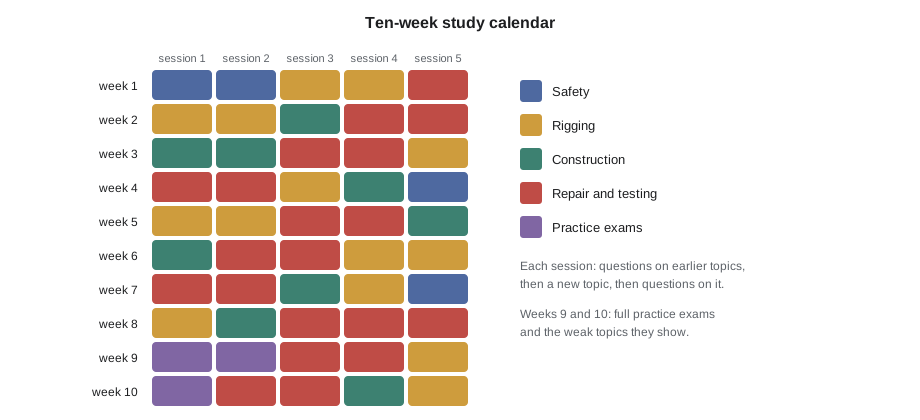
The plan gives boilers, vessels, tanks and codes 15 of the 60 hours, rigging and layout about 14 each, maintenance and testing about 11 and safety under 6. Kiera turns that into a weekly calendar: five sessions a week of about 45 minutes, plus a longer session in the study group, over ten weeks, with the last two weeks kept for practice tests and the topics those tests show to be weak.
Flashcards and spaced review
Flashcards are the simplest tool for retrieval practice, and they work for the facts an exam asks for: limits, definitions, names, sequences and which formula to use. A good card asks one thing and has a short answer. "What is the minimum oxygen level for entry?" is a good card; "Everything about confined spaces" is not. Cards can be paper or on a phone app; what matters is that you try to answer before you turn the card over.
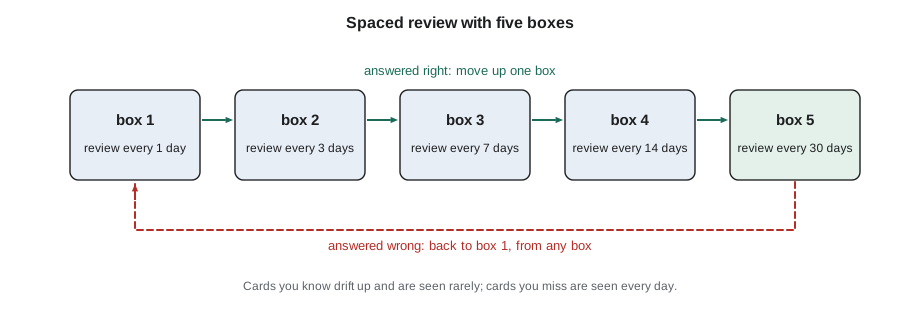
The box system, named after Sebastian Leitner, who described it in the 1970s, spaces the reviews automatically. Every new card starts in box 1, which is reviewed every day. A card answered correctly moves up a box, and each higher box is reviewed less often: every three days, every week, every two weeks, every month. A card answered wrongly goes back to box 1, however high it was. The cards you know drift up and are seen rarely; the cards you do not know stay low and are seen often. The code above follows one card through six reviews, including one miss, and shows when each review falls.
Worked problem
Writing good questions from notes
Kiera's notes from the rigging course say: "Sling angle measured from the horizontal. Below 30 degrees not allowed in most rigging practices. Load per leg = load / number of legs / sin(angle)." Turn this into flashcards.
Show solution
- Split the note into single facts, each with a short answer.
- Card 1: From what is the sling angle measured in the load factor formula? Answer: the horizontal.
- Card 2: What is the usual minimum sling angle? Answer: 30 degrees from the horizontal.
- Card 3: What is the load factor at 45 degrees? Answer: 1.414.
- Card 4 is a problem card: a two-leg bridle lifts 20,000 lb at 60 degrees; what is each leg's tension? Answer: 11,547 lb.
Answer: Four cards, each testing one thing; the problem card trains the method, not just the fact.
Practice questions and the error log
Practice questions are the most valuable part of the plan, because they are what the exam is. The study group writes its own questions in the exam's style, swaps them, and answers each other's under time. Every wrong answer goes into an error log: the question, the answer chosen, the right answer, and, most important, why the wrong answer was chosen. The reasons fall into a few groups: did not know the fact, knew it but misread the question, used the wrong method, made an arithmetic slip, or ran out of time. Each needs a different fix. Not knowing a fact needs a flashcard; misreading needs slower reading; a wrong method needs a worked example; arithmetic slips need the habit of checking the size of the answer; and running out of time needs practice under time.
Kiera's first error log, after a 30-question set on rigging, shows nine wrong answers. Three were facts she had forgotten, four were the wrong sling angle measured from the vertical, and two were misread questions that asked for the minimum and she answered the recommended value. Four of nine from one method mistake is a pattern, and Dale spends the next session on nothing but sling angles. On the next set she misses two.
| Reason for the wrong answer | Fix |
|---|---|
| Did not know the fact | Make a flashcard and add it to box 1 |
| Misread the question | Read to the end; find the key word: not, except, first, minimum |
| Used the wrong method | Redo a worked example; write the method on a card |
| Arithmetic slip | Estimate the answer's size before choosing; check units |
| Ran out of time | Practice under time; mark and move on |
Looking after yourself
Studying around shift work is hard, and the group is honest about it. A ten-hour day of grinding and fitting leaves little energy, and studying when exhausted wastes time. The plan puts the hardest sessions on lighter days and the flashcards, which take ten minutes, on the hard days. Sleep comes before late-night study. A good meal and a walk before the study session help more than another coffee. Kiera's employer gives her two paid days off before the exam, which many contractors do, and she uses one for the last practice exam and the other for rest. Exam nerves are normal; the best cure for them is practice under exam conditions, so that the real thing feels familiar.
Common mistakes
MistakeRereading notes until they feel familiar.
InsteadAnswer questions from memory; recall is what strengthens memory.
MistakeCramming in the last week.
InsteadSpread study over weeks; spaced practice lasts longer.
MistakeStudying only the topics you like.
InsteadWeight study by exam share and weakness; use the standard to find gaps.
MistakeIgnoring wrong answers once you see the right one.
InsteadLog every miss and its cause; patterns show what to fix.
Summary and key terms
- The tests are written from the apprenticeship standards' work processes and the NCCER-based curriculum.
- Use the standard to find what is in scope and to rate yourself honestly.
- Retrieval practice, spacing, interleaving and sleep make study stick.
- Share study hours by exam weight multiplied by weakness.
- Flashcards in a box system space reviews automatically; missed cards return to box 1.
- An error log sorts mistakes by cause, and each cause has its own fix.
- Work processes
- The list of skills an apprentice must learn on the job, with approximate hours, in the apprenticeship standards.
- Retrieval practice
- Recalling information from memory, for example by answering questions, which strengthens it.
- Spaced practice
- Studying a topic in sessions spread over days or weeks rather than all at once.
- Interleaving
- Mixing different topics or problem types in one study session.
- Leitner system
- A flashcard method in which cards move between boxes reviewed at longer and longer intervals.
- Error log
- A record of wrong answers in practice, with the reason for each.
Practice problems
Work each problem on paper first, then reveal the answer to check.
What two lists in the apprenticeship standards matter most for study?
Show answer
The work processes learned on the job and the related classroom instruction.
A topic weighted 30 is rated 2 and one weighted 20 is rated 4. Which gets more study time, and by how much?
Show answer
The first: 30 x 4 = 120 against 20 x 2 = 40, three times as much.
A card in box 4 is answered wrongly. Where does it go?
Show answer
Back to box 1, to be reviewed the next day.
Four of your nine wrong answers come from one method mistake. What should you do?
Show answer
Spend the next session on that method with worked examples, then test it again.
Lesson quiz · 5 questions
Score 60% or more to complete this lesson.
Create a free account to save your progress, take quizzes and earn a certificate.