
BLR-340 · Lesson 3 of 12 · 21 min
Safety and access review
Imran Qureshi, Ironbridge's safety advisor, takes the third study night. He has written test questions himself for the company's orientation, and he starts with a warning. "Safety questions look easy," he says, "and that's why people lose points on them. Everyone knows you need a permit. The test asks which permit, signed by whom, tested how often, with what limit. Precise answers." Safety and access carry 15 percent of the committee's written test, but safety also runs through every other area: a rigging question may turn on the exclusion zone, and a repair question on the isolation. This lesson reviews permits and hazard assessment, confined spaces and gas testing, fall protection and access, hot work and hazardous materials, as they were taught in BLR-110.
Permits and hazard assessment
A permit to work is the plant's written authorization for a specific job, at a specific place, for a specific time, under stated conditions. It is issued by the owner's authorized person, usually an operator, after the equipment has been prepared and the hazards identified, and it is accepted by the person in charge of the work, who signs to say the crew understands the conditions. Plants use a general or safe work permit for most jobs and add certificates for the higher hazards: hot work, confined space entry, isolation, excavation, radiography and working near energized equipment. The permit stays at the work site, is reviewed at shift change and is closed out when the job is finished or suspended. BLR-110 lesson 3 covers the permit system in full.
The job safety analysis, or JSA, is the crew's own check of the hazards at the work site, done before the work starts and again when conditions change. It lists the steps of the job, the hazards of each and the controls, and every crew member signs it. OSHA requires employers to provide a workplace free of recognized hazards and sets specific rules for many of them, and the JSA is how plants and contractors put those rules into practice at the work face. A favorite test point is the hierarchy of controls: elimination, substitution, engineering controls, administrative controls and, last, personal protective equipment. PPE is the last line of defense because it protects only the person wearing it and only if it is worn correctly.
Worked problem
A hierarchy-of-controls question
Grinding inside a drum produces dust from old refractory. Which control comes highest on the hierarchy: respirators for the crew, a rule limiting time inside, local exhaust ventilation at the grinder, or replacing the refractory with a type that contains no crystalline silica?
Show solution
- Rank each control: respirators are PPE, the time limit is administrative, local exhaust is an engineering control, and the new refractory is substitution.
- Substitution ranks above engineering, administrative and PPE.
- In practice the crew may use several controls together; the question asks which ranks highest.
Answer: Substituting a silica-free refractory. It removes the hazard at its source, at least for future work.
Confined spaces and gas testing
OSHA defines a confined space as large enough to enter, with limited means of entry or exit, and not designed for continuous occupancy. A permit-required confined space also has one or more serious hazards: a hazardous or possibly hazardous atmosphere, material that could engulf the entrant, a shape that could trap or asphyxiate, or any other serious hazard. Boilers, drums, vessels, columns, tanks, ducts and stacks are all permit spaces when opened. Entry needs a written program, an entry permit signed by the entry supervisor, atmospheric testing, an attendant, communication and a rescue plan. BLR-110 lessons 5 to 7 cover all of this.
Gas testing is done before entry and at intervals, or continuously, while people are inside. The test order matters and is a common test question: oxygen first, because a flammable gas detector needs enough oxygen to read correctly, then flammable gas, then toxic gases. Testing covers the top, middle and bottom of the space, because gases lighter than air collect high and heavier gases low. OSHA's acceptable entry conditions require oxygen between 19.5 and 23.5 percent and flammable gas below 10 percent of the lower flammable limit. Plants set their own toxic limits, often stricter than OSHA's permissible exposure limits; Northgate's are 10 ppm for hydrogen sulfide and 25 ppm for carbon monoxide, and hot work needs a flammable reading of zero.
| Test | Limit | Why |
|---|---|---|
| Oxygen | 19.5 to 23.5 % | Low oxygen kills without warning; high oxygen makes things burn fiercely |
| Flammable gas | Below 10 % of the LEL; zero for hot work | A flammable atmosphere can ignite |
| Hydrogen sulfide | 10 ppm (plant limit) | Toxic; kills the sense of smell at higher levels |
| Carbon monoxide | 25 ppm (8 h) | Toxic; from engines, combustion and some processes |
A rescue plan is a frequent exam topic, because many deaths in confined spaces are of would-be rescuers who went in without protection. The attendant never enters to attempt a rescue. The plan sets who will rescue, with what equipment, how quickly, and how a person will be brought out through the openings that exist; at Riverbend in BLR-110 the rescue exit was the north manway, because a stretcher could not turn at the south one. Calling an emergency number is not a rescue plan.
Fall protection
Fall protection is required in construction when a worker could fall 6 feet or more to a lower level, under OSHA's construction rules, and at 4 feet in general industry. The preferred order is to eliminate the hazard, then to use guardrails, then travel restraint, which stops the worker reaching the edge, and only then fall arrest. A personal fall arrest system has three parts: an anchor, a connecting device such as a lanyard with an energy absorber or a self-retracting device, and a full-body harness. Anchors for fall arrest must hold 5,000 pounds for each worker attached, or be designed with a safety factor of at least two by a qualified person, and the arrest force on the worker must not exceed 1,800 pounds. BLR-110 lessons 8 and 9 cover fall protection, scaffolds and aerial lifts.
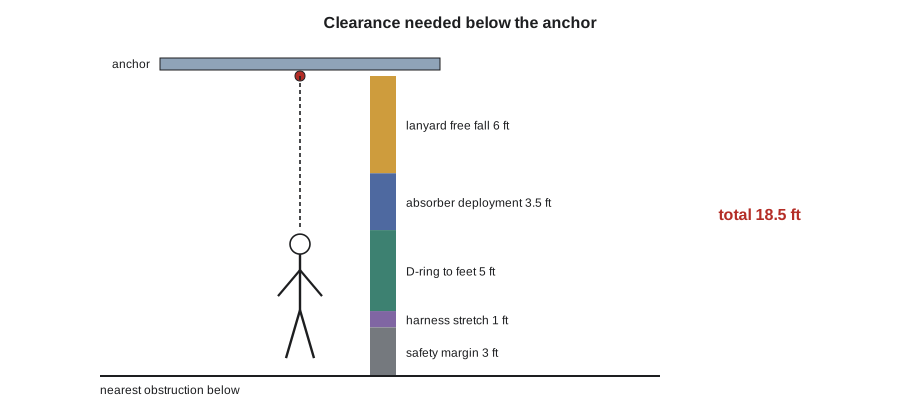
Clearance below the anchor is the calculation that most often appears. A worker on a 6 ft lanyard falls the length of the lanyard, plus the distance the energy absorber pulls out, plus the height of the D-ring above the feet, plus harness stretch, plus a safety margin, before the feet stop. If the structure, ground or equipment below is closer than that, the worker hits it before the system arrests the fall.
# Safety review: fall clearance below the anchor and a gas test check before entry
FREE_FALL = 6.0      # lanyard length plus anchor below the D-ring
DECEL = 3.5         # deployment of the energy absorber
HEIGHT = 5.0         # D-ring height above the feet
STRETCH = 1.0        # harness stretch and D-ring slide
MARGIN = 3.0         # safety margin
U = "ft"
need = FREE_FALL + DECEL + HEIGHT + STRETCH + MARGIN
print(f"Clearance needed below the anchor: {need:.1f} {U}")
for avail in [21.0, 17.0]:
    print(f"  {avail:.1f} {U} available -> {'ok' if avail >= need else 'NOT ENOUGH: shorten the lanyard or use a self-retracting lifeline'}")

O2_LOW, O2_HIGH = 19.5, 23.5
readings = [(20.9, 0, 0, 2), (19.2, 0, 0, 0), (20.8, 12, 0, 0), (20.6, 3, 14, 5)]   # O2 %, % LEL, H2S ppm, CO ppm
for o2, lel, h2s, co in readings:
    bad = []
    if not O2_LOW <= o2 <= O2_HIGH: bad.append("oxygen")
    if lel >= 10: bad.append("flammable")
    if h2s >= 10: bad.append("H2S")
    if co >= 25: bad.append("CO")
print(f"O2 {o2:4.1f} LEL {lel:2} H2S {h2s:2} CO {co:2} ->", "no entry: " + ", ".join(bad) if bad else "entry allowed")Clearance needed below the anchor: 18.5 ft 21.0 ft available -> ok 17.0 ft available -> NOT ENOUGH: shorten the lanyard or use a self-retracting lifeline O2 20.9 LEL 0 H2S 0 CO 2 -> entry allowed O2 19.2 LEL 0 H2S 0 CO 0 -> no entry: oxygen O2 20.8 LEL 12 H2S 0 CO 0 -> no entry: flammable O2 20.6 LEL 3 H2S 14 CO 5 -> no entry: H2S
The first site has enough clearance and the second does not; the fix is a shorter lanyard, an anchor higher up, or a self-retracting lifeline, which arrests a fall in a much shorter distance. The gas checks show three ways to fail an entry test: low oxygen, flammable gas above the limit, and a toxic gas above its limit, each on its own enough to stop the entry.
Scaffolds and aerial lifts carry their own rules. A scaffold is built, inspected and tagged by competent people; the tag shows whether it is safe to use, safe with conditions such as a harness, or not to be used, and nobody alters a scaffold except the scaffold crew. Aerial lift operators are trained on the machine they use, inspect it before each shift, and wear a harness clipped to the platform's anchor point in a boom lift. Ladders are set at a ratio of four up to one out and extend three rungs, or about 3 ft, above the landing.
Hot work
Hot work is any work that can produce a flame, spark or enough heat to ignite a flammable material: welding, cutting, gouging, grinding and heating. In a plant it needs a hot work permit, a gas test showing zero flammable gas, removal or protection of combustibles within 35 ft, covers on drains and sewers, and a fire watch with an extinguisher who stays during the work and for a period after it, commonly at least 30 minutes and often an hour under current fire protection practice. Hot work on or near equipment that has held flammable material needs the equipment to be cleaned, purged or inerted and tested first. BLR-110 lesson 10 covers hot work, and BLR-330 lesson 11 covers it during turnarounds.
Worked problem
A hot work sequence question
Put these steps in order for hot work near a vessel that held hydrocarbon: issue the hot work permit; isolate, drain and purge the vessel; post the fire watch; test for flammable gas; start welding.
Show solution
- Preparation comes first: the vessel must be isolated, drained and purged before testing means anything.
- The gas test must show zero before the permit is issued.
- The fire watch is in place before the first arc is struck.
Answer: Isolate, drain and purge; test; issue the permit; post the fire watch; start welding.
Hazardous materials
Boilermakers meet several materials that cause disease years after exposure. Asbestos was used in old insulation, gaskets and refractory; it is handled only by trained and certified abatement workers, and boilermakers stop work and report any suspected material. Crystalline silica comes from grinding and removing refractory and cutting concrete; OSHA's permissible exposure limit for respirable crystalline silica is 50 micrograms per cubic meter, and controls include wet methods, local exhaust and respirators. Refractory ceramic fiber insulation can be a respiratory hazard after heating. Welding fume, especially from stainless steel and coated metals, needs ventilation. And process chemicals, residues and deposits such as iron sulfide, which can ignite as it dries, are covered by safety data sheets under OSHA's Hazard Communication standard. BLR-110 lesson 11 covers these materials.
Traps in safety questions
Imran finishes with a list of the traps his own questions are built on. Questions that ask for the first action usually want the action that protects people: stop the work, warn others, get people out. Questions about a gas alarm want you to leave and not to reset the detector. Questions about a rescue never want the attendant to enter. Questions about a damaged harness, sling or scaffold want it removed from service and tagged, not repaired on the spot. And questions that offer "use more PPE" as the answer to a hazard that could be engineered out usually have a better answer among the options.
Common mistakes
MistakeTesting for flammable gas before oxygen.
InsteadTest oxygen first; a flammable detector needs oxygen to read correctly.
MistakeUsing 6 ft as the clearance for a 6 ft lanyard.
InsteadAdd absorber deployment, D-ring height, stretch and a margin.
MistakeSending the attendant in to help a collapsed worker.
InsteadThe attendant stays outside, calls the rescue team and starts the rescue plan.
MistakeChoosing PPE as the best control.
InsteadPPE is last on the hierarchy; look for elimination, substitution or engineering controls first.
Summary and key terms
- Permits are issued by the owner's authorized person and accepted by the person in charge of the work.
- The JSA records the crew's hazard check; the hierarchy of controls puts PPE last.
- Gas tests: oxygen first, then flammable, then toxic; test top, middle and bottom.
- Oxygen 19.5 to 23.5 percent under OSHA; fall protection from 6 ft in construction; anchors 5,000 lb.
- Clearance below the anchor adds free fall, absorber, D-ring height, stretch and margin.
- Hot work needs a permit, a zero flammable reading, combustibles removed and a fire watch that stays after the work.
- Permit to work
- A written authorization from the plant for a specific job, place, time and set of conditions.
- Hierarchy of controls
- Elimination, substitution, engineering, administrative controls and PPE, in order of effectiveness.
- LEL
- Lower explosive limit: the lowest concentration of a flammable gas in air that can ignite.
- Travel restraint
- A system that stops a worker from reaching a fall hazard.
- Fire watch
- A trained person who watches for fire during hot work and for a set time afterwards.
- Clearance
- The distance below the anchor needed to arrest a fall before the worker hits anything.
Practice problems
Work each problem on paper first, then reveal the answer to check.
In what order are the three gas tests done?
Show answer
Oxygen, then flammable gas, then toxic gases.
A worker on a 6 ft lanyard has 16 ft below the anchor, and the calculation needs 18.5 ft. What can be done?
Show answer
Shorten the connection, move the anchor higher, or use a self-retracting lifeline.
Who issues a permit to work, and who accepts it?
Show answer
The owner's authorized person issues it; the person in charge of the work accepts it for the crew.
A crew member finds old gray insulation that may contain asbestos. What should happen?
Show answer
Stop work in the area, keep people away, and report it so that it can be tested and handled by trained abatement workers.
Lesson quiz · 5 questions
Score 60% or more to complete this lesson.
Create a free account to save your progress, take quizzes and earn a certificate.