
BLR-340 · Lesson 1 of 12 · 20 min
How journeyman boilermaker assessments work
It is February 2030, three months after the Northgate turnaround, and Kiera Lafontaine is in the last months of her four-year apprenticeship. Her logbook shows just over 6,000 hours on the job, and the apprenticeship committee that runs her program has scheduled her final assessments for April: a written test and a practical test, which together decide whether she completes the program and receives her certificate as a journeyman boilermaker. Dale Whitford, who has mentored her since her first week at Ironbridge, has agreed to run a study group two evenings a week in the Port Allen yard's lunchroom, with Joanne Pellerin taking the layout nights and Harjit Gill the code nights. "You already know most of this," Dale tells her. "The test is about showing it on paper, under time, without the job in front of you. That's a skill too, and you can practice it." This course is that study group. Each lesson reviews one part of the trade, works through the kind of problem a test asks, points out the traps, and sends you back to the lesson in the earlier courses where the topic was taught in full.
How a boilermaker becomes a journeyman
The United States has no national license for boilermakers, and Louisiana does not license the trade itself. A boilermaker becomes a journeyman by completing a registered apprenticeship: a program approved by the US Department of Labor or a state apprenticeship agency, in which the apprentice works a set number of hours under journeymen and attends classroom training each year. Most boilermaker apprentices in heavy construction and repair train through joint apprenticeship programs run by the union and contractors under the Boilermakers National Apprenticeship Program. Those programs typically run four years, with about 6,000 hours on the job and classroom hours every year, and the apprentice receives a certificate of completion as a journeyworker at the end. Many programs set final written and practical assessments before they sign that certificate, and contractors and owners may also ask for NCCER credentials, which are earned through written module tests and hands-on performance checks.
Completing the apprenticeship matters beyond the certificate. Large industrial projects and outages draw boilermakers from across the country, and the local lodge's hiring hall dispatches journeymen to jobs in other states through the union's travel system. Owners' contracts often set the share of journeymen on a crew and the ratio of apprentices to journeymen. And a journeyman card is the first step toward a foreman's or general foreman's job, a welding inspector's certification, or a supervisor's job later on.
How the final assessments are built
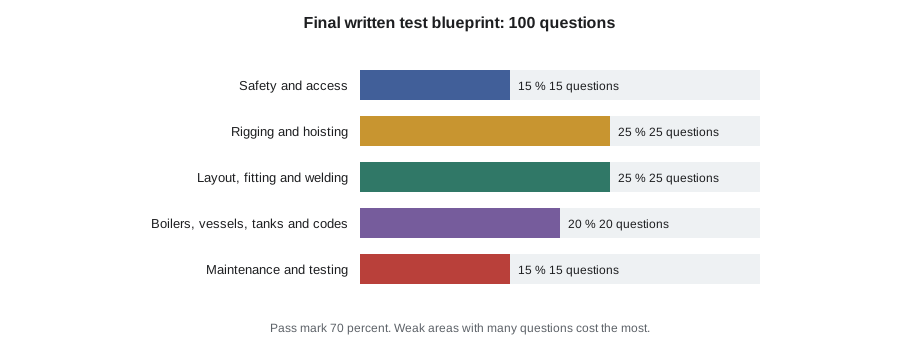
There is no single national journeyman exam for boilermakers, so the details depend on the program. Kiera's apprenticeship committee uses a final written test of 100 multiple-choice questions with four answers each, built from its own blueprint, and a practical test in the training center's shop. The written test's blueprint gives a share of the questions to each part of the trade: safety and access, 15 percent; rigging and hoisting, 25 percent; layout, fitting and welding, 25 percent; boilers, vessels, tanks and codes, 20 percent; and maintenance and testing, 15 percent. Other programs weight their tests differently, but nearly all of them give rigging and repair work the largest share, which reflects what boilermakers actually spend their working lives doing. The NCCER module tests follow the curriculum's levels in the same way.
Kiera's committee sets the pass mark at 70 percent and allows three hours for the written test. A formula sheet is provided, so you do not need to memorize every formula, but you do need to know which one to use and how to put the numbers in. A basic calculator is allowed. You will not have your own code books, tables or notes. Results come back with a breakdown by area of the blueprint, which is the most useful thing to have if you need to retest.
Turning the blueprint into numbers
A blueprint becomes useful when you turn the percentages into question counts and a target score. Kiera's first study-group night starts there. If you know how many questions each area carries, you know where a weak area costs you the most, and you know how many questions you can afford to miss and still pass. The code below does the arithmetic, and also works out the time you have for each question.
# Exam blueprint: questions per area, the score needed to pass, and time per question
BLUEPRINT = [("Safety and access", 15), ("Rigging and hoisting", 25), ("Layout, fitting and welding", 25), ("Boilers, vessels, tanks and codes", 20), ("Maintenance and testing", 15)]   # (area, share of the exam in percent)
QUESTIONS = 100
PASS_PCT = 70
MINUTES = 180

counts = [round(QUESTIONS * pct / 100) for _, pct in BLUEPRINT]
counts[-1] += QUESTIONS - sum(counts)          # keep the total exact after rounding
for (area, pct), n in zip(BLUEPRINT, counts):
    print(f"{area:44} {pct:3d} %  about {n:3d} questions")
need = -(-QUESTIONS * PASS_PCT // 100)           # round up
print(f"Total {QUESTIONS} questions; {PASS_PCT} % means at least {need} correct")
print(f"Time per question: {MINUTES * 60 / QUESTIONS:.0f} seconds ({MINUTES} minutes in all)")
spare = MINUTES - QUESTIONS * 1.5
print(f"At 1.5 minutes a question, {spare:.0f} minutes are left for review")Safety and access 15 % about 15 questions Rigging and hoisting 25 % about 25 questions Layout, fitting and welding 25 % about 25 questions Boilers, vessels, tanks and codes 20 % about 20 questions Maintenance and testing 15 % about 15 questions Total 100 questions; 70 % means at least 70 correct Time per question: 108 seconds (180 minutes in all) At 1.5 minutes a question, 30 minutes are left for review
The numbers tell Kiera three things. First, she needs 70 correct answers out of 100, which means she can miss 30 and still pass; she does not need to be perfect, but she cannot afford to give away a whole area. Second, rigging and layout carry half the test between them, so a weakness there is far more costly than a weakness in safety. Third, at just under two minutes a question, there is time to read every question twice and still have half an hour left, provided she does not get stuck. Most people who fail a test like this do not fail because the questions were too hard; they fail because they spent too long on a few hard ones and rushed the rest.
What the questions look like
Multiple-choice questions in trade exams come in a few common types, and recognizing the type helps you choose an approach. Knowledge questions ask for a fact: a name, a definition, a limit, a sequence. Comprehension questions ask why something is done, or what would happen if it were not. Application questions give you a situation and ask what you would do or what the correct value is, and many of these involve a calculation. A smaller number of questions ask you to read a drawing, a chart or a table that is printed with the question. The study group's practice questions in this course are original questions written in the same styles; they are not copies of real exam questions, which are kept confidential.
| Question type | What it asks | Example from the study group |
|---|---|---|
| Knowledge | A fact, limit, name or sequence | What is the minimum oxygen level for entry into a confined space? |
| Comprehension | Why something is done or what it causes | Why is a sling's capacity lower in a choker hitch than in a vertical hitch? |
| Application | A situation or a calculation | A two-leg bridle lifts 40,000 lb at 45 degrees; what is the tension in each leg? |
| Interpretation | Read a drawing, chart or table | Using the load chart provided, what is the capacity at 50 ft radius? |
Every question has one best answer and three distractors. Good distractors are not silly; they are the answers people get when they make a common mistake. A sling tension question will offer the tension calculated with the angle measured from the wrong side, and a circumference question will offer the length calculated on the outside diameter. This is why working the problem fully and then looking for your answer is safer than looking at the answers first and picking the one that seems right.
Worked problem
Spotting the distractor
A study-group question asks for the stretchout of a shell with an inside diameter of 96 in rolled from 5/8 in plate. The answers offered are 301.6, 303.6, 305.5 and 307.5 in. Which is correct, and where do the others come from?
Show solution
- Work the problem before you look at the answers: the stretchout is calculated on the mean diameter, the inside diameter plus one plate thickness.
- 96 + 0.625 = 96.625 in; multiplied by pi this gives 303.6 in.
- The inside diameter alone gives 301.6 in, and the outside diameter gives 305.5 in; both are the common mistakes.
- The last answer adds two thicknesses to the outside diameter, which nobody would get by accident, so it is the weakest distractor.
Answer: 303.6 in. The two closest distractors are exactly the inside- and outside-diameter mistakes.
Exam day
Dale sat his own journeyman tests more than twenty years ago, and has since helped grade practical tests for the committee, and his advice is practical. Ask the committee for its rules early: what to bring, what calculator is allowed, how long the written test lasts and how the practical test is scored. Arrive early, and expect to leave your phone and notes outside. Read the instructions, and check that the number of questions matches what you expect. Go through the whole test once, answering every question you are sure of and marking the ones you are not; then go back. Never leave a question blank, because there is no penalty for a wrong answer and a guess has a one-in-four chance of being right. And if you do not pass, the results breakdown tells you where to work before you retest; programs set their own rules for retests, so check them before you plan.
The study plan Kiera's group follows has three parts: a review of each part of the trade, one per study night, in the order of the lessons in this course; a set of practice questions after each review, scored by topic; and a full practice test two weeks before the real one, under time, which is the capstone. The practical test is covered in lesson 12. The next lesson builds the plan.
Reading the question, not the one you expected
The commonest single cause of wrong answers in trade exams is not a lack of knowledge but a misread question. People see a familiar picture, a sling, a shell course or a gas detector, and answer the question they have seen many times before instead of the one actually printed. Dale's rule for the study group is to read every question to the end, find the word that tells you what is being asked, and underline it in your head before you look at the answers. The words that change everything are small ones: not, except, first, minimum, maximum, most and least.
A question that asks which step comes first in opening a vessel has four correct steps among its answers; only one of them is first. A question that asks which of four items is not part of a lift plan has three items that are; the answer is the odd one out. A question that asks for the minimum clearance has a larger value among the answers that would also be safe, but is not what was asked. When the study group misses a question in practice, the first thing Dale asks is whether they misread it, and about a third of the time the answer is yes.
Units are the other trap. A question may give a dimension in inches and ask for an answer in feet, or give a load in pounds and a capacity in tons. Before you calculate, write the units next to each number and convert them to one system. Before you choose an answer, check that it is in the units the question asked for and that its size makes sense: a sling tension cannot be less than the share of the load the sling carries, and a stretchout cannot be shorter than three times the diameter.
Common mistakes
MistakeStudying everything equally.
InsteadWeight your study by the blueprint: rigging and repair work carry the most questions.
MistakeLooking at the answers before working the problem.
InsteadWork it first, then find your answer; the distractors are the answers common mistakes produce.
MistakeSpending ten minutes on one hard question.
InsteadMark it, move on, and come back; there is time for a second pass if you keep moving.
MistakeLeaving questions blank.
InsteadThere is no penalty for a wrong answer; always choose one.
Summary and key terms
- In the US a boilermaker becomes a journeyman by completing a registered apprenticeship; there is no national license.
- Union programs under the Boilermakers National Apprenticeship Program typically run four years with about 6,000 hours on the job.
- Kiera's committee uses a 100-question written test with a five-area blueprint, and a practical test.
- The pass mark is 70 percent; formulas are provided, but you must know which one to use.
- Turn the blueprint into question counts to see where weak areas cost the most.
- Distractors are the answers that common mistakes produce; work the problem before looking.
- Red Seal endorsement
- The seal on a provincial certificate showing the holder passed the interprovincial exam for the trade.
- Major work activity
- One of the large groups of tasks in an occupational standard, each with a share of the exam.
- Blueprint
- The plan that sets how many questions an exam gives to each part of the trade.
- Distractor
- A wrong answer offered in a multiple-choice question, usually the result of a common mistake.
- Registered apprenticeship
- An apprenticeship program approved by a government agency, ending in a certificate of completion.
- Journeyworker
- A worker who has completed an apprenticeship and is qualified in the trade; usually called a journeyman.
Practice problems
Work each problem on paper first, then reveal the answer to check.
How many questions on Kiera's written test come from rigging and hoisting?
Show answer
25, which is 25 percent of 100.
Why is there no penalty for guessing?
Show answer
Wrong answers simply score zero, so a guess can only gain marks; never leave a question blank.
What should you do with a question you cannot answer in two minutes?
Show answer
Mark it, choose your best guess, move on and come back to it on the second pass.
Why does a breakdown of results by area matter?
Show answer
It shows where to focus before a rewrite or retest, instead of studying everything again.
Lesson quiz · 5 questions
Score 60% or more to complete this lesson.
Create a free account to save your progress, take quizzes and earn a certificate.