
BAS-340 · Lesson 7 of 12 · 29 min
Electrical metering and power monitoring
▶ Video coming soon A video version of this lesson is on the way.
Tegan Farrow's part of the November 4 kickoff had been the tenant meter. Thistledown's lease made the tenant pay for its own lighting and plug loads and for after-hours HVAC, and Ilona wanted no repeat of the seventh-floor dispute. Kelso would install a meter on the fourth-floor tenant panel; Quillon would bring it into the BAS. Callie had met meters twice already, in Declan's energy evenings and in the August story of PM-1's word-order fault. "This time," Prakash said, "think of the meter as one system among the others, with its own owner and its own rules, not just as a source of numbers."
Meters, power monitoring and the BAS
BAS-330 covered how meters measure and how their data is checked, and BAS-310 covered Modbus, the protocol most meters speak. This lesson is about metering as an integrated system: how meters are arranged in a building, how a power monitoring system relates to the BAS, what the codes and billing rules require, and which parts of the work belong to whom.
A power monitoring system is a set of meters with their own software, usually installed by the electrical contractor and configured by the meter supplier or a specialist. It focuses on the electrical system: energy and demand, power quality, voltage events, breaker status, and alarms for the electrical engineer. A BAS can read the same meters, or read the power monitoring software, for energy management. The two can coexist if the meters are shared correctly, which mostly means deciding who polls them.
The metering hierarchy
Meters in a building form a tree. The utility's revenue meter is at the top, then the owner's main meter (PM-1 at Ninefield), then meters on large feeders, panels and tenant spaces, and finally meters or meter channels on individual loads. Each level should add up to the level above, less the losses in the wiring and transformers and any loads that are not metered.
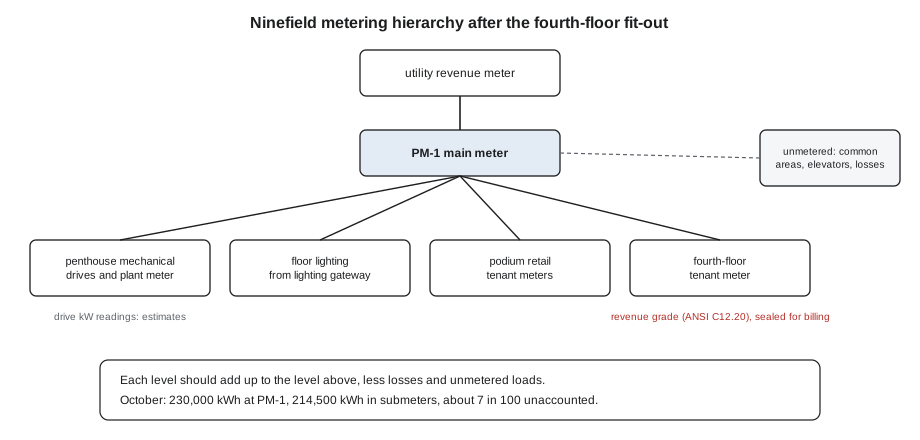
A building rarely meters every branch, and it doesn't need to. The question to ask, as Declan said in BAS-330, is which decisions each meter supports. At Ninefield the answers are the main meter for the bill and demand, the drive readings for fans and pumps, the lighting system's floor power, a chiller plant meter for efficiency, and now tenant meters where leases charge by use.
Worked problem
Reconciling submeters against the main meter
In October, PM-1 recorded 230,000 kWh. The penthouse mechanical meters, floor lighting data, podium tenant meters and other submeters added up to 214,500 kWh. How much is unaccounted for, and is that reasonable?
Show solution
- Unaccounted = 230,000 − 214,500 = 15,500 kWh.
- Share = 15,500 ÷ 230,000 = 0.067, about 7 in 100.
Answer: About 7 in 100, which in a tower with unmetered common areas, elevators, the parking ramp lighting and transformer losses is plausible. The figure should be stable month to month; a sudden jump to 15 in 100 would point to a submeter that has stopped reporting or a new load nobody metered.
Meter types in a modern building
| Type | Where it goes | What it offers |
|---|---|---|
| Switchboard or panel meter | Main switchboard, large feeders | Energy, demand, power factor, voltages, currents, often power quality and event logs |
| Multi-circuit meter | A panel with many branch circuits | One meter body with many current inputs; energy and demand per circuit or per tenant |
| Branch circuit monitoring | Every breaker in a panel, common in data rooms | Current and energy per circuit, overload warnings |
| Tenant billing meter | Tenant panel or feeder | Revenue-grade energy and demand, sealed, approved for billing |
| Embedded meters | Drives, chillers, LED drivers with D4i, UPS units | Approximate energy and power from the equipment itself |
Current sensing has also changed. Besides the 5 A current transformers of older switchboards, most new submeters use CTs with a low-voltage output, often 333 mV at full scale, which cannot produce dangerous voltages when disconnected, or flexible Rogowski coils that wrap around large conductors or bus bars. All of these are installed on energized equipment only by a licensed electrician following the electrical safety rules for that work. At Ninefield that is Tegan; Quillon wires the meter's communication port and nothing else.
Bringing meters into the BAS
Most meters speak Modbus, either Modbus RTU over RS-485 or Modbus TCP over Ethernet, and many newer meters also offer BACnet. Several meters on RS-485 are usually daisy-chained on one trunk to a gateway or a controller port. BAS-310 told the story of PM-1's integration in August: the word order of floating-point values and a one-based register offset. The same two problems appear with almost every new meter model, and the cure is the same: read a known value, compare it with the meter's own display, and fix the mapping before trusting anything.
Worked problem
How long does a Modbus polling cycle take?
The fit-out will put the new fourth-floor tenant meter on an existing RS-485 trunk with 11 other meters, read by a gateway at 19,200 baud. Each meter is read in 2 block requests, and each request with its response takes about 0.15 s including gaps (a typical figure at this speed). How long does one complete cycle take, and can the BAS have 15-second updates?
Show solution
- Requests per cycle = 12 meters × 2 = 24.
- Cycle time = 24 × 0.15 = 3.6 s.
Answer: About 3.6 s, well inside a 15 s update. Adding many more registers per meter, or slowing the trunk to 9,600 baud, would lengthen the cycle; the integration points list records the cycle time so later additions can be checked against it.
When a power monitoring system and the BAS both need the same meters, two masters polling the same RS-485 trunk will collide, because Modbus RTU allows only one master. The choices are to give the trunk to one system and let the other read from it, to use meters with two communication ports, or to put the meters on Modbus TCP, which allows several clients. Prakash's preference is the first: the power monitoring software owns the meters, and the BAS reads chosen values from the software's own BACnet or Modbus TCP server. That gives one owner, one register map and one place to fix problems.
Billing tenants
Using a meter to bill a tenant brings rules that do not apply to meters used only for energy management.
In the United States, the rules for submetering and billing tenants for electricity are set by each state, usually through the public utility commission, and they differ between residential and commercial buildings and between allocation and resale. Leases that allocate costs by floor area or a formula are common. Where tenants are billed by metered use, the meter should be a revenue-grade meter meeting ANSI C12.20 accuracy classes, installed and sealed so that readings can be audited. Thistledown's lease charges by metered use, so Kelso will install a revenue-grade billing meter, and the BAS will read it for information; the billing figures come from the meter's own registers, read by the billing service.
Prakash's rule follows from that: a BAS value is never the billing value. The BAS copies a meter reading every 15 seconds through a gateway; it can miss intervals, it can be scaled wrongly after a firmware update, and it can be overwritten by an operator. The meter's own register is the record. The BAS is for seeing what is happening, alarming when something changes, and producing energy reports.
Worked problem
Measured energy against a flat after-hours rate
For the 5.5 after-hours hours of lesson 4, the penthouse air handler serving floors 2 to 5 ran for the fourth floor alone. Its supply and return fan drives reported an average of 9 kW together. What is the measured fan energy, and what does it cost at a sample energy price of 0.17 dollars per kWh? Compare with the sample flat rate of 45 dollars an hour.
Show solution
- Fan energy = 9 kW × 5.5 h = 49.5 kWh.
- Cost at the sample price = 49.5 × 0.17 = 8.42 dollars.
- Flat rate = 5.5 × 45 = 247.50 dollars.
Answer: The measured fan energy costs about 8 dollars; the flat rate charges about 248. The difference is not necessarily unfair: the flat rate is meant to cover cooling or heating, demand, wear and the share of the plant that must run for one floor. But a tenant who asks will want to know what the rate covers, and meter data lets the landlord show it.
What the energy codes ask of metering
Newer energy codes require new buildings to measure their electricity by end use. Recent editions of ASHRAE 90.1, which Ohio projects may follow as the alternative to the IECC path, require new buildings above a size threshold (25,000 ft² in the editions most often cited) to monitor total electricity and, separately, HVAC, interior lighting, exterior lighting and receptacle loads, to record the data at short intervals (15 minutes is common), to report it hourly, daily and monthly, and to keep it for several years. The IECC has related requirements. The details depend on the edition and the compliance path, and a fit-out that changes the electrical system may bring them in, so the engineer's code analysis says what applies.
The practical effect for a controls contractor is that end-use metering, once an energy project, is now often a code requirement, and the BAS or a metering system is where the data is recorded and reported. Panel design matters: end-use monitoring is much easier when lighting, receptacles and HVAC are on separate panels or separate groups of circuits, which is a decision made by the electrical engineer long before the controls contractor arrives.
Power quality and electrical alarms
Switchboard meters also see the quality of the supply. A few of their values are worth alarming in the BAS, because they warn of problems that will otherwise appear as mysterious equipment trips.
- Voltage sags and swells: short drops or rises in voltage, which can trip drives and restart controllers.
- Voltage unbalance between phases, which makes motors run hot.
- Harmonic distortion, produced by drives, LED drivers and computer power supplies, which heats transformers and neutral conductors.
- Power factor, which some utilities bill for, and which affects the kVA demand on transformers.
- Loss of a phase, which can destroy a three-phase motor that keeps trying to run.
Worked problem
Checking voltage unbalance
PM-1 reports phase-to-neutral voltages of 277 V, 273 V and 280 V. Unbalance is commonly calculated as the largest deviation from the average, divided by the average. What is the unbalance, and how does it compare with the 1 in 100 often used as the point where motor derating starts (a typical figure)?
Show solution
- Average = (277 + 273 + 280) ÷ 3 = 276.7 V.
- Deviations: 0.3, 3.7 and 3.3 V; the largest is 3.7 V.
- Unbalance = 3.7 ÷ 276.7 = 0.0134, about 1.3 in 100.
Answer: About 1.3 to 1.4 in 100, above the 1 in 100 guideline. One reading is not a problem, but a persistent unbalance is worth reporting to the electrical contractor, who can check the distribution of single-phase loads across the phases. The BAS's job is to trend it and alarm on it, not to diagnose the electrical system.
Electric vehicle chargers
Electric vehicle chargers in parking garages are a new kind of electrical load that wants integration. A charger management system talks to the chargers, usually with the Open Charge Point Protocol (OCPP), to authorize sessions, collect energy data and limit power. Where the electrical service is tight, load management shares a fixed capacity among the chargers, and some systems can take a limit from the building: the BAS's demand limiter, described in BAS-330, can send a lower limit during a peak. The chargers' own safety functions, and the electrical design that sets the maximum, stay with the charger system and the electrician.
Worked problem
Sharing capacity among chargers
A garage has 8 chargers rated 7.2 kW each (a typical Level 2 rating), on a circuit capacity allocated at 30 kW. During a demand-limiting event the BAS asks the charger system to cut the limit to 20 kW. If 6 cars are charging, what power does each get before and during the event?
Show solution
- Before: 30 ÷ 6 = 5.0 kW each (below the 7.2 kW rating, so each is limited by the share).
- During: 20 ÷ 6 = 3.3 kW each.
Answer: Each car drops from 5.0 to about 3.3 kW during the event, a 10 kW cut on the building's demand. The cars take longer to charge but nobody loses service, which is the kind of flexible load that BAS-330's demand-limiting chapter described.
Common mistakes
MistakeUsing the BAS's copy of a meter reading as the billing value.
InsteadBill from the meter's own registers, through the billing service; the BAS is for monitoring.
MistakeLetting two systems poll the same Modbus RTU trunk.
InsteadGive the trunk one master, use a second port, or move to Modbus TCP.
MistakeBilling a tenant from a submeter that is not approved for billing.
InsteadUse a revenue-grade meter and follow the state's submetering rules.
MistakeInstalling or moving CTs as part of controls work.
InsteadCTs on energized conductors are electrical work for a licensed electrician.
MistakeIgnoring the unaccounted share of a metering tree.
InsteadReconcile submeters with the main meter monthly and investigate sudden changes.
Summary and key terms
- A power monitoring system and the BAS can share meters if one system owns the polling.
- Meters form a hierarchy that should reconcile with the main meter, less losses and unmetered loads.
- Multi-circuit, branch circuit, tenant billing and embedded meters each have a role; CT work is electrical work.
- Modbus integration needs a verified register map and a known polling cycle time.
- Billing by consumption follows state rules and calls for revenue-grade meters; the BAS copy is never the billing value.
- Newer energy codes require end-use electricity monitoring in many new buildings.
- Trend and alarm voltage events, unbalance, harmonics and power factor; manage chargers through their own system.
- Power monitoring system
- A set of electrical meters with their own software for energy, demand and power quality.
- Multi-circuit meter
- A meter with many current inputs that measures several circuits or tenants.
- Rogowski coil
- A flexible current sensor that wraps around a conductor or bus bar.
- Revenue-grade meter
- A meter accurate and sealed enough to be used for billing.
- Voltage unbalance
- The difference between phase voltages, expressed as a share of their average.
- OCPP
- The Open Charge Point Protocol used between electric vehicle chargers and their management systems.
Practice problems
Work each problem on paper first, then reveal the answer to check.
A main meter records 180,000 kWh; submeters total 171,000 kWh. What share is unaccounted?
Show answer
9,000 ÷ 180,000 = 5 in 100.
Ten meters read in 3 requests of 0.12 s each. What is the cycle time?
Show answer
30 × 0.12 = 3.6 s.
Phase voltages 480, 475 and 485 V (line to line). What is the unbalance?
Show answer
Average 480; largest deviation 5; 5 ÷ 480 = 1.0 in 100.
A fan pair averages 12 kW for 4 h. What is the energy?
Show answer
48 kWh.
A 24 kW charger limit is shared by 4 cars. What does each get?
Show answer
6 kW each.
Lesson quiz · 5 questions
Score 60% or more to complete this lesson.
Create a free account to save your progress, take quizzes and earn a certificate.