
BAS-340 · Lesson 4 of 12 · 26 min
Access control and security system interfaces
▶ Video coming soon A video version of this lesson is on the way.
Kasimir Wendt of Ironmark Security had been at the Ninefield kickoff on November 4 because Ironmark maintains the building's card access system and would add the readers for the new fourth-floor tenant. His contribution to the minutes was one line that Declan had underlined: Thistledown wants a card swipe at the suite door after hours to start the HVAC. Below it Declan had written, in pencil, what data, which way, and who keeps it? Prakash read the note aloud. "That's the whole lesson," he said. "Access control is the easiest system in the building to integrate badly, because it knows who people are."
The parts of an access control system
An access control system decides who may open which doors at which times, unlocks the door for them, and records what happened. Its parts are the same in a small office and a campus.
- Credentials: what a person presents. Proximity cards working at 125 kHz are old and easy to copy. Smart cards working at 13.56 MHz with encryption are the current standard. Mobile credentials on a phone, PIN keypads and biometric readers are also used, sometimes in combination.
- Readers: devices at the door that read the credential and pass it to a controller.
- Door controllers: panels, usually in a secure room or ceiling space, that hold the access rules for a group of doors and decide in a fraction of a second whether to unlock. They keep working if the server is offline.
- Locking hardware: electric strikes, electrified locksets, electromagnetic locks and, on some doors, automatic operators, each powered from a supply that the design and the codes control.
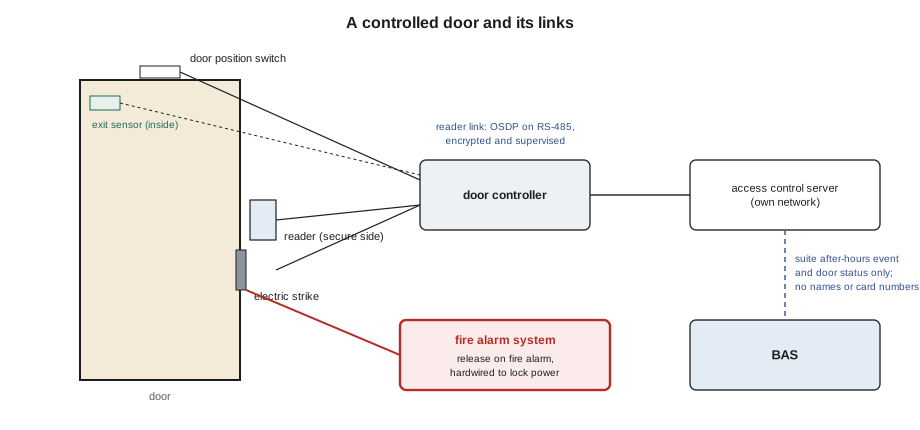
- Door monitoring: a door position switch (door contact) that reports open or closed, and a request-to-exit device, such as a motion sensor or a push bar switch, that tells the controller someone is leaving so that it does not report a forced door.
- The server and software: the cardholder database, schedules, reports and the operator interface.
Reader wiring: Wiegand and OSDP
For decades, readers talked to controllers with the Wiegand interface, a simple one-way scheme with separate data wires that send the card number as a stream of pulses. It is widely supported, but it is not encrypted and not supervised: anyone with access to the wires can read card numbers or replay them, and a disconnected reader can go unnoticed. The Open Supervised Device Protocol (OSDP), published by the Security Industry Association and also adopted as an IEC standard, replaces it. OSDP runs on a two-wire RS-485 bus, the same physical layer as BACnet MS/TP, carries data both ways, supervises every reader continuously, and with its secure channel encrypts the traffic.
| Wiegand | OSDP | |
|---|---|---|
| Direction | Reader to controller only | Both ways: the controller can update readers and change their lights and sounds |
| Wiring | Several conductors per reader | Two-wire RS-485 bus plus power; several readers can share it |
| Typical distance | About 500 ft (typical) | About 4,000 ft on RS-485 (typical) |
| Security | Unencrypted; card numbers can be captured | Secure channel encryption; supervised links |
| Supervision | None built in | Controller knows at once if a reader is removed or fails |
Controls technicians meet OSDP because it looks familiar, and Prakash warned Callie not to treat it as a BAS bus. It belongs to the security system, it carries security data, and it is installed and maintained by the security contractor. The same care with termination and shielding applies, but the trunk is not a place for BAS devices, and BAS devices are not a place for its traffic.
Locks, egress and the fire alarm
Access control locks doors, and doors are also the way out of a building in a fire. Building codes therefore put firm limits on how exit doors may be locked. People must always be able to leave without a key, a card or special knowledge, and locks on exit doors and doors in the path of egress are allowed only under specified conditions. Electromagnetic locks, which hold a door with a powered magnet, are the clearest example: the codes permit them on egress doors only with conditions that include release when the fire alarm system operates, release on loss of power, and a manual release device near the door, with further conditions on signs and timing. Delayed-egress locks, which hold a door for a short time while sounding an alarm, have their own conditions.
In Ohio these conditions are set by the building code (based on the IBC) and maintained under the fire code (based on the IFC). The access contractor designs the locking arrangements to the code, the fire alarm contractor provides the release signal from the fire alarm system, and the release is verified as part of the fire alarm acceptance testing and any integrated testing.
The fire alarm release is hardwired: a relay controlled by the fire alarm system interrupts the power to the lock power supply or signals a listed release input. It is not done by the access control software, and it is never done by the BAS. Prakash had seen a proposal, years ago and from another contractor, to release doors from the BAS when its fire alarm monitoring input changed state. He had refused to price it. A BAS input that monitors a fire alarm relay is a monitoring point, not a life-safety function, and putting a life-safety action behind it would make door release depend on a system that is not designed, listed or tested for that purpose.
What the BAS can use from access control
With life safety set aside, access control holds information the BAS can use well.
- After-hours requests. A card granted at a suite door outside scheduled hours shows that someone is starting work. The BAS can start the suite's HVAC for a block of time, record it for billing, and extend it with later swipes.
- Door status as an occupancy input. A door contact on a meeting room or a lab that opens after hours is a strong sign of occupancy. Some buildings use the door contact on a loading dock door to stop a nearby unit heater fighting the cold air, or to close a vestibule's heating when the doors are held open.
- Shared calendars. The access system unlocks the main entrance on business days; the BAS runs the HVAC on business days. If they keep separate holiday calendars, one will be wrong. Sharing the calendar, or at least loading both from the same list on the same day, avoids that. Harcastle's 2027 closure calendar, which Gus sent on November 9, went to the access control administrator as well as to Quillon.
- Equipment alarms. The BAS can monitor an access panel's trouble output, or a power supply fault, so that operators see it on the same alarm list. The security contractor still owns the response.
None of these needs to know who the person is. That observation is the basis of Quillon's design rule for access integration: the BAS receives events by place and time, such as suite 4 after-hours access at 19:10, and door status by door. It never receives names, card numbers, photographs or individual movement histories, and it does not store them.
Worked problem
After-hours HVAC from card swipes
Ninefield's proposed rule gives each after-hours card grant at a suite door two hours of HVAC for that suite, starting from the swipe, with later swipes extending the period. On one evening the suite door logs grants at 19:10, 20:40 and 23:05. Normal hours end at 19:00. How many after-hours HVAC hours are recorded, and what is the charge at a sample rate of 45 dollars an hour?
Show solution
- 19:10 starts a period to 21:10.
- 20:40 is inside it and extends the end to 22:40. The first period is 19:10 to 22:40 = 3.5 hours.
- 23:05 starts a new period to 1:05 = 2 hours.
- Total = 3.5 + 2 = 5.5 hours. Charge = 5.5 × 45 = 247.50 dollars (sample rate).
Answer: 5.5 hours. The BAS needs only the suite and the times of the grants, not who swiped, to calculate it. Each period should also be shown on the tenant's report so that the bill can be checked.
The rule also fixes the old dispute on Ninefield's seventh floor. In September a request for after-hours HVAC had been made under a shared tenant account, and nobody could say afterward which tenant had asked or how long the system had run. A per-suite event from the access system, with the HVAC hours recorded against the suite, answers both questions without identifying anyone.
How access systems connect
There are three common ways to bring access events into the BAS, from the simplest to the most capable.
| Method | How it works | Good for | Watch for |
|---|---|---|---|
| Dry contact outputs | The access panel closes a relay output on an event, such as after-hours grant at suite 4; a BAS input sees it | A few events, simple and robust | Each event needs a pair of wires; the pulse must be long enough for the BAS to see |
| BACnet interface | The access system presents door status and event points as BACnet objects | Many doors, door status, trouble alarms | Map only the points needed; check what happens when the server restarts |
| Software integration | The BAS or a middleware platform subscribes to events through an API | Rich data, people counts, large sites | Data minimization and security; agree in writing what is passed and kept |
Worked problem
How long must an event pulse be?
An access panel signals an after-hours grant by closing a relay output for a set time. The BAS input is on a controller that scans its inputs every 0.5 s and filters each change for 2 scans. What is the shortest pulse the BAS will reliably see, and what pulse length would you ask the security contractor to set?
Show solution
- A change must last 2 scans to pass the filter: 2 × 0.5 = 1.0 s.
- Allowing one more scan for the pulse to start between scans: 1.0 + 0.5 = 1.5 s.
- A margin of about two times gives 3 s.
Answer: The BAS needs at least about 1.5 s; ask for a pulse of 3 s or more. A momentary 0.2 s pulse, which some panels default to, would often be missed. Pulse timing is one of the details an integration points list must state.
People counts and their limits
Some access systems, and some turnstile and camera systems, count people in and out of a floor or building. It is tempting to feed those counts to the HVAC for demand-controlled ventilation. Counts from doors drift: people hold doors for each other, leave by stairs without badging, and tailgate in groups. A count that is right at 9:00 is often wrong by evening.
Worked problem
Drift in a door count
A tenant floor's turnstile counts 412 entries and 389 exits by the end of a weekday. Everyone has left. How large is the error, and what does that mean for ventilation control?
Show solution
- Count at the end of the day = 412 − 389 = 23 people, when the true number is 0.
- Error = 23 people, about 23 ÷ 412 = 6 in 100 of the day's entries.
Answer: The count claims 23 people in an empty space. Used for ventilation it would keep outdoor air flowing all night. Counts need a nightly reset and should be treated as a trend, not a measurement; for ventilation, carbon dioxide sensing, as BAS-230 described, remains the more reliable method.
Privacy
Access control data is personal information: it shows where an identifiable person was and when. In the United States there is no single federal privacy law for building data. Several states have comprehensive consumer privacy laws, and some, such as Illinois, have strict laws on biometric data; the rules vary by state and change often. Good practice is the same everywhere: collect only what is needed for an identified purpose, tell people what is collected and why, use it only for that purpose, keep it secure, and keep it no longer than necessary. Employers, landlords and tenants each have their own obligations, and leases and service contracts often say who may see access logs.
For a controls contractor the practical rules are simple and are written into Quillon's integration standard. Pass only events by place and time to the BAS. Do not copy access logs into the BAS or into an analytics platform. Do not build reports that follow an individual. If a client asks for something that would identify people, refer the question to the client's privacy officer and the security contractor before doing anything. Prakash added one more: never use a test card in someone else's name. Ironmark issues numbered test cards for commissioning.
Keep the networks apart
Access control systems are security systems, and they are attractive targets. A BAS connected to one can become a path into it, or the other way round. The usual design keeps the access control system on its own network, connected to the BAS only through a defined interface, often a gateway or a firewall rule that allows a few points in one direction. BAS-430 covers network security in depth; for integration work the rule is that the link is as narrow as the data it carries.
Common mistakes
MistakeReleasing doors from a BAS output when the BAS sees a fire alarm input.
InsteadDoor release on fire alarm is hardwired from the fire alarm system and verified by the fire alarm contractor; the BAS has no part in it.
MistakePassing card numbers or names to the BAS for after-hours billing.
InsteadPass events by suite and time; the billing needs no identities.
MistakeUsing door counts directly for ventilation.
InsteadCounts drift; reset them nightly and use carbon dioxide sensing for ventilation.
MistakeAccepting a 0.2 s event pulse from an access panel.
InsteadState a pulse length the BAS can see reliably, such as 3 s or more.
MistakeTreating an OSDP trunk as a spare RS-485 bus for BAS devices.
InsteadOSDP belongs to the security system and stays separate.
Summary and key terms
- Access control has credentials, readers, door controllers, locks, door monitoring and a server.
- OSDP replaces Wiegand with a supervised, encrypted, two-way RS-485 link.
- Codes limit how exit doors may be locked; fire alarm release of locks is hardwired and never done by the BAS.
- The BAS can use after-hours events, door status, shared calendars and equipment alarms.
- Quillon's rule: events by place and time only; no names, card numbers or movement histories.
- Door counts drift and need a nightly reset; they are not a ventilation measurement.
- Access data is personal information; follow privacy law and the client's policies, and keep the networks apart.
- Credential
- What a person presents to a reader: a card, phone, PIN or biometric.
- Door position switch
- A contact that reports whether a door is open or closed.
- Request-to-exit device
- A sensor or switch that tells the door controller someone is leaving.
- Electromagnetic lock
- A lock that holds a door closed with a powered magnet.
- Wiegand
- An older one-way, unencrypted interface between card readers and controllers.
- OSDP
- The Open Supervised Device Protocol, a two-way, supervised and encryptable reader interface on RS-485.
- Data minimization
- Collecting and passing only the data needed for a stated purpose.
Practice problems
Work each problem on paper first, then reveal the answer to check.
Swipes at 18:30 (after an 18:00 end), 19:45 and 21:50 each give 2 h. How many after-hours hours?
Show answer
18:30 to 21:45 is 3.25 h, then 21:50 to 23:50 is 2 h: 5.25 h.
A BAS scans inputs every 0.25 s and filters for 3 scans. What is the shortest reliable pulse?
Show answer
3 × 0.25 + 0.25 = 1.0 s.
Entries 250, exits 238, everyone gone. What is the count error?
Show answer
12 people.
Which reader interface is supervised and can be encrypted?
Show answer
OSDP.
Who provides the fire alarm release signal for maglocks?
Show answer
The fire alarm contractor, from the fire alarm system, hardwired.
Lesson quiz · 5 questions
Score 60% or more to complete this lesson.
Create a free account to save your progress, take quizzes and earn a certificate.