
BAS-340 · Lesson 6 of 12 · 25 min
Elevators, generators and other equipment interfaces
▶ Video coming soon A video version of this lesson is on the way.
Prakash's notes from the October 18 fire alarm test had a second page that Callie had not expected. While the air handlers stopped, the elevators had done their own work: all five cars returned to the lobby and parked with their doors open, and the BAS front end showed, for each car, the change from in service to fire service. "That's the right amount of integration for an elevator," Prakash said. "We see it. We don't touch it." The same page listed the emergency generator's points, which had not changed during the test because nobody had cut the power, and a question in his own handwriting: who checks that the generator room fans run when the generator does?
Elevators and the BAS
Elevators are controlled by their own controllers, installed and maintained by an elevator contractor under strict rules. Their design and maintenance follow the safety code for elevators and escalators, which in North America is a single harmonized code published as ASME A17.1, harmonized with CSA B44 in Canada. The codes cover how elevators are built, how they are tested, and how they behave in a fire.
In Ohio, elevators are inspected and certified under the state's elevator safety program, and work on them is done by the elevator contractor's qualified mechanics. Some cities have their own elevator inspection programs as well.
Firefighters' emergency operation is the elevator function most often confused with integration. In Phase I, recall, the fire alarm system signals the elevator controller when a smoke detector in an elevator lobby, machine room or hoistway operates, and the elevators return to a designated floor, or to an alternate floor if the fire is on the designated one, open their doors and stop answering calls. In Phase II, firefighters use a key inside a car to operate it themselves. The recall signal comes from the fire alarm system through its own listed outputs. It is not a BAS function, and the BAS has no part in it.
What the BAS can usefully do with elevators is watch them and look after the spaces they depend on.
| Point or function | Source | BAS role |
|---|---|---|
| Car in service or out of service | Elevator controller dry contact or gateway | Monitor and alarm |
| Fire service Phase I active | Elevator controller dry contact | Monitor; show on the life-safety page |
| Elevator on emergency power | Elevator controller or transfer switch | Monitor |
| Car position and direction | Elevator gateway, if provided | Monitor, for graphics only |
| Machine room temperature and cooling | BAS sensor and BAS-controlled cooling unit | Control: this is ordinary HVAC |
| Hoistway venting and pressurization | Building and fire code design | Not the BAS unless the design says so, and then only as listed life-safety equipment |
Machine room cooling is a real BAS job. Elevator controllers and drives produce heat, and manufacturers set limits on the room temperature, typically a range such as 55 to 90 °F (check the manufacturer's value). A failed cooling unit in a machine room can shut an elevator down on a hot afternoon. The BAS controls the cooling unit and raises a high temperature alarm well before the limit.
Worked problem
Elevator monitoring points for a tower
Ninefield has four passenger elevators and one service elevator. The BAS monitors, for each car, in service, fire service active and on emergency power, and for the shared machine room, temperature and cooling unit status. How many points is that, and how many of them may the BAS command?
Show solution
- Car points: 5 cars × 3 points = 15 points, all read only.
- Machine room: 1 temperature + 1 cooling unit status = 2 points, plus 1 cooling unit command = 3 points.
- Total: 15 + 3 = 18 points.
Answer: 18 points, of which only one, the machine room cooling unit command, is a BAS output. None of the elevator points is commandable.
Emergency and standby generators
Most larger buildings have an engine generator to supply essential loads when the utility fails. The codes distinguish the emergency power that life safety depends on, such as emergency lighting, fire alarm backup where required, elevators for firefighters and smoke control fans, from standby power for loads the owner wants to keep running, such as a server room or a freezer. Emergency loads are fed through their own transfer switch and wiring, separate from everything else.
In the United States, emergency generators are designed, installed, maintained and tested to NFPA 110, Standard for Emergency and Standby Power Systems, which the building and fire codes reference, with the electrical code covering the wiring. It sets weekly inspections and monthly exercise under load, commonly described as at least 30 minutes at a minimum share of the generator's rating, with records kept on site. The generator service contractor and the building's operators share that work under the fire code.
Ninefield's emergency generator is a diesel unit in a ground-floor room off the loading dock, replaced in 2012. It feeds the emergency lighting, the two stair pressurization fans, one elevator at a time, the fire alarm panel's charger, and a small panel in the penthouse that keeps the BAS supervisory controller, the front-end server and the chiller plant controller powered through an outage. The automatic transfer switch (ATS) senses the loss of utility power, signals the generator to start, and transfers the emergency loads within the time the code requires.
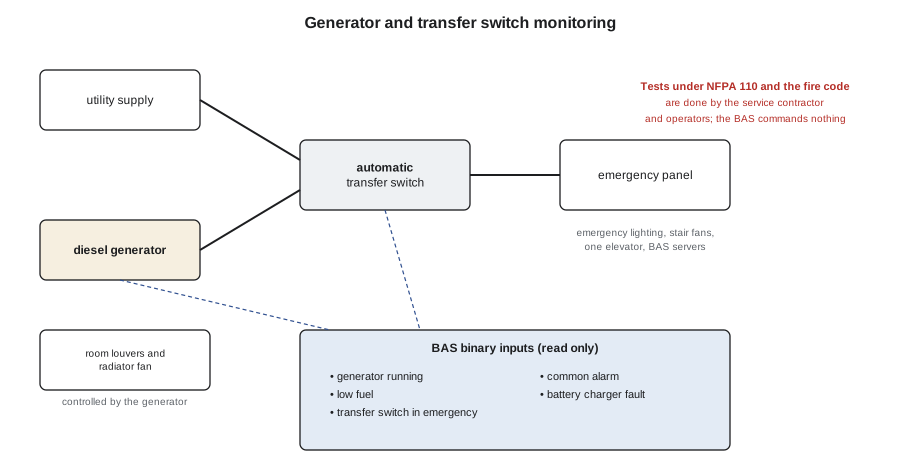
| Point | Type | Why the BAS needs it |
|---|---|---|
| Generator running | Binary input | Confirms tests and outages; trends run hours |
| Generator common alarm | Binary input | Raises an urgent alarm to the operator and service contractor |
| Low fuel level | Binary input (or an analog level from a gateway) | Gives time to order fuel during a long outage |
| Battery charger fault | Binary input | A dead starting battery is the most common reason a generator fails to start |
| Transfer switch in emergency position | Binary input | Tells the BAS that normal power is off to the emergency loads, and when it returns |
The BAS never starts, stops or tests a generator, and it never operates a transfer switch. Those are functions of the generator controller and the ATS, tested under the fire code. The BAS does two useful things with the information. It records every run, so the monthly tests and their loads are trended alongside the building's other data. And it uses the transfer switch signal in its own programs: when normal power returns after an outage, the BAS restarts the chillers, pumps and air handlers in order, with the same restart inhibit that lesson 5 described after a fire alarm reset.
Worked problem
Does the test load meet the target?
Ninefield's generator is rated 350 kW. During its October test the BAS trend showed the generator carrying about 120 kW of building load for 35 minutes. If the test procedure calls for a run of at least 30 minutes at no less than 30 in 100 of the rating (a typical target; the governing standard and the manufacturer set the actual values), did the test meet it?
Show solution
- Minimum load = 0.30 × 350 = 105 kW.
- Actual load 120 kW ≥ 105 kW, and 120 ÷ 350 = 34 in 100.
- Duration 35 min ≥ 30 min.
Answer: Yes, at 34 in 100 of the rating for 35 minutes. If the building load had been too low, the service contractor would use a load bank. Diesel engines run lightly for long periods build up unburned fuel in the exhaust, which is one reason test loads are specified.
Worked problem
Fuel for a long outage
The generator's tank holds 265 gal. At the emergency load it burns about 18 gal an hour (a sample figure from the data sheet at 75 in 100 load). The low fuel alarm is set at one quarter of the tank. How long can it run from full, and how much warning does the low fuel alarm give?
Show solution
- Run time from full = 265 ÷ 18 = 14.7 h.
- Low fuel at 265 × 0.25 = 66 gal, which lasts 66 ÷ 18 = 3.7 h.
Answer: About 14.7 hours from full, with about 3.7 hours of warning from the low fuel alarm. The alarm must go to someone who can order fuel at night, which is why it is classed as urgent in the BAS alarm list.
Prakash's question about the generator room fans had a simple answer. The louvers and the radiator fan are controlled by the generator itself, which opens them when it runs, so they do not depend on the BAS or on normal power. The BAS could usefully monitor the room temperature, and the spring 2027 list now includes a sensor. It would not control the louvers.
Uninterruptible power supplies
Server rooms, BAS front ends and security panels are often on an uninterruptible power supply (UPS), which carries them through short outages on batteries and through longer ones until the generator takes over. A UPS can report its status over a network, usually through a network card with SNMP, BACnet or Modbus. The BAS can monitor on battery, low battery, bypass and fault, and should alarm on them, because a UPS that has been on bypass for a month will not carry anything. As with the generator, the BAS does not command the UPS.
Other equipment with its own safety systems
Many other systems in a building have their own controls and safety functions, and the same principle applies to all of them: the equipment keeps its safety functions, and the BAS monitors, and sometimes enables or schedules normal operation where the design and the manufacturer allow it.
| Equipment | Its own safety or control | Typical BAS role |
|---|---|---|
| Kitchen hood with fire suppression | The suppression system shuts off fuel and controls the hood fans in a fire | Schedule the exhaust and makeup air in normal use; monitor suppression system status |
| Clean agent suppression in a server room | The suppression panel shuts down the room HVAC and closes dampers before discharge | Monitor; the BAS must not restart the room's cooling while the panel holds it off |
| Parking garage ventilation | Gas detection required by code starts the exhaust fans | Often the BAS does the control, from listed detectors, as the design states |
| Domestic water booster pumps | Their own controller holds pressure | Monitor pressure, run status and alarms |
| Sump and sewage pumps | Float controls | Monitor high level and pump failure alarms |
| Refrigeration for food or medicine | Its own controls | Monitor temperatures and alarm; urgent alarms to someone on call |
| Laboratory fume hoods | Hood controller maintains face velocity | Monitor flow alarms; coordinate room pressurization |
The parking garage is the one in that table where the BAS often does more than monitor, and even there the detection devices and the response are set by the code and the design. The BAS program that runs the garage fans from carbon monoxide and nitrogen dioxide readings is part of a required ventilation function, and it is tested like one.
Getting the points
Equipment like this usually offers its points in one of two ways. The simplest is a set of dry contacts, one per status, which every elevator controller, generator panel and transfer switch provides. They are robust and easy to test, and for a handful of status points they are often the best choice. The other is a network interface, a Modbus or BACnet card on the generator controller or a gateway on the elevator system, which can provide many more values: engine temperatures, oil pressure, fuel level in gallons, car positions. The network link is fine for monitoring and graphics. It must never be the only path for an alarm that matters, unless the BAS can tell when the link has failed, as BAS-310 showed with heartbeats.
Prakash's habit, which he passed on, is to ask the equipment contractor for the point list, the contact ratings and the meaning of each contact (open on alarm or closed on alarm) in writing before wiring anything. A generator common alarm contact that closes on alarm, wired to a BAS input configured for normally closed, produces a permanent alarm that everyone learns to ignore, which is the worst outcome of all.
One last check applies to all of this equipment: after any outage or test, look at the BAS points for each system and confirm they have returned to normal. A generator left in manual, an elevator still showing fire service, or a UPS left on bypass is easy to miss when everything else has restarted.
Common mistakes
MistakeWiring a BAS output into an elevator or generator control circuit.
InsteadThe BAS monitors elevators and generators; it never commands them.
MistakeTreating elevator recall as an integration the BAS could perform.
InsteadPhase I recall is signaled by the fire alarm system to the elevator controller under the elevator and fire codes.
MistakeIgnoring the battery charger fault point.
InsteadA dead starting battery is the most common reason a generator fails to start; alarm it as urgent.
MistakeRestarting all HVAC at once when normal power returns.
InsteadUse the transfer switch signal to restart equipment in order.
MistakeConfiguring a contact without knowing whether it opens or closes on alarm.
InsteadGet the point list and contact meanings in writing, and test each one.
Summary and key terms
- Elevators follow ASME A17.1 and CSA B44 and are worked on only by qualified elevator mechanics.
- Firefighters' emergency operation is triggered by the fire alarm system, not the BAS.
- The BAS monitors elevator status and controls only the machine room HVAC.
- Emergency generators and transfer switches are tested under NFPA 110 and the fire code; the BAS monitors running, alarms, fuel, charger and transfer position.
- The BAS uses the transfer switch signal to restart its own equipment in order after an outage.
- UPS units, suppression systems, pumps and refrigeration keep their own safety functions; the BAS monitors and schedules within the design.
- Get contact meanings in writing, and never rely on an unmonitored network link for an alarm that matters.
- Firefighters' emergency operation
- Elevator functions for fires: Phase I recall and Phase II in-car operation by firefighters.
- Phase I recall
- Return of elevators to a designated floor when the fire alarm system signals smoke in an elevator lobby, machine room or hoistway.
- Emergency power
- Power for life-safety loads from a generator or other source when the utility fails.
- Automatic transfer switch (ATS)
- A switch that moves loads from utility power to the generator and back.
- Load bank
- A test load connected to a generator when the building load is too small for a proper test.
- Uninterruptible power supply (UPS)
- A battery system that carries loads through short outages and until a generator takes over.
Practice problems
Work each problem on paper first, then reveal the answer to check.
A 500 kW generator must be tested at 30 in 100 of rating. What is the minimum load?
Show answer
0.30 × 500 = 150 kW.
A 400 gal tank burns 24 gal/h. How long does it last from full?
Show answer
400 ÷ 24 = 16.7 h.
Six elevators with three monitored points each, plus two machine room points. How many points?
Show answer
18 + 2 = 20.
Who signals elevator Phase I recall?
Show answer
The fire alarm system.
What should the BAS do when the transfer switch returns to normal?
Show answer
Restart its equipment in order with a restart interval.
Lesson quiz · 5 questions
Score 60% or more to complete this lesson.
Create a free account to save your progress, take quizzes and earn a certificate.