
BAS-340 · Lesson 3 of 12 · 23 min
Daylighting and occupancy-based lighting
▶ Video coming soon A video version of this lesson is on the way.
Two of the ideas in Quillon's files for next year depended on the same small devices. Sophie's draft of Ninefield's spring 2027 retro-commissioning sequence used the lighting occupancy sensors to put VAV boxes into occupied standby. And at Harcastle, during the T-120 demand-controlled ventilation work in October, she had suggested to Gus that the seminar rooms beside the lecture hall could do the same with the occupancy sensors already in their ceilings. "Before anyone trusts a lighting sensor with the HVAC," Prakash told Callie, "they should understand what it actually senses, and what it misses. The sixth floor at Ninefield taught us that."
How occupancy sensors work
Occupancy sensors detect people indirectly, by their movement or their heat, and each technology has its own blind spots.
| Type | What it senses | Strengths | Weaknesses |
|---|---|---|---|
| Passive infrared (PIR) | Changes in infrared (heat) across zones of a lens pattern | Few false ons; cheap; good for walking motion | Needs line of sight; misses small motions at a desk; blocked by partitions |
| Ultrasonic | Doppler shift of reflected high-frequency sound | Sees around partitions; catches small motions | False ons from air from diffusers or moving objects; sensitivity drift |
| Dual technology | Both, with rules such as PIR to turn on, either to stay on | Few false ons and few false offs | Higher cost; settings need care |
| Microwave and radar | Reflected radio waves | Very sensitive; used in some fixtures | Can see through thin walls and trigger on the next room |
| Camera and thermal array | Images or low-resolution heat maps; some count people | Counts and locations, not just presence | Privacy questions; cost; usually reach the BAS by API |
The sixth-floor fault at Ninefield was a classic PIR problem: tall partitions between workstations hid seated people from ceiling sensors chosen when the floor was open. The fix in November was dual-technology sensors, which keep lights on if either technology sees someone, and a longer delay. Ultrasonic sensing sees around partitions, and requiring PIR to turn lights on avoids most false ons.
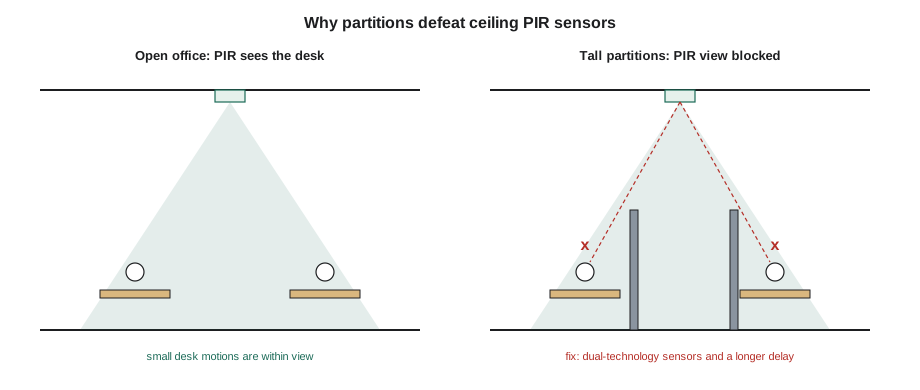
Placement matters as much as type. A PIR sensor sees motion across its zones far better than motion toward it, so a sensor in a private office is better on the ceiling above the desk than in a corner looking at the door. Sensors must be kept away from supply diffusers, which can trigger ultrasonic sensors with moving air and PIR sensors with warm air. Manufacturers publish coverage patterns for walking motion and for the smaller motions of a person at a desk; the second is the one that matters in offices, and it is often half the size of the first.
Time delays and control modes
A sensor turns the lights off after a time delay with no detection. A short delay saves energy but switches lights off on people sitting still, which annoys them and, with frequent switching, wears out older lamp types (LEDs do not mind). A long delay is comfortable but wastes energy. Typical delays in offices are 10 to 20 minutes; Ninefield's sixth floor went from 10 to 20 in November because the partitions made detection less reliable.
- Occupancy mode, also called auto-on: lights turn on automatically when someone enters and off after the delay.
- Vacancy mode, also called manual-on: people turn lights on at the switch, and the sensor only turns them off. Vacancy mode saves more, because people often find daylight enough and never switch on.
- Partial-on: lights come on automatically to a reduced level, and a switch brings them to full.
- Partial-off: when a space empties, lights dim to a lower level first, then turn off later. Common in corridors and stairwells, where people prefer some light to a dark space.
Energy codes now require many of these behaviors, which is why new buildings have far more sensors than old ones did.
What the energy codes require
In Ohio, commercial buildings comply with the energy code based on the 2021 IECC, which allows ASHRAE 90.1-2019 as an alternative path. Both require automatic shut-off of interior lighting, by schedule or occupancy sensing, with occupancy sensors in many space types such as offices, classrooms, meeting rooms and restrooms; separate controls for each space; daylight-responsive controls in areas near windows and under skylights; and limits on installed lighting power. The specific values depend on the edition and the path chosen, so the controls technician works from the specification and the engineer's code analysis, not from memory.
The values below are the commonly cited ones from ASHRAE 90.1-2019, which many projects in both countries use. They are listed in summary form; the standard itself has many conditions and exceptions.
| Requirement | Summary of ASHRAE 90.1-2019 (typical case) |
|---|---|
| Automatic turn-off by occupancy | Lights in many space types off within 20 minutes after the space is vacated |
| Partial-on or manual-on | Automatic on limited to no more than 50 in 100 of lighting power in many spaces |
| Partial-off | Lighting reduced by at least 50 in 100 when unoccupied in some spaces, such as corridors and stairs (at least 30 in 100 in parking garages) |
| Manual control | At least one intermediate level between 30 and 70 in 100 of full power in many spaces |
| Daylight zones, sidelighting | Primary zone one window head height deep; secondary zone two window head heights deep |
| Daylight zones, toplighting | Zone extending about 0.7 times the ceiling height beyond the skylight edge |
| Daylight dimming | Continuous dimming down to 20 in 100 or less, then off |
| Automatic receptacle control | At least 50 in 100 of receptacles in many spaces switched off when unoccupied |
Daylight harvesting
Daylight harvesting dims electric lights when daylight provides enough light. A photosensor measures light, and a controller sets the dimming level of the fixtures in the daylight zone. There are two ways to arrange it.
- Closed loop: the photosensor is in the space, looking down at the work surface, and sees both daylight and electric light. The controller dims until the total reaches a target. This holds a steady light level but needs careful calibration, because the sensor sees reflected light, not the light on the desk.
- Open loop: the photosensor looks out the window or at the sky and sees only daylight. The controller sets the electric light from a curve calibrated during commissioning. It is simpler and stable but cannot correct for blinds being closed.
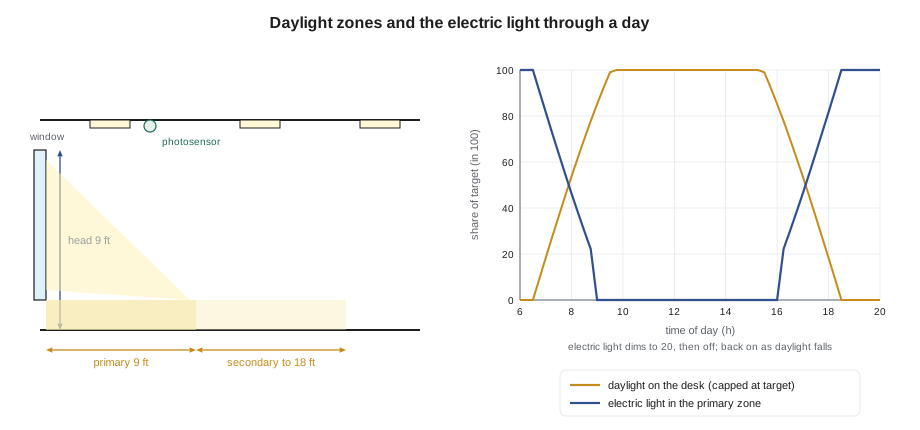
Daylight zones are measured from the window. Under ASHRAE 90.1-2019 the primary sidelit zone extends one window head height into the room and the secondary zone a second window head height beyond it, across the width of the window plus a little on each side; the primary zone is required to have automatic daylight control and the secondary zone usually is too. Office targets are typically 30 to 50 footcandles on the work surface. Commissioning sets the target, the response time (slow enough that passing clouds do not make lights pulse) and the minimum level.
Worked problem
Sizing Ninefield's perimeter daylight zones
A Ninefield office floor is about 131 ft by 98 ft, with windows around the whole perimeter, a window head height of 9 ft, and LED lighting at 0.6 W/ft². About how much lighting power is in the primary daylight zones? If daylight harvesting cuts that power by 40 in 100 on average over 2,600 hours a year (a typical estimate for this orientation), how much energy is saved?
Show solution
- Perimeter = 2 × (131 + 98) = 458 ft.
- Primary zone area ≈ perimeter × depth − corner overlaps = 458 × 9 − 4 × 9² = 4,122 − 324 = 3,798 ft².
- Lighting power in the zone = 3,798 × 0.6 = 2,280 W.
- Energy saved = 2,280 W × 0.40 × 2,600 h = 2,371,200 Wh, about 2,370 kWh a year.
Answer: About 2,400 kWh a year per floor, roughly 24,000 kWh across ten office floors. LED lighting has already cut the power so far that daylight savings are modest; the larger benefit of the sensors at Ninefield is what they can tell the HVAC.
Daylight harvesting goes wrong in predictable ways. Photosensors get moved during fit-outs, covered by ceiling tiles, or recalibrated by someone standing under them at night. Tenants close blinds permanently, so a closed-loop system holds full output all day. And zones get rewired so that the sensor controls fixtures far from the window. A BAS trend of daylight zone output against time of day, available through the gateway, shows these faults at a glance: a zone that never dims, or one that is dim at noon on a cloudy day, needs a visit.
Using lighting occupancy for HVAC
A lighting occupancy sensor already answers the question an HVAC zone needs answered: is anyone here? Sharing that answer lets the BAS put a zone into occupied standby, a mode defined in ASHRAE Guideline 36 and described in BAS-230. In occupied standby, during scheduled occupied hours, a zone that is vacant can let its heating and cooling setpoints drift a set amount wider and, where the ventilation standard allows zero outdoor air for that space type when unoccupied, can reduce its minimum airflow to zero. When the sensor sees someone, the zone returns to occupied mode within a few minutes.
The benefit is largest in spaces that are often empty during the day: meeting rooms, seminar rooms, private offices of people who travel, and classrooms between classes. It is smallest in open offices that are busy all day. The savings come from three places: less fan energy, less reheat, and less outdoor air to heat and cool.
Worked problem
Reheat saved in a Harcastle seminar room
A seminar room beside T-120 has a VAV box with a minimum airflow of 125 cfm. In winter, supply air at 55 °F is reheated to about 70 °F at minimum flow. The room's occupancy sensor shows it vacant about 1,500 scheduled hours a year. How much reheat would occupied standby save if the minimum could go to zero during those hours?
Show solution
- Heat per hour = 1.08 × airflow (cfm) × ΔT (°F) = 1.08 × 125 × (70 − 55) = 2,025 Btu/h.
- Over 1,500 hours: 2,025 × 1,500 = 3,037,500 Btu, about 890 kWh of heat a year.
Answer: About 860 to 890 kWh of heat a year for one room, before counting fan energy and outdoor air. Across a dozen such rooms on a campus, occupied standby is worth doing, and the sensors are already paid for.
Using lighting sensors for HVAC needs care in three places. First, the mapping: the HVAC zone and the lighting zone are rarely the same shape, so the sequence uses the combination of all the sensors that cover each VAV box's area, and treats the zone as occupied if any of them sees someone. Second, the timing: lighting delays of 10 or 20 minutes are short for HVAC, so the sequence usually adds its own delay before entering standby. Third, the fallback: if the lighting data stops, the zone goes to occupied, as lesson 1 showed.
Occupied standby from lighting occupancy - draft rule (Ninefield spring 2027)
FOR each VAV box on an office floor:
  OCC_LTG = OR of the lighting occupancy values mapped to this box
  IF building schedule is occupied
     AND OCC_LTG has been FALSE for 15 min
     AND gateway heartbeat is healthy
  THEN mode = OCCUPIED_STANDBY
  IF OCC_LTG becomes TRUE OR heartbeat alarm OR operator override
  THEN mode = OCCUPIED (immediately)
Standby: heating and cooling setpoints each 1 K (2 F) wider; minimum airflow 0
         only where the ventilation standard allows it for the space type
Plug loads and other occupancy uses
The same sensors can switch receptacles. Energy codes now require automatic control of a share of the receptacles in offices, conference rooms and similar spaces, so that task lights, monitors and space heaters go off when people leave. In practice the controlled receptacles are marked, and the switching is done by relays in the electrical panel or in the furniture, driven by the lighting system's occupancy data or a schedule. This is electrical work; the BAS's interest is in the data, because plug loads are a large part of a modern office's base load.
Occupancy data can also count people, if the sensors support it. People counts are useful for ventilation and space planning, and they bring privacy questions that lesson 4 discusses. A presence sensor that says a room is occupied is not personal information. A camera that recognizes faces is a different matter entirely.
Common mistakes
MistakeUsing a PIR sensor where partitions hide seated people.
InsteadUse dual-technology or ultrasonic sensors, and check the desk-motion coverage pattern.
MistakeMounting a sensor beside a supply diffuser.
InsteadKeep sensors away from diffusers to avoid false triggering.
MistakeCommissioning daylight dimming with a fast response.
InsteadUse a slow response so passing clouds do not make lights pulse.
MistakeTreating a lighting zone as an HVAC zone.
InsteadMap each VAV box to all the sensors that cover its area, and treat the zone as occupied if any sees someone.
MistakeUsing lighting occupancy for HVAC without a fallback.
InsteadReturn to occupied mode on a gateway or sensor failure.
Summary and key terms
- PIR, ultrasonic, dual-technology, microwave and camera sensors each have their own blind spots.
- Placement matters: across the view for PIR, away from diffusers, and judged by desk-motion coverage.
- Occupancy, vacancy, partial-on and partial-off modes trade comfort against savings.
- Energy codes require automatic shut-off, occupancy sensing in many spaces and daylight controls near windows.
- Daylight harvesting dims fixtures in daylight zones, closed loop or open loop, and needs careful commissioning.
- Lighting occupancy can drive HVAC occupied standby, with mapping, extra delay and a safe fallback.
- Controlled receptacles and people counting extend occupancy data to plug loads and planning.
- Passive infrared (PIR) sensor
- A sensor that detects changes in infrared heat across zones of its lens.
- Dual-technology sensor
- A sensor combining PIR and ultrasonic detection.
- Vacancy sensor
- A sensor that only turns lights off; people switch them on manually.
- Partial-off
- Dimming lights to a lower level when a space empties, before turning them off.
- Daylight harvesting
- Dimming electric light in response to available daylight.
- Primary daylight zone
- The area next to a window, about one window head height deep, that gets the most daylight.
- Occupied standby
- A mode in which a vacant zone during occupied hours widens its setpoints and may reduce its airflow.
Practice problems
Work each problem on paper first, then reveal the answer to check.
A window head is 10 ft above the floor. How deep are the primary and secondary sidelit zones?
Show answer
Primary 10 ft; secondary to 20 ft from the window.
A daylight zone has 3,000 W of lighting, saved 35 in 100 over 2,500 h. What is the annual saving?
Show answer
3,000 × 0.35 × 2,500 = 2,625 kWh.
A VAV box at 100 cfm reheats air by 16 °F. What is the heat rate?
Show answer
1.08 × 100 × 16 = 1,728 Btu/h.
Which sensor type is best behind tall partitions?
Show answer
Ultrasonic or dual technology.
What should occupied standby do if the lighting gateway heartbeat fails?
Show answer
Return every affected zone to occupied mode.
Lesson quiz · 5 questions
Score 60% or more to complete this lesson.
Create a free account to save your progress, take quizzes and earn a certificate.