
BAS-220 · Lesson 9 of 12 · 23 min
Alarm logic and priorities
▶ Video coming soon A video version of this lesson is on the way.
Nell Nakagawa's complaint was simple: too many alarms. The front-end alarm list Prakash had shown Callie on her first day held a few hundred unacknowledged entries, most of them old, many of them meaningless, and Nell's operators had learned to ignore it. On Saturday, October 24, Sophie used the workshop to go through Tilden Hall's alarm logic with Callie. "An alarm is a request for a person to do something," Sophie said. "If there is nothing to do, it isn't an alarm. If nobody can tell which ones matter, none of them do." This lesson covers the logic that decides when an alarm is raised and cleared, how alarms are given priorities and sent to people, and how to stop alarms from flooding the operators.
What makes a good alarm
A good alarm is relevant, timely and actionable. Relevant: it reports something that matters to comfort, safety, equipment or energy. Timely: it arrives soon enough to act, but not so fast that brief, harmless excursions trigger it. Actionable: the person who receives it knows what to do, or at least where to look. An alarm that fails these tests is noise, and noise trains people to ignore the alarm list. The international alarm management standard used in process industries, ISA-18.2, and its counterpart IEC 62682 set out a whole life cycle for alarms; building automation has borrowed many of its ideas, even where the standard itself is not applied.
| Kind of alarm | Raised when | Example at Tilden |
|---|---|---|
| High or low limit | A value goes beyond a fixed limit | Discharge air below a low limit |
| Deviation | A value stays too far from its setpoint | Room 214 more than 3 °F from setpoint for 45 minutes |
| Command and status mismatch | Equipment does not do what it is told | Fan commanded on but status off |
| Sensor failure | An input is out of its valid range | Thermistor open or shorted |
| Safety trip | A hardwired safety has acted | Freezestat or high static limit tripped |
| Maintenance | Runtime or condition says service is due | Filter differential high; fan runtime over limit |
| Communication | A device stops responding | A VAV controller offline |
The parts of alarm logic
Whatever the kind, alarm logic is built from the same parts: a condition, a delay, a deadband, a reset behavior, and conditions under which the alarm is inhibited. The program or the controller's built-in alarm functions combine them. Getting each part right is what separates a useful alarm from a nuisance.
| Part | Does | Without it |
|---|---|---|
| Condition | The comparison or logic that defines abnormal | No alarm |
| Delay | Requires the condition to last before alarming | Every brief excursion alarms |
| Deadband | Requires the value to come back past a margin before returning to normal | Alarms chatter on and off near the limit |
| Reset behavior | Auto-reset when normal, or latch until a person resets | Safety trips clear themselves unseen |
| Inhibit or enable | Suppresses the alarm when it does not apply | Alarms during start-up, shutdown and unoccupied hours |
(* AHU-2 discharge air low temperature alarm *)
DATLowCond := DATLoop.Enable AND (DAT < DATSP - 5.4);
DATLowDelay(IN := DATLowCond, PT := T#10m);         (* on-delay *)

IF DATLowDelay.Q THEN
    DATLowAlarm := TRUE;
ELSIF DAT > DATSP - 3.6 THEN                        (* 1.8 F deadband *)
    DATLowAlarm := FALSE;                           (* returns to normal *)
END_IF;
The listing shows all the parts in a few lines. The condition is the temperature more than a set amount below setpoint. The condition only counts while the loop is enabled, which inhibits the alarm when the fan is off. The on-delay timer from lesson 4 requires the condition to last ten minutes. The ELSIF branch only clears the alarm once the temperature has recovered past a smaller margin, which is the deadband. The alarm resets itself when normal; a safety alarm would instead latch until reset.
Worked problem
Tracing an alarm with delay and deadband
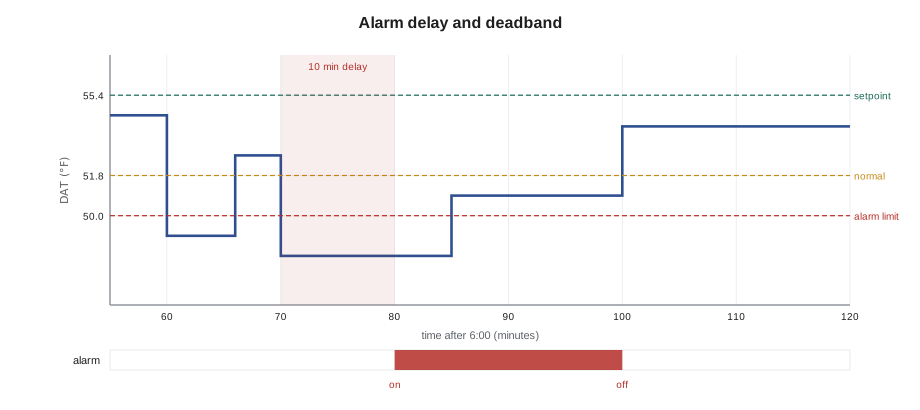
AHU-2's discharge air setpoint is 55.4 °F. The alarm limit is 5.4 °F below setpoint, the delay 10 minutes and the return-to-normal margin 3.6 °F below setpoint. The temperature is 49.1 °F from 7:00 to 7:06, 52.7 °F from 7:06 to 7:10, 48.2 °F from 7:10 to 7:25, 50.9 °F from 7:25 to 7:40, then 54.0 °F. When does the alarm go on and off?
Show solution
- Limit: 55.4 − 5.4 = 50.0 °F. Normal margin: 55.4 − 3.6 = 51.8 °F.
- 7:00 to 7:06 below the limit for only 6 minutes, then above it: the delay restarts, no alarm.
- 7:10 below the limit again; after 10 minutes, at 7:20, the alarm goes on.
- 7:25 the temperature is 50.9 °F: above the limit, but not above 51.8 °F, so the alarm stays on.
- 7:40 the temperature is 54.0 °F, above 51.8 °F: the alarm returns to normal.
Answer: On at 7:20, off at 7:40. The six-minute dip never alarmed, and the alarm did not flicker off while the temperature hovered between the limit and the normal margin.
Choosing delays and limits
Delays should match the process. A freezestat or smoke shutdown needs no delay at all, because the hardwired safety acts immediately and the alarm reports what it did. A fan failure needs a short delay, long enough for the fan to prove after a start command, typically under a minute. A space temperature deviation needs a long one, because rooms recover slowly after warm-up or a door left open; BAS-130's room 214 alarm waited 45 minutes. Limits should be set from what matters, not from habit. A deviation alarm set too tight alarms every morning during warm-up; one set too wide never alarms until people are already complaining.
Deviation alarms are often better than fixed limits for controlled values, because they follow the setpoint. A fixed high limit on a space temperature has to be set wide enough for the unoccupied setpoint; a deviation alarm compares with whatever the setpoint is at the time, and can be inhibited during setpoint changes and warm-up.
Inhibiting and suppressing alarms
Many alarms only make sense when the equipment is supposed to be running. A low discharge air temperature on an air handler that is off is meaningless; so is a VAV box's airflow alarm when its air handler is stopped. Inhibiting alarms by mode stops these. A further step is alarm suppression by dependency: when an upstream device fails, the alarms it causes downstream are suppressed and only the root cause is shown. If AHU-2's supply fan fails, its many terminal units will all report low airflow and rising temperatures; with dependency suppression, the operator sees one alarm, the fan failure, instead of thirty.
Inhibiting must not hide real problems. A safety trip should never be inhibited, and an alarm that is inhibited because equipment is off should come back when the equipment is commanded on. Sophie warned Callie about the opposite fault, which she had found several times: alarms disabled during commissioning, because they were annoying while the system was incomplete, and never enabled again.
Priorities and routing
Not every alarm is equally urgent, and not every person needs every alarm. Alarms are given priorities, usually in a few classes such as critical, urgent, normal and maintenance, and each class is routed differently: critical alarms to the operator's phone at any hour, urgent alarms to the front end and the day shift, maintenance alarms to a work-order system. BAS-320 covers routing in detail. In BACnet, each alarm or event refers to a Notification Class object, which holds its priority, whether it needs acknowledgment and a list of recipients, with days and times when each recipient should be told. In BACnet, a lower priority number means a more urgent alarm.
| Class | Examples | Response expected | Typical routing |
|---|---|---|---|
| Critical | Freezestat trip, smoke shutdown, boiler failure | Immediately, at any hour | Phone or text to the on-call operator, plus the front end |
| Urgent | Fan failure, chilled or hot water too far from setpoint | Within the hour during operating hours | Front end, with a page if not acknowledged |
| Normal | Space temperature deviation, sensor failure | During the working day | Front end |
| Maintenance | Filter dirty, runtime due, actuator travel high | At the next planned visit | Work-order system or a weekly report |
Alarms also need to be acknowledged. Acknowledgment means a person has seen the alarm; it does not mean the problem is fixed. An alarm that has returned to normal but has not been acknowledged stays on the list until someone does, which is useful for brief events that happened overnight. Too many alarms needing acknowledgment, though, is how the list Nell complained about had grown.
Alarm floods
An alarm flood is a burst of more alarms than an operator can handle, usually after a single event. A power failure is the classic cause. When power returns, every controller restarts, every fan takes a while to prove, every space has drifted, and every communication alarm clears and re-alarms as devices come back online. Process industry guidance suggests that an operator can handle roughly one alarm every ten minutes in steady operation and that more than about ten in ten minutes is a flood; building operators face the same human limits.
Worked problem
Estimating a restart flood
Ninefield Tower has about 140 VAV box controllers. After a power failure, each one raises an average of three alarms during restart: communication lost, airflow low and space temperature deviation. How many alarms reach the operator? With restart inhibits and dependency suppression, Sophie's proposed sequence would suppress all three while each box's air handler was in its first 20 minutes of running. What would remain?
Show solution
- Without suppression: 140 × 3 = 420 alarms.
- With suppression during the restart period, the box alarms are hidden; the operator sees the power failure, the air handlers restarting and any that fail to prove.
Answer: Over 400 alarms, a flood in which a real failure would be lost, against a handful of meaningful ones with suppression. Sophie put the restart inhibit into the draft sequence for Ninefield's spring 2027 retro-commissioning.
Cleaning up Tilden's alarm list
By the end of the morning, Sophie and Callie had sorted Tilden Hall's alarms into four piles: alarms that were right as they were, alarms whose limits or delays needed changing, alarms that needed an inhibit or dependency, and alarms that should not exist at all, such as alarms on points that were only displayed for information. They wrote it up as a short list for Nell and Gus, with a recommendation that each alarm in the building have a written reason and a written response, which is the heart of an alarm philosophy. Nell's comment, when she read it, was that it was the first time anyone had asked her which alarms she actually wanted.
Writing an alarm philosophy
An alarm philosophy is a short document that sets the rules for a building's alarms: what deserves an alarm, how priorities are assigned, who receives each class, what response is expected and how often the alarm list is reviewed. It is written with the owner, because the owner's people are the ones who respond. For Tilden, Sophie drafted a two-page philosophy for Gus and Nell to edit, with a rule that every new alarm must be added to a table giving its point, condition, delay, priority, recipient and written response. An alarm that cannot fill in the response column should not be created.
| Column | Example entry |
|---|---|
| Point | TH.AHU2.DAT |
| Condition | More than 5.4 °F below setpoint while the loop is enabled |
| Delay and deadband | 10 minutes; returns within 3.6 °F |
| Priority | Urgent |
| Recipient | Front end; page the day operator if not acknowledged in 30 minutes |
| Response | Check heating valve and actuator, then converter supply temperature, then the trend |
The philosophy also sets a review rhythm. Once a month, Nell's team would look at the ten alarms that occurred most often, and for each one decide whether to fix the cause, change the alarm, or remove it. Sophie had seen the same habit cut a building's alarm count by more than half in a few months, mostly by fixing a few chronic faults that had been raising alarms every day for years.
Common mistakes
MistakeAlarming on every excursion with no delay.
InsteadAdd a delay that suits the process, so that brief harmless excursions are ignored.
MistakeClearing alarms at the same value that raises them.
InsteadUse a deadband so that alarms do not chatter near the limit.
MistakeLeaving alarms active when equipment is off.
InsteadInhibit alarms by mode, and suppress downstream alarms when an upstream failure explains them.
MistakeDisabling alarms during commissioning and forgetting them.
InsteadKeep a list of disabled alarms and enable them before handover.
MistakeGiving every alarm the same priority.
InsteadClassify alarms by urgency and route each class to the right people.
Summary and key terms
- A good alarm is relevant, timely and actionable; anything else is noise that trains people to ignore alarms.
- Alarm logic combines a condition, a delay, a deadband, a reset behavior and inhibit conditions.
- Delays suit the process: none for safety reports, short for proof failures, long for space deviations.
- Deviation alarms follow the setpoint and are often better than fixed limits for controlled values.
- Inhibits and dependency suppression stop meaningless and consequential alarms.
- Priorities and routing send each alarm to the right person at the right time; BACnet uses Notification Class objects.
- Power restarts cause alarm floods; restart inhibits keep the real failures visible.
- Alarm
- A notice that asks a person to act on an abnormal condition.
- Alarm delay
- The time a condition must last before an alarm is raised.
- Alarm deadband
- The margin a value must recover past before an alarm returns to normal.
- Deviation alarm
- An alarm on the difference between a value and its setpoint.
- Latching alarm
- An alarm that stays active until a person resets it.
- Inhibit
- A condition that suppresses an alarm when it does not apply.
- Dependency suppression
- Hiding alarms that are explained by an upstream failure.
- Notification Class
- A BACnet object that holds an alarm's priority, acknowledgment rules and recipients.
- Alarm flood
- More alarms in a short time than an operator can handle.
Practice problems
Work each problem on paper first, then reveal the answer to check.
A fan status alarm has no delay. What happens every morning?
Show answer
It alarms each time the fan is started, before the fan has had time to prove.
Alarm limit 50 °F, normal margin 52 °F. The value goes from 48 °F to 51 °F. Does the alarm clear?
Show answer
No; it must rise above 52 °F.
Why should a smoke shutdown alarm have no delay?
Show answer
The safety has already acted; the alarm reports it and needs immediate attention.
80 controllers each raise two alarms on restart. How many alarms without suppression?
Show answer
160.
In BACnet, is priority 10 more or less urgent than priority 100?
Show answer
More urgent; lower numbers are more urgent.
Lesson quiz · 5 questions
Score 60% or more to complete this lesson.
Create a free account to save your progress, take quizzes and earn a certificate.