
BAR-241 · Lesson 9 of 12 · 19 min
South Carolina family law: family court, divorce, equitable apportionment and common-law marriage
▶ Video coming soon A video version of this lesson is on the way.
About a third of Kinard & Bethea's files are domestic. In September 2026, Earline Kinard gave Lainey two of them to follow. The first was a divorce for Mrs. Lyerly, a dental hygienist who had separated from her husband in July 2025 after twenty-two years of marriage. The second was stranger. A woman named Vernelle had lived with a long-haul trucker in a house outside Lake City from 2012 until his death in a highway accident in June 2026. They never had a wedding, but she had always called him her husband, and now his brother was claiming the house through the estate. The question was whether Vernelle had been his wife at all.
Family law left the MEE in July 2026, and NextGen will add it back as a foundational concept only from July 2028, so Lainey will not see it on her February 2027 exam. Marchetti told her to learn it anyway. 'Half the people who walk into a small-town firm have a family law question,' she said. 'And South Carolina has some rules you will not find in the outlines.'
This lesson covers the Family Court's jurisdiction, the grounds and procedure for divorce, alimony, the equitable apportionment of marital property and South Carolina's abolition of common-law marriage.
The Family Court
The Family Court has exclusive jurisdiction over most domestic relations matters in South Carolina: divorce, separate support and maintenance, the division of marital property, alimony, custody and visitation, child support, adoption, termination of parental rights and juvenile delinquency. It sits in every county, and its judges are elected by the General Assembly, like circuit judges. Family Court cases are tried without a jury.
A party who wants support without a divorce can seek an order of separate support and maintenance, and the court can enter temporary orders on custody, support and use of the house while a case is pending. Many Family Court cases settle at mediation, and the court reviews and approves the parties' agreements.
Grounds for divorce
Section 20-3-10 lists five grounds for divorce: adultery; desertion for a period of one year; physical cruelty; habitual drunkenness, including drunkenness caused by the use of narcotic drugs; and living separate and apart without cohabitation for one year. The last is South Carolina's no-fault ground. There is no shorter no-fault ground based on irreconcilable differences.
Residency rules are in Section 20-3-30. Generally, the plaintiff must have lived in South Carolina for at least one year before filing, or, if the plaintiff is a nonresident, the defendant must have. If both parties are residents when the action is filed, the plaintiff needs only three months. Section 20-3-80 adds waiting periods: no reference of the case can occur until two months after the complaint is filed, and no final decree can be entered until three months after filing. For the desertion and one-year separation grounds, the hearing and decree may come once responsive pleadings are filed or the defendant is in default.
| Ground | Section 20-3-10 | Notes |
|---|---|---|
| Adultery | Fault | Can bar alimony to the adulterous spouse |
| Desertion | Fault; one year | Rarely used |
| Physical cruelty | Fault | Often paired with a protective order |
| Habitual drunkenness | Fault; includes narcotic drugs | Must be habitual |
| Separation | No-fault; one year without cohabitation | The most common ground |
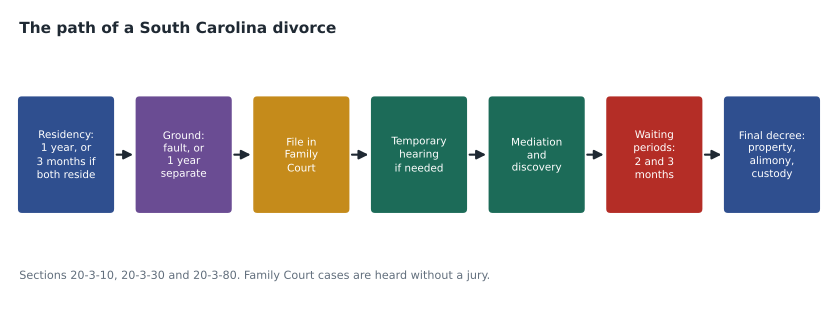
Mrs. Lyerly and her husband separated on July 18, 2025, and had not lived together since. By July 18, 2026 they had lived apart for a year, so she could file on the no-fault ground. Earline Kinard filed her complaint in August 2026.
Alimony
Section 20-3-130 authorizes several forms of alimony: periodic, lump-sum, rehabilitative and reimbursement alimony, separate maintenance and support, and other forms the court considers just. The statute lists factors the court weighs, including the length of the marriage, the parties' ages, health, education and earning capacity, their standard of living, marital misconduct and tax consequences. Adultery by the spouse seeking alimony is a statutory bar to an award in most circumstances.
Periodic alimony can be modified or terminated when circumstances change, and continued cohabitation by the supported spouse is a recurring issue. For Section 20-3-130 and the related modification statute, continued cohabitation means living with another person in a romantic relationship for ninety or more consecutive days, unless the parties agree otherwise in writing. The court may find cohabitation even where the supported spouse alternates shorter stays to avoid the ninety-day mark.
Equitable apportionment of marital property
South Carolina divides marital property by equitable apportionment. The court identifies the marital property, values it and divides it according to the factors in Section 20-3-620. Equitable does not necessarily mean equal; the court weighs fifteen statutory factors.
| Section 20-3-620 factor (summarized) | Section 20-3-620 factor (summarized) |
|---|---|
| Duration of the marriage and the parties' ages | Marital misconduct affecting the economic circumstances or contributing to the breakup |
| Value of the property and each spouse's contribution, including as homemaker | Income and earning potential |
| Physical and emotional health | Need for additional education or training |
| Nonmarital property of each spouse | Vested retirement benefits |
| Alimony or separate maintenance awarded | Desirability of awarding the family home |
| Tax consequences | Support obligations from a prior marriage or other sources |
| Liens and debts | Child custody arrangements |
| Any other factor the court states in its order |
Section 20-3-630 defines what is not marital property. Nonmarital property includes property acquired by inheritance, devise, bequest or gift from someone other than the spouse; property acquired before the marriage, or after the earliest of a temporary order, a signed settlement agreement or a permanent order of separate maintenance; property acquired in exchange for nonmarital property; property excluded by written contract, such as a valid premarital agreement; and the increase in value of nonmarital property, except to the extent the other spouse's efforts during the marriage contributed to it. Gifts between spouses are marital property.
Worked problem
The Lyerly house and the inherited land
Mrs. Lyerly and her husband bought a house in Florence in 2008 with joint savings. In 2015 Mrs. Lyerly inherited ten acres of timberland from her aunt and kept it in her own name. In 2019 her husband gave her a diamond ring for their anniversary. Which items are marital?
Show solution
- The house: acquired during the marriage with marital funds; marital property subject to apportionment.
- The timberland: inherited from a third party; nonmarital, unless the husband's efforts during the marriage increased its value, and then only to that extent.
- The ring: a gift between spouses; marital property under Section 20-3-630.
- The court divides the marital property using the fifteen factors.
Answer: The house and the ring are marital; the timberland is nonmarital. Earline Kinard will need evidence that the husband did no work on the timber.
Common-law marriage and Stone v. Thompson
For more than a century, South Carolina recognized common-law marriage: a marriage formed without a license or ceremony when two people agreed to be married and lived as husband and wife. In Stone v. Thompson, decided July 24, 2019, the Supreme Court of South Carolina abolished common-law marriage prospectively. No one may enter into a common-law marriage in South Carolina after the date of the opinion. Common-law marriages formed before then remain valid.
The Court also changed how a pre-existing common-law marriage is proved. The claimant must show mutual assent: that each party intended to be married to the other and understood that the other shared that intent. The Court required proof by clear and convincing evidence and abandoned the old presumption that long cohabitation and a reputation as a married couple were evidence of marriage. Evidence such as tax returns filed as married, sworn documents, insurance forms, the way the couple introduced each other and joint accounts can help or hurt.
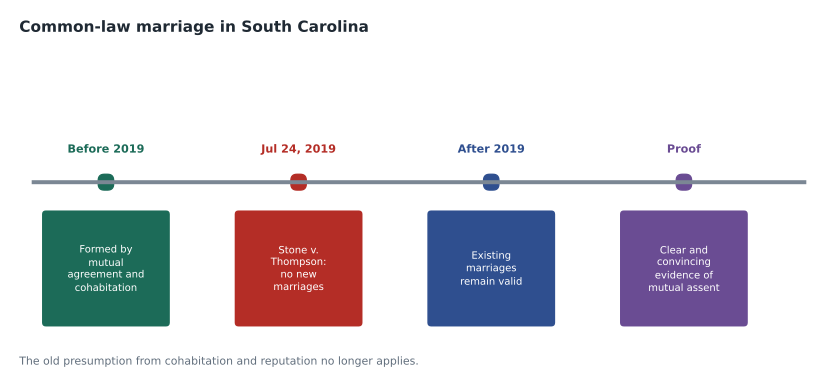
Vernelle's claim depends on this standard. She and her partner began living together in 2012, well before 2019, so a common-law marriage could have formed. But she must prove by clear and convincing evidence that both of them intended to be married. Lainey listed what to gather: their tax returns, his employer's benefit forms, the deed and insurance on the house, his trucking company's emergency contact form, church records and the testimony of people who knew them. If he filed taxes as single every year and listed his brother as next of kin, Vernelle's case is weak; if they filed jointly and he called her his wife on forms, it is much stronger.
Common mistakes
MistakeSouth Carolina has a no-fault divorce for irreconcilable differences.
InsteadThe only no-fault ground is living separate and apart without cohabitation for one year.
MistakeEquitable apportionment always means a 50-50 split.
InsteadThe court weighs fifteen factors; equitable does not necessarily mean equal.
MistakeA couple can still form a common-law marriage in South Carolina.
InsteadStone v. Thompson (2019) abolished new common-law marriages; only those formed before the decision remain valid.
MistakeAn anniversary gift from one spouse to the other is the recipient's separate property.
InsteadInterspousal gifts are marital property under Section 20-3-630.
Custody and child support
Mrs. Lyerly's children were grown, but many of the firm's divorce clients had minor children, and custody and support are the issues that matter most to them. South Carolina courts decide custody according to the best interests of the child, weighing statutory and case-law factors such as each parent's role in the child's care, the child's needs and relationships, the stability of each home, and any history of domestic violence. The court can award joint or sole custody and sets a parenting plan or visitation schedule. Child support is calculated under the state's child support guidelines, which consider both parents' incomes and the number of children, and the court may deviate from the guideline amount only for reasons it states.
Custody and support orders remain modifiable as children grow and circumstances change, so a divorce decree is often the beginning of a long relationship between the Family Court and the family. Lainey noticed that the firm's oldest open files were not divorces at all but custody modifications from divorces decided years before.
Premarital agreements
Section 20-3-630 recognizes property excluded by written contract, including a qualifying premarital agreement, as nonmarital. Couples who marry later in life or bring significant property into a marriage often use such agreements to define what will remain separate. A lawyer drafting one should make sure each party makes full disclosure, has time to consider the agreement and has the opportunity for independent counsel, because an agreement signed under pressure or without disclosure invites a challenge.
Fault still matters
Although most South Carolina divorces are granted on the one-year separation ground, fault can still matter in other ways. Adultery can bar alimony to the spouse who committed it. Marital misconduct that affects the family's economic circumstances or contributes to the breakup is one of the equitable apportionment factors. A lawyer should therefore ask about fault even in a case that will be filed on the no-fault ground, and should be careful about the client's conduct during separation. Romantic cohabitation during a pending case can affect alimony.
The estate side of common-law marriage
Vernelle's case shows that common-law marriage questions often arise at death rather than divorce. A surviving common-law spouse may claim the rights of a spouse in the estate, including an intestate share, an elective share or survivor benefits under insurance or retirement plans. The claimant must prove the marriage, and the other heirs will resist. Since Stone v. Thompson, the claimant carries the burden of clear and convincing evidence of mutual assent, without the help of a presumption from cohabitation. Lawyers who advise unmarried couples now tell them plainly that a ceremony and a license are the only reliable way to marry in South Carolina, and that wills, deeds and beneficiary designations should reflect what each partner wants.
Mediation in Family Court
Mediation is part of most contested Family Court cases. The mediator helps the parties reach agreement on property, alimony, custody and support, and the court reviews any agreement to make sure it is fair and, where children are involved, in their best interests. Lainey sat in on a mediation in the Lyerly case in October 2026. The parties agreed on the house and the retirement accounts by early afternoon; the dog took another hour.
What Lainey took from the files
By November 2026, Mrs. Lyerly's case was set for a final hearing in early 2027, with the house and retirement accounts divided by agreement and the timberland left with her as nonmarital property. Vernelle's case was still gathering documents. Lainey had found two joint tax returns from 2014 and 2015, and an insurance form on which the trucker had listed Vernelle as his wife. Earline Kinard thought the case was now worth pursuing.
Summary and key terms
- The Family Court has exclusive jurisdiction over divorce, property division, alimony, custody and support, and cases are tried without a jury.
- Section 20-3-10 provides four fault grounds and one no-fault ground: one year living separate and apart.
- Residency is generally one year, or three months if both parties are residents; Section 20-3-80 imposes waiting periods.
- Marital property is divided by equitable apportionment under fifteen factors; Section 20-3-630 defines nonmarital property.
- Stone v. Thompson (2019) abolished new common-law marriages; pre-2019 marriages require clear and convincing proof of mutual assent.
- 0
- Family Court
- 1
- separate support and maintenance
- 2
- one-year separation
- 3
- periodic alimony
- 4
- continued cohabitation
- 5
- equitable apportionment
- 6
- nonmarital property
- 7
- common-law marriage
Practice problems
Work each problem on paper first, then reveal the answer to check.
What is South Carolina's no-fault ground for divorce?
Show answer
Living separate and apart without cohabitation for one year.
How many factors does Section 20-3-620 list for equitable apportionment?
Show answer
Fifteen.
What did Stone v. Thompson hold?
Show answer
That no one may enter into a common-law marriage in South Carolina after July 24, 2019, while existing common-law marriages remain valid.
What standard of proof applies to a claim of a pre-2019 common-law marriage?
Show answer
Clear and convincing evidence of mutual assent.
Lesson quiz · 5 questions
Score 60% or more to complete this lesson.
Create a free account to save your progress, take quizzes and earn a certificate.