
BAR-241 · Lesson 11 of 12 · 19 min
Score transfer, limited admission and practice after admission
▶ Video coming soon A video version of this lesson is on the way.
Kinard & Bethea wanted to hire a second associate in 2027, and in November 2026 Earline Kinard asked Lainey to help sort the applications. Two candidates stood out. One had passed the UBE in North Carolina in July 2024 with a 281 and was practicing in Charlotte. The other had practiced for twelve years in Georgia and Florida, both by examination, and wanted to come home to Florence. 'Can either of them start here without taking your exam?' Kinard asked. Lainey said she would find out.
This lesson covers the ways into South Carolina practice other than sitting the UBE in South Carolina, then turns to the duties that begin on admission: South Carolina Bar membership, the Rule 403 trial experiences, continuing legal education and the Essentials course.
Admission on a transferred UBE score
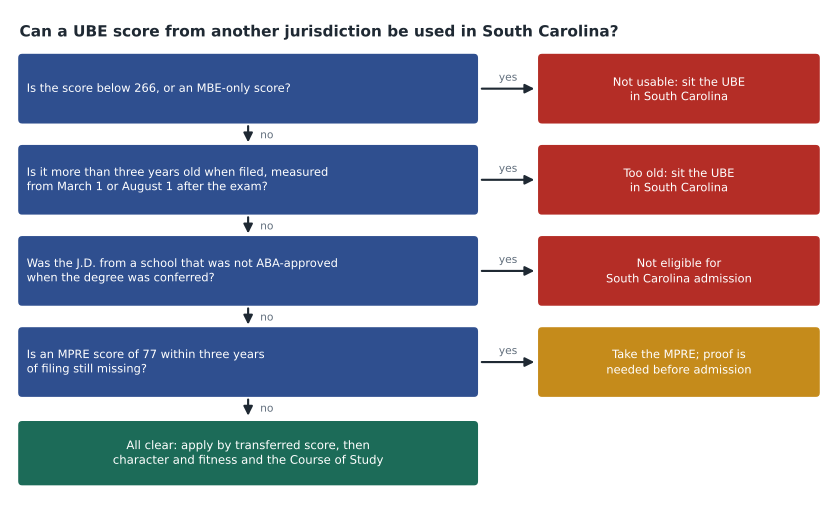
South Carolina accepts UBE scores earned in other jurisdictions. Rule 402(d)(2) treats an application based on an existing UBE score as its own category, with no filing window. The score must be at least 266, and under Rule 402(c)(5) it may not be more than three years old when the application is filed. The three-year period is measured from March 1 after a February exam or August 1 after a July exam. NCBE transfers the score to South Carolina at the applicant's request.
NCBE's summary of South Carolina adds several features. There is no limit on the number of attempts it took the applicant to earn the score. South Carolina does not accept transferred MBE scores standing alone. And an applicant may not apply concurrently for admission by transferred score while also applying to sit for the exam. The application fee is 1,000 dollars, with an additional 750 dollars for an applicant who has been admitted elsewhere for more than one year. The applicant must still meet every other requirement of Rule 402(c): the ABA-approved degree, good moral character, the MPRE score of 77 within three years of filing and the Course of Study.
Worked problem
The two candidates
Candidate A passed the UBE in North Carolina in July 2024 with a 281 and wants to apply in December 2026. Candidate B has practiced twelve years in Georgia and Florida, both admitted by examination, and has never taken the UBE. Can either be admitted in South Carolina without sitting the exam?
Show solution
- Candidate A: 281 meets 266. A July 2024 exam's three-year period runs from August 1, 2024, so a December 2026 application is within it. A must also have an MPRE score of 77 within three years of filing, pay 1,000 dollars plus 750 if admitted more than a year elsewhere and complete the Course of Study.
- Candidate B: has no UBE score to transfer. South Carolina permits admission on motion only on a limited basis, and nothing suggests that B's Georgia and Florida licenses qualify under any of the limited routes.
- B could obtain a limited certificate only if B fits one of the narrow categories, such as in-house counsel, or appear in a single case pro hac vice with local counsel.
- Otherwise B must take the UBE in South Carolina.
Answer: Candidate A can be admitted on the transferred score after the usual review. Candidate B will almost certainly need to sit the exam.
Limited admission and pro hac vice
NCBE describes South Carolina as permitting admission on motion only on a limited basis, and Rule 402(a) says that limited certificates of admission and pro hac vice admission are governed by other rules. The categories are narrow. They include limited certificates for lawyers employed as in-house counsel, special rules for military spouse attorneys under Rule 430 and pro hac vice appearances in particular cases with the association of South Carolina counsel. None of them gives an experienced out-of-state lawyer a general license to practice in South Carolina. A lawyer who wants a full license and has no recent UBE score generally must take the exam.
| Route | Who it is for | Key features |
|---|---|---|
| Transferred UBE score | Applicants with a UBE score of 266 or more | No filing window; score no more than three years old; no attempt limit; MBE-only scores not accepted |
| Limited certificate | Narrow categories such as in-house counsel | Limited practice; governed by separate rules |
| Military spouse attorney | Spouses of service members stationed in South Carolina | Rule 430; not exempt from Rule 403 |
| Pro hac vice | Out-of-state lawyers in a single case | Association with South Carolina counsel |
South Carolina Bar membership
Every lawyer admitted in South Carolina must be a member of the South Carolina Bar, the state's unified bar. Membership carries annual dues and license fees, a requirement to keep contact information current in the Attorney Information System, and compliance with the continuing legal education and trust accounting rules. Lawyers can elect active, inactive or other membership classes, and the class affects CLE obligations.
Trial experiences under Rule 403
South Carolina's Rule 403 limits what a newly admitted lawyer may do in court. Until the Supreme Court approves the lawyer's trial experiences, the lawyer may not appear as counsel in any hearing, trial or deposition in a case pending before a South Carolina court, unless accompanied throughout by a lawyer who is approved or exempt. Lawyers admitted on or before March 1, 1979 and holders of limited certificates are exempt; military spouse attorneys under Rule 430 are not.
Rule 403(b) requires four kinds of experience. The lawyer must observe or participate in one complete civil or criminal jury trial in the circuit court or the United States District Court for the District of South Carolina, including an opening statement, closing argument and the direct and cross-examination of at least two witnesses. The lawyer must observe one video trial approved by the Supreme Court. The lawyer must observe one alternative dispute resolution proceeding in Common Pleas, Family Court or a federal case, or an approved ADR video. And the lawyer must complete two 'day in court' experiences in Common Pleas, General Sessions, Family Court or an administrative law court, each attested by the presiding judge for at least four hours.
| Rule 403(b) experience | Requirement | Video option |
|---|---|---|
| Jury trial | One complete civil or criminal jury trial in circuit or federal district court | No |
| Video trial | One trial video approved by the Supreme Court | It is a video |
| ADR | One ADR proceeding in Common Pleas, Family Court or federal court | Yes, an approved ADR video |
| Day in court | Two days of at least four hours each | No; one may be a judicial observation program |
Students may complete most of the experiences after finishing two-thirds of the credit hours needed to graduate, and a judicial observation program after one-third. The lawyer files a certificate listing the case names, dates and courts, attested by the presiding judge or mediator, with certificates of completion for any videos and a 50-dollar fee. Certificates are accepted only after the lawyer is sworn in. Alternative routes exist for lawyers admitted in another state for two years, judge advocates and judicial law clerks, and Rule 403 lists them separately.
Lainey had observed a General Sessions jury trial in her third year of law school with a clinic professor, and Earline Kinard planned to take her to a Family Court docket and a Common Pleas motions day in the spring. She would still need the video trial and an ADR proceeding, and she planned to sit in on one of the firm's mediations in Mr. Pettus's case.
Continuing legal education under Rule 408
Under Rule 408, an active South Carolina lawyer must complete at least fourteen hours of approved continuing legal education each reporting year, of which at least two must be devoted to legal ethics and professional responsibility, called LEPR hours. At least once every two reporting years, one hour must be devoted exclusively to substance abuse, mental health issues or stress management and the legal profession; that hour counts toward the fourteen but not toward the LEPR hours. A 2019 amendment changed this requirement from every three years to every two.
The reporting year runs from March 1 through the last day of February, and the annual report is due by March 1 to the Commission on Continuing Legal Education and Specialization, with a filing fee. Failure to comply leads to suspension. A new lawyer is exempt for the reporting year in which the lawyer is admitted, and the first required reporting year begins the March 1 after admission.
The Essentials course
Rule 408 adds a new-lawyer requirement. A lawyer admitted under Rule 402 must complete an Essentials course administered by the South Carolina Bar before the end of the first required reporting year, in addition to the fourteen-hour requirement, and the Essentials hours count toward that first year's total. The rule exempts lawyers on active military duty who elect military member status, inactive members who remain inactive through the end of the first required year, lawyers admitted in another jurisdiction for at least two years before South Carolina admission and lawyers who took the Bar's earlier Bridge the Gap program before March 2013.
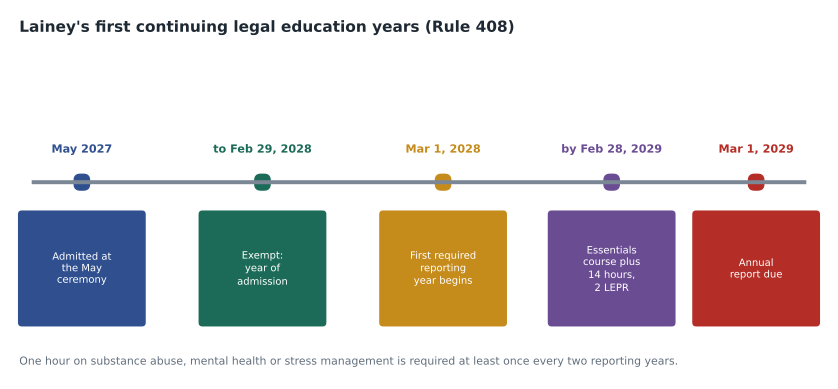
For Lainey, admitted in May 2027, the reporting year that began March 1, 2027 is her exempt year. Her first required reporting year begins March 1, 2028 and ends on the last day of February 2029. In that year she must complete the Essentials course and enough other approved hours to reach fourteen, including two LEPR hours, and she should take the substance abuse or mental health hour either then or in the following year.
Common mistakes
MistakeAn experienced lawyer from another state can waive into South Carolina after five years.
InsteadSouth Carolina permits admission on motion only on a limited basis; most lawyers without a UBE score must take the exam.
MistakeMy UBE score is good in South Carolina for five years.
InsteadIt may not be more than three years old when the application is filed.
MistakeOnce sworn in, I can take depositions alone.
InsteadRule 403 bars appearing alone in a hearing, trial or deposition until the experiences are approved.
MistakeThe Essentials course is optional.
InsteadRule 408 requires it in the first required reporting year unless an exemption applies.
Planning the first year
Marchetti and Lainey sketched her first year as a lawyer. Admission in May 2027. Rule 403 experiences completed over the spring and summer, with the certificate filed as soon as she was sworn in and the last experience done. Her first CLE reporting year beginning March 1, 2028, with the Essentials course scheduled early in that year rather than in February 2029. And an eye on the Bar's resources for new lawyers, including mentoring and practice management help.
The plan also covered the work itself. Until her Rule 403 approval came through, Lainey would attend every hearing and deposition with Earline Kinard or Ozias Bethea, which suited the firm's training style anyway. Her closings work would continue under Bethea's supervision. And she would keep the habit she had started as a clerk: before advising on any issue, look up the South Carolina authority.
Answering Earline Kinard
Lainey wrote a one-page memo answering Kinard's question about the two applicants. The North Carolina lawyer could apply for admission on her transferred UBE score at any time, without waiting for a window, if she had an MPRE score within the three-year window, and would then need the character and fitness review and the Course of Study. The Georgia and Florida lawyer had no UBE score; unless he fit one of the narrow limited routes, he would need to sit the UBE in South Carolina. Kinard read the memo, said 'good,' and scheduled interviews.
Membership classes and the first dues bill
New members also receive their first dues and license fee notice from the South Carolina Bar soon after admission. The notice asks the member to choose a membership class. Most new lawyers who practice in the state choose active status. A lawyer who moves away or takes a job that does not require a license may consider inactive status, which changes the CLE requirement and, under Rule 408, can affect the Essentials course timing. Lainey's plan was simple: active status, Essentials in her first required year and the Rule 403 certificate filed as soon as possible.
Summary and key terms
- A transferred UBE score of 266 or more, no more than three years old, supports admission without sitting in South Carolina; there is no attempt limit, and MBE-only scores are not accepted.
- Admission on motion is available only on a limited basis, through narrow categories such as limited certificates, military spouse attorneys and pro hac vice.
- Rule 403 requires a jury trial, a video trial, an ADR proceeding and two days in court before a new lawyer appears alone.
- Rule 408 requires fourteen CLE hours a year, including two LEPR hours, and a substance abuse or mental health hour every two years; the year runs March 1 to the end of February.
- New lawyers complete the Essentials course in their first required reporting year.
- 0
- transferred score
- 1
- score age
- 2
- limited certificate
- 3
- pro hac vice
- 4
- Rule 403
- 5
- day in court
- 6
- LEPR
- 7
- Essentials course
Practice problems
Work each problem on paper first, then reveal the answer to check.
May a South Carolina applicant transfer a 270 UBE score earned four years ago?
Show answer
No. The score may not be more than three years old when the application is filed.
Name the four kinds of Rule 403 experiences.
Show answer
One jury trial, one approved video trial, one ADR proceeding or approved ADR video and two day-in-court experiences.
How many CLE hours must an active South Carolina lawyer complete each year?
Show answer
Fourteen, including two LEPR hours.
When does a new lawyer's first required CLE reporting year begin?
Show answer
On the March 1 after admission.
Lesson quiz · 5 questions
Score 60% or more to complete this lesson.
Create a free account to save your progress, take quizzes and earn a certificate.