
BAR-241 · Lesson 8 of 12 · 19 min
South Carolina torts: comparative negligence, Act 42 and the Tort Claims Act
▶ Video coming soon A video version of this lesson is on the way.
On the evening of April 11, 2026, a sixty-four-year-old retired postal carrier named Mr. Pettus was driving home through an intersection in Florence when two vehicles hit his car almost at once. A pickup driven by a man who had spent the previous three hours at a bar on the edge of town ran the red light from his left. A city sanitation truck, returning late to the yard, entered the intersection from the other side and could not stop in time. Mr. Pettus spent nine days in the hospital. By the time Lainey joined Kinard & Bethea in August, his file was two inches thick, and Ozias Bethea wanted her to write a memo on three questions: how fault would be divided, what could be recovered from the city, and whether the bar could be brought into the case.
Marchetti read the facts and told Lainey she had been handed a very good teaching file. 'You will need modified comparative negligence, South Carolina's joint and several liability statute as rewritten in 2025, the liquor liability provisions of the same act and the Tort Claims Act,' she said. 'That is most of what makes South Carolina tort practice distinctive.'
This lesson covers each of those topics, along with punitive damages and the medical malpractice limits. As with Lesson 7, none of it is tested on the UBE, but all of it is South Carolina practice.
Modified comparative negligence
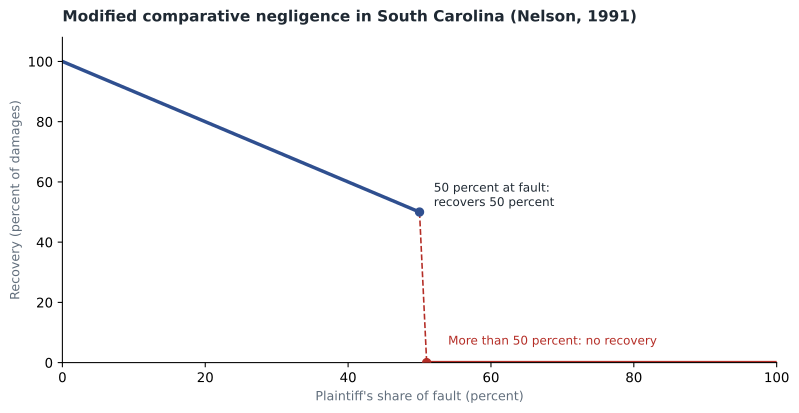
For most of its history South Carolina followed contributory negligence, under which any negligence by the plaintiff barred recovery. The Supreme Court of South Carolina abandoned that rule in Nelson v. Concrete Supply Co., decided January 7, 1991. The Court held that a plaintiff in a negligence action may recover damages if the plaintiff's negligence is not greater than that of the defendant, with the recovery reduced in proportion to the plaintiff's negligence. Where there are several defendants, the plaintiff's negligence is compared with the combined negligence of all defendants. The new rule applied to causes of action arising on or after July 1, 1991.
The words 'not greater than' make South Carolina a 51 percent bar jurisdiction. A plaintiff who is 50 percent at fault recovers half of the damages, and a plaintiff who is 51 percent at fault recovers nothing. The comparison with the defendants' combined negligence means that a plaintiff who is 40 percent at fault can recover against two defendants who are each 30 percent at fault.
Joint and several liability: Section 15-38-15
Section 15-38-15 of the South Carolina Code limits joint and several liability. A defendant whose conduct is less than 50 percent of the total fault is liable only for its own percentage of the indivisible damages. A defendant whose conduct is 50 percent or more remains jointly and severally liable for the whole. The jury or other fact finder allocates percentages of fault among the defendants and, where the rules allow, other tortfeasors, with the plaintiff's own share included so the total equals 100 percent.
Subsection (F) of the statute has long excluded certain kinds of conduct from the protection of the 50 percent rule. Before 2026, a defendant whose conduct was willful, wanton, reckless, grossly negligent or intentional, or involved the use of alcohol or illegal drugs, remained jointly and severally liable even if found less than 50 percent at fault. The 2025 legislation described below changed that subsection, and commentary on the act describes it as removing or narrowing those exceptions. Because the change matters in every multi-defendant case, a lawyer should read the enacted text of subsection (F) as it now stands before advising a client.
Act 42 of 2025
In 2025 the General Assembly passed H.3430, enacted as Act No. 42 and signed by Governor Henry McMaster on May 28, 2025. The act took effect January 1, 2026 and applies only to causes of action or claims arising or accruing after that date. It made three groups of changes that matter in tort practice.
First, it restored the ability of a defendant to argue that a nonparty caused or contributed to the plaintiff's injury and to have fault allocated to that nonparty. In 2017 the Supreme Court had held, in Machin v. Carus Corp. and Smith v. Tiffany, that the statute did not permit allocation of fault to nonparties. Act 42 overrode that result. A defendant who wants a nonparty on the verdict form must generally disclose the nonparty within 180 days after the action begins, or later for good cause, and bears the burden of proving the nonparty's fault.
Second, the act addressed fault involving intoxicated drivers and alcohol licensees. A driver charged with certain driving-under-the-influence offenses can be placed on the verdict form on a defendant's motion. And under a new Section 61-2-147, when a verdict is rendered against both a licensee that served alcohol and a defendant charged under the listed traffic statutes, the licensee is jointly and severally liable for 50 percent of the plaintiff's actual damages, notwithstanding Section 15-38-15.
Third, the act changed the law of alcohol service and liquor liability insurance. It prohibits knowingly selling alcohol by the drink to an intoxicated person, requires server training, adjusts penalties and creates a program that lets establishments reduce the standard one-million-dollar liquor liability coverage requirement by meeting conditions such as closing by midnight, training servers or keeping alcohol below 40 percent of sales, while keeping a minimum of 300,000 dollars in coverage.
| Issue | Before January 1, 2026 | Claims accruing after January 1, 2026 (Act 42) |
|---|---|---|
| Fault of nonparties | Not allocated (Machin v. Carus Corp.; Smith v. Tiffany, 2017) | May be allocated if disclosed within 180 days or for good cause; defendant bears the burden |
| Defendants under 50 percent at fault | Several liability, with subsection (F) exceptions for reckless, intentional or alcohol-related conduct | Several liability; subsection (F) changed (read the current text) |
| Bar that served an impaired driver | Joint and several liability possible under the exceptions | Licensee jointly and severally liable for 50 percent of actual damages when both are found liable (Section 61-2-147) |
| Liquor liability coverage | One million dollars required for late-night on-premises sales | Reductions available for risk-mitigation steps, minimum 300,000 dollars |
The South Carolina Tort Claims Act
The South Carolina Tort Claims Act, Sections 15-78-10 and following, waives the sovereign immunity of the state and its political subdivisions for torts, subject to the limits and exceptions in the act. It is the exclusive remedy for torts committed by government employees acting within the scope of their duties, and an employee acting within the scope of official duty is generally not personally liable. Under Section 15-78-70, the exception is conduct outside the scope of official duties or conduct involving actual fraud, actual malice, intent to harm or a crime involving moral turpitude.
Section 15-78-60 lists forty exceptions to the waiver, under which the government is not liable at all. They include legislative, judicial and quasi-judicial acts, the exercise of discretion, many licensing and regulatory inspection functions and claims covered by workers' compensation. Some exceptions do not apply where the government's conduct was grossly negligent, so the standard of care matters.
Section 15-78-120 limits recovery. No person may recover more than 300,000 dollars for loss from a single occurrence, and the total recovered from a single occurrence may not exceed 600,000 dollars. For torts by a licensed physician or dentist employed by a governmental entity, both limits are 1.2 million dollars. No award may include punitive damages or prejudgment interest.
The act also sets procedure. A claimant may file a verified claim with the appropriate agency or political subdivision, or with the Attorney General if the proper defendant is unclear, within one year after the loss was or should have been discovered; the entity has 180 days to act, and silence counts as a disallowance. A lawsuit must be commenced within two years after the loss was or should have been discovered, or within three years if the claimant first filed a verified claim. Suit is brought in circuit court in the county where the act or omission occurred, and where a joint tortfeasor is also named, the fact finder must return a special verdict stating each defendant's share of liability.
| Tort Claims Act rule | Section | Content |
|---|---|---|
| Exclusive remedy and employee immunity | 15-78-70 | Claim lies against the entity; employee liable only for conduct outside duties or involving fraud, malice, intent to harm or moral turpitude |
| Exceptions | 15-78-60 | Forty exceptions, including discretion and many regulatory functions |
| Verified claim | 15-78-80 | Within one year of discovery; 180 days to act |
| Limitations | 15-78-110 | Two years from discovery, or three if a verified claim was filed |
| Limits on recovery | 15-78-120 | 300,000 dollars per person and 600,000 per occurrence; 1.2 million for physicians and dentists; no punitive damages or prejudgment interest |
Worked problem
Mr. Pettus's memo
Assume Mr. Pettus's damages are 900,000 dollars. A jury finds the pickup driver 60 percent at fault, the city 30 percent and Mr. Pettus 10 percent. The pickup driver, who was charged with driving under the influence, has 50,000 dollars of insurance and few assets. The bar that served him is also found liable. What can Mr. Pettus recover, and from whom?
Show solution
- Comparative negligence: his 10 percent is not greater than the defendants' combined 90 percent, so he recovers 90 percent of 900,000, or 810,000 dollars.
- The pickup driver, at 60 percent, is jointly and severally liable for the whole 810,000 dollars, but collecting beyond his insurance is unlikely.
- The city, at 30 percent, is severally liable for its share, 270,000 dollars, which is within the 300,000-dollar per-person limit of Section 15-78-120. No punitive damages or prejudgment interest are available against it.
- Because the claim accrued after January 1, 2026, Section 61-2-147 makes the bar jointly and severally liable for 50 percent of his actual damages when verdicts are rendered against both the bar and the charged driver.
Answer: The city's share is capped by the Tort Claims Act, the driver is underinsured and the bar's 50 percent exposure under Act 42 may be the most important source of recovery. The memo should flag that the figures change if the jury allocates fault differently.
Punitive damages and medical malpractice limits
South Carolina allows punitive damages against private defendants for conduct that is willful, wanton or in reckless disregard of the plaintiff's rights, proved by clear and convincing evidence, and since 2011 the Code has limited the amount, with exceptions for the most serious conduct. The Code also limits noneconomic damages in medical malpractice actions, and the limits are adjusted each year for inflation; the state's Revenue and Fiscal Affairs Office publishes the current figures. A lawyer should look up the current year's amounts and the exceptions before valuing a case.
Common mistakes
MistakeSouth Carolina still follows contributory negligence.
InsteadNelson v. Concrete Supply Co. (1991) adopted modified comparative negligence for causes of action arising on or after July 1, 1991.
MistakeFault can never be allocated to a nonparty in South Carolina.
InsteadAct 42 restored nonparty allocation for claims accruing after January 1, 2026, with a 180-day disclosure rule.
MistakeA city is liable for punitive damages if its driver was reckless.
InsteadThe Tort Claims Act bars punitive damages and prejudgment interest against governmental entities.
MistakeThe Tort Claims Act limit is 300,000 dollars per occurrence.
InsteadIt is 300,000 dollars per person and 600,000 dollars per occurrence, with higher limits for physicians and dentists.
An intake checklist for a South Carolina injury case
Ozias Bethea and Lainey turned the Pettus file into a checklist for new injury cases. Record the date of injury, because it decides whether Act 42 applies and starts every limitations period. Identify every potential defendant, including governmental entities, alcohol licensees and nonparties a defendant might later blame. If a governmental entity is involved, decide whether to file a verified claim under Section 15-78-80 and calendar both the one-year claim period and the two- or three-year limitations period. Estimate the client's share of fault and each defendant's share, because the 51 percent bar and the 50 percent threshold for joint and several liability shape the value of the case and the choice of defendants.
Next, identify every insurance policy: each defendant's liability coverage, the client's own medical payments and uninsured and underinsured motorist coverage, and any health insurer with a reimbursement claim. For a licensed establishment, ask about its liquor liability coverage, which Act 42 made more flexible. Finally, confirm the version of every statute in force on the date of injury. South Carolina's tort statutes changed significantly in 2025, and a rule learned from an older outline may not govern a new file.
Summary and key terms
- Nelson v. Concrete Supply Co. (1991): recovery if the plaintiff's negligence is not greater than the defendants' combined negligence, reduced by the plaintiff's share.
- Section 15-38-15: defendants less than 50 percent at fault are severally liable; those at 50 percent or more are jointly and severally liable.
- Act No. 42 (signed May 28, 2025; effective January 1, 2026) restored nonparty fault allocation, changed the exceptions and set a 50 percent rule for alcohol licensees.
- The Tort Claims Act waives immunity with forty exceptions, limits recovery to 300,000 dollars per person and 600,000 per occurrence and bars punitive damages.
- Tort Claims Act suits must be filed within two years of discovery, or three if a verified claim was filed.
- 0
- modified comparative negligence
- 1
- joint and several liability
- 2
- several liability
- 3
- nonparty allocation
- 4
- Act No. 42
- 5
- licensee
- 6
- Tort Claims Act
- 7
- verified claim
Practice problems
Work each problem on paper first, then reveal the answer to check.
Under Nelson, may a plaintiff who is 50 percent at fault recover against a single defendant who is 50 percent at fault?
Show answer
Yes. The plaintiff's negligence is not greater than the defendant's, so the plaintiff recovers half of the damages.
When does Act 42 apply?
Show answer
To causes of action or claims arising or accruing after January 1, 2026.
What are the Tort Claims Act limits for a single occurrence?
Show answer
300,000 dollars per person and 600,000 dollars in total, or 1.2 million dollars for torts by government-employed physicians and dentists.
Within what time must a nonparty be disclosed for fault allocation under Act 42?
Show answer
Within 180 days after the action begins, or later for good cause.
Lesson quiz · 5 questions
Score 60% or more to complete this lesson.
Create a free account to save your progress, take quizzes and earn a certificate.