
BAR-241 · Lesson 7 of 12 · 19 min
South Carolina courts, judicial selection and civil procedure
▶ Video coming soon A video version of this lesson is on the way.
On her second day at Kinard & Bethea, Lainey was asked to file a summons and complaint in the Court of Common Pleas, check a hearing date in Family Court, and call a magistrate's office about a small claims judgment. By noon she had visited three different clerk's windows and realized that her law school procedure course had taught her almost nothing about where things actually go in South Carolina. Earline Kinard laughed when Lainey said so. 'That is what the first year is for,' she said. 'Draw yourself a map.'
This lesson is that map. It covers the structure of the South Carolina courts, the way South Carolina selects its judges, which is unusual among the states, and the features of South Carolina civil procedure a new lawyer meets in the first months of practice. None of it is tested on the UBE, but much of it is the kind of difference the Course of Study is designed to teach.
A unified judicial system
Article V of the South Carolina Constitution establishes a unified judicial system. The Chief Justice of the Supreme Court is the administrative head of the system, and the Supreme Court has rulemaking power over practice and procedure in the state's courts, as well as authority over the admission and discipline of lawyers. The courts fall into three levels: two appellate courts, the trial courts of general jurisdiction and several courts of limited jurisdiction.
The appellate courts
The Supreme Court of South Carolina has five justices: the Chief Justice and four associate justices. It hears appeals in certain classes of cases directly, reviews decisions of the Court of Appeals by writ of certiorari and exercises original jurisdiction in some matters. It is also the court that admits lawyers, disciplines them and writes the rules discussed in Lessons 1 through 3 and 11.
The Court of Appeals is the intermediate appellate court. It has nine judges, sitting in panels of three, and hears most appeals from the circuit courts and the Family Court. A party who loses in the Court of Appeals may petition the Supreme Court for a writ of certiorari, which the Supreme Court grants in its discretion. The South Carolina Appellate Court Rules govern both courts' procedure, which is why the same rule set contains both the appellate rules and the admission rules.
The trial courts
The circuit court is the trial court of general jurisdiction. The state is divided into sixteen judicial circuits, each made up of one or more counties; Florence County, where Lainey works, is in the Twelfth Circuit. The circuit court has two divisions. The Court of Common Pleas hears civil cases, and the Court of General Sessions hears criminal cases. A lawyer files a civil complaint 'in the Court of Common Pleas for Florence County' and defends a criminal client 'in General Sessions.'
The Family Court has exclusive jurisdiction over most domestic relations matters, including divorce, separate support and maintenance, equitable apportionment of marital property, custody, child support, adoption and juvenile matters. Lesson 9 covers it in detail. Masters-in-equity hear nonjury equity matters referred to them by the circuit court, including many mortgage foreclosures. The Administrative Law Court hears contested cases and appeals involving many state agencies.
The courts of limited jurisdiction
Each county has a probate court, which handles estates, guardianships and conservatorships and the involuntary commitment of persons with mental illness. Probate judges are elected by the voters of the county. Magistrate courts handle small civil claims, landlord and tenant matters, preliminary hearings and minor criminal offenses; magistrates are appointed by the Governor with the advice and consent of the Senate. Municipal courts hear violations of city ordinances and minor offenses within city limits.
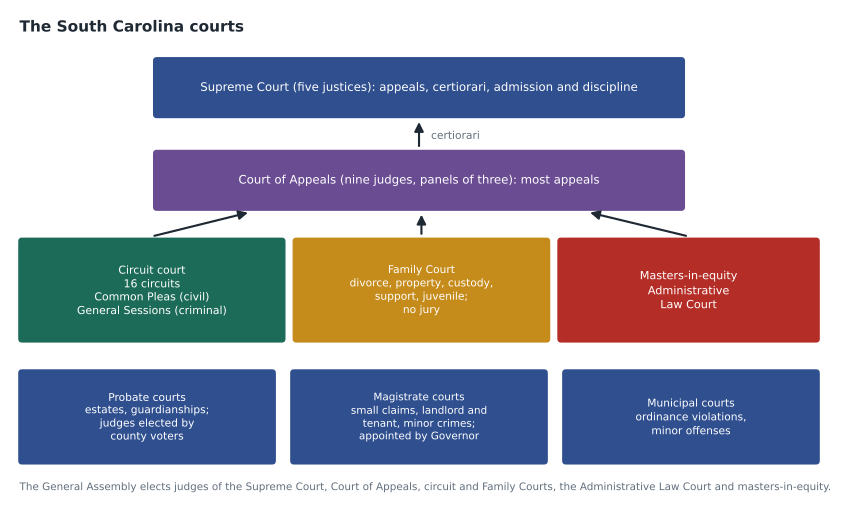
| Court | Main work | How judges are chosen |
|---|---|---|
| Supreme Court | Appeals, certiorari, admission and discipline of lawyers | Elected by the General Assembly |
| Court of Appeals | Most appeals from circuit and Family Court | Elected by the General Assembly |
| Circuit court (Common Pleas and General Sessions) | Civil and criminal trials | Elected by the General Assembly |
| Family Court | Divorce, property, custody, support, juvenile | Elected by the General Assembly |
| Master-in-equity | Nonjury equity matters, foreclosures | Elected by the General Assembly |
| Probate court | Estates, guardianships, commitments | Elected by county voters |
| Magistrate court | Small claims, landlord and tenant, minor crimes | Appointed by the Governor with Senate consent |
Judicial selection by the General Assembly
South Carolina is one of only two states in which the legislature elects most judges; Virginia is the other. The General Assembly, meeting in joint session, elects the justices of the Supreme Court, the judges of the Court of Appeals, the circuit courts, the Family Court and the Administrative Law Court, and the masters-in-equity. Before the election, the Judicial Merit Selection Commission screens candidates and finds them qualified or not qualified, and only candidates it nominates can be elected.
The system was revised in 2024. Act No. 219, signed by the Governor on July 2, 2024 and effective July 1, 2025, restructured the Judicial Merit Selection Commission and changed its procedures. Under the act, the Commission has twelve members: six legislators, three from each house, and six non-legislators, four of them appointed by the Governor. The Commission may now nominate up to six qualified candidates for a seat, rather than three, and must state its reasons for finding any candidate not qualified. Candidates may not seek pledges of support from legislators, and legislators may not act on a candidate's behalf, until the Commission has formally released its report on all candidates, and the act makes a violation a misdemeanor.
For a new lawyer, the main practical effect of legislative election is that judges are well known to the bar and the legislature, and that the bar's evaluations of judicial candidates matter. It also explains why some of the state's leading trial lawyers have served in the General Assembly. A lawyer who wants to become a judge one day starts by building a reputation for competence and civility before the bench and bar of the circuit.
Civil procedure in the Court of Common Pleas
South Carolina civil procedure is governed by the South Carolina Rules of Civil Procedure, which were modeled on the federal rules and follow their numbering, with state-specific differences. A civil action is commenced by filing a summons and complaint, which are then served on the defendant. The summons tells the defendant how long it has to answer; a South Carolina defendant generally has thirty days after service to answer the complaint, which is longer than the federal rule. A lawyer coming from federal practice should read the South Carolina rule rather than assume the federal deadline.
Many civil cases in the Court of Common Pleas are subject to court-annexed alternative dispute resolution, usually mediation, under the Supreme Court's ADR rules, and Rule 403's trial experience requirement includes observing an ADR proceeding for that reason. Discovery follows the general pattern of the federal rules. Civil juries in circuit court have twelve members.
Limitations periods
South Carolina's general statute of limitations for most actions in contract and tort is three years. Medical malpractice actions also carry a three-year period with a discovery rule and an outside limit, and actions under the South Carolina Tort Claims Act have their own limits, covered in Lesson 8. Limitations periods are set by statute and change, so a lawyer should look up the specific provision for each claim rather than rely on a general rule.
Worked problem
Where does the file go?
Earline Kinard hands Lainey four matters: (1) a contract claim for 60,000 dollars against a Darlington County contractor; (2) a client's divorce; (3) a widow's petition to probate her husband's will; (4) a landlord's eviction of a tenant behind on rent. Where does each begin?
Show solution
- Contract claim: the Court of Common Pleas, in a county where venue is proper, because the amount is above the magistrate's civil limit.
- Divorce: the Family Court, which has exclusive jurisdiction.
- Will: the probate court of the county where the husband was domiciled.
- Eviction: magistrate court, which handles landlord and tenant matters.
Answer: Each matter goes to a different court. Knowing which court has jurisdiction is the first question in every file.
Common mistakes
MistakeSouth Carolina judges are elected by the voters.
InsteadMost judges are elected by the General Assembly after screening by the Judicial Merit Selection Commission; probate judges are elected by county voters.
MistakeThe Court of Common Pleas hears criminal cases.
InsteadCommon Pleas is the civil division; General Sessions is the criminal division.
MistakeThe answer deadline in South Carolina is twenty-one days, as in federal court.
InsteadA South Carolina defendant generally has thirty days after service.
MistakeDivorces are filed in circuit court.
InsteadThe Family Court has exclusive jurisdiction over divorce.
Practicing in a county seat
Florence County is a good place to learn how the pieces fit together, because the county's courts share a building and a small bar. On a typical week, Lainey saw Earline Kinard appear at a motions hearing in Common Pleas on Monday, sit through a Family Court temporary hearing on Tuesday, file an estate inventory in probate court on Wednesday and spend Thursday on closings. Ozias Bethea handled most of the firm's criminal work in General Sessions and its magistrate court collections. Each court had its own clerk, its own filing practices and its own rhythm.
The South Carolina Judicial Branch also runs electronic filing in the trial courts, and the firm filed most civil pleadings electronically. Lainey learned to check each court's filing requirements before preparing a document, because the requirements differ by court and type of case. She also learned that some things still happen on paper, particularly in probate and magistrate courts in smaller counties.
Appeals in practice
A new lawyer rarely handles an appeal alone, but every lawyer needs to know how appeals begin, because the deadlines are short. The South Carolina Appellate Court Rules govern the notice of appeal, the record and the briefs, and the time to file a notice of appeal runs from service of written notice of entry of the order or judgment. A missed appellate deadline is one of the most common causes of malpractice claims against lawyers. Kinard & Bethea's practice was to calendar the appeal deadline the day any final order arrived, whether or not the client wanted to appeal.
Federal court in South Carolina
South Carolina is a single federal judicial district, the District of South Carolina, with divisions across the state, including one in Florence. Appeals from the district court go to the United States Court of Appeals for the Fourth Circuit. Admission to the federal district court is separate from state admission and has its own requirements under the court's local rules. For a lawyer in Lainey's position, federal practice matters mostly for removal of state cases on diversity grounds and for the jury trial that can satisfy Rule 403.
Why judicial selection matters to a new lawyer
Legislative election shapes the culture of the South Carolina bench. Judges are known to the bar and to the General Assembly before they are elected, and many have practiced in the circuits where they sit. The Judicial Merit Selection Commission's screening includes reviews by citizens' committees and the South Carolina Bar, and lawyers who appear before a judge may be asked about the judge's temperament, knowledge and fairness. The 2024 reforms aimed to make the process more transparent by allowing more nominees and restricting early pledges. For a new lawyer, the lesson is simple: reputation travels quickly in a small bar, and civility and preparation are noticed.
A map for the binder
By the end of her first month, Lainey had drawn the map Earline Kinard suggested. It showed each court, what it heard, how its judges were chosen and where its clerk sat in the Florence County Judicial Center. Marchetti asked to see it and suggested one addition: the deadline that most often mattered in each court. For Common Pleas, the answer deadline. For Family Court, the statutory waiting periods. For appeals, the notice of appeal. For the Tort Claims Act, the claim and limitations periods. The map went into her binder next to the requirements page from Lesson 1.
Magistrates and small claims
Magistrate courts deserve a word because they are where many new lawyers first appear. They handle small civil claims, landlord and tenant cases and minor criminal matters, and many litigants appear without lawyers. Procedure is simpler than in circuit court, but the stakes for clients, especially tenants facing eviction, can be high. A new lawyer appearing in magistrate court still needs Rule 403 approval or an accompanying lawyer, because the rule covers hearings and trials in South Carolina courts generally.
Summary and key terms
- Article V creates a unified judicial system headed by the Chief Justice, with a five-member Supreme Court and a nine-member Court of Appeals.
- The circuit court sits as Common Pleas for civil cases and General Sessions for criminal cases in sixteen circuits.
- The Family Court, masters-in-equity, probate, magistrate and municipal courts handle specialized matters.
- The General Assembly elects most judges after Judicial Merit Selection Commission screening, revised by Act No. 219 effective July 1, 2025.
- The South Carolina Rules of Civil Procedure follow the federal model with differences, including a thirty-day answer period.
- 0
- unified judicial system
- 1
- Court of Common Pleas
- 2
- Court of General Sessions
- 3
- Family Court
- 4
- master-in-equity
- 5
- Judicial Merit Selection Commission
- 6
- certiorari
- 7
- statute of limitations
Practice problems
Work each problem on paper first, then reveal the answer to check.
How many justices sit on the Supreme Court of South Carolina?
Show answer
Five: the Chief Justice and four associate justices.
Which body elects most South Carolina judges?
Show answer
The General Assembly, in joint session, after screening by the Judicial Merit Selection Commission.
How many nominees may the Judicial Merit Selection Commission send for a seat after Act No. 219?
Show answer
Up to six.
Where is a criminal case tried in circuit court?
Show answer
In the Court of General Sessions.
Lesson quiz · 5 questions
Score 60% or more to complete this lesson.
Create a free account to save your progress, take quizzes and earn a certificate.