
BAR-241 · Lesson 1 of 12 · 19 min
Becoming a lawyer in South Carolina
▶ Video coming soon A video version of this lesson is on the way.
Lainey Gaillard grew up in Florence, in the Pee Dee region of South Carolina, where her mother teaches eighth-grade science and her father manages a tire distribution warehouse off Interstate 95. She finished her J.D. at a South Carolina law school in May 2026 and planned to sit for the July 2026 bar exam. A summer clerkship offer changed her plans. Kinard & Bethea, a three-lawyer general practice firm two blocks from the Florence County Judicial Center, needed a clerk from August through the spring, and the senior partner, Earline Kinard, told her she could study while she worked if she sat in February. Lainey filed for the February 2027 exam in August 2026 and joined Hollis Marchetti's Tuesday evening study group in September.
At her first one-on-one session, Marchetti asked Lainey what she knew about getting admitted in South Carolina. Lainey knew it was a Uniform Bar Examination state and that the passing score was 266. She was less sure about the rest. 'Who actually decides whether I get in?' she asked. 'The Board? The Bar? The Supreme Court?' Marchetti said it was the right first question, because the answer shapes every deadline that follows.
This lesson maps the institutions that control admission in South Carolina, the routes into practice, the requirements an applicant by examination must meet and the order in which those requirements usually fall. Later lessons take each requirement in detail.
The Supreme Court's control of admission
In South Carolina, as in every state, the power to admit lawyers belongs to the judiciary. The South Carolina Constitution gives the Supreme Court authority over the admission of persons to practice law, and the Court exercises that power through its own rules. The rules on admission are in Part IV of the South Carolina Appellate Court Rules, usually cited as SCACR. The most important for a new applicant is Rule 402, which governs admission to the practice of law. Rule 403 sets the trial experience requirements that limit a new lawyer's courtroom work, and Rule 408 sets the continuing legal education requirements, including a course every new admittee must complete.
Because the Court writes these rules, it can and does amend them by order. A rule learned from a commercial outline written a few years ago may have changed. The Court's website publishes the current text of the rules and recent orders amending them, and applicants should read the current Rule 402 itself rather than rely on summaries.
The bodies involved
Several bodies carry out the Court's rules. The Board of Law Examiners prepares, administers and grades the bar examination, and in a UBE state that means arranging the administration of the National Conference of Bar Examiners' components and grading the written answers. The Committee on Character and Fitness decides whether each applicant has the character and fitness to practice. Rule 402 sets its size at twenty-four members appointed for five-year terms, sitting in three-member panels. The Office of Bar Admissions, part of the Supreme Court's administrative staff, receives applications, collects fees, communicates with applicants and schedules the admission ceremonies.
Two other organizations matter. The National Conference of Bar Examiners, usually called NCBE, writes the components of the Uniform Bar Examination and the Multistate Professional Responsibility Examination and transfers scores among jurisdictions. NCBE's published summary of South Carolina notes that South Carolina does not use NCBE's character and fitness investigation services, so the character review is handled within the state. The South Carolina Bar is the unified bar association: every lawyer licensed in the state must be a member. The Bar administers the online Course of Study on South Carolina Law that applicants must complete before admission and the Essentials course that new members complete after admission.
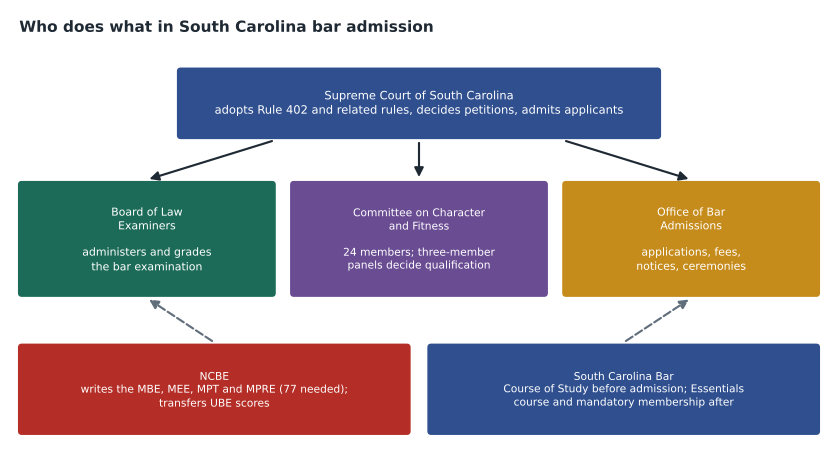
| Body | Main role for an applicant |
|---|---|
| Supreme Court of South Carolina | Adopts Rule 402 and related rules, decides petitions and admits applicants at ceremonies |
| Board of Law Examiners | Administers and grades the bar examination |
| Committee on Character and Fitness | Decides whether the applicant has the character and fitness to practice |
| Office of Bar Admissions | Receives applications and fees, sends notices, sets ceremony deadlines |
| NCBE | Writes the MBE, MEE, MPT and MPRE; transfers UBE scores |
| South Carolina Bar | Administers the Course of Study and the Essentials course; mandatory membership after admission |
Three routes into South Carolina practice
There are three broad ways to become a South Carolina lawyer. The first, and the one Lainey is taking, is admission after passing the UBE in South Carolina. The second is admission on an existing UBE score earned in South Carolina or another UBE jurisdiction and transferred by NCBE. Rule 402 treats this as its own application, with no filing window, and it requires a score of 266 or more that is not more than three years old. The third covers narrower kinds of admission. NCBE describes South Carolina as permitting admission on motion only on a limited basis, and Rule 402 itself says that other rules provide for limited certificates of admission and for pro hac vice admission in a single case. Lesson 11 covers the second and third routes.
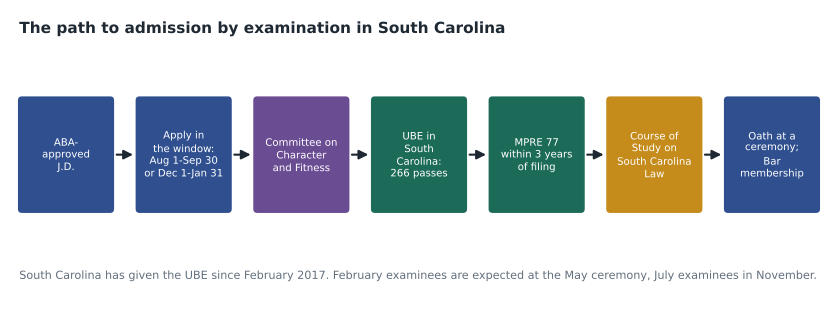
For an applicant by examination, the list of requirements is set out in Rule 402(c). The applicant must be at least twenty-one, must be of good moral character, must hold a J.D. or LL.B. from a law school approved by the American Bar Association, must earn a UBE score of at least 266, must earn a scaled score of at least 77 on an MPRE taken within three years of the application's filing date and must complete the Course of Study on South Carolina Law. The Committee on Character and Fitness must find the applicant qualified, and the applicant must then take the oath at an admission ceremony.
The order of events
The requirements do not have to be met in a fixed order, but some are tied to dates. The application must be filed in the window for the exam the applicant wants to take: for the February exam, between August 1 and September 30, with a lower fee through August 31; for the July exam, between December 1 and January 31, with a lower fee through January 10. The MPRE may be taken before or after filing, as long as the score is within the three-year window. The Course of Study may not be taken until a complete application has been filed. Proof of everything is due at least ten days before the admission ceremony.
Rule 402 schedules admission ceremonies in February, May, September and November. It expects applicants who sit the February exam in South Carolina to be admitted at the May ceremony and July examinees at the November ceremony. For Lainey, that means a target of a May 2027 swearing-in, as long as her MPRE score, her Course of Study completion and her character and fitness determination are all in place by the deadline the Office of Bar Admissions sets.
Worked problem
Mapping Lainey's year
Lainey graduated in May 2026, took the MPRE in August 2025 and scored 91, filed her application on August 20, 2026 and sits the UBE on February 23 and 24, 2027. Put her remaining requirements in order and identify her target ceremony.
Show solution
- Application: filed August 20, inside the August 1 to August 31 window for the lower fee.
- MPRE: 91 exceeds 77, and August 2025 is within three years of the August 2026 filing date.
- Character and fitness: the Committee reviews her file; if it has not decided by February 1, Rule 402(g)(1) lets her sit and the Committee decides afterward.
- Course of Study: available only after her complete application is on file; she must finish it by the deadline the Office of Bar Admissions gives.
- Exam: February 23 and 24, 2027; she needs 266.
- Ceremony: the May 2027 ceremony, with proof of every requirement at least ten days before.
Answer: Lainey is on track for a May 2027 admission. The only items still open after the exam are the Course of Study, the Committee's decision and the ceremony paperwork.
What happens after admission
Admission is not the end of the process. A new lawyer becomes a member of the South Carolina Bar and must keep that membership current. Under Rule 408, new members are exempt from continuing legal education for the reporting year in which they are admitted, but must complete an Essentials course administered by the Bar before the end of their first required reporting year, along with the regular fourteen hours. And under Rule 403, a new lawyer may not appear alone as counsel in a hearing, trial or deposition in a South Carolina court until the Supreme Court approves the lawyer's trial experiences, unless accompanied throughout by an approved or exempt lawyer. Lesson 11 explains both requirements. Lainey's firm already had a plan: Earline Kinard would take her to a General Sessions term and a Family Court docket in the spring.
Why the details matter
Marchetti's view, after fifteen years of coaching, was that most failed admissions are not failures of the exam. 'People miss a window, forget that the MPRE score has an age limit, leave the Course of Study until the week before the ceremony or answer a character and fitness question carelessly,' she told Lainey. 'Each of those can cost you a ceremony or more. The exam is the hard part, but it is not the only part.'
She gave Lainey a single page to keep at the front of her binder. It listed each requirement, the rule that imposed it, the date by which it had to be met and the document that proved it. Lainey added a column for the date she actually finished each item. By the end of September 2026, the first three rows were filled in.
Common mistakes
MistakeThe South Carolina Bar admits new lawyers.
InsteadThe Supreme Court admits lawyers; the Bar is the membership organization new lawyers join.
MistakeNCBE investigates my character and fitness.
InsteadSouth Carolina does not use NCBE's character and fitness services; the Committee on Character and Fitness decides.
MistakeI can take the Course of Study any time, even before I apply.
InsteadRule 402(c)(8) says it cannot be taken before a complete application is filed.
MistakeOnce I am sworn in, I can try a case on my own.
InsteadRule 403 bars a lawyer from appearing alone until the trial experiences are approved.
Reading Rule 402 yourself
Marchetti asked Lainey to read Rule 402 from start to finish before their next session, with a highlighter in one hand and the requirements page in the other. Lainey found it shorter than she expected and more precise. Subsection (c) listed the requirements. Subsection (d) set the filing windows and fees and the rule against using an earlier exam's scores when sitting in South Carolina. Subsection (g) explained what happens if the Committee has not decided an applicant's character and fitness by the exam. Subsection (h) set the ceremony schedule and the ten-day proof deadline, and subsection (i) set what happens if an applicant who qualifies is not admitted within a year.
Marchetti's point was that the rule answers most questions applicants ask in study groups and on message boards. 'When someone tells you that you can file late, or that an old MPRE score is fine, or that you can take the Course of Study in law school, go to the rule,' she said. 'If the rule and the rumor disagree, the rule wins. If the rule is unclear, call the Office of Bar Admissions and write down whom you spoke to and what they said.'
Lainey also learned to distinguish the rule from the forms. The Office of Bar Admissions moved to a new online application system in 2025, and its website keeps separate links for accounts and amendment forms filed before April 1, 2025. The forms change more often than the rule, and they carry their own instructions. Lainey printed the instructions for the February 2027 application and kept them in the binder behind the requirements page.
The firm's perspective
Earline Kinard had hired clerks before, and she gave Lainey one piece of advice on her first day. 'Your job here is to learn how a South Carolina practice works,' she said. 'Your job at home is to pass the exam. Do not let this office eat your study time. If I hand you something on a Tuesday afternoon, tell me it is a study night.' Lainey wrote the sentence on a sticky note and put it on her monitor, where it stayed until February.
Marchetti added one more habit. Every Sunday evening, Lainey would spend ten minutes on the requirements page and her email from the Office of Bar Admissions, so that nothing about admission could surprise her while she was focused on the exam. 'Ten minutes a week,' Marchetti said, 'saves you a month in May.'
Summary and key terms
- The Supreme Court of South Carolina controls admission through Part IV of the South Carolina Appellate Court Rules, especially Rule 402.
- The Board of Law Examiners runs the exam; the Committee on Character and Fitness decides qualification; the Office of Bar Admissions manages applications and ceremonies.
- An applicant by examination needs an ABA-approved J.D., a UBE score of 266, an MPRE score of 77, the Course of Study and a favorable character and fitness determination.
- February examinees are expected to be admitted in May, July examinees in November.
- After admission, the Essentials course and the Rule 403 trial experiences shape a new lawyer's first year.
- 0
- SCACR
- 1
- Rule 402
- 2
- Board of Law Examiners
- 3
- Committee on Character and Fitness
- 4
- Office of Bar Admissions
- 5
- South Carolina Bar
- 6
- Course of Study on South Carolina Law
- 7
- Rule 403
Practice problems
Work each problem on paper first, then reveal the answer to check.
Which body decides whether an applicant has the character and fitness to practice in South Carolina?
Show answer
The Committee on Character and Fitness, sitting in three-member panels.
What UBE and MPRE scores does South Carolina require?
Show answer
A UBE score of 266 and an MPRE scaled score of 77 from an exam within three years of the application's filing date.
At which ceremony does Rule 402 expect a February examinee to be admitted?
Show answer
The May ceremony.
Name two requirements that follow a new lawyer after admission.
Show answer
The Rule 408 Essentials course in the first required reporting year and the Rule 403 trial experiences before appearing alone.
Lesson quiz · 5 questions
Score 60% or more to complete this lesson.
Create a free account to save your progress, take quizzes and earn a certificate.