
BAR-241 · Lesson 5 of 12 · 18 min
Exam changes ahead: South Carolina and the NextGen bar exam
▶ Video coming soon A video version of this lesson is on the way.
Ozias Bethea, the younger partner at Kinard & Bethea, had read a news item in the spring about South Carolina and the NextGen bar exam. In October he asked Lainey whether she was 'taking the new one.' She was not, but she realized she could not explain why or when the change would happen. She put the question on her list for Tuesday.
Marchetti's short answer was that Lainey would take the legacy UBE in February 2027, and that South Carolina would keep giving the legacy UBE through February 2028 before switching to NextGen in July 2028. 'But you should understand the change anyway,' she said. 'If you had to retake after February 2028, it would be NextGen. And within a few years, every new associate your firm hires will have taken it.'
This lesson explains why the bar exam is changing, what NextGen looks like, South Carolina's adoption and timetable, how scores work during the transition and what the change means for candidates at different stages.
Why the exam is changing
NCBE designed the NextGen bar exam after a multi-year study of what newly licensed lawyers actually do. The study found that the existing exam put heavy weight on memorized rules across many subjects, while new lawyers spend much of their time on skills: legal research, writing, issue spotting, counseling clients and negotiating. NextGen tests fewer subjects in less depth and more skills, using integrated questions that mix knowledge and lawyering tasks.
The legacy UBE has been narrowing in the same direction. Starting with the July 2026 exam, NCBE removed conflict of laws, family law, trusts and estates and secured transactions from the MEE, bringing its subject list closer to NextGen's. Candidates who sit the legacy exam in South Carolina from July 2026 through February 2028 take that narrower MEE.
What NextGen looks like
NextGen is a single integrated exam given over a day and a half, with six hours of testing on the first day and three on the second. It is organized in sections of about three hours each. Each section contains stand-alone multiple-choice questions, integrated question sets built around a common fact pattern and a performance task. NCBE's published blueprint weights them at roughly 49 percent for the stand-alone questions, 21 percent for the integrated sets and 30 percent for the performance tasks.
During the transition, NextGen tests eight foundational concepts: business associations, civil procedure, constitutional law, contracts, criminal law, evidence, real property and torts. NCBE has announced that family law will be added as a foundational concept starting in July 2028, which is the month South Carolina's first NextGen exam is scheduled. NextGen also tests seven foundational skills: legal research, legal writing, issue spotting and analysis, investigation and evaluation, client counseling and advising, negotiation and dispute resolution, and client relationship and management. Professional responsibility rules most often used in practice appear within the skills questions.
NextGen produces a single score on a new scale from 500 to 750, rather than the 400-point UBE scale. Each jurisdiction sets its own passing score on that scale. NCBE's summary of South Carolina lists the NextGen passing score as to be announced.
| Feature | Legacy UBE (South Carolina through February 2028) | NextGen (South Carolina from July 2028) |
|---|---|---|
| Length | Two full days (12 hours) | A day and a half (9 hours) |
| Structure | MEE, MPT and MBE as separate components | Integrated sections with multiple choice, question sets and performance tasks |
| Subjects | Seven MBE subjects plus business associations on the MEE | Eight foundational concepts, with family law added from July 2028 |
| Skills | Mostly through the MPT | Seven foundational skills throughout |
| Score scale | 400 points; South Carolina passes at 266 | 500 to 750; South Carolina's passing score to be announced |
| Delivery | Paper MBE; laptop optional for written work | Computer-based at the jurisdiction's site |
South Carolina's adoption
NCBE announced on March 23, 2026 that South Carolina will administer the NextGen UBE beginning in July 2028. NCBE's summary of South Carolina lists February 2028 as the final legacy UBE administration and July 2028 as the first NextGen administration. South Carolina's choice puts it among the later adopters: NextGen was first given in July 2026 in a small group of jurisdictions, and others are adopting it on schedules running through 2028.
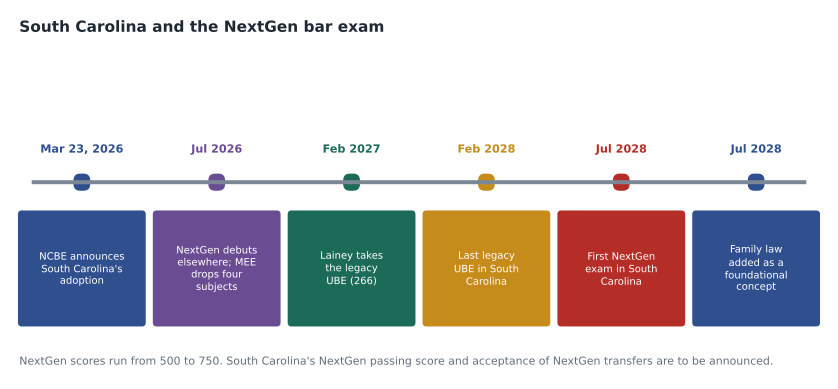
The timing gives South Carolina candidates four legacy administrations after Lainey's graduation: July 2026, February 2027, July 2027 and February 2028. A candidate who has not passed by February 2028 will take NextGen at the next South Carolina administration in July 2028. The Rule 402(d)(4) waiting rule still applies: a candidate with three non-qualifying results must wait a year from the most recent one, which could push a retake into the NextGen period.
The jurisdiction component under NextGen
NCBE's summary of South Carolina lists a jurisdiction-specific component as required on the current exam, which is the Course of Study on South Carolina Law. For NextGen, the same summary lists South Carolina's jurisdiction component requirement as to be announced. A candidate planning for 2028 or later should watch for changes to Rule 402 that address it.
Scores during the transition
Score portability is the main practical question during the change. South Carolina continues to accept transferred legacy UBE scores of 266 or more that are not more than three years old, with no limit on the number of attempts. NCBE's summary lists South Carolina's acceptance of transferred NextGen scores as to be announced. Until South Carolina announces its NextGen rules, a candidate who earns a NextGen score elsewhere and wants to transfer it should not assume it will be accepted.
Worked problem
Who takes which exam?
Four candidates ask which exam applies: (1) Lainey, sitting in South Carolina in February 2027; (2) a candidate who fails in South Carolina in February 2028 and wants to retake in South Carolina; (3) a candidate who passed the legacy UBE in North Carolina in July 2025 with a 272 and wants to transfer to South Carolina in 2027; (4) a candidate who passes NextGen in another state in July 2026 and wants to transfer to South Carolina.
Show solution
- Lainey: legacy UBE; 266 passes.
- February 2028 failure: the next South Carolina exam, July 2028, is NextGen.
- North Carolina legacy score of 272: it meets 266, and a July 2025 score is within three years if filed by the end of the three-year period under Rule 402(c)(5).
- NextGen score from another state: South Carolina's acceptance is to be announced; check before relying on it.
Answer: The date of the exam decides the format. Transfers depend on the kind of score and South Carolina's rules for it.
Studying during a transition
A February 2027 candidate needs legacy UBE materials. As commercial bar courses and publishers shift toward NextGen, some practice materials will be written for the new format. A NextGen practice set may contain question types that do not appear on the legacy exam. Older MEE practice sets have the opposite problem: they include essays on subjects that left the MEE in July 2026. Marchetti told Lainey to skip those essays and to check the date and format of every practice set before using it.
What the change means for practice
For lawyers like Ozias Bethea, the change matters most in hiring and supervision. A clerk who took NextGen will have practiced performance tasks and integrated questions and may have studied fewer subjects in depth. Firms that once assumed a new associate had studied secured transactions or trusts and estates for the bar exam can no longer make that assumption, and the Course of Study and the Essentials course will carry more of the job of teaching South Carolina law.
Common mistakes
MistakeSouth Carolina already gives NextGen.
InsteadSouth Carolina gives the legacy UBE through February 2028 and NextGen from July 2028.
MistakeNextGen uses the same 400-point scale.
InsteadNextGen uses a 500 to 750 scale; South Carolina's passing score is to be announced.
MistakeSouth Carolina accepts NextGen scores from other states now.
InsteadNCBE lists South Carolina's acceptance of NextGen scores as to be announced.
MistakeOld MEE practice essays on trusts and estates are still useful for a 2027 candidate.
InsteadThose subjects left the MEE in July 2026.
What candidates at different stages should do
Marchetti grouped the candidates she coaches by where they stand in the transition. A candidate sitting in February 2027, as Lainey is, should ignore NextGen except for its effect on materials. A candidate who will graduate in 2027 and sit in July 2027 or February 2028 is still on the legacy exam, but has less margin: a failure in February 2028 means the next attempt is NextGen. That candidate should plan to pass on the first try and should treat the legacy materials as final.
A law student who will graduate in 2028 or later will take NextGen in South Carolina and should use NextGen materials. NCBE has published sample questions, performance tasks and a content scope for NextGen, and commercial courses are building products for it. That student should also watch for South Carolina's announcements about its NextGen passing score, its acceptance of NextGen scores from other jurisdictions and any changes to the Course of Study.
How law schools are responding
Law schools in South Carolina and elsewhere have begun adjusting their teaching to NextGen. The skills NextGen tests, such as research, writing, counseling and negotiation, are skills many schools already teach in legal writing, clinics and simulation courses. The shift may lead schools to spend more time on integrated problems that combine doctrine and practice and less on memorization of rules in subjects NextGen does not test. For a lawyer who supervises clerks, the practical effect is that new graduates may be strong in skills and less familiar with certain doctrinal subjects.
The professional responsibility component
NextGen does not replace the MPRE. South Carolina's Rule 402 still requires an MPRE score of 77, and nothing in the NextGen announcements suggests that will change. NextGen does include professional responsibility issues within its skills questions, so a candidate who knows the core conduct rules has an advantage on both exams.
Keeping up with announcements
The details of a transition change as jurisdictions finalize their rules. NCBE maintains a public list of jurisdictions with their first NextGen administration, their acceptance of transferred NextGen scores and whether they will have a jurisdiction-specific component. The Supreme Court of South Carolina publishes orders amending its rules. A candidate planning for 2028 should check both sources at least every few months and should read any order amending Rule 402.
Lainey set a reminder for herself even though she would not be affected. 'If I am ever the lawyer at Kinard & Bethea who hires the summer clerk,' she told Marchetti, 'I want to know what they studied.'
A note on what does not change
For all the change in format, much of the bar exam's purpose stays the same. Both exams test whether a new lawyer can identify legal issues in a set of facts, state and apply the governing rules, reason clearly under time pressure and produce useful written work. A candidate who learns to do those things well is preparing for either exam and for practice. Marchetti's study methods for Lainey, which emphasize reading carefully, outlining before writing and reviewing every missed question, are the same methods she will use with NextGen candidates.
Ozias Bethea, when Lainey explained all this, said that the change sounded sensible to him. 'When I took the bar, I memorized secured transactions for three weeks and never used it,' he said. 'What I needed my first year was to know how to talk to a client and write a letter that did not make a judge angry.'
Retakers during the transition
The transition is hardest for candidates who need more than one attempt. Consider a 2026 graduate who sits in South Carolina in July 2026, February 2027 and July 2027 and does not pass. Under Rule 402(d)(4), that candidate must wait one year after the July 2027 exam before sitting in South Carolina again, which means the next South Carolina attempt is in July 2028, on NextGen. The candidate will have spent three attempts preparing for one format and must now prepare for another. Marchetti tells candidates in that position to take a real break, then treat NextGen as a new exam with its own materials, rather than assuming legacy preparation will carry over.
A candidate in that position may also consider sitting in another jurisdiction that still offers the legacy UBE and transferring the score, subject to South Carolina's transfer rules and the other jurisdiction's eligibility and residency requirements. That option will disappear as jurisdictions finish their transitions in 2028.
Summary and key terms
- NCBE announced on March 23, 2026 that South Carolina will begin NextGen in July 2028.
- South Carolina gives the legacy UBE through February 2028.
- NextGen is a day-and-a-half integrated exam testing eight foundational concepts and seven skills, with family law added from July 2028.
- NextGen scores run from 500 to 750; South Carolina's passing score and score acceptance are to be announced.
- Candidates in the transition must use legacy materials and skip subjects removed from the MEE.
- 0
- NextGen
- 1
- foundational concepts
- 2
- foundational skills
- 3
- integrated question set
- 4
- performance task
- 5
- legacy UBE
- 6
- score portability
- 7
- transition
Practice problems
Work each problem on paper first, then reveal the answer to check.
When will South Carolina give its first NextGen exam?
Show answer
July 2028.
What is South Carolina's last legacy UBE administration?
Show answer
February 2028.
What is the NextGen score scale?
Show answer
500 to 750.
Which foundational concept will be added to NextGen in July 2028?
Show answer
Family law.
Lesson quiz · 5 questions
Score 60% or more to complete this lesson.
Create a free account to save your progress, take quizzes and earn a certificate.