
BAR-241 · Lesson 3 of 12 · 19 min
Character and fitness and the MPRE
▶ Video coming soon A video version of this lesson is on the way.
In the summer of 2019, two weeks after her high school graduation, Lainey was charged with misdemeanor shoplifting at an outlet mall near Myrtle Beach. She had walked out of a store with a pair of sunglasses she had meant to pay for while her friends argued about where to eat. The charge was resolved through a pretrial intervention program: she paid a fee, did community service and wrote a letter of apology, and the charge was dismissed. A year later her record was expunged. She had not thought about it in years until she opened the bar application and reached the questions about criminal charges.
'Do I have to tell them about something that was expunged?' she asked Marchetti. Marchetti's answer was the one she gives every candidate. 'Read the exact wording of the question. If it asks about it, disclose it. If you are unsure whether it asks, disclose it and explain. The Committee forgives old mistakes all the time. What it does not forgive is an applicant who hides one.'
This lesson explains how character and fitness review works in South Carolina, what the Committee looks for, the procedure when a problem arises and the MPRE requirement.
The standard
Rule 402(c)(2) requires an applicant to be of good moral character, and the Committee on Character and Fitness decides whether each applicant has the character and fitness to practice law. The burden is on the applicant. Under Rule 402(l)(5), the applicant must establish qualification to the reasonable satisfaction of a majority of the three-member panel considering the application, and an applicant is entitled to a hearing before a panel recommends denial.
The inquiry looks forward. The question is not whether the applicant has ever done anything wrong but whether the applicant can be trusted to meet the duties a lawyer owes to clients, courts and the public: honesty, diligence, financial responsibility, respect for the law and the ability to meet deadlines and obligations. Past conduct matters because it is evidence of future conduct, and evidence of rehabilitation matters for the same reason.
What the Committee looks at
Character and fitness reviews across the country focus on similar kinds of conduct, and South Carolina's application asks about them in detail. The categories that most often lead to further inquiry are criminal charges and convictions, academic discipline, dishonesty in employment or school, unpaid debts and defaults, prior bar discipline or license problems, litigation involving fraud or misconduct, and conduct that suggests an inability to meet obligations. Any lack of candor on the application itself is treated as serious, often more serious than the underlying conduct.
| Kind of issue | Questions a panel asks | Evidence that helps |
|---|---|---|
| Old minor criminal matter | How long ago? What happened since? Was it disclosed fully? | Court records, expungement order, a frank explanation |
| Financial problems | Were debts addressed? Is there a pattern? | Payment records, a budget, letters from creditors |
| Academic discipline | What was the conduct? Was it dishonest? | School records, the applicant's account, faculty references |
| Employment termination | Why? Was dishonesty involved? | Employer records, references from later employers |
| Failure to disclose | Was the omission careless or deliberate? | A prompt correction; little else helps |
Lainey's file had two items. The first was the 2019 charge. She disclosed it, explained what happened in four sentences and attached the pretrial intervention completion letter and the expungement order. The second was a store credit card that had gone sixty days past due in 2023 while she was between summer jobs. It had been current ever since, and she attached the account history. Neither item was serious, and both were the kind of thing the Committee sees every week.
Timing and the exam
Character and fitness review takes time, and South Carolina's rule addresses what happens if the review is not finished before the exam. Under Rule 402(g)(1), if the Committee has not made a determination by July 1 for the July exam or February 1 for the February exam, the applicant may sit for the exam, and the Committee decides afterward. A passing score does not guarantee admission: an applicant who passes still cannot be sworn in until the Committee finds the applicant qualified.
When a panel has concerns
If a panel has concerns, it can ask for more information, interview the applicant or schedule a hearing. Under Rule 402(l), the Committee has twenty-four members appointed for five-year terms; panels have three members, and a quorum of the full Committee is thirteen. An applicant who is found not qualified may petition the Supreme Court within fifteen days of the notice, under the procedure in Rule 240 of the Appellate Court Rules. An applicant who is finally denied may reapply only after two years.
Rule 402(e) and (f) add consequences for dishonesty. Providing false information on an application, or cheating on the exam, can lead to contempt of court, a finding that the applicant is unfit, or a bar on reapplying for up to five years. These provisions are rarely used, because most applicants are honest, but they explain why Marchetti's advice about disclosure is so firm.
The provisional application
Rule 402(g)(2) offers law students a way to get an early answer. A student who believes there may be a character problem can file a provisional application for a 100-dollar non-refundable fee, so the Committee can review the matter before the student finishes school and invests in bar preparation. It is a sensible step for a student with a serious matter, such as a felony record or a past bar or license discipline, and it is usually unnecessary for minor matters like Lainey's.
Worked problem
Should Teague disclose?
Hypothetical: Teague Satterfield, a 2026 graduate, received a speeding ticket in 2022, paid it online and forgot it. In 2024 he was sued in magistrate court by a former landlord over a 900-dollar security deposit dispute and settled for 400 dollars. The application asks about traffic violations above a stated level and all civil actions in which he was a party. What should he do?
Show solution
- Read each question's exact wording and threshold; if the speeding ticket falls within it, list it with the date, court and disposition.
- The magistrate court suit falls within a question about civil actions; disclose it with the case number and the settlement.
- Attach a short explanation and the settlement record.
- Do not decide on his own that an item is too minor to matter; if the question asks, he answers.
Answer: Teague should disclose both if the questions reach them. Neither is likely to cause a problem; leaving either off could.
The MPRE requirement
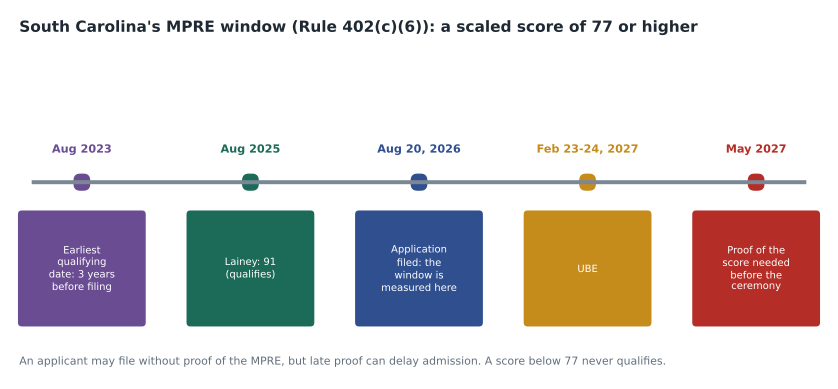
South Carolina requires a passing score on the Multistate Professional Responsibility Examination. Under Rule 402(c)(6), the applicant needs a scaled score of at least 77 from an MPRE administered within three years of the date the application is filed. An applicant may file without proof of a passing MPRE score, but proof must be provided before admission, and late proof can delay the applicant's ceremony under Rule 402(h)(2).
The MPRE is written by NCBE and given several times a year. It is a two-hour, sixty-question multiple-choice exam, of which fifty questions are scored, testing the rules of professional conduct as reflected in the ABA Model Rules and related law, including judicial conduct, the law of lawyering and evidentiary privilege. It is scored on a scale of 50 to 150. Each jurisdiction sets its own passing score, and South Carolina's 77 sits toward the lower end of the national range. The score is reported by NCBE, and the applicant must make sure South Carolina receives it.
| Feature | South Carolina rule |
|---|---|
| Passing scaled score | 77 |
| Timing | Administered within three years of the application's filing date |
| Filing without proof | Allowed; proof needed before admission |
| Effect of late proof | Can delay admission to a later ceremony |
The three-year window is measured from the filing date, not the exam date or the admission date. That has a practical consequence for an applicant who took the MPRE early in law school. A student who took it in the spring of the second year and files more than three years later, perhaps after a clerkship or a failed attempt, may need to retake it. Lainey's August 2025 score of 91 was well inside her window.
Why ethics is not just an exam
The MPRE tests rules, but the character and fitness process tests behavior. Marchetti pointed out the connection. 'The application is your first legal document,' she said. 'It is signed under oath, it is reviewed by lawyers and it has consequences. Treat it the way you would treat a client's verified pleading. Check every date. Attach the records. Say what happened in plain words. That is what lawyers are supposed to do.'
Common mistakes
MistakeAn expunged charge never has to be disclosed.
InsteadRead the question's wording; if it reaches the matter, disclose it and attach the order.
MistakeIf my character and fitness review is not finished, I cannot sit.
InsteadUnder Rule 402(g)(1), the applicant may sit; the Committee decides afterward.
MistakeThe MPRE must be within three years of the exam.
InsteadIt must be within three years of the application's filing date.
MistakeA passing UBE score means I will be admitted.
InsteadAdmission also requires a favorable character and fitness determination and the other requirements.
Writing a disclosure
Marchetti showed Lainey how to write a disclosure that a panel could read in a minute. It had four parts. First, the facts: what happened, when and where, in plain words and without excuses. Second, the outcome: the charge, the court and the disposition, with the case number if there was one. Third, what changed: what the applicant learned, and evidence of it, such as years of clean conduct, employment references or completed obligations. Fourth, the attachments: court records, completion letters, payment histories or expungement orders.
Lainey's draft of her 2019 disclosure began with a paragraph about how crowded the store was and how her friends had distracted her. Marchetti crossed it out. 'The panel does not need the scene,' she said. 'It needs to know that you took sunglasses without paying, that the charge was resolved through pretrial intervention and dismissed, that the record was expunged and that you have had no problems since. Say that you were eighteen and careless. That is the truth, and it is enough.' The final version was four sentences long.
Financial responsibility
Debts are among the most common reasons for further inquiry, because a lawyer handles other people's money and a pattern of unpaid obligations raises a question about how the lawyer will handle a trust account. The question is not whether the applicant has debt; nearly every law graduate has student loans. The question is whether the applicant meets obligations or has a plan for them. An applicant with a defaulted loan should show the steps taken to cure it. An applicant with a single late account, as Lainey had, should show that it was resolved and that the account has been current since.
Candor during the review
The duty of candor continues after filing. If the Committee asks for more information, the answer should be complete and prompt. If a new event occurs, such as a traffic citation, a lawsuit or a change in employment, it must be reported under the duty to update. Panels see far more trouble from applicants who are evasive about small matters than from the matters themselves. A panel member once told Marchetti that the hardest applications to approve were not the ones with long records but the ones in which the applicant's account kept changing.
Mental health and conduct
Applicants sometimes worry about questions concerning their health. The national trend in bar admissions has been to focus on conduct rather than diagnosis, and many jurisdictions have narrowed or removed questions about mental health treatment. Applicants should read South Carolina's current application carefully and answer the questions it actually asks. Seeking treatment is not misconduct, and a candidate who needs support during bar preparation should get it without fear that doing so will count against admission.
The MPRE in your study plan
For candidates who have not yet passed the MPRE, Marchetti recommended taking it early, ideally before the bar exam study period begins in earnest. The exam requires a few weeks of focused study of the Model Rules and the law of lawyering, and combining it with full-time UBE preparation is hard. A candidate who passes it in the August before a February exam, as Lainey did a year earlier, removes one requirement from the list and gains a head start on the professional responsibility issues that appear in practice.
Lainey's file drew no follow-up questions. In early December 2026 she received word that the Committee had no further inquiries, and she checked the item off her requirements page with some relief.
Summary and key terms
- The applicant must prove good moral character to the reasonable satisfaction of a three-member panel of the Committee on Character and Fitness.
- Candor matters most; false information can lead to contempt, a finding of unfitness or a bar of up to five years.
- If the Committee has not decided by July 1 or February 1, the applicant may sit and the decision follows.
- An applicant found unqualified may petition the Supreme Court within fifteen days; a denied applicant may reapply after two years.
- South Carolina requires an MPRE scaled score of 77 from an exam within three years of the filing date.
- 0
- good moral character
- 1
- reasonable satisfaction
- 2
- panel
- 3
- provisional application
- 4
- candor
- 5
- MPRE
- 6
- scaled score
- 7
- rehabilitation
Practice problems
Work each problem on paper first, then reveal the answer to check.
What MPRE scaled score does South Carolina require?
Show answer
77.
From what date is the three-year MPRE window measured?
Show answer
The date the application is filed.
How long does an applicant have to petition the Supreme Court after notice that the Committee found the applicant not qualified?
Show answer
Fifteen days.
What can a law student with a possible character problem do before graduation?
Show answer
File a provisional application for a 100-dollar non-refundable fee.
Lesson quiz · 5 questions
Score 60% or more to complete this lesson.
Create a free account to save your progress, take quizzes and earn a certificate.