
BAR-239 · Lesson 9 of 12 · 21 min
Pennsylvania family law, wills, intestacy and inheritance tax
▶ Video coming soon A video version of this lesson is on the way.
Family law was a third of the work at Wren's firm, and estates arrived through the same door. In one month she drafted a divorce complaint, sat in on a custody conference, organized the financial records for an equitable distribution case and helped a widower whose wife had died without a will. The widower asked her a question she could not answer: 'Do I get everything?' Her supervising attorney answered for her. 'It depends who else she left behind,' he said, 'and the Commonwealth wants its share too.' Wren brought the question to the group. Hollis noted that trusts and estates and family law had both left the MEE in July 2026, so none of this would be tested on the essays in February. 'Which means,' she said, 'that you will learn it on a real client. Better to learn it here first.'
This lesson covers Pennsylvania divorce grounds, equitable distribution, alimony and premarital agreements, custody after the 2024 and 2025 amendments, child support, the execution and probate of wills, intestate succession, the elective share and the Pennsylvania inheritance tax.
Grounds for divorce
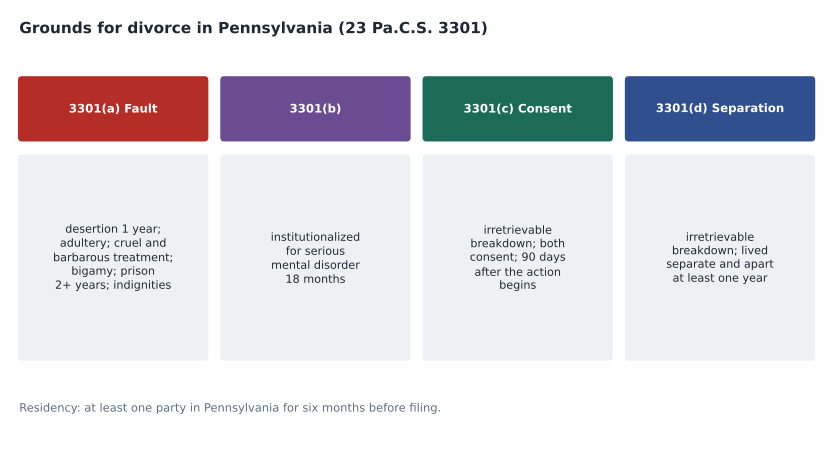
Divorce in Pennsylvania is governed by the Divorce Code in Title 23 of the Consolidated Statutes. An action may be brought if at least one party has been a bona fide resident of Pennsylvania for at least six months immediately before the action begins. Section 3301 lists the grounds.
Fault grounds remain available under section 3301(a). The court may grant a divorce to the innocent and injured spouse if the other spouse has committed willful and malicious desertion for a year or more without reasonable cause, adultery, cruel and barbarous treatment endangering the spouse's life or health, knowingly entering a bigamous marriage, or indignities that render the spouse's condition intolerable, or has been sentenced to imprisonment for two or more years for a crime. Section 3301(b) adds a ground based on institutionalization for serious mental disorder for at least eighteen months.
Most Pennsylvania divorces are no-fault. Under section 3301(c), the court may grant a divorce where the marriage is irretrievably broken, ninety days have passed since the action began and both parties have filed affidavits of consent. Consent is presumed where one party has been convicted of a personal injury crime against the other. Under section 3301(d), the court may grant a divorce where the marriage is irretrievably broken and the parties have lived separate and apart for at least one year; the period was reduced from two years by a 2016 amendment, for separations that began after it took effect. If the other spouse denies that the marriage is irretrievably broken, the court decides after a hearing and may order counseling if there is a reasonable prospect of reconciliation.
Equitable distribution
When a marriage ends, the court divides marital property under Chapter 35 of the Divorce Code. Section 3501 defines marital property as property acquired by either party during the marriage, subject to exclusions. Property acquired before the marriage, property acquired by gift or inheritance and property excluded by a valid agreement are not marital, but the increase in value of nonmarital property during the marriage generally is. Property acquired after final separation is generally not marital either. Pennsylvania is therefore a separate property state that divides marital property at divorce, not a community property state.
Section 3502 directs the court to divide marital property equitably, in such percentages and manner as it considers just, after considering all relevant factors and without regard to marital misconduct. The statute lists factors including the length of the marriage, any prior marriage, the age, health, income, skills, employability, assets, liabilities and needs of each party, contributions by one party to the education, training or increased earning power of the other, each party's opportunity for future acquisitions of capital assets and income, the sources of income of both parties, each party's contribution to or dissipation of marital property, including contributions as a homemaker, the value of the property set apart to each party, the standard of living established during the marriage, the economic circumstances of each party when the division takes effect, the tax consequences of the division, the expense of selling or transferring an asset and whether a party will be serving as custodian of dependent minor children. Equitable does not mean equal, although many divisions land near it.
Support, alimony and agreements
Pennsylvania distinguishes several kinds of financial support between spouses. Spousal support and alimony pendente lite provide support while the divorce is pending, the first through the domestic relations section of the court and the second in the divorce action itself. Alimony after the divorce is awarded only where necessary and is based on statutory factors that include the parties' relative earnings, ages, health, the duration of the marriage and the marital misconduct of either party during the marriage. Marital misconduct is therefore irrelevant to the division of property but can bear on alimony.
Premarital agreements are enforceable in Pennsylvania much like other contracts. In Simeone v. Simeone, decided in 1990, the Supreme Court of Pennsylvania held that courts should not inquire into the reasonableness of a prenuptial agreement and should enforce it according to its terms, absent fraud, misrepresentation or duress, provided there was full and fair disclosure of the parties' financial positions. The Divorce Code now codifies that approach. Postnuptial and property settlement agreements are also common and enforceable.
Custody
Custody is governed by Chapter 53 of Title 23. Pennsylvania distinguishes legal custody, the right to make major decisions about the child's education, health care and religion, from physical custody, the actual physical possession and control of the child. Either may be shared or sole. The court decides custody in the best interest of the child, considering the factors in section 5328, and must give substantial weighted consideration to factors that affect the safety of the child.
The factors changed twice in two years. Kayden's Law, enacted as Senate Bill 55, signed on April 15, 2024 and effective August 15, 2024, responded to the 2018 killing of a seven-year-old Bucks County girl by her father during an unsupervised visit. It requires courts to consider a party's history of abuse and specified criminal convictions more broadly, requires the court to set out safety conditions when a party with a history of abuse receives custody, and creates a rebuttable presumption that only supervised physical custody may be awarded to a party the court finds by a preponderance of the evidence poses a risk of harm to the child. Act 11 of 2025, signed on June 30, 2025 and effective about two months later, reorganized the section 5328 factors, reducing them from sixteen to twelve, adding a factor on the level of cooperation and conflict between the parties, adding work schedules to the child care factor and requiring the court to give each party a copy of the factors within thirty days of a custody filing.
Relocation of a child is governed by a separate section requiring advance notice to the other parent and, if there is an objection, a hearing at which the court weighs statutory factors. A new lawyer handling a custody case should read the current text of section 5328 and the relocation provisions, because the amendments changed the language courts apply and the order of the factors.
Child support
Pennsylvania calculates child support under guidelines adopted by the Supreme Court in the Rules of Civil Procedure. The guidelines use an income shares model: the court combines the parents' monthly net incomes, finds the basic support obligation for that combined income and number of children in the guideline schedule, and divides the obligation in proportion to each parent's share of the combined income, with adjustments for custody time, child care, health insurance and other expenses. The domestic relations section of each county's court handles most support cases through conferences before a hearing officer or judge.
Wills
Pennsylvania's rule on executing a will is unusual. Under section 2502 of the Probate, Estates and Fiduciaries Code, every will must be in writing and signed by the testator at the end. The statute does not require attesting witnesses when the testator signs his or her own name. Witnesses are required only when the testator signs by mark or when another person signs the testator's name at the testator's direction; in those cases two witnesses must sign in the testator's presence. A handwritten will signed at the end can therefore be valid in Pennsylvania without witnesses.
Proving a will at probate is a separate step. A will is ordinarily proved before the register of wills of the county by the oaths of two competent witnesses to the testator's signature, or by a self-proving affidavit signed when the will was executed. That is why Pennsylvania lawyers still have wills signed before two witnesses and a notary: the witnesses are not needed for validity, but the ceremony makes probate simple. Words written after the signature are not part of the will, although they do not invalidate what comes before.
Intestate succession
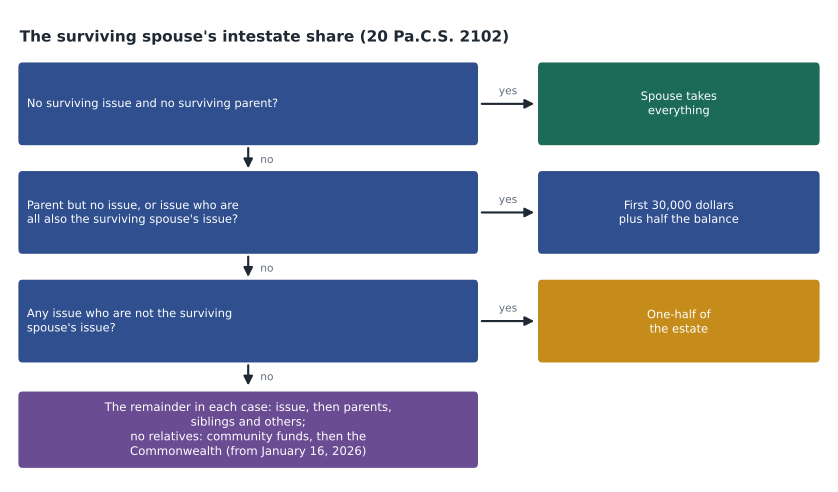
When a person dies without a valid will, Chapter 21 of the Code decides who takes. Under section 2102, the surviving spouse takes the entire estate if the decedent left no surviving issue and no surviving parent. If the decedent left a parent but no issue, or left issue all of whom are also issue of the surviving spouse, the spouse takes the first 30,000 dollars plus one-half of the balance. If the decedent left issue one or more of whom are not issue of the surviving spouse, the spouse takes one-half of the estate. The part not passing to the spouse goes under section 2103, first to issue, then to parents, then to siblings and their issue, and then to more distant relatives in a statutory order.
A recent amendment changed the end of the line. Under Act 50 of 2025, effective January 16, 2026, an estate with no relatives entitled to take under the statute passes first to an endowed community fund serving the decedent's municipality, then to one serving the school district, then to one serving the county, and only if none exists to the Commonwealth. Before the amendment, such estates escheated directly to the Commonwealth.
The elective share
A surviving spouse who is unhappy with a will is not limited to what the will provides. Under section 2203, the surviving spouse may elect to take one-third of specified property of the decedent, including property passing by will or intestacy and certain property the decedent conveyed during life while keeping the income or a power to revoke. The election must be made within the time the statute allows, generally six months after the decedent's death or the probate of the will, whichever is later. A spouse who elects gives up the property the will provides, and the election can be lost by conduct, such as desertion, described in the statute.
The inheritance tax
Pennsylvania imposes an inheritance tax on the transfer of property at death, measured by the relationship between the decedent and the person who receives it. Transfers to a surviving spouse are taxed at zero, and so are transfers from a child aged twenty-one or younger to a parent. Transfers to direct descendants and other lineal heirs are taxed at 4.5 percent, transfers to siblings at 12 percent and transfers to other heirs at 15 percent, with charities, exempt institutions and government entities exempt. The tax is due at death and becomes delinquent nine months after death, and a 5 percent discount is allowed on tax paid within three months. Jointly owned property of spouses is exempt, and there are exemptions for certain farm property and for property of service members who die from injuries received on active duty.
The widower's answer came together. His wife had no children and both her parents had died, so under section 2102 he took the entire estate, and as a surviving spouse he owed no inheritance tax on what he received. Had she left a surviving mother, he would have taken 30,000 dollars plus half the balance, and the mother's share would have been taxed at 4.5 percent.
Worked problem
An estate with a stepchild
A Pennsylvania resident dies without a will, leaving a surviving wife, their two children and a son from his first marriage. His probate estate is worth 600,000 dollars, all in his own name. Who takes, and what inheritance tax applies?
Show solution
- One of the decedent's issue is not issue of the surviving spouse, so under section 2102 the wife takes one-half: 300,000 dollars.
- The other 300,000 dollars passes to the decedent's issue under section 2103, divided equally among his three children: 100,000 dollars each.
- The wife's share is taxed at zero; each child's share is a lineal transfer taxed at 4.5 percent.
- Tax paid within three months of death earns a 5 percent discount; it is delinquent after nine months.
Answer: The wife takes 300,000 dollars tax-free and each of the three children takes 100,000 dollars, subject to 4.5 percent inheritance tax.
Common mistakes
MistakePennsylvania divorce requires two years of separation.
InsteadSince the 2016 amendment, one year of separation suffices under section 3301(d), for separations that began after it took effect.
MistakeMarital misconduct reduces a spouse's share of marital property.
InsteadEquitable distribution is without regard to marital misconduct; misconduct can matter for alimony.
MistakeA Pennsylvania will needs two witnesses to be valid.
InsteadA will signed by the testator at the end is valid without witnesses; witnesses matter for marks, proxies and proof at probate.
MistakeA surviving spouse always takes the whole intestate estate.
InsteadThe spouse's share depends on surviving issue and parents.
MistakePennsylvania has no death taxes.
InsteadIt imposes an inheritance tax at rates from zero to 15 percent.
Practice problems
Work each problem on paper first, then reveal the answer to check.
How long must a party reside in Pennsylvania before filing for divorce?
Show answer
At least six months.
How long must the parties live separate and apart under section 3301(d)?
Show answer
At least one year.
What did Simeone v. Simeone (1990) hold?
Show answer
Prenuptial agreements are enforced as contracts, without review for reasonableness, if there was full and fair disclosure and no fraud or duress.
What presumption did Kayden's Law create?
Show answer
A rebuttable presumption that only supervised physical custody may be awarded to a party found to pose a risk of harm.
What is the inheritance tax rate on a transfer to a sibling?
Show answer
12 percent.
Summary and key terms
- Pennsylvania divorce grounds include fault grounds, mutual consent after ninety days and irretrievable breakdown after one year apart.
- Marital property is divided equitably under section 3502 without regard to marital misconduct; misconduct can affect alimony.
- Simeone (1990) enforces premarital agreements as contracts with full and fair disclosure.
- Custody factors were changed by Kayden's Law (2024) and Act 11 of 2025; safety factors receive substantial weighted consideration.
- A will must be signed at the end; witnesses are not required for validity, but two are used for probate proof.
- Intestate shares turn on surviving issue and parents; the elective share is one-third; inheritance tax runs from zero to 15 percent.
- equitable distribution
- Division of marital property in the proportions the court finds just.
- marital property
- Property acquired by either spouse during the marriage, subject to statutory exclusions.
- Kayden's Law
- The 2024 amendments to Pennsylvania custody law emphasizing child safety.
- elective share
- A surviving spouse's right to take one-third of specified property instead of the will's provisions.
- inheritance tax
- Pennsylvania's tax on property passing at death, at rates set by the recipient's relationship to the decedent.
Lesson quiz · 5 questions
Score 60% or more to complete this lesson.
Create a free account to save your progress, take quizzes and earn a certificate.