
BAR-239 · Lesson 11 of 12 · 20 min
Score transfer, admission on motion and practice after admission in Pennsylvania
▶ Video coming soon A video version of this lesson is on the way.
Two of Wren's colleagues at the firm were already lawyers, just not in Pennsylvania. One had passed the UBE in New Jersey in July 2025 and moved to Scranton when her husband took a job there. The other had practiced for eight years in New York before joining the firm to run its municipal defense work. Both needed Pennsylvania licenses, and neither wanted to sit another bar exam. Wren asked Hollis to explain their options, partly out of curiosity and partly, she admitted, because she expected to need a second license herself one day. Hollis said Pennsylvania offers both colleagues a route, and that the routes are very different.
This lesson covers admission by transferred UBE score under Rule 206, admission by reciprocity under Rule 204, the limited licenses available to lawyers already admitted elsewhere, and the obligations that begin on the day of admission: the oath, registration, continuing legal education and the other duties of a Pennsylvania lawyer.
Admission by transferred UBE score
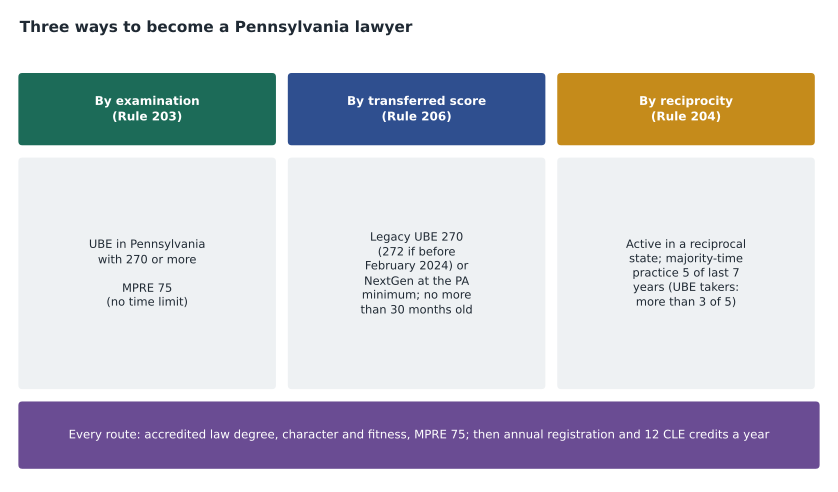
Rule 206 allows an applicant who earned a qualifying Uniform Bar Examination score in another jurisdiction to be admitted in Pennsylvania without sitting the exam again. The score must meet Pennsylvania's minimum: 270 for a legacy UBE score from the February 2024 administration or later, 272 for a legacy score from an earlier administration, and, from September 1, 2026, a NextGen score at Pennsylvania's NextGen minimum, which NCBE lists as 620. The score must have been earned no more than 30 months before the application is filed.
The applicant must also meet the other requirements for admission. That means the education requirement of Rule 203, character and fitness approval by the Board and a passing MPRE score of 75. NCBE's chart notes that Pennsylvania does not accept transferred MBE scores alone, does not allow concurrent applications for admission by transferred score and lists a fee of 750 dollars. A lawyer who transfers a score is admitted as a full member of the Pennsylvania bar, with no practice requirement and no restrictions.
The New Jersey colleague fit the rule. Her July 2025 UBE score was above 270 and less than 30 months old; it would remain transferable until early 2028. She had a JD from an ABA-approved school and an MPRE score above 75. Hollis told her to apply soon rather than late, both to leave time for character and fitness review and because a 30-month window is shorter than it sounds.
Admission by reciprocity
Rule 204 provides admission without examination for experienced lawyers from reciprocal states, which are states that admit Pennsylvania lawyers on comparable terms. The applicant must have a law degree from a law school that was accredited when the applicant matriculated or graduated, must be a member of the bar of a reciprocal state on active status when filing, must submit certificates of good standing from every court and jurisdiction where the applicant is admitted and active, and must not be disbarred or suspended anywhere. The applicant must also satisfy the character and fitness and MPRE requirements.
The heart of the rule is the practice requirement, which the rule allows an applicant to meet in one of three ways. The first applies to an applicant who passed the bar exam of a reciprocal state and has practiced law for a majority of the time in one or more states for five of the last seven years before filing. The second applies to an applicant admitted in a reciprocal state, by exam or otherwise, who has practiced for a majority of the time in one or more reciprocal states for five of the last seven years. The third applies to an applicant who earned a UBE score in a reciprocal state that would qualify for transfer under Rule 206 and has practiced for a majority of the time for more than three of the five years since sitting for that exam, within the five years before filing.
The rule defines practice broadly. It includes private practice, work for legal services or defender programs or government agencies, full-time law teaching at an accredited law school, service as a judge of a court of record, full-time judicial clerkships, work as corporate counsel, service as a military judge advocate and certain independent contractor work for law firms. Remote practice, meaning practice authorized by the licensing state performed from a place where the lawyer is not licensed, counts if the other requirements are met, with a limit of two years for remote practice from outside the United States. Supervised practice in a jurisdiction where the lawyer was not licensed counts for no more than two years. Majority of time means more than half of the weeks in the period, and a week counts only if the applicant practiced more than twenty hours in it.
A committee note adds a limit that surprises some applicants: Pennsylvania cannot be reciprocal with itself. Work done in Pennsylvania may not count toward the practice requirement for an applicant who did not take the bar exam of a reciprocal state, even if that work was authorized, for example under a limited license.
The New York colleague fit the second path. He first checked that New York appears on the Board's current list of reciprocal states, which it does because New York admits experienced Pennsylvania lawyers on motion; he was admitted and active in New York, and he had practiced full time there for eight years, well over five of the last seven. NCBE's chart lists the reciprocity fee as 1,325 dollars. Hollis reminded him that the time spent in Pennsylvania working for the firm before admission would not count toward the five years, but that he did not need it.
Limited licenses
Lawyers licensed elsewhere who do not qualify for full admission, or who need only a narrow license, have other options. Pennsylvania offers limited admission for lawyers working as in-house counsel for a business whose business is not the practice of law, and for lawyers working in defender and legal services programs, and it licenses foreign legal consultants under Rule 341 to advise on the law of the country where they are admitted. Out-of-state lawyers may also appear in a particular Pennsylvania case by being admitted pro hac vice on motion of a Pennsylvania lawyer, under the rules of the court where the case is pending. Each of these licenses has its own conditions and limits.
Law students have a route to supervised practice as well. Under the Pennsylvania rules on certified law students, a qualifying law student may appear in court and represent clients under the supervision of a member of the bar, for example in a law school clinic or a district attorney's or public defender's office. Wren had been a certified student in a family law clinic in her third year.
The oath and admission
After the Board certifies that an applicant has met every requirement, the applicant is admitted by the Supreme Court. The Board's instructions explain how the applicant is moved for admission by a member of the bar and takes the oath, and new lawyers often choose a ceremony that family can attend. The oath includes a promise to support the Constitution of the United States and the Constitution of Pennsylvania and to discharge the duties of an attorney with fidelity to the court and to the client. Admission to the federal district courts in Pennsylvania, the Eastern, Middle and Western Districts, is separate and requires its own application to each court.
Registration
A new lawyer must register with the Disciplinary Board under Pa.R.D.E. 219 and then renew registration every year, paying the annual fee and reporting contact information, trust accounts and professional liability insurance. Failure to register leads to administrative suspension. The registration also reports whether the lawyer is on active, inactive or retired status. An inactive lawyer may not practice in Pennsylvania but may return to active status by meeting the requirements, including any missed CLE.
Continuing legal education
The Pennsylvania Rules for Continuing Legal Education require every active lawyer to complete 12 credit hours each year, including at least 2 hours of ethics, professionalism or substance abuse. Up to 6 of the 12 hours may be earned through distance learning; the rest must come from live courses, which include live webcasts in many cases. The CLE Board assigns each lawyer to one of three compliance groups with different annual periods: Group 1 runs from May 1 to April 30, Group 2 from September 1 to August 31 and Group 3 from January 1 to December 31. Excess live credits may be carried forward, within limits, to later compliance periods.
New lawyers have a grace period and a special requirement. A newly admitted lawyer is exempt from the annual requirement for a period that depends on the compliance group assigned, at least twelve and no more than twenty-four months after admission. During the first compliance period that follows, the new lawyer must complete the full requirement, and it must include a Bridge the Gap program, a four-credit course on the practical and ethical aspects of practice in Pennsylvania offered by approved providers. Hollis suggested completing Bridge the Gap in the first few months. 'It is the closest thing Pennsylvania has to a state law course,' she said. 'Take it when it is useful, not when it is due.'
| Requirement | What it is | When |
|---|---|---|
| Annual registration | Register with the Disciplinary Board and pay the fee under Pa.R.D.E. 219 | Every year |
| CLE | 12 credits, at least 2 ethics, professionalism or substance abuse; up to 6 by distance learning | Each compliance year |
| Bridge the Gap | Four-credit program for new lawyers within the first CLE requirement | First compliance period after the grace period |
| Insurance disclosure | Written notice to new clients if coverage is below the Rule 1.4(c) minimums | At the start of each new representation |
| Trust accounts | Approved institution, IOLTA where required, records under Rule 1.15 | Whenever client funds are held |
Practicing across state lines
Many Pennsylvania lawyers practice in more than one jurisdiction. A lawyer admitted in Pennsylvania by UBE can transfer the Pennsylvania score to another UBE jurisdiction within that jurisdiction's time limit, often three to five years, and many neighboring jurisdictions accept transferred scores. A Pennsylvania lawyer with several years of practice may qualify for admission on motion elsewhere, depending on that state's rules and whether it treats Pennsylvania as reciprocal. Each jurisdiction sets its own MPRE score and time limit, which is why Hollis had told Wren to keep her MPRE score report.
Wren's long-term plan was modest: pass in February, be admitted in Pennsylvania in the spring and, if the firm's township work took her into New York or New Jersey matters, transfer her score within the window those states allow. Hollis said that was exactly how the UBE is supposed to work.
Worked problem
Two colleagues, two routes
Colleague A passed the UBE in New Jersey in July 2025 with a score of 276 and has never practiced. Colleague B was admitted in New York by exam in 2018 and has practiced full time in New York since, before joining a Pennsylvania firm in 2026. Both have ABA JDs and MPRE scores above 75. Which route fits each?
Show solution
- A has a legacy UBE score above 270, earned after February 2024, so Rule 206 applies if she files within 30 months of July 2025.
- A does not qualify for reciprocity, which requires years of practice.
- B is active in New York, a reciprocal state, and has practiced for a majority of the time for five of the last seven years, so Rule 204 applies.
- Both must clear character and fitness; B's Pennsylvania work before admission does not count toward the practice requirement but is not needed.
Answer: A should apply by transferred score under Rule 206 well before her 30-month window closes; B should apply by reciprocity under Rule 204.
Common mistakes
MistakePennsylvania accepts transferred UBE scores of any age.
InsteadThe score must be no more than 30 months old at filing.
MistakeAny lawyer with five years of practice anywhere can be admitted on motion.
InsteadThe applicant must be admitted and active in a reciprocal state and meet the rule's practice definitions.
MistakeTime practicing in Pennsylvania under a limited license always counts toward Rule 204.
InsteadPennsylvania cannot be reciprocal with itself for applicants who did not pass a reciprocal state's exam.
MistakeNew lawyers owe CLE from the day of admission.
InsteadThey have a grace period of 12 to 24 months, then must include Bridge the Gap.
MistakeAdmission in Pennsylvania includes admission to the federal courts there.
InsteadEach federal district court requires a separate application.
Practice problems
Work each problem on paper first, then reveal the answer to check.
How old may a transferred UBE score be when the application is filed?
Show answer
No more than 30 months.
What does majority of time mean under Rule 204?
Show answer
More than half of the weeks, counting only weeks with more than 20 hours of practice.
How many CLE credits does Pennsylvania require each year?
Show answer
12, including at least 2 in ethics, professionalism or substance abuse.
How many CLE credits may be earned by distance learning?
Show answer
Up to 6.
What program must new lawyers complete in their first CLE period?
Show answer
A four-credit Bridge the Gap program.
Summary and key terms
- Rule 206 admits applicants with a qualifying UBE score (270, or 272 before February 2024; NextGen from September 2026) no more than 30 months old.
- Rule 204 admits active members of reciprocal-state bars with five of the last seven years of majority-time practice, or more than three of five years for UBE takers.
- Practice is defined broadly, with limits for remote practice abroad and supervised practice; Pennsylvania cannot be reciprocal with itself.
- Limited licenses cover in-house counsel, defender and legal services lawyers, foreign legal consultants and pro hac vice appearances.
- After admission: annual registration, 12 CLE credits a year in one of three compliance groups and Bridge the Gap for new lawyers.
- Federal court admission is separate; Pennsylvania scores can be transferred to other UBE jurisdictions within their limits.
- Rule 206
- Pennsylvania's rule on admission by a transferred UBE score.
- reciprocal state
- A state that admits Pennsylvania lawyers on comparable terms.
- compliance group
- One of three CLE reporting cycles assigned to each Pennsylvania lawyer.
- Bridge the Gap
- A required four-credit CLE program for newly admitted Pennsylvania lawyers.
- pro hac vice
- Admission of an out-of-state lawyer for a single case.
Lesson quiz · 5 questions
Score 60% or more to complete this lesson.
Create a free account to save your progress, take quizzes and earn a certificate.