
BAR-239 · Lesson 4 of 12 · 20 min
The Pennsylvania bar exam: the Uniform Bar Examination, scoring and the 270 passing score
▶ Video coming soon A video version of this lesson is on the way.
Wren asked Hollis how close she had to be. 'Is 270 hard?' Hollis answered the way she always does: 'It is a number, and numbers can be planned for.' She pulled up a blank page and wrote two numbers side by side, an MBE score and a written score, that added to 270. Then she wrote two more pairs that also added to 270, one with a strong MBE and a weak written score, one the other way round. 'There is no single way to pass,' she said. 'You decide where to earn your points. But you need to understand how the points are built before you can decide.'
This lesson explains the Uniform Bar Examination as Pennsylvania gives it: the two days, the three parts, how each part is scored and weighted, how the written work is scaled, and what a passing score of 270 means. Pennsylvania will move to the NextGen exam in July 2028, as Lesson 5 explains, but every Pennsylvania exam through February 2028 is the current UBE, which NCBE now calls the legacy UBE to distinguish it from the new one.
Two days, three parts
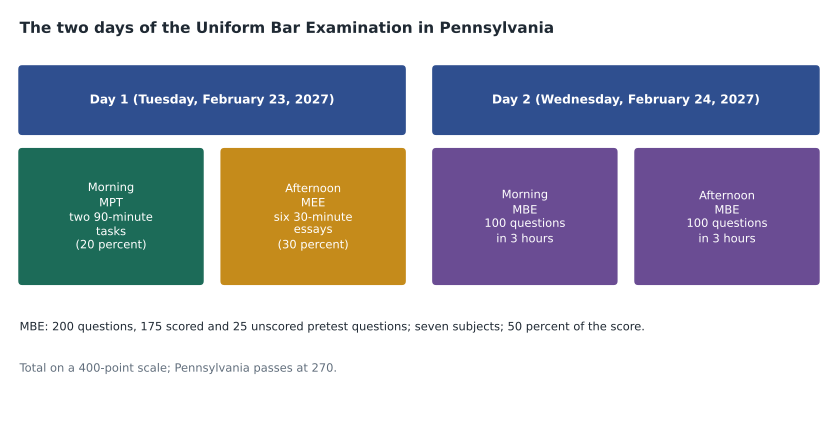
The UBE is given over two consecutive days, on the last Tuesday and Wednesday of February and July. Pennsylvania's February 2027 exam is on February 23 and 24, 2027.
Day one is the written day. The morning session is the Multistate Performance Test, two 90-minute tasks in a three-hour session. Each task gives the candidate a file of facts, such as a memo from a supervising partner, interview notes, letters or a contract, and a library of legal authorities, which may be real, modified or written for the exam. The candidate must write a document such as an objective memo, a persuasive brief, a client letter or a set of contract provisions, using only the library. The afternoon session is the Multistate Essay Examination, six 30-minute essay questions in a three-hour session.
Day two is the Multistate Bar Examination, 200 multiple-choice questions given in two three-hour sessions of 100 questions each. Of the 200 questions, 175 are scored and 25 are unscored pretest questions that are indistinguishable from the scored ones. The MBE covers seven subjects: civil procedure, constitutional law, contracts, criminal law and procedure, evidence, real property and torts.
The MEE subjects now
The MEE changed in July 2026. NCBE removed four subjects from the essay exam, aligning it with the planned scope of the NextGen exam: conflict of laws, family law, secured transactions and trusts and estates are no longer tested on the MEE. The remaining MEE subjects are business associations (agency and partnership, corporations and limited liability companies), civil procedure, constitutional law, contracts including Article 2 of the Uniform Commercial Code, criminal law and procedure, evidence, real property and torts. NCBE has said that family law and trusts and estates may still appear on the MPT during the transition, because the MPT supplies the law in its library and does not depend on memorized rules.
The change matters for a February 2027 candidate in two ways. First, older practice essays on the removed subjects are no longer useful for MEE practice, although they can still help a candidate learn the law for practice. Second, the subjects that remain on the MEE are all MBE subjects except business associations, so a candidate's MBE study now supports the essays more directly than before. Business associations is the one subject that must be learned for the essays alone.
How the UBE is scored
Every UBE score is reported on a 400-point scale. The MBE produces a scaled score on a 200-point scale. NCBE converts the number of scored questions a candidate answers correctly into a scaled score through a process called equating, which adjusts for small differences in difficulty between exam forms, so that a scaled score of 135 means the same level of performance on any administration.
The written components are graded by graders in each UBE jurisdiction, using NCBE's grading materials and a common grading approach. Each MEE answer and each MPT answer receives a raw grade on the jurisdiction's scale. The raw written grades are then scaled to the MBE: the jurisdiction's written scores are placed on the same 200-point scale, with the same mean and spread as the MBE scores of the same group of candidates. This step makes written scores comparable across jurisdictions and across exams, and it is what makes a UBE score portable.
The weights are fixed. The MBE counts for 50 percent of the total, the MEE for 30 percent and the MPT for 20 percent. Put another way, the written components together count for half, and within the written half the MEE counts for 60 percent and the MPT for 40 percent. The total UBE score is the MBE scaled score plus the scaled written score, giving a number on the 400-point scale.
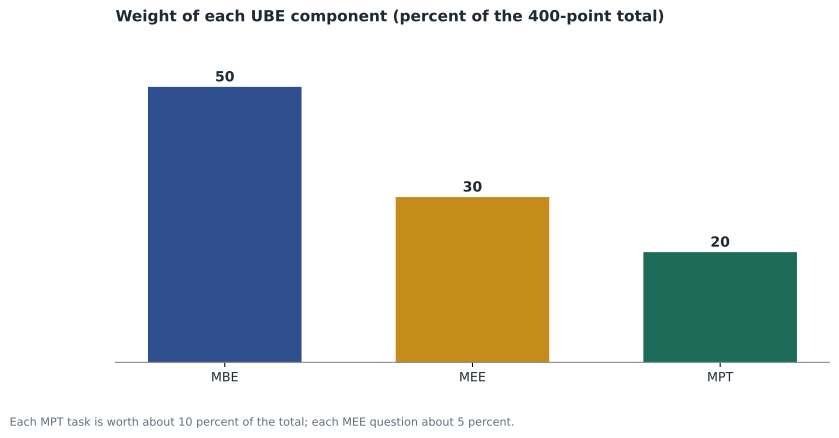
Because each MPT task counts for 10 percent of the total, a single performance test is worth more than any single essay, each of which counts for 5 percent. Hollis made that point to every February group. 'The MPT is the most neglected part of the exam,' she said, 'and two tasks are a fifth of your score. You can practice it, and you should.'
The passing score
Pennsylvania's passing score is 270. The Supreme Court lowered it from 272 to 270 by an order of December 27, 2023, effective with the February 2024 exam. For applications that rely on a UBE score from an administration before February 2024, in any jurisdiction, the passing score remains 272. That rule matters mainly for score transfer: a candidate who earned a 271 in another UBE state in July 2023 cannot transfer that score to Pennsylvania, but a candidate who earned 271 in February 2024 or later can, within the time limit for transfers.
Two hundred seventy places Pennsylvania toward the upper end of UBE passing scores, most of which fall between 260 and 270; a few jurisdictions set a higher minimum. A Pennsylvania passing score of 270 therefore transfers to most UBE jurisdictions, subject to each jurisdiction's own minimum, time limit and other requirements, and a candidate who plans to transfer should check the receiving jurisdiction's minimum before relying on a score just above 270.
| MBE scaled score | Written scaled score | Total | Result in Pennsylvania |
|---|---|---|---|
| 135 | 135 | 270 | Pass |
| 140 | 130 | 270 | Pass |
| 128 | 142 | 270 | Pass |
| 138 | 131 | 269 | Does not pass |
| 150 | 125 | 275 | Pass |
The table shows Hollis's point. The two halves are added, so a strong MBE can carry a weaker written score and the reverse. There is no separate minimum for either half in Pennsylvania. A candidate who is consistently strong at multiple choice can afford a written score in the low 130s; a candidate who writes well can pass with an MBE score in the high 120s. The aim of study is not perfection in either half but a reliable total.
What a score means
Scaled scores are not percentages. An MBE scaled score of 135 does not mean 135 questions right, and it does not translate to a fixed number of correct answers, because equating varies the conversion slightly from exam to exam. As a rough guide, candidates who answer around 60 to 65 percent of the scored MBE questions correctly tend to land near the scaled scores that pass in a 270 jurisdiction, but that is a rule of thumb, not a target. Commercial practice exams and NCBE's own practice materials give candidates a sense of where they stand.
The written grades work differently from what many candidates expect. Graders are not looking for a perfect answer; they are ranking answers against each other on a scale, and an answer that spots the main issues, states the rules accurately and applies them to the facts in an organized way will score well even if it misses a minor issue. Because written scores are scaled to the MBE, a candidate's written score depends both on the quality of the answers and on how the whole group of candidates performed.
Results and reports
Pennsylvania releases results for the February exam in the spring and for the July exam in the fall, on dates the Board announces. A candidate who passes receives notice of passing and then completes the remaining steps for admission. A candidate who does not pass receives a score report with the total and the component scores, which helps plan a retake. NCBE also reports scores to candidates who request it and keeps them for transfer to other jurisdictions.
Wren asked whether the Board would publish her score if she passed. Hollis said Pennsylvania reports results to the candidate and that a passing candidate can obtain her score for transfer purposes, but that employers almost never ask for the number. 'Passing is passing,' she said. 'Nobody's first client asks for the score.'
What the score does not include
The MPRE is not part of the UBE score. It is a separate exam with its own scale and its own passing score of 75 in Pennsylvania. A candidate can pass the UBE and still need an MPRE score before admission, or pass the MPRE and still need a UBE score. The two are tracked separately by the Board.
Nor does the UBE score include anything about Pennsylvania law. Lesson 6 explains what that means for study and for practice.
Planning a score
Hollis asked the group to build a target score sheet before the end of December. Each candidate wrote down a recent MBE practice score, an honest estimate of written performance based on graded practice essays and performance tests, and the gap to 270. She then asked where the cheapest points were. For most candidates the answer was the MPT, because performance-test skills improve quickly with practice and because each task carries a tenth of the score. For candidates whose MBE practice scores were far below their written estimates, the answer was the MBE, because a few more correct answers in each subject move the scaled score substantially.
Wren's sheet showed MBE practice scores in the low 130s and essays that her bar review grader rated as solid but slow. Her plan, which Lesson 12 develops, was to protect her MBE score with daily practice, to finish every essay within 30 minutes even at the cost of polish, and to do one full performance test every week. 'You do not need a 140 anywhere,' Hollis told her. 'You need about 135 everywhere.'
Timing on the day
Time is the most common reason for a lost written score. An essay that is excellent on two issues and silent on a third scores worse than an essay that is adequate on all three. On the MEE, candidates should read the call of the question first, outline briefly, and stop at 30 minutes to move to the next question, because the session does not split the time for them. On the MPT, a common approach is to spend about 35 to 45 minutes reading and organizing and the rest writing, and to treat the task memo from the supervising lawyer as the grading guide, since it tells the candidate exactly what to produce.
On the MBE, candidates have an average of 1.8 minutes per question. Candidates who skip and return should mark their answer sheet with care, since a misaligned answer sheet can cost many points. Leaving no question blank is a basic rule, because there is no penalty for wrong answers.
Worked problem
Is this a pass?
A Pennsylvania candidate receives an MBE scaled score of 131.4 and a written scaled score of 139.2 on the February 2027 exam. A friend who took the exam in July 2023 in another UBE state scored 271. Did the candidate pass, and can the friend transfer the 2023 score to Pennsylvania?
Show solution
- Add the two halves: 131.4 plus 139.2 equals 270.6.
- Pennsylvania's passing score for exams from February 2024 on is 270, and there is no separate minimum for either half.
- The candidate passes.
- For applications relying on UBE administrations before February 2024, Pennsylvania requires 272, so a July 2023 score of 271 does not qualify, and a July 2023 score is in any case far older than 30 months.
Answer: The candidate passes with 270.6. The friend cannot transfer the 271 from July 2023, both because 272 applies to pre-2024 scores and because the score is too old.
Common mistakes
MistakeThe MEE still tests family law and trusts and estates.
InsteadThose subjects were removed from the MEE in July 2026; they may appear on the MPT with a supplied library.
MistakeEach essay is worth more than each performance test.
InsteadEach MPT task is worth 10 percent; each MEE question about 5 percent.
MistakePennsylvania requires a minimum score on each half.
InsteadThe MBE and written scores are added; only the total must reach 270.
MistakePennsylvania's passing score is 272.
InsteadIt has been 270 since February 2024; 272 applies only to earlier scores.
MistakeA scaled score is a percentage correct.
InsteadScaled scores are equated and do not correspond to a fixed number of correct answers.
Practice problems
Work each problem on paper first, then reveal the answer to check.
What are the weights of the MBE, MEE and MPT?
Show answer
50, 30 and 20 percent.
How many MBE questions are scored?
Show answer
175 of 200.
When did Pennsylvania's passing score change to 270?
Show answer
With the February 2024 exam, by order of December 27, 2023.
Which four subjects left the MEE in July 2026?
Show answer
Conflict of laws, family law, secured transactions and trusts and estates.
What is the total of an MBE score of 133 and a written score of 136?
Show answer
269, which does not pass in Pennsylvania.
Summary and key terms
- Day one is the MPT (two 90-minute tasks) and the MEE (six 30-minute essays); day two is the MBE.
- The MBE has 200 questions, 175 scored, in seven subjects.
- Since July 2026 the MEE omits conflict of laws, family law, secured transactions and trusts and estates.
- Written scores are scaled to the MBE; the weights are 50, 30 and 20 percent on a 400-point scale.
- Pennsylvania's passing score is 270, lowered from 272 for exams from February 2024; 272 still applies to earlier scores.
- Only the total matters; strengths in one half can offset weaknesses in the other.
- MBE
- The Multistate Bar Examination, NCBE's 200-question multiple-choice exam.
- MEE
- The Multistate Essay Examination of six 30-minute questions.
- MPT
- The Multistate Performance Test of practical lawyering tasks using a supplied file and library.
- equating
- The statistical process that makes MBE scaled scores comparable across exam forms.
- scaling
- Placing written scores on the MBE scale so they are comparable across jurisdictions.
Lesson quiz · 5 questions
Score 60% or more to complete this lesson.
Create a free account to save your progress, take quizzes and earn a certificate.