
BAR-239 · Lesson 3 of 12 · 21 min
Character and fitness and the MPRE
▶ Video coming soon A video version of this lesson is on the way.
Wren had one item on her application that had kept her awake. In her first year of college she had been cited for underage drinking at a party near campus. She paid a fine, completed a short alcohol education program and never thought about it again until the Pennsylvania application asked about every citation, summons and charge, including matters that had been dismissed, expunged or resolved without a conviction. She disclosed it, attached the paperwork she could find and described what had happened in four plain sentences. Then she worried for a month. When she raised it with the group, Hollis smiled. 'You did the only thing that matters,' she said. 'You told them. A citation from age eighteen, disclosed in full, almost never stops anyone. A citation from age eighteen, left off the form and found later, can.'
This lesson covers Pennsylvania's character and fitness requirement, how the Board reviews applications, the issues that most often cause delay, and the Multistate Professional Responsibility Examination, which every Pennsylvania applicant must pass with a scaled score of at least 75.
The standard
Rule 203 makes character and fitness a condition of admission by examination. An applicant must show that the applicant has no prior conduct that the Board finds incompatible with the standards expected of members of the bar of Pennsylvania. The same standard applies to admission by transferred score and by reciprocity. The purpose of the requirement is protection of clients, courts and the public, not punishment: the question is whether the applicant can be trusted with the duties a lawyer owes.
The standard looks forward, but it is judged by the past. Lawyers handle other people's money, keep their secrets, make representations to courts and meet deadlines that affect lives and businesses. An applicant's history is the best available evidence of how the applicant will behave in that role. The Board therefore asks about conduct that bears on honesty, trustworthiness, diligence, reliability and respect for the law, and it looks at the whole record rather than any single event.
How the Board reviews an application
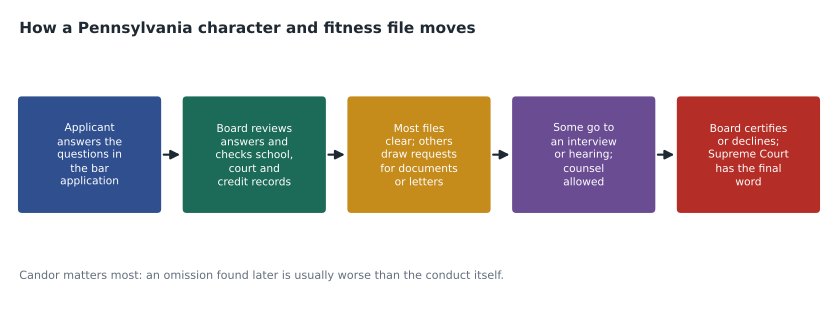
The character and fitness questions are part of the bar application. The Board reviews the answers, checks them against records such as law school files, court records and credit reports, and asks follow-up questions when something needs explanation. Many applications clear without any follow-up. Others draw a letter or email asking for documents or a written explanation. A smaller number lead to an interview or a hearing, at which the applicant can present evidence and witnesses and may be represented by counsel.
If the Board decides an applicant has not shown the required character and fitness, the Pennsylvania rules provide for review, ultimately by the Supreme Court, which has the final word on admission. An applicant in that position should get advice from a lawyer who handles admission matters; the process has deadlines and procedures of its own.
Character review runs alongside exam preparation, and a candidate can pass the exam before the Board has finished. In that case the Board does not certify the applicant for admission until the character and fitness review is complete. A delayed review can therefore delay admission, and with it a job that depends on a license.
Candor comes first
The most common way to turn a small problem into a large one is to leave it out. Bar examiners across the country treat a lack of candor on the application as conduct bearing on character in its own right, often more serious than the event that was concealed. An applicant who omits an arrest, a school disciplinary matter or a lawsuit, and whose omission is discovered through records the Board obtains, must then explain both the event and the decision not to disclose it. The second explanation is much harder.
The Pennsylvania application asks broad questions, and the safest approach is to read them literally and answer them fully. If a question asks about matters that were dismissed or expunged, the answer includes them. If a question asks about every job, the answer includes the job that ended badly. If an applicant is unsure whether a matter falls within a question, the better course is to disclose it with an explanation. Wren's approach to her citation is the model: disclose, document and explain briefly, without minimizing or arguing.
Issues that commonly draw attention
Hollis walked the group through the categories that most often lead to follow-up questions, with a reminder that none of them is an automatic bar and that the Board looks at the full picture.
Criminal and quasi-criminal matters, including traffic matters beyond minor parking tickets, raise questions about respect for the law, especially when they involve alcohol, drugs, dishonesty or violence. A single old matter, fully disclosed, rarely causes trouble. A pattern, a recent matter or a matter involving dishonesty draws closer review.
Academic matters, such as discipline for plagiarism or cheating in college or law school, bear directly on honesty. The law school's certification usually reports any discipline, and the applicant's disclosure should match it.
Financial matters, such as defaulted loans, accounts in collection, unpaid judgments or unfiled tax returns, bear on reliability and on the risk that a lawyer under financial pressure will misuse client funds. Student loan debt alone is not a problem; ignoring obligations is. An applicant with a past default helps the file by showing a repayment plan and a record of keeping to it.
Civil litigation in which the applicant was a party, especially matters involving fraud or misrepresentation, may draw questions. So may employment terminations, professional discipline in another field and, for applicants already admitted elsewhere, any bar complaint.
Mental health and substance use questions are handled with care. Bar examiners nationally have narrowed questions about mental health diagnosis and treatment in recent years and focus instead on conduct. Treatment is not misconduct, and seeking help is never held against an applicant in a well-run system. What matters is whether the applicant's conduct has shown a risk to clients, and an applicant with a past problem who is in recovery or treatment can usually demonstrate fitness with documentation.
| Area | What the Board looks for | What helps |
|---|---|---|
| Criminal and traffic matters | Respect for the law; dishonesty; patterns | Full disclosure, court dispositions, time and conduct since |
| Academic discipline | Honesty in school work | A disclosure that matches the school's certification |
| Financial obligations | Reliability; risk of misusing funds | Repayment plans and a record of keeping to them |
| Employment and litigation | Honesty and diligence at work | Plain explanations and references |
| Mental health and substance use | Conduct showing risk to clients | Documentation of treatment or recovery where relevant |
Rehabilitation
When an applicant's past includes serious conduct, the question becomes rehabilitation. Factors that bar examiners generally weigh include the applicant's age at the time, how recent the conduct was, how serious it was, whether it was isolated or part of a pattern, whether the applicant has accepted responsibility, whether restitution was made and the applicant's conduct since. Evidence of rehabilitation can include letters from employers, professors, treatment providers or community leaders who know the history and can speak to the applicant's present character.
Hollis was blunt about one point. 'Rehabilitation is a story you prove with documents and witnesses, not with adjectives,' she said. 'Saying you have changed is not evidence. Five years of steady work, paid debts and people willing to sign their names to letters is evidence.'
The MPRE
Every Pennsylvania applicant must pass the Multistate Professional Responsibility Examination with a scaled score of at least 75. The requirement comes from Rule 203 and an order of the Supreme Court setting the score. The MPRE is written and administered by NCBE, not by the Board, and candidates register with NCBE.
The MPRE is a two-hour, multiple-choice exam of 60 questions, 50 of which are scored and 10 of which are unscored pretest questions that look like the others. It is given on computer at testing centers several times a year. Scores are reported on a scale from 50 to 150. The exam tests the rules governing lawyers' conduct, mainly the ABA Model Rules of Professional Conduct, together with the ABA Model Code of Judicial Conduct and generally accepted principles from court decisions on topics such as malpractice and the attorney-client privilege. It does not test Pennsylvania's own variations of the rules.
NCBE's chart for Pennsylvania shows no time limit on when the MPRE score must have been earned. Some states require the MPRE to be passed within a set number of years before or after the bar exam; Pennsylvania does not. A candidate who passed the MPRE in law school, as Wren did, can use that score for Pennsylvania however long ago it was earned, and a candidate who has not yet taken it can take it after the bar exam. The score must be reported to the Board before admission. Candidates who want to transfer a score to another state should check that state's time limits, because many are stricter.
Pennsylvania's 75 is at the lower end of the range of MPRE passing scores, which run from 75 to 86 depending on the state. That makes the score easy to bank for Pennsylvania but less useful elsewhere. A candidate who expects to seek admission in New Jersey or New York as well should check those states' requirements, which are higher.
Wren's score of 101 from August 2025 cleared every state's requirement. Hollis told her to keep the NCBE score report with her admission papers, because she might want it again if she later sought admission elsewhere.
Ethics after the MPRE
Passing the MPRE does not mean a new lawyer knows Pennsylvania's ethics rules. The MPRE tests the Model Rules, and Pennsylvania's rules differ in ways that come up in daily practice, such as the requirement that the basis of a fee be communicated in writing to a new client and the requirement that a lawyer without professional liability insurance tell clients so in writing. Lesson 10 covers those differences. Ethics also continues through CLE: every Pennsylvania lawyer must complete ethics credits every year, as Lesson 11 explains.
Timing the review
Character and fitness review takes time, and the time is mostly outside the applicant's control once the application is filed. What the applicant controls is how quickly follow-up requests are answered. Hollis told the group to treat any letter or email from the Board as urgent: read it the day it arrives, gather what it asks for and respond completely by the date it gives. An incomplete response produces a second request, and each round adds weeks.
Applicants with a matter that is likely to draw questions can save time by anticipating them. A short written explanation attached to the application, with the court disposition, the payment record or the school's letter, answers the questions the Board would otherwise ask. Wren had done exactly that with her citation. She also kept a folder of everything she had submitted, so that she could answer any follow-up without reconstructing her own application from memory.
Reporting changes
An application is a continuing statement. If something changes after filing, such as a new job, a new address, a new traffic ticket, a lawsuit or a change in a matter already disclosed, the applicant should report it to the Board under its instructions. The duty to keep the application accurate lasts until admission. Hollis gave an example from an earlier group: a candidate who was in a minor car accident a week before the exam and received a citation reported it the next day with a short explanation, and it caused no delay. A candidate who had not reported it would have had to explain at the end of the process why the application was no longer true.
References
Some applications ask for references, people who know the applicant and can speak to character. The best references are people who have seen the applicant work over time, such as a supervisor, a professor who supervised a clinic or a judge for whom the applicant clerked, rather than family friends or famous names. An applicant should ask each reference in advance, explain what the Board may ask and make sure the contact information is current.
Worked problem
An old citation and a loan
An applicant was cited for disorderly conduct at age 19, paid a fine and had the record expunged. She also defaulted on a private student loan three years ago, then signed a repayment plan and has made every payment for two years. How should she handle these on the Pennsylvania application?
Show solution
- The application asks about matters even if dismissed or expunged, so she should disclose the citation.
- She should attach whatever court paperwork she has and explain the incident briefly and accurately.
- The default must be disclosed in the financial questions, with the repayment plan and payment history.
- Neither matter is an automatic bar; candor and documented responsibility since are what the Board weighs.
Answer: Disclose both fully with documents and short, factual explanations; the age of the citation and the repayment record weigh in her favor, while any omission would be a serious problem in itself.
Common mistakes
MistakeAn expunged matter does not need to be disclosed.
InsteadRead the question literally; if it covers expunged or dismissed matters, disclose them.
MistakePassing the exam guarantees admission.
InsteadThe Board certifies only after character and fitness review is complete.
MistakePennsylvania requires the MPRE within a set number of years.
InsteadNCBE's chart shows no time limit for Pennsylvania.
MistakeThe MPRE tests Pennsylvania's rules.
InsteadIt tests the ABA Model Rules and general principles, not Pennsylvania's variations.
MistakeMental health treatment must be hidden.
InsteadTreatment is not misconduct; examiners focus on conduct, and documentation helps.
Practice problems
Work each problem on paper first, then reveal the answer to check.
What is the character and fitness standard in Rule 203?
Show answer
No prior conduct the Board finds incompatible with the standards expected of members of the Pennsylvania bar.
What MPRE score does Pennsylvania require?
Show answer
A scaled score of at least 75.
How many MPRE questions are scored?
Show answer
50 of the 60 questions.
What is usually worse than the conduct itself?
Show answer
Failing to disclose it on the application.
Name three kinds of evidence of rehabilitation.
Show answer
Time and steady conduct since, restitution or repayment, and letters from people who know the history.
Summary and key terms
- Character and fitness asks whether past conduct is incompatible with the standards expected of Pennsylvania lawyers.
- The Board reviews applications, checks records and may hold interviews or hearings; the Supreme Court has the final word.
- Candor is the most important factor; omissions are treated as serious in themselves.
- Criminal, academic, financial and employment history commonly draw follow-up; none is an automatic bar.
- The MPRE must be passed with 75; NCBE's chart shows no time limit for Pennsylvania.
- The MPRE tests the Model Rules, so Pennsylvania's own variations must be learned separately.
- character and fitness
- The requirement that an applicant's conduct shows the honesty and reliability expected of a lawyer.
- candor
- Complete and truthful disclosure in the application.
- rehabilitation
- Proof, by conduct and evidence over time, that past problems no longer reflect present character.
- MPRE
- NCBE's Multistate Professional Responsibility Examination.
- scaled score
- A score adjusted for differences in difficulty across exam forms.
Lesson quiz · 5 questions
Score 60% or more to complete this lesson.
Create a free account to save your progress, take quizzes and earn a certificate.