
BAR-239 · Lesson 8 of 12 · 22 min
Pennsylvania torts: comparative negligence, the Fair Share Act, motor vehicle tort options and governmental immunity
▶ Video coming soon A video version of this lesson is on the way.
Two files crossed Wren's desk in the same week. In the first, the firm's client had been hit by a pickup truck while crossing a township road outside the crosswalk; the truck's driver and a township snowplow crew that had left a ridge of snow blocking the crosswalk both seemed partly at fault, and so, perhaps, did the client. In the second, a client's car had been rear-ended by a bus owned by a regional transit authority. Wren's supervising attorney told her the two files would teach her most of Pennsylvania tort law that the bar exam leaves out. 'Comparative fault, the Fair Share Act, limited tort, the immunity acts and the six-month notice,' he said. 'Get any one of them wrong and you lose the case or the client loses the money.'
This lesson covers the Pennsylvania rules on comparative negligence and the allocation of liability among defendants, the constitutional limit on damage caps and its exceptions, the motor vehicle insurance choice between full and limited tort, and the immunity statutes that protect the Commonwealth and local agencies, including the 2026 decision upholding the cap on damages against Commonwealth parties.
Comparative negligence
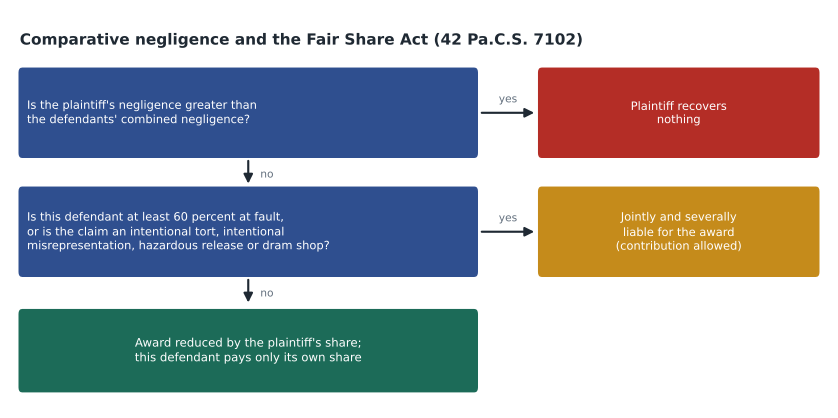
Pennsylvania abandoned contributory negligence as a complete bar decades ago. Under section 7102(a) of the Judicial Code, a plaintiff's own negligence does not bar recovery if it was not greater than the causal negligence of the defendant or defendants against whom recovery is sought, and the plaintiff's damages are reduced in proportion to the plaintiff's share of the fault. Pennsylvania is therefore a modified comparative negligence state with a greater-than bar, sometimes called the 51 percent rule: a plaintiff who is 50 percent at fault recovers half the damages, and a plaintiff who is 51 percent at fault recovers nothing.
The comparison is between the plaintiff and the defendants against whom recovery is sought, taken together. A plaintiff found 40 percent at fault, with two defendants found 30 percent each, recovers, because 40 percent is not greater than the defendants' combined 60 percent. The jury allocates fault in percentages on a verdict slip, and the court reduces the award accordingly.
The Fair Share Act
The more distinctive Pennsylvania rule concerns what happens among several defendants. Before 2011, Pennsylvania followed traditional joint and several liability: each defendant found liable could be made to pay the whole award, and a defendant who paid more than its share sought contribution from the others. The Fair Share Act of 2011 rewrote section 7102 to make several liability the default. Under section 7102(a.1), when liability is attributed to more than one defendant, each defendant is liable only for the share of damages that matches its share of the total liability, and the court enters a separate judgment against each defendant for its share.
The Act keeps joint and several liability in five situations. A defendant is liable for the full amount of the award if the defendant has been held liable for not less than 60 percent of the total liability apportioned to all parties; if the claim involves intentional misrepresentation; if the claim involves an intentional tort; if the claim involves a release or threatened release of a hazardous substance under the Hazardous Sites Cleanup Act; or if the claim involves a violation of section 497 of the Liquor Code, the dram shop provision that makes licensees liable for serving visibly intoxicated persons. A defendant who pays more than its share under one of those exceptions may seek contribution from defendants who paid less.
The Act also allows the fact-finder to apportion liability to a person who has settled with the plaintiff and been released, even though that person is not a defendant at trial. It does not allow apportionment to an employer that is immune from suit under the Workers' Compensation Act.
| Fault: plaintiff / defendant A / defendant B | Plaintiff recovers? | A pays | B pays (award of 100,000 dollars before reduction) |
|---|---|---|---|
| 0 / 70 / 30 | Yes, 100,000 | Up to all 100,000 (A is at least 60 percent) | 30,000 |
| 20 / 50 / 30 | Yes, 80,000 | 50,000 | 30,000 |
| 40 / 30 / 30 | Yes, 60,000 | 30,000 | 30,000 |
| 50 / 25 / 25 | Yes, 50,000 | 25,000 | 25,000 |
| 55 / 25 / 20 | No | Nothing | Nothing |
The first row of the table shows the 60 percent threshold. Defendant A, found 70 percent at fault, can be made to pay the whole 100,000 dollars if B cannot pay, and A then seeks contribution from B. Defendant B, below 60 percent, never pays more than its own 30,000 dollars. In the other rows, no defendant reaches 60 percent, so each pays only its own share, and the plaintiff bears the risk that a defendant cannot pay.
No general caps, with exceptions
Article III, section 18 of the Pennsylvania Constitution provides that the General Assembly shall not limit the amount to be recovered for injuries resulting in death or for injuries to persons or property, except in workers' compensation. For that reason Pennsylvania has no general statutory cap on compensatory damages in private tort cases, including noneconomic damages in medical malpractice cases, unlike many states. The constitutional limit applies to private defendants; the Supreme Court has held that the legislature may cap damages against government parties, because those caps define the extent of a waiver of immunity, as discussed below.
Punitive damages are available in Pennsylvania for outrageous conduct, meaning conduct that is malicious, wanton, willful or oppressive or that shows reckless indifference to the rights of others. In medical malpractice cases, the MCARE Act limits punitive damages against an individual health care provider to 200 percent of compensatory damages, except where the conduct was intentional misconduct. Punitive damages are not available against Commonwealth parties or local agencies under the immunity statutes.
Motor vehicle claims: full tort and limited tort
Pennsylvania's Motor Vehicle Financial Responsibility Law requires every registered vehicle to carry liability insurance and first-party medical benefits, and it gives the named insured a choice that shapes later tort claims. Under section 1705 of the Vehicle Code, a named insured on a private passenger auto policy elects either the full tort option or the limited tort option. Full tort keeps the right to recover both economic losses, such as medical bills and lost wages, and noneconomic losses, such as pain and suffering. Limited tort, which costs less, keeps the right to recover economic losses but bars recovery of noneconomic losses unless the injury is a serious injury, defined in the statute as one resulting in death, serious impairment of a body function or permanent serious disfigurement.
The limited tort bar has exceptions. A limited tort insured may still recover noneconomic damages if the at-fault driver was convicted of driving under the influence in the accident or accepted Accelerated Rehabilitative Disposition for it; was operating a vehicle registered in another state; intended to injure; or was uninsured. The bar also does not apply to claims against a business that designed, made, repaired or serviced a vehicle, based on a defect, or to injuries suffered as an occupant of a vehicle other than a private passenger vehicle, such as a bus. An insured who never makes an election is presumed to have chosen full tort.
Wren's second file turned on that last exception. Her client had elected limited tort, but she had been injured by a bus, not while riding one. Hollis asked the group whether the client was an occupant of a vehicle other than a private passenger vehicle. She was not: she was in her own car. The limited tort bar therefore applied to her noneconomic damages unless she could show serious injury, and whether an injury is serious is usually a question for the jury. That was only the first problem in the file. The bus belonged to a transit authority, and that raised immunity.
Immunity of the Commonwealth
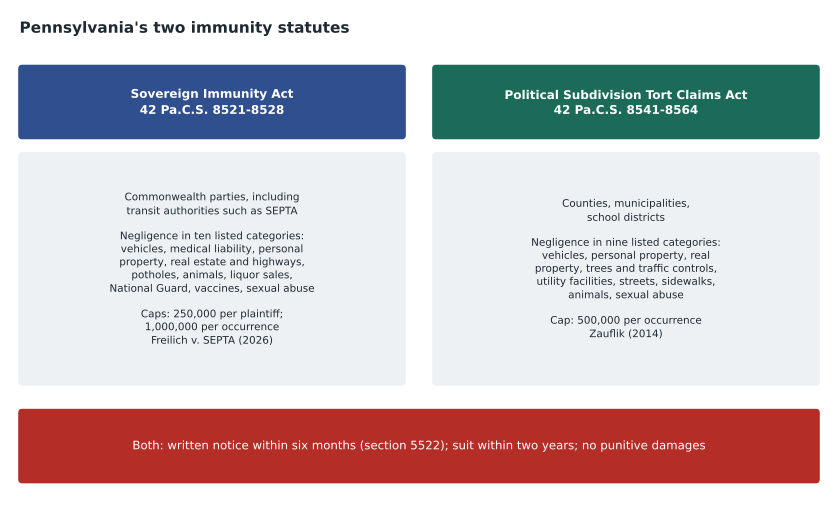
The Pennsylvania Constitution allows suits against the Commonwealth in the manner the General Assembly directs, and the General Assembly has declared that the Commonwealth and its officials and employees acting within the scope of their duties enjoy sovereign immunity except where it has been specifically waived. The Sovereign Immunity Act, sections 8521 to 8528 of the Judicial Code, waives immunity only for damages caused by negligent acts within listed categories in section 8522(b): the operation of a motor vehicle, medical-professional liability, the care, custody or control of personal property, dangerous conditions of Commonwealth real estate, highways and sidewalks, potholes and other dangerous highway conditions, the care, custody or control of animals, liquor store sales, National Guard activities, the administration of toxoids and vaccines, and sexual abuse. Intentional torts are not within the waiver.
Section 8528 caps damages against Commonwealth parties at 250,000 dollars per plaintiff and 1,000,000 dollars in the aggregate for all plaintiffs from a single occurrence, and it limits the types of damages recoverable. Regional transit authorities such as SEPTA are treated as Commonwealth agencies for this purpose, so the 250,000 dollar cap applies to them.
In Freilich v. SEPTA, decided on October 1, 2026, the Supreme Court of Pennsylvania rejected a challenge to the 250,000 dollar cap brought by a woman left with severe injuries after a SEPTA bus accident. The parties had stipulated to a verdict of 7 million dollars, and the trial court reduced it to the cap. The Court held that the cap did not violate the right to a jury trial or the right to a remedy under the Pennsylvania Constitution, relying on its 2014 decision in Zauflik v. Pennsbury School District, which had upheld the cap for local agencies. Several justices wrote separately urging the General Assembly to raise a cap that has not changed in decades, and two justices dissented. The message to practitioners is that the cap stands unless the legislature changes it.
Immunity of local agencies
The Political Subdivision Tort Claims Act, sections 8541 to 8564 of the Judicial Code, provides that a local agency, such as a county, city, borough, township or school district, is not liable for damages for injury caused by an act of the agency or its employees, except as the Act provides. Section 8542 imposes liability only where the damages would be recoverable at common law or by statute against a person without immunity, the injury was caused by the negligent act of the agency or an employee acting within the scope of employment, and the act falls within one of the listed exceptions: vehicle liability, the care, custody or control of personal property, real property, trees, traffic controls and street lighting, utility service facilities, streets, sidewalks, the care, custody or control of animals, and sexual abuse.
Section 8553 caps damages against a local agency at 500,000 dollars in the aggregate for all claims arising from a single occurrence. Zauflik upheld that cap in 2014 in a case in which a school district bus injured many students, leaving a large verdict reduced to the cap. Local agency employees share the agency's immunity for acts within the scope of employment, but under section 8550 an employee loses it where the conduct constituted a crime, actual fraud, actual malice or willful misconduct.
The six-month notice
Claims against government parties carry a trap that ordinary tort claims do not. Under section 5522 of the Judicial Code, a person who intends to sue a Commonwealth agency, a local agency or a government employee for damages must file a written statement with the agency, and for Commonwealth claims also with the Attorney General, within six months after the cause of action accrues. The statement must give the claimant's name and address, the date and place of the accident and the nature of the injury, among other details. A court may excuse a late notice for reasonable excuse in limited circumstances, and the notice is not required where the government party had actual or constructive notice, but a new lawyer should never rely on either. The two-year limitations period still applies, and the notice does not extend it.
Hollis made the group recite the deadlines aloud. 'Six months for the notice to the government. Two years to file suit. A lawyer who learns about a government claim at month five has a week of work and no time to think.'
Worked problem
The snowplow and the pickup
Wren's first client was hit by a pickup truck while crossing a township road outside a crosswalk, after the township's plow crew left a ridge of snow blocking the crosswalk. A jury finds total damages of 600,000 dollars and allocates fault: client 20 percent, pickup driver 45 percent, township 35 percent.
Show solution
- Comparative negligence: the client's 20 percent is not greater than the defendants' combined 80 percent, so she recovers 480,000 dollars.
- Fair Share Act: neither defendant is at least 60 percent at fault, so each pays its own share; the driver owes 45 percent of 600,000 dollars, or 270,000 dollars, and the township owes 35 percent, or 210,000 dollars.
- Immunity: the township is a local agency; the claim must fit an exception, such as streets or sidewalks, and the client must have given written notice within six months.
- Cap: the township's share of 210,000 dollars is below the 500,000 dollar aggregate cap for the occurrence.
Answer: The client recovers 480,000 dollars if the claim against the township falls within an exception and notice was timely: 270,000 dollars from the driver and 210,000 dollars from the township, with no joint liability because neither reached 60 percent.
Common mistakes
MistakePennsylvania uses pure comparative negligence.
InsteadA plaintiff more at fault than the defendants combined recovers nothing.
MistakeEvery Pennsylvania defendant is jointly and severally liable.
InsteadSince 2011 most defendants pay only their share unless they are at least 60 percent at fault or an exception applies.
MistakePennsylvania caps noneconomic damages in malpractice cases.
InsteadThe Constitution bars caps on damages against private defendants; MCARE limits only punitive damages.
MistakeA limited tort plaintiff can never recover pain and suffering.
InsteadShe can if the injury is serious or an exception applies.
MistakeFiling suit within two years is enough for a claim against a township.
InsteadWritten notice is due within six months under section 5522.
Practice problems
Work each problem on paper first, then reveal the answer to check.
What fault percentage triggers joint and several liability under the Fair Share Act?
Show answer
Not less than 60 percent of the total liability.
What does the limited tort option bar?
Show answer
Recovery of noneconomic losses unless the injury is serious or an exception applies.
What are the caps under the Sovereign Immunity Act?
Show answer
250,000 dollars per plaintiff and 1,000,000 dollars per occurrence.
What is the cap under the Political Subdivision Tort Claims Act?
Show answer
500,000 dollars in the aggregate per occurrence.
What did Freilich v. SEPTA decide in 2026?
Show answer
The 250,000 dollar cap does not violate the jury trial or remedy clauses of the Pennsylvania Constitution.
Summary and key terms
- Pennsylvania bars a plaintiff whose negligence is greater than the defendants' combined negligence and otherwise reduces damages.
- The Fair Share Act (2011) makes liability several unless a defendant is at least 60 percent at fault or an exception applies.
- Article III, section 18 bars caps on damages against private defendants; MCARE limits medical malpractice punitive damages.
- Limited tort bars noneconomic damages unless the injury is serious or an exception applies.
- The Sovereign Immunity Act (caps 250,000 and 1,000,000 dollars) and the Political Subdivision Tort Claims Act (cap 500,000 dollars) waive immunity only in listed categories.
- Written notice to the government is due within six months; Freilich (2026) and Zauflik (2014) upheld the caps.
- modified comparative negligence
- A rule reducing a negligent plaintiff's damages and barring recovery above a set share of fault.
- Fair Share Act
- The 2011 amendment making several liability the default in Pennsylvania.
- limited tort
- An auto insurance election that limits recovery of noneconomic losses.
- serious injury
- Under the Vehicle Code, death, serious impairment of a body function or permanent serious disfigurement.
- local agency
- A government unit other than the Commonwealth, such as a county, municipality or school district.
Lesson quiz · 5 questions
Score 60% or more to complete this lesson.
Create a free account to save your progress, take quizzes and earn a certificate.