
BAR-239 · Lesson 6 of 12 · 21 min
What the exam tests and how Pennsylvania law appears
▶ Video coming soon A video version of this lesson is on the way.
Wren's supervising attorney at the firm, a lawyer who had sat the old Pennsylvania bar exam twenty years earlier, asked her one afternoon how she was studying Pennsylvania evidence. She said she was not. 'The UBE tests the Federal Rules,' she explained. He was quiet for a moment and then said, 'Then you had better learn the Pennsylvania rules on your own time, because I am going to need you to know them in May.' Wren told the story to the group with some embarrassment. Hollis said it was the most useful conversation Wren could have had. 'He is right, and so are you,' she said. 'You study one body of law for the exam and another for your job. The trick is not to mix them up on the exam day.'
This lesson explains what the Uniform Bar Examination tests, why Pennsylvania law does not appear on it, where Pennsylvania law departs from the general rules a candidate learns for the exam, and how a new lawyer can learn Pennsylvania law efficiently after the exam.
No Pennsylvania component
Some UBE jurisdictions require a separate test or course on local law, such as an online course with a short test or an open-book exam taken before admission. Pennsylvania does not. NCBE's jurisdiction page answers no to the question whether Pennsylvania has a jurisdiction-specific component, for both the legacy UBE and NextGen, and Pennsylvania's bar admission rules list no Pennsylvania law course or test among the requirements for admission. A candidate who passes the UBE, passes the MPRE and clears character and fitness has done everything the rules require in the way of testing.
That design has advantages for candidates. It keeps the requirements simple, makes Pennsylvania scores portable and lets candidates focus their study on one exam. It also puts the burden of learning Pennsylvania law on the new lawyer and the employer. Pennsylvania meets part of that burden through continuing legal education: a new lawyer's first CLE compliance period must include a Bridge the Gap program, discussed in Lesson 11, which introduces practical and ethical aspects of Pennsylvania practice.
What the UBE tests
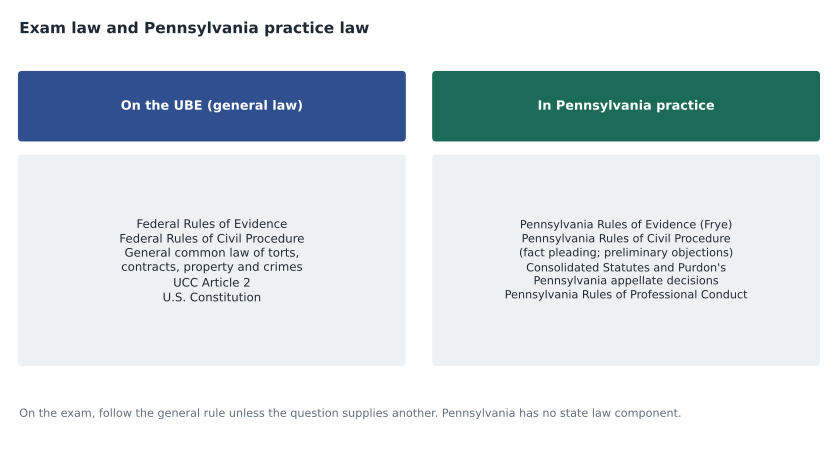
The UBE tests generally applicable principles of law. The MBE asks candidates to apply the Federal Rules of Evidence and the Federal Rules of Civil Procedure where they govern, the common law as generally understood in the United States for torts, contracts, property and criminal law, Article 2 of the Uniform Commercial Code for sales of goods and the United States Constitution as the Supreme Court has interpreted it. The MEE grades answers against the same kinds of general rules, and the MPT supplies its own law in the library.
When a jurisdiction's rule differs from the general rule, the exam answer follows the general rule unless the question says otherwise. An MBE question about the admissibility of a prior inconsistent statement applies the Federal Rules, not Pennsylvania's rule. An MEE torts question about comparative fault expects the candidate to explain the main approaches and apply the one the question indicates, or to apply the generally accepted rule if it does not. A candidate who answers from Pennsylvania practice instead of general law can lose points without knowing why.
Where Pennsylvania law differs
Hollis gave the group a short list of places where Pennsylvania law departs from what a candidate learns for the exam. She called it the do-not-confuse list, to be read in the spring, after the exam, not in February.
Evidence is first. Pennsylvania has its own Rules of Evidence, adopted by the Supreme Court and numbered to track the federal rules, with differences in substance. Pennsylvania follows the Frye general acceptance test for novel scientific evidence, reaffirmed by the Supreme Court in Grady v. Frito-Lay, Inc., decided in 2003, rather than the Daubert approach the Federal Rules use. Pennsylvania admits some prior inconsistent statements of a testifying witness as substantive evidence on terms that differ from the federal rule. And Pennsylvania still has a Dead Man's statute, which limits testimony by an interested party about a transaction with a person who has died, a rule the Federal Rules do not contain.
Civil procedure is second. Pennsylvania requires fact pleading, under which the complaint must state the material facts on which a claim rests, rather than the federal notice-pleading standard. Defendants attack a complaint by preliminary objections rather than a motion to dismiss. Many smaller civil claims go to compulsory arbitration before a panel of lawyers in the county court. Lesson 7 covers these rules.
Torts is third. Pennsylvania uses a modified comparative negligence rule that bars a plaintiff whose negligence is greater than the defendants', and since 2011 most defendants are liable only for their own share. Drivers choose full or limited tort coverage. Claims against the Commonwealth and local agencies face immunity, notice requirements and caps. Lesson 8 covers these rules.
Contracts includes one Pennsylvania peculiarity worth knowing. Under Pennsylvania's Uniform Written Obligations Act, a written promise is not unenforceable for lack of consideration if the writing contains an express statement, in any form of language, that the signer intends to be legally bound. Pennsylvania contracts and releases therefore often include the words 'intending to be legally bound,' a phrase that puzzles lawyers from other states. The statute has limits: in Socko v. Mid-Atlantic Systems of CPA, Inc., decided in 2015, the Supreme Court of Pennsylvania held that the phrase could not substitute for the new consideration Pennsylvania requires when an employer asks a current employee to sign a covenant not to compete. On the exam, consideration analysis follows the general rules.
Wills and estates is fifth. Pennsylvania requires that a will be in writing and signed by the testator at the end, but it does not require attesting witnesses for a will the testator signs, unlike most states. Witnesses are needed only when the testator signs by mark or another person signs at the testator's direction, and two witnesses are ordinarily used to prove the will at probate. Pennsylvania also taxes inheritances. Lesson 9 covers these rules. Since July 2026, trusts and estates is no longer an MEE subject.
| Topic | On the exam (general rule) | In Pennsylvania practice |
|---|---|---|
| Expert evidence | Daubert under FRE 702 | Frye general acceptance (Grady v. Frito-Lay, 2003) |
| Pleading | Federal notice pleading | Fact pleading; preliminary objections |
| Comparative fault | Explain and apply the indicated approach | Plaintiff barred if more at fault than the defendants; Fair Share Act |
| Consideration | Bargained-for exchange | Also enforceable with a written statement of intent to be legally bound |
| Will execution | Typically two attesting witnesses | Signed at the end; witnesses not required for a testator's own signature |
Sources of Pennsylvania law
Pennsylvania's statutes come in two forms. The Pennsylvania Consolidated Statutes, cited by title and section, such as 42 Pa.C.S. 7102, are statutes the General Assembly has reenacted in organized titles, such as Title 20 for decedents' estates, Title 23 for domestic relations, Title 42 for the judiciary and judicial procedure and Title 75 for vehicles. Older statutes that have not been consolidated are cited to Purdon's Pennsylvania Statutes, as P.S., such as the Uniform Written Obligations Act at 33 P.S. 6. A new lawyer must learn to look in both places.
Court rules are adopted by the Supreme Court and published in the Pennsylvania Code and the Pennsylvania Bulletin. They include the Rules of Civil Procedure, the Rules of Criminal Procedure, the Rules of Evidence, the Rules of Appellate Procedure, the Orphans' Court Rules and the rules governing lawyers. Many counties also have local rules, which matter a great deal in daily practice and differ from county to county.
Case law comes from the Supreme Court, the Superior Court and the Commonwealth Court, all reported in the Atlantic Reporter. The Superior Court issues many of its decisions as non-precedential memoranda. Under the appellate rules, non-precedential Superior Court decisions filed after May 1, 2019 may be cited for their persuasive value but do not bind other panels. A new lawyer researching an issue should know which kind of decision he or she is reading.
Learning Pennsylvania law after the exam
Hollis recommended an order for the months after the exam. Start with the procedure of the courts where the lawyer will practice: the Rules of Civil Procedure or Criminal Procedure, the county's local rules and the Rules of Evidence. Then learn the substantive law of the lawyer's practice area from the Consolidated Statutes and recent appellate decisions. Read the Pennsylvania Rules of Professional Conduct in full, noting the places where they differ from the Model Rules. Complete the Bridge the Gap program early in the first CLE period rather than late.
Wren's supervising attorney gave her a more practical version. He handed her a binder with the firm's standard complaint for a car-accident case, its standard preliminary objections and answers, a sample compulsory arbitration memo and a copy of the motor vehicle statute's limited tort provisions. 'That is your first month,' he said. 'Learn why every paragraph is there.'
Two more areas to watch
Criminal law and procedure appear on the MBE and the MEE as general law: common law crimes, the Model Penal Code where questions invoke it, and the federal constitutional rules on searches, confessions, counsel and trial rights. Pennsylvania prosecutions are governed by the Crimes Code in Title 18 of the Consolidated Statutes and the Pennsylvania Rules of Criminal Procedure. The Crimes Code grades murder by degree, and second-degree murder in Pennsylvania is a killing committed while the defendant was engaged as a principal or an accomplice in the perpetration of a felony, a definition that differs from the way many states and exam questions use the term. Pennsylvania's speedy trial rule, Rule 600 of the Rules of Criminal Procedure, generally requires trial within 365 days of the complaint, subject to exclusions, which has no counterpart on the exam. A lawyer who goes into criminal practice learns these rules in the first weeks.
Real property on the exam follows general common law and recording act principles. Pennsylvania has its own recording statutes and a strong form of tenancy by the entireties for married couples, which protects entireties property from the creditors of one spouse alone. A Pennsylvania real estate lawyer also deals with the state realty transfer tax and local transfer taxes at closing. None of these appears on the exam, and all of them appear in the first real estate file a new lawyer handles.
Keeping the two bodies of law apart
Hollis gave the group three habits for the months before the exam. First, when a work assignment involves Pennsylvania law, write a one-line note of the Pennsylvania rule and the general rule side by side, so the difference becomes something the candidate notices rather than something that leaks into exam answers. Second, during bar study, answer practice questions without reference to work materials, and when a practice answer seems wrong, check whether the instinct came from Pennsylvania practice. Third, in the last three weeks before the exam, set the Pennsylvania materials aside entirely.
Wren found the first habit useful almost immediately. Her firm's file on a rear-end collision involved a limited tort plaintiff, a question the exam would never ask. Her bar review lecture that week covered comparative negligence in general terms. Writing the two rules next to each other in her notebook, she said, made her see that the exam question and the work question were not the same question, and that the right answer to each was different. 'I stopped arguing with the practice questions,' she said, 'once I understood they were not about Scranton.'
After the exam, the habit reverses. A new lawyer who has spent months answering from general law must now check Pennsylvania authority first, because the client's case will be decided under Pennsylvania rules. Hollis suggested a simple rule for the first year of practice: never state a legal rule to a client or a supervising lawyer without having checked it in a Pennsylvania source that week.
Worked problem
An exam answer and a practice answer
On the MBE, a question asks whether expert testimony based on a new technique is admissible where the technique has been tested and peer reviewed but is not yet generally accepted. Later, in practice, the same issue arises in a Pennsylvania state court case.
Show solution
- The MBE applies the Federal Rules of Evidence, under which Rule 702 and the Daubert approach focus on reliability.
- On the exam, testing and peer review support admissibility even without general acceptance.
- Pennsylvania state courts apply the Frye general acceptance test, reaffirmed in Grady v. Frito-Lay (2003) and reflected in Pennsylvania Rule of Evidence 702.
- In the Pennsylvania case, the proponent must show the methodology is generally accepted in the relevant scientific community.
Answer: The exam answer turns on reliability under the Federal Rules; the Pennsylvania practice answer turns on general acceptance under Frye.
Common mistakes
MistakeThe UBE tests Pennsylvania law because it is given in Pennsylvania.
InsteadThe UBE tests general law; Pennsylvania has no state law component.
MistakePennsylvania follows Daubert.
InsteadPennsylvania state courts apply Frye, as reaffirmed in Grady v. Frito-Lay.
MistakeA Pennsylvania will needs two attesting witnesses.
InsteadA will signed by the testator at the end needs no attesting witnesses; witnesses matter for marks, proxies and probate proof.
MistakeAll Pennsylvania statutes are in the Consolidated Statutes.
InsteadMany older statutes are still cited to Purdon's Statutes (P.S.).
MistakeNon-precedential Superior Court memoranda cannot be cited.
InsteadThose filed after May 1, 2019 may be cited for persuasive value.
Practice problems
Work each problem on paper first, then reveal the answer to check.
Does Pennsylvania have a jurisdiction-specific component?
Show answer
No.
Which test does Pennsylvania use for novel scientific evidence?
Show answer
Frye general acceptance.
What phrase makes a written promise enforceable without consideration under the Uniform Written Obligations Act?
Show answer
An express statement that the signer intends to be legally bound.
Which title of the Consolidated Statutes covers domestic relations?
Show answer
Title 23.
Where are Pennsylvania appellate decisions reported?
Show answer
In the Atlantic Reporter.
Summary and key terms
- Pennsylvania has no state law component; the UBE tests general law.
- Exam answers follow general rules unless the question supplies another rule.
- Pennsylvania differs on evidence (Frye, Dead Man's statute), pleading, comparative fault, consideration and wills.
- Statutes are in the Consolidated Statutes (Pa.C.S.) or Purdon's (P.S.); rules are in the Pennsylvania Code.
- Some non-precedential Superior Court decisions may be cited for persuasive value.
- New lawyers learn Pennsylvania law through practice, local rules and the Bridge the Gap program.
- jurisdiction-specific component
- A local law course or test some UBE jurisdictions require; Pennsylvania has none.
- Frye test
- The rule that novel scientific evidence must be generally accepted in the relevant field.
- Dead Man's statute
- A statute limiting an interested party's testimony about transactions with a deceased person.
- Uniform Written Obligations Act
- A Pennsylvania statute making a signed written promise enforceable without consideration if it states an intent to be legally bound.
- Pa.C.S.
- The Pennsylvania Consolidated Statutes.
Lesson quiz · 5 questions
Score 60% or more to complete this lesson.
Create a free account to save your progress, take quizzes and earn a certificate.