
BAR-239 · Lesson 10 of 12 · 20 min
The Pennsylvania Rules of Professional Conduct, trust accounts and lawyer discipline
▶ Video coming soon A video version of this lesson is on the way.
The firm's office manager gave Wren a folder on her first day labeled 'New client packet.' Inside were the firm's standard fee letter, its contingent fee agreement, a privacy notice and a one-page disclosure Wren had never seen before, stating the firm's professional liability insurance limits. 'Every new client gets the fee letter and the insurance paragraph,' the manager said. 'The lawyers say the rules require it.' Wren had passed the MPRE with a strong score and did not remember either requirement. When she raised it with the group, Hollis explained why: 'Because the MPRE tests the Model Rules, and those two requirements are Pennsylvania's own.'
This lesson covers how the Pennsylvania Rules of Professional Conduct relate to the ABA Model Rules, the Pennsylvania variations a new lawyer meets in the first weeks of practice, the rules on client funds and trust accounts, and the discipline system run by the Disciplinary Board and the Supreme Court.
The Pennsylvania rules and the Model Rules
The Supreme Court of Pennsylvania adopted Rules of Professional Conduct based on the ABA Model Rules in 1987 and has amended them many times since, including a broad revision after the ABA's Ethics 2000 project. The rules follow the Model Rules' numbering, so a lawyer who knows the Model Rules can find the Pennsylvania counterpart quickly, and most rules are identical or nearly so. The comments to the Pennsylvania rules are guides to interpretation. Where the Pennsylvania text differs from the Model Rules, the Pennsylvania text governs Pennsylvania lawyers, and the MPRE answer and the Pennsylvania answer can diverge.
Fees in writing
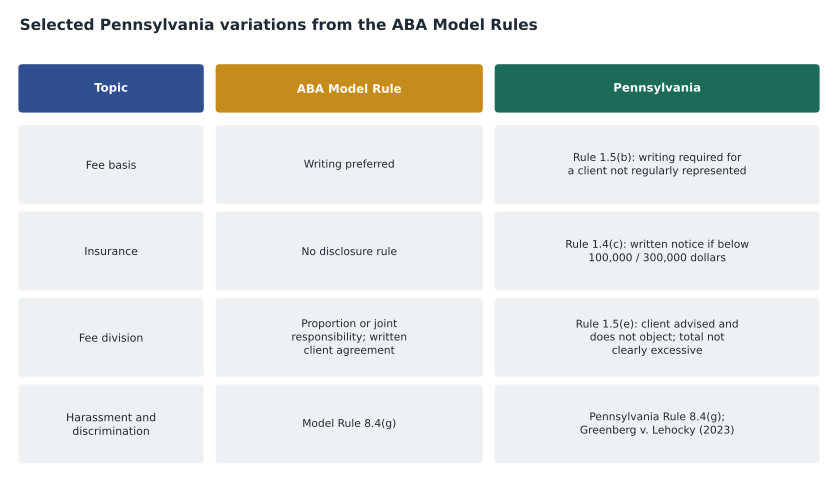
Model Rule 1.5(b) requires that the scope of the representation and the basis or rate of the fee be communicated to the client, preferably in writing. Pennsylvania Rule 1.5(b) makes the writing mandatory in the situation that matters most: when the lawyer has not regularly represented the client, the basis or rate of the fee must be communicated to the client in writing before or within a reasonable time after commencing the representation. For a new client, an oral fee arrangement violates the Pennsylvania rule even though it might satisfy the Model Rule.
Contingent fees must be in writing under both versions. Pennsylvania Rule 1.5(c) requires a written agreement stating the method by which the fee is determined, including the percentage that goes to the lawyer in the event of settlement, trial or appeal, the litigation and other expenses to be deducted from the recovery and whether those expenses are deducted before or after the contingent fee is calculated. At the end of the matter, the lawyer must give the client a written statement showing the outcome and, if there is a recovery, the remittance to the client and how it was calculated. Rule 1.5(d) prohibits contingent fees in a criminal case and in certain domestic relations matters.
Fee division between lawyers in different firms is looser in Pennsylvania. Model Rule 1.5(e) allows a division only if it is in proportion to the services each lawyer performs or each lawyer assumes joint responsibility, the client agrees in a writing that states each lawyer's share and the total fee is reasonable. Pennsylvania Rule 1.5(e) allows the division if the client is advised of and does not object to the participation of all the lawyers involved, and the total fee is not illegal or clearly excessive. The Pennsylvania rule does not require that the division track the work done, and its comment says the client need not be told each lawyer's share. Referral fees are therefore common in Pennsylvania personal injury practice.
In 2025 the Pennsylvania Bar Association's ethics committee issued Formal Opinion 2025-100, which reinforced the importance of written fee agreements as a matter of compliance and risk management. Opinions of the bar association are advisory, not binding, but Pennsylvania lawyers and disciplinary counsel read them.
The insurance disclosure
Pennsylvania Rule 1.4(c) has no counterpart in the Model Rules. A lawyer in private practice must inform a new client in writing if the lawyer does not have professional liability insurance of at least 100,000 dollars per occurrence and 300,000 dollars in the aggregate per year, subject to commercially reasonable deductibles. The rule does not require insurance; it requires disclosure of its absence, so that clients can make an informed choice. The Disciplinary Board asks about insurance on each lawyer's annual registration, and the information is available to the public.
The firm's one-page disclosure was a belt-and-suspenders version. The firm carried more than the minimum coverage, so the rule did not require any statement, but the partners preferred to describe the coverage in the new client packet anyway. Hollis said that was common and harmless; what is not harmless is a solo practitioner who lets coverage lapse and keeps taking new clients without telling them.
Harassment and discrimination: Rule 8.4(g)
Pennsylvania's version of Rule 8.4(g) prohibits a lawyer, in the practice of law, from knowingly engaging in conduct constituting harassment or discrimination based on listed characteristics, including race, sex, gender identity or expression, religion, national origin, ethnicity, disability, age, sexual orientation, marital status and socioeconomic status. The rule was adopted after the ABA added a similar provision to the Model Rules in 2016, and it has a litigation history. A Pennsylvania lawyer who teaches continuing legal education courses on free speech challenged the rule in federal court as a violation of the First Amendment, and the district court enjoined enforcement. After the Court amended the rule, the lawyer challenged the amended version, and the district court again enjoined it. In Greenberg v. Lehocky, decided in 2023, the Third Circuit reversed, holding that the lawyer lacked standing because the rule did not arguably reach the speech he planned and the disciplinary authorities had no intention of disciplining him for it. The rule remains in force.
Confidentiality and other rules to read
Pennsylvania's Rule 1.6 on confidentiality tracks the Model Rule's structure, with exceptions permitting disclosure to prevent reasonably certain death or substantial bodily harm, to prevent or rectify certain client crimes or frauds in which the lawyer's services were used, to secure ethics advice, to establish claims or defenses in controversies with the client and to comply with law or court order, but the exceptions are worded differently in places. A new lawyer should read the Pennsylvania text rather than assume the Model Rule's wording. The same is true of the conflict rules, the rules on advertising and solicitation and the rule on a lawyer's duties when a client's representation ends.
Technology raises new questions under old rules. In May 2024, the Pennsylvania Bar Association and the Philadelphia Bar Association issued Joint Formal Opinion 2024-200 on the use of generative artificial intelligence, advising that lawyers using such tools must understand them well enough to protect client confidences, must verify any citations and assertions the tools produce and must consider whether and how to bill for their use. Courts across the country have sanctioned lawyers who filed briefs with citations to cases that did not exist.
Client funds and trust accounts
Rule 1.15 governs the safekeeping of property, and Pennsylvania's version is long and detailed. A lawyer must hold client and third-party funds separately from the lawyer's own property in a trust account, keep complete records of the funds and promptly deliver funds a client or third person is entitled to receive. Funds that are nominal in amount or are expected to be held for a short time go into a pooled interest-bearing account under the IOLTA program, whose interest is paid to the Pennsylvania IOLTA Board to fund civil legal aid. Larger sums held for longer periods go into separate interest-bearing accounts for the client's benefit.
Rule 221 of the Pennsylvania Rules of Disciplinary Enforcement adds a safeguard. A lawyer may keep trust accounts only at financial institutions approved by the Disciplinary Board, and an approved institution agrees to report to the Board whenever a trust account check is presented against insufficient funds, whether or not the bank honors it. An overdraft report starts an inquiry by the Office of Disciplinary Counsel. Mishandling client funds is the most common basis for serious discipline in Pennsylvania, as elsewhere, and negligent commingling or conversion can lead to suspension even without dishonest intent.
Pennsylvania also maintains the Pennsylvania Lawyers Fund for Client Security, funded by an annual assessment on lawyers, which reimburses clients who lose money through a lawyer's dishonest conduct. The fund does not excuse the lawyer; it protects the client.
| Requirement | Source | What it means in practice |
|---|---|---|
| Separate trust account | Rule 1.15 | Never mix client funds with operating funds |
| IOLTA for nominal or short-term funds | Rule 1.15 and the IOLTA Board | Pooled account; interest funds civil legal aid |
| Approved bank with overdraft reporting | Pa.R.D.E. 221 | An overdraft triggers a report to the Disciplinary Board |
| Complete records | Rule 1.15 | Ledgers for each client, reconciliations, retained for the period the rule sets |
| Prompt delivery and accounting | Rule 1.15 | Pay clients and third parties what they are owed and account on request |
Registration and discipline
Every Pennsylvania lawyer must register with the Disciplinary Board each year under Pa.R.D.E. 219 and pay the annual fee, reporting contact information, trust account information and insurance status. A lawyer who fails to register is placed on administrative suspension and may not practice until reinstated. New lawyers register after admission and then annually by the deadline the Board sets.
Complaints of misconduct go to the Office of Disciplinary Counsel, which investigates and can dismiss a complaint, offer private discipline or file formal charges. Formal charges are heard by a hearing committee, whose report goes to the Disciplinary Board. The Board can impose private discipline, such as an informal admonition or a private reprimand, or a public reprimand, and it recommends more serious discipline to the Supreme Court. Only the Supreme Court can suspend or disbar a lawyer. A disbarred lawyer may petition for reinstatement only after the waiting period the rules set and must prove fitness to practice again.
The Board publishes disciplinary decisions and a monthly summary of discipline. Hollis encouraged the group to read a few issues. 'Most of what you will read is not about clever ethics puzzles,' she said. 'It is about trust accounts, missed deadlines and lawyers who stopped answering their clients. The rules that matter most are the boring ones.'
Worked problem
A new client walks in
Wren, now admitted, opens her own practice in 2028. A new client hires her for a car-accident claim on a one-third contingent fee, and a second new client hires her to draft a will for a flat fee of 600 dollars, agreed over the phone. She has not yet bought malpractice insurance. A lawyer in another firm referred the car-accident client and asks for a third of the fee.
Show solution
- The contingent fee agreement must be in writing under Rule 1.5(c), stating the percentages, expenses and how expenses are deducted.
- For the will client, whom she has not regularly represented, Rule 1.5(b) requires the fee basis in writing before or within a reasonable time after starting work.
- Without insurance meeting the minimums, Rule 1.4(c) requires her to tell each new client so in writing.
- Under Rule 1.5(e), she may share the fee with the referring lawyer if the client is advised of and does not object to the participation of both lawyers and the total fee is not clearly excessive.
Answer: She needs a written contingent fee agreement, a written fee statement for the will client, a written insurance disclosure to both clients and the car-accident client's informed non-objection to the referral fee.
Common mistakes
MistakeAn oral fee agreement with a new client is fine if it is reasonable.
InsteadPennsylvania Rule 1.5(b) requires the fee basis in writing for a client not regularly represented.
MistakePennsylvania lawyers must carry malpractice insurance.
InsteadRule 1.4(c) requires written disclosure to new clients if a private practitioner lacks minimum coverage.
MistakeReferral fees require a written agreement stating each lawyer's share.
InsteadPennsylvania Rule 1.5(e) requires that the client be advised and not object, and that the total not be clearly excessive.
MistakeThe Third Circuit struck down Rule 8.4(g).
InsteadIt held the challenger lacked standing; the rule remains in force.
MistakeA bank overdraft on a trust account is a private matter.
InsteadApproved banks must report trust account overdrafts to the Disciplinary Board.
Practice problems
Work each problem on paper first, then reveal the answer to check.
What insurance minimums trigger the Rule 1.4(c) disclosure?
Show answer
Less than 100,000 dollars per occurrence and 300,000 dollars aggregate per year.
When must the fee basis be in writing under Pennsylvania Rule 1.5(b)?
Show answer
When the lawyer has not regularly represented the client.
Who may suspend or disbar a Pennsylvania lawyer?
Show answer
Only the Supreme Court of Pennsylvania.
What happens to a lawyer who does not complete annual registration?
Show answer
Administrative suspension until reinstated.
What did Joint Formal Opinion 2024-200 address?
Show answer
Lawyers' ethical use of generative artificial intelligence.
Summary and key terms
- Pennsylvania's rules follow the Model Rules' numbering but differ in places; the Pennsylvania text governs.
- Rule 1.5(b) requires a written fee basis for new clients; Rule 1.5(c) requires written contingent fee agreements and closing statements.
- Rule 1.4(c) requires written disclosure when a private practitioner lacks 100,000/300,000 dollar coverage.
- Rule 1.5(e) allows fee division if the client is advised and does not object; Rule 8.4(g) survived Greenberg v. Lehocky (2023) on standing grounds.
- Rule 1.15 and Pa.R.D.E. 221 govern trust accounts, IOLTA and overdraft reporting.
- Lawyers register annually; the Disciplinary Board handles complaints, and only the Supreme Court suspends or disbars.
- Rule 1.4(c)
- Pennsylvania's requirement to disclose the absence of minimum professional liability insurance to new clients.
- IOLTA
- Interest on Lawyers' Trust Accounts, a pooled account program whose interest funds civil legal aid.
- overdraft notification
- An approved bank's report to the Disciplinary Board when a trust account check is presented against insufficient funds.
- Office of Disciplinary Counsel
- The office that investigates and prosecutes complaints against Pennsylvania lawyers.
- administrative suspension
- Suspension for failing to meet registration, CLE or similar requirements.
Lesson quiz · 5 questions
Score 60% or more to complete this lesson.
Create a free account to save your progress, take quizzes and earn a certificate.