
BAR-208 · Lesson 8 of 12 · 18 min
Delaware corporate and alternative entity law
▶ Video coming soon A video version of this lesson is on the way.
Most of Tamsin's work at her firm is estates and real estate, so corporate law is the subject she worries about most. 'Every Delaware lawyer is supposed to know the DGCL,' she says. Marchetti agrees that the essays expect it, but points out that the exam tests the core: how entities are formed and governed, what their governing documents can and cannot do, and how Delaware's entity statutes differ from the general rules taught in law school. This lesson covers formation and structure; Lesson 9 covers fiduciary duties and litigation.
Why Delaware law dominates
More than half of US public companies, and a large share of private companies and alternative entities, are formed under Delaware law. Three features explain why. The Delaware General Corporation Law (DGCL) is detailed, flexible and frequently updated by the General Assembly on the recommendation of the Corporation Law Council of the Delaware State Bar Association. The Court of Chancery provides fast, expert decisions without juries, building a large body of precedent. And the Delaware Secretary of State runs an efficient filing system. Under the internal affairs doctrine, the law of the state of incorporation governs the relationship among a corporation, its directors and its stockholders, wherever the company does business.
Competition. Delaware's position has been challenged. In 2024 Tesla reincorporated in Texas after a Court of Chancery decision rescinding its chief executive's 2018 pay package, and other companies moved to Nevada or Texas. Commentators called the trend 'DExit.' The General Assembly responded in 2025 with the SB 21 amendments discussed in Lesson 9, and in December 2025 the Delaware Supreme Court reversed the rescission remedy in the Tesla case. For an exam candidate, the point is that Delaware corporate law is not static: the statute and the leading cases changed in 2024, 2025 and 2026.
Forming a Delaware corporation
A corporation is formed by filing a certificate of incorporation with the Secretary of State under DGCL section 101. Section 102 lists what the certificate must contain, including the name, the registered agent in Delaware, the purpose (which can be any lawful business) and the authorized stock, and what it may contain.
Exculpation. Section 102(b)(7) allows the certificate of incorporation to eliminate or limit the personal liability of directors for money damages for breach of the duty of care. Since a 2022 amendment, the certificate may also exculpate certain senior officers, but only for direct claims, not claims brought by or in the right of the corporation. Exculpation can never cover breaches of the duty of loyalty, acts or omissions not in good faith or involving intentional misconduct or a knowing violation of law, or transactions from which the director or officer derived an improper personal benefit. Directors also cannot be exculpated for unlawful dividends under section 174.
Bylaws. Under section 109 the bylaws may contain any provision consistent with law and the certificate relating to the business, the conduct of its affairs and the rights or powers of the corporation, its stockholders, directors, officers or employees. Section 115 allows forum selection provisions for internal corporate claims, as Lesson 7 explained.
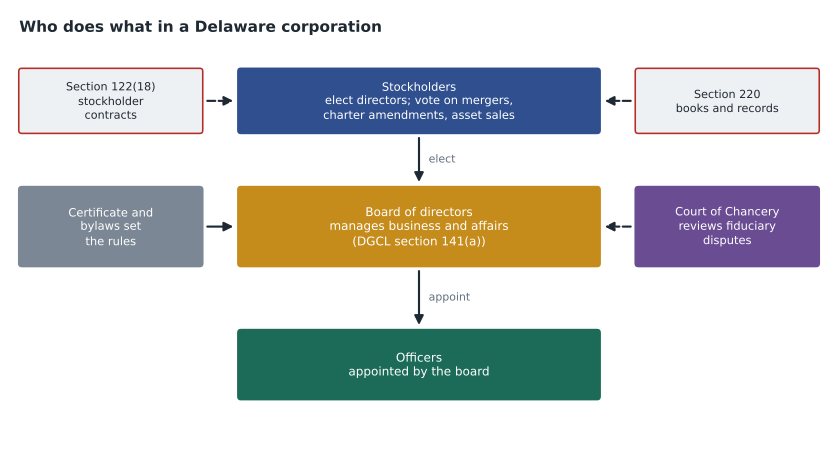
The board. Section 141(a) is the foundation of Delaware corporate law: the business and affairs of every corporation are managed by or under the direction of the board of directors, unless the statute or the certificate provides otherwise. Directors may act at meetings or by unanimous written consent.
Stockholder rights
Stockholders elect directors, vote on fundamental changes such as mergers, charter amendments and sales of substantially all assets, and can sue to enforce fiduciary duties. They act at annual or special meetings or, unless the certificate provides otherwise, by written consent under section 228.
Stockholder agreements and section 122(18). In February 2024, in West Palm Beach Firefighters' Pension Fund v. Moelis & Co., the Court of Chancery held that several provisions of a stockholder agreement giving a founder approval rights over board actions were invalid because they intruded on the board's authority under section 141(a). The General Assembly responded within months. Effective August 1, 2024, new section 122(18) authorizes a corporation to enter into contracts with stockholders, including approval rights over corporate actions and covenants about board composition, even if not set out in the certificate of incorporation. The amendment applies to agreements made before and after it took effect, subject to limits in the statute.
Books and records. Section 220 lets a stockholder inspect corporate books and records for a proper purpose, such as investigating possible wrongdoing. The 2025 SB 21 amendments narrowed the definition of books and records to an enumerated list and tightened the procedure, as Lesson 9 explains.
Appraisal. In a merger, stockholders who do not vote for the deal and follow the statutory procedure can ask the Court of Chancery to determine the fair value of their shares under section 262, instead of accepting the merger consideration.
| Topic | DGCL section | Key point |
|---|---|---|
| Formation | 101, 102 | File a certificate of incorporation; purpose can be any lawful business |
| Exculpation | 102(b)(7) | Directors for care claims; officers for direct care claims since 2022; never loyalty or bad faith |
| Bylaws | 109 | Any provision consistent with law and the certificate |
| Board authority | 141(a) | Business managed by or under the direction of the board |
| Stockholder agreements | 122(18) | Contracts with stockholders allowed since August 1, 2024 |
| Written consent | 228 | Stockholders may act without a meeting unless the certificate says otherwise |
| Mergers | 251 | Board approval plus stockholder vote |
| Appraisal | 262 | Fair value determined by Chancery |
| Books and records | 220 | Proper purpose; narrowed by SB 21 in 2025 |
Limited liability companies
The Delaware Limited Liability Company Act, in Title 6, chapter 18, is built around one idea: freedom of contract. The statute says it is the policy of the Act to give maximum effect to the principle of freedom of contract and to the enforceability of LLC agreements. In practice that means the LLC agreement, often called an operating agreement, controls almost everything about how the LLC is run.
Fiduciary duties can be eliminated. Under section 18-1101(c), an LLC agreement may expand, restrict or eliminate the fiduciary duties of members and managers. It may not eliminate the implied contractual covenant of good faith and fair dealing. It can limit liability for breach of contract and of duties, but not for bad faith violations of the implied covenant. That combination, broad freedom with a floor of good faith, is a classic Delaware essay issue.
Default rules. When the agreement is silent, the Act's default rules apply, and the Court of Chancery has held that managers and controlling members owe traditional fiduciary duties by default unless the agreement displaces them. Members may also have statutory inspection rights and the right to seek judicial dissolution where it is not reasonably practicable to carry on the business in conformity with the LLC agreement.
Series and other features. Delaware allows series LLCs, in which assets and liabilities can be separated into series within one LLC, and it permits LLCs to divide or convert under statutory procedures.
Limited partnerships and other forms
The Delaware Revised Uniform Limited Partnership Act, in Title 6, chapter 17, follows the same contractarian approach. A limited partnership agreement may expand, restrict or eliminate fiduciary duties, but not the implied covenant of good faith and fair dealing. Many investment funds and master limited partnerships use Delaware limited partnerships for this reason.
Delaware also allows public benefit corporations, which are for-profit corporations that must balance stockholders' financial interests with a specific public benefit and the interests of those affected by their conduct. They are created under a subchapter of the DGCL added in 2013.
Worked problem
Reading an LLC agreement on an essay
Hypothetical: Lewes Brewing LLC is a Delaware LLC. Its agreement says the managing member 'shall have no duties to the LLC or the other members other than those expressly set out in this Agreement.' The managing member sells the LLC's taproom to his cousin at a low price, using a process the agreement does not forbid. A minority member sues. Outline the analysis.
Show solution
- Under section 18-1101(c), the agreement may eliminate fiduciary duties, and this language appears to do so clearly.
- So a claim for breach of the fiduciary duty of loyalty likely fails.
- The implied covenant of good faith and fair dealing cannot be eliminated; ask whether the agreement left a gap the parties would have filled had they thought of it, such as an implied requirement that sales to affiliates be at fair value.
- The member can also claim breach of any express provisions, such as a required approval or notice.
- Conclusion: the strongest claims are contractual: express terms and the implied covenant, not fiduciary duty.
Answer: The same analysis applies to Delaware limited partnerships under the parallel provision in chapter 17.
Common mistakes
MistakeSaying a Delaware LLC agreement cannot eliminate fiduciary duties.
InsteadSection 18-1101(c) allows elimination; only the implied covenant of good faith and fair dealing is mandatory.
MistakeApplying section 102(b)(7) to a duty of loyalty claim.
InsteadExculpation never covers loyalty, bad faith, intentional misconduct, knowing violations of law or improper personal benefits.
MistakeThinking officers can be exculpated for derivative claims.
InsteadOfficer exculpation, added in 2022, covers only direct claims, not claims by or in the right of the corporation.
MistakeRelying on Moelis as current law on stockholder agreements.
InsteadSection 122(18), effective August 1, 2024, authorizes many of the provisions Moelis invalidated.
Choosing an entity: what clients ask
In practice, Tamsin's firm often helps clients choose between a corporation and an LLC. Marchetti uses the question to tie the lesson together. A corporation offers a familiar governance structure, easy issuance of stock to investors and the large body of Chancery precedent on fiduciary duties. An LLC offers contractual flexibility: the members can design governance, economics and even the scope of fiduciary duties in the agreement. Tax treatment also differs, and investors in venture-backed companies usually expect a Delaware corporation. On an essay, the question is usually narrower: given the entity the facts describe, which statute applies and what do the governing documents say.
Mergers and stockholder votes
Under section 251, a merger generally requires approval by the board of each constituent corporation and by a majority of the outstanding stock entitled to vote. The statute contains exceptions, such as certain short-form mergers of a parent with a subsidiary it owns at least 90 percent of, under section 253, which need no stockholder vote of the subsidiary, and certain two-step mergers following a tender offer under section 251(h). Sales of all or substantially all of a corporation's assets need board and stockholder approval under section 271. Stockholders who do not vote for certain mergers can seek appraisal under section 262.
These provisions interact with fiduciary duty law. A merger that complies with the statute can still be challenged as a breach of fiduciary duty, and the standard of review depends on who stands on each side of the deal, as Lesson 9 explains. Delaware lawyers describe this as the doctrine of independent legal significance on the statutory side and equitable review on the fiduciary side: compliance with the statute is necessary but not always sufficient.
Annual obligations
Delaware entities must keep a registered agent and office in Delaware and file annual reports and pay franchise taxes or annual fees to the Secretary of State. Failure to do so can lead to loss of good standing. These details rarely appear on essays, but new Delaware lawyers handle them constantly, and they are part of what makes Delaware's entity system work.
Charter amendments and stock
Under section 242, a corporation amends its certificate of incorporation by a board resolution followed by a stockholder vote, with class votes required in some cases when an amendment affects a class of stock. Under section 151 the certificate may authorize classes and series of stock with different voting, dividend and liquidation rights, and it may give the board authority to set the terms of preferred stock in later resolutions, often called blank check preferred. Dividends may be paid only out of surplus or, in some cases, net profits under section 170, and directors who approve unlawful dividends can be personally liable under section 174. On an essay about a startup's financing round, those four sections usually supply the framework.
Summary and key terms
- Delaware dominates US entity law because of the DGCL, the Court of Chancery and the internal affairs doctrine; the statute and cases changed significantly in 2024 to 2026.
- Section 102(b)(7) allows exculpation of directors for care claims and, since 2022, of officers for direct care claims, never for loyalty or bad faith.
- Section 141(a) vests management in the board; section 122(18), effective August 1, 2024, authorizes stockholder agreements after Moelis.
- The Delaware LLC Act gives maximum effect to freedom of contract: fiduciary duties can be eliminated, but not the implied covenant of good faith and fair dealing.
- Delaware limited partnerships follow the same approach; public benefit corporations balance profit with a stated public benefit.
- Internal affairs doctrine
- The rule that the law of the state of incorporation governs relations among a corporation, its directors and stockholders.
- Exculpation
- A charter provision eliminating personal liability for money damages for certain breaches of duty.
- Implied covenant of good faith and fair dealing
- A contractual gap-filler that Delaware LLC and LP agreements cannot eliminate.
- Appraisal
- A stockholder's statutory right to have the Court of Chancery set the fair value of shares in certain mergers.
- Public benefit corporation
- A Delaware for-profit corporation required to balance stockholder interests with a stated public benefit.
Practice problems
Work each problem on paper first, then reveal the answer to check.
What may a Delaware LLC agreement never eliminate?
Show answer
The implied contractual covenant of good faith and fair dealing.
Which DGCL section was added in 2024 in response to Moelis?
Show answer
Section 122(18), authorizing contracts with stockholders.
Can a certificate of incorporation exculpate a director for a breach of the duty of loyalty?
Show answer
No; section 102(b)(7) excludes loyalty breaches, bad faith, intentional misconduct, knowing violations of law and improper personal benefits.
Lesson quiz · 5 questions
Score 60% or more to complete this lesson.
Create a free account to save your progress, take quizzes and earn a certificate.