
BAR-208 · Lesson 11 of 12 · 18 min
No admission on motion, the pre-admission conference and practice after admission
▶ Video coming soon A video version of this lesson is on the way.
Marchetti invites Ngozi, who is sitting the New York exam, to join part of this call, because Ngozi asked the group a question last week: once she is admitted in New York, could she practice in Delaware too? Tamsin is curious about the answer for her own reasons. Her firm sometimes works with Pennsylvania and New Jersey lawyers on Delaware matters, and she wants to understand how they appear in Delaware courts without a Delaware license.
No admission on motion
Delaware does not offer admission on motion. Most states let experienced lawyers from other jurisdictions join their bar without an exam after a number of years of practice; Delaware does not. NCBE's summary of Delaware's rules lists admission on motion as not available, and the Board's own materials put it plainly: examination is required of all applicants.
Delaware also accepts no transferred scores. Because it has never given the UBE, it accepts no UBE scores from elsewhere, and it does not accept MBE scores earned in another jurisdiction. An experienced lawyer applying in Delaware therefore follows the same path as a new graduate: preceptor, application, the full two-day exam, the clerkship and checklist, the character investigation and the pre-admission conference. Lawyers admitted elsewhere pay a higher filing fee, and those whose degrees are not from ABA-approved schools may petition the Board to waive the law school requirement.
Marchetti's answer to Ngozi, then, is that her New York admission will not give her any route into the Delaware Bar except the Delaware exam. She will be able to work on Delaware matters in limited ways, which the rest of this section explains.
| Route | Available in Delaware? | Notes |
|---|---|---|
| Admission on motion | No | Every applicant sits the Delaware exam |
| UBE score transfer | No | Delaware has never given the UBE |
| MBE score transfer | No | MBE scores from other jurisdictions are not accepted |
| Pro hac vice for a single case | Yes | With Delaware counsel, under each court's rules |
| Limited practice for certain agency lawyers | Yes | Supreme Court Rule 55, at the Board's discretion |
| Limited practice for in-house counsel | Yes | A certificate of limited practice for lawyers employed by a business in Delaware |
Appearing without admission
Pro hac vice. A lawyer admitted elsewhere can be admitted for a particular case in a Delaware court on motion of a member of the Delaware Bar, who stays responsible for the case. Each court has its own rule and certification requirements, and the Delaware lawyer typically must sign filings and attend proceedings. This is how national firms try cases in the Court of Chancery: a Delaware firm serves as Delaware counsel and moves the out-of-state lawyers' admission.
In-house counsel. Delaware allows lawyers admitted elsewhere who work as in-house counsel for a business in Delaware to obtain a certificate of limited practice. The certificate lets them advise their employer but not appear in Delaware courts or advise the public.
Agency lawyers and recent graduates. As Lesson 2 explained, Supreme Court Rule 55 allows certain graduates working for qualifying Delaware nonprofit or government agencies to practice on their employer's matters before admission, at the Board's discretion.
Each of these routes is limited in purpose, and none substitutes for admission. A lawyer who wants a general Delaware practice must pass the exam.
Finishing the process: from results to the oath
After results are posted, passing applicants move to the last stage. Marchetti lays it out for Tamsin as a checklist she can follow from April through June 2027.
The character investigation and interview with an assigned Board member, described in Lesson 3.
The preceptor's certificates and the fingerprint-based criminal history reports, due on the Board's set dates.
Completion of the clerkship and the clerkship checklist, certified by the applicant and preceptor.
The pre-admission conference. Delaware requires every passing applicant to attend a pre-admission conference, a session on the professional responsibilities and practical realities of Delaware practice. Attendance is a prerequisite to admission, and the Board asks applicants to attend in professional attire. A fee is paid to the Clerk of the Supreme Court.
The oath. Admission ceremonies are held for July applicants in December and for February applicants in June, with additional ceremonies during the year. Only a Justice of the Supreme Court can administer the oath.
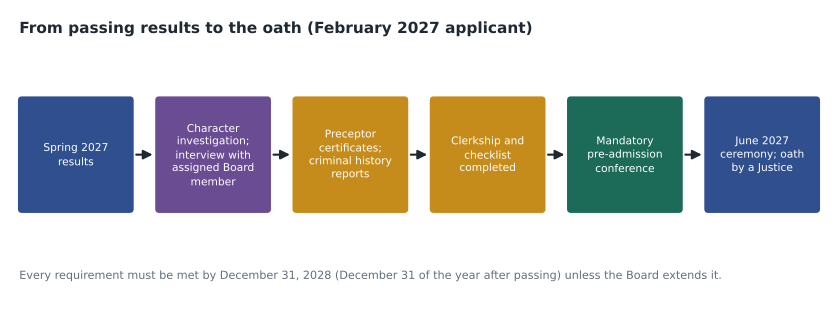
The deadline. Every requirement must be completed by December 31 of the year after the applicant passes. An applicant who needs more time can petition the Board for an extension under its rules, but extensions are discretionary, and an applicant who lets the deadline pass without one must sit the exam again.
Practice after admission
Annual registration. Delaware lawyers register with the Supreme Court every year and pay annual assessments that fund the court's attorney regulation programs, including the Lawyers' Fund for Client Protection. The annual registration includes certifications about the lawyer's practice and, for lawyers who hold client money, about trust accounts and bookkeeping.
Continuing legal education. Under the Delaware CLE rules, a lawyer must complete at least 24 approved credit hours in each two-year compliance period, including at least 4 hours of ethics and at least 12 hours earned in person. Up to 20 extra hours can carry forward. For new lawyers, the requirement starts on January 1 of the year after admission.
The Fundamentals courses. Newly admitted Delaware lawyers must also attend seven Fundamentals courses offered by the Delaware State Bar Association by the end of their second compliance year: Lawyer-Client Relations, Family Law, Real Estate, Civil Litigation, Will Drafting and Estate Administration, Law Practice Management and Technology, and Criminal Law and Procedure. The list mirrors the checklist's philosophy: every Delaware lawyer should know the basics of the work Delaware lawyers actually do.
| Obligation | Rule | Key point |
|---|---|---|
| CLE hours | Delaware CLE Rule 4 | 24 hours every two years, at least 4 ethics and 12 in person |
| Carryover | Delaware CLE Rule 4 | Up to 20 hours to the next period |
| New lawyer courses | Delaware CLE Rule 4(D) | Seven Fundamentals courses by the end of the second compliance year |
| Registration | Supreme Court rules | Annual registration, assessments and trust account certifications |
| Conduct | Delaware Lawyers' Rules of Professional Conduct | Based on the ABA Model Rules, with Delaware variations |
Professional conduct. Delaware lawyers are governed by the Delaware Lawyers' Rules of Professional Conduct, which are based on the ABA Model Rules with Delaware variations. Complaints are investigated by the Office of Disciplinary Counsel and heard by the Board on Professional Responsibility, with review by the Supreme Court. The Delaware State Bar Association is a voluntary association; regulation of the profession belongs to the court.
A note for lawyers who want to practice elsewhere
Tamsin raises the reverse question: if she passes in Delaware and later wants to practice in Pennsylvania, what happens? Marchetti tells her that each state sets its own rules for lawyers admitted elsewhere. Many states allow admission on motion after several years of practice in any jurisdiction, so years of Delaware practice may eventually help. But because Delaware's exam produces no UBE score, she cannot transfer a score the way a UBE candidate can. She should look up the target state's rules when the time comes.
Worked problem
Advising three lawyers about Delaware practice
Hollis gives the group three questions. (1) Ngozi, admitted in New York, wants to help her firm's Delaware counsel try a Chancery case. (2) A Pennsylvania lawyer with fifteen years of practice wants to open a Wilmington office. (3) A New Jersey lawyer is moving to an in-house job at a company headquartered in Wilmington. What should each do?
Show solution
- Ngozi: seek pro hac vice admission in the Court of Chancery on the motion of Delaware counsel, who remains responsible for the case.
- The Pennsylvania lawyer: there is no admission on motion; she must apply, find a preceptor, sit the full exam and complete the clerkship, checklist and pre-admission conference.
- The New Jersey lawyer: apply for a certificate of limited practice as in-house counsel, which allows advising the employer but not appearing in Delaware courts.
- All three: if they want a general Delaware practice, the exam is the only route.
Answer: Delaware's limited-practice routes solve specific problems, but none replaces admission.
Common mistakes
MistakeAssuming years of practice elsewhere lead to admission on motion in Delaware.
InsteadDelaware has no admission on motion; every applicant sits the exam.
MistakeSkipping the pre-admission conference because results are in.
InsteadAttendance is mandatory and a prerequisite to admission.
MistakeThinking the CLE requirement starts on admission day.
InsteadFor new lawyers it starts January 1 of the year after admission, with the Fundamentals courses due by the end of the second compliance year.
MistakeTreating in-house limited practice as permission to appear in court.
InsteadIn-house counsel certificates allow advising the employer, not court appearances or public practice.
Professional conduct in the first year
Marchetti closes the substantive part of the course with the professional responsibility issues that most often trip up new Delaware lawyers. Trust accounting comes first: client funds must be kept separate from the lawyer's own money, in properly designated accounts, with complete records, and the annual registration asks lawyers to certify compliance. Delaware's attorney regulation system takes trust accounting seriously, and errors that look minor can lead to discipline.
Supervision and delegation come second. New lawyers often work with paralegals and staff on routine filings, real estate settlements and estate administration. The supervising lawyer remains responsible for the work. Conflicts come third: in a small bar, the same families, businesses and opposing counsel appear again and again, and a new lawyer should run conflict checks carefully before taking on a matter, especially in estate and family disputes.
Finally, candor and civility. Delaware courts are known for expecting professionalism from the lawyers who appear before them, and the Delaware Bar takes pride in a culture of civility. A new lawyer who keeps promises to opposing counsel, files accurate papers and treats court staff with respect will build a reputation quickly in a bar this size.
Keeping track after admission
Tamsin will be admitted, she hopes, in June 2027. Her CLE requirement begins on January 1, 2028, and she must complete the seven Fundamentals courses by the end of her second compliance year. Marchetti suggests she take the Fundamentals courses early, while her questions are fresh, and keep her CLE certificates in the same folder she used for her application. 'The habits that got you admitted,' she says, 'are the same habits that keep you in good standing.'
Wellness and support
The Delaware Bar supports a lawyers' assistance program that offers confidential help with stress, substance use and mental health. Marchetti mentions it to every candidate, not because she expects trouble, but because the first years of practice are demanding and knowing where to turn is part of being ready to practice.
Ngozi's question, answered in full
Before Ngozi leaves the call, Marchetti summarizes the answer for her. If her firm's Delaware counsel moves her admission, she can work on a specific Chancery case pro hac vice, under the court's rule and with Delaware counsel remaining responsible. She cannot open a Delaware practice, advise Delaware clients generally or appear in Delaware courts in other matters without a separate admission each time. If she ever wants a Delaware license, she will follow Tamsin's path from the beginning: a preceptor, the application, the full Delaware exam, the clerkship and checklist, the character interview and the pre-admission conference. Her New York admission and years of practice will not shorten any of those steps.
Ngozi says that sounds like a lot. Tamsin, who has spent ten weeks in her clerkship and filled nine checklist items, says it is, but that the clerkship is the part she has enjoyed most. She has sat in on a Chancery hearing, watched a real estate settlement from start to finish and helped her preceptor prepare an estate inventory for the Register of Wills. 'It is the closest thing to a first year of practice,' she says, 'before the first year of practice.'
A closing checklist for the year after passing
Marchetti ends with a short list for Tamsin's fridge door: calendar the interview as soon as it is assigned; send the preceptor the clerkship log and checklist well before the certificate dates; book the pre-admission conference; confirm the ceremony date and invite family; set up annual registration and trust account records as soon as she is admitted; and register for the first Fundamentals courses.
Summary and key terms
- Delaware has no admission on motion and accepts no transferred UBE or MBE scores; lawyers admitted elsewhere sit the full exam.
- Lawyers licensed elsewhere can appear pro hac vice with Delaware counsel, and limited practice is available for certain agency lawyers and in-house counsel.
- Passing applicants complete the character interview, preceptor certificates, clerkship and checklist, and a mandatory pre-admission conference before the oath, which only a Justice can administer.
- All requirements must be met by December 31 of the year after passing unless the Board grants an extension.
- After admission: annual registration, 24 CLE hours every two years (4 ethics, 12 in person) and seven Fundamentals courses for new lawyers.
- Admission on motion
- Admission without examination for experienced lawyers from other jurisdictions; not available in Delaware.
- Pro hac vice
- Permission for a lawyer admitted elsewhere to appear in a particular case, with Delaware counsel.
- Pre-admission conference
- The mandatory session all passing Delaware applicants attend before admission.
- Fundamentals courses
- Seven Delaware State Bar Association courses that new Delaware lawyers must complete.
Practice problems
Work each problem on paper first, then reveal the answer to check.
Can a New York lawyer transfer a UBE score to Delaware?
Show answer
No; Delaware has never given the UBE and accepts no transferred scores.
When are February exam applicants usually admitted?
Show answer
At a June admission ceremony, after completing all requirements.
How many CLE hours must a Delaware lawyer complete each two-year period?
Show answer
At least 24, including at least 4 hours of ethics and at least 12 in person.
Lesson quiz · 5 questions
Score 60% or more to complete this lesson.
Create a free account to save your progress, take quizzes and earn a certificate.