
BAR-208 · Lesson 1 of 12 · 19 min
Becoming a lawyer in Delaware
▶ Video coming soon A video version of this lesson is on the way.
Tamsin Wolcott grew up in Newark, Delaware, went to law school across the state line in Pennsylvania and spent the summer after her second year working as a clerk in a small Wilmington firm that handles estates, real estate closings and the occasional Court of Chancery dispute. She graduated in May 2026 and joined the firm full time as a law clerk. When she told Hollis Marchetti, the coach who runs the Tuesday study group, that she planned to sit the Delaware bar exam in February 2027, Marchetti asked her a question she had not expected. 'Have you started your clerkship hours yet? And who is your preceptor?' Tamsin had no idea what a preceptor was.
That exchange is typical. Delaware is a small state with an outsized legal profession, and its admission system has features found almost nowhere else: a preceptor who sponsors every applicant, a required clerkship in a Delaware law office or court, a checklist of practical legal tasks, a mandatory pre-admission conference, and a bar exam that has never been part of the Uniform Bar Exam (UBE). Marchetti set up a series of undated evening calls with Tamsin to work through it. This course follows those calls.
Every practice question in this course was written for it. None comes from the Delaware Board of Bar Examiners, the National Conference of Bar Examiners (NCBE) or any released exam. Facts about rules, fees and deadlines were checked against Delaware Supreme Court rules, Board publications, NCBE's published jurisdiction information and other public sources as of November 2026. They change, so confirm anything that matters with the Board before you rely on it.
Who controls admission
Admission to the Delaware Bar belongs to the Supreme Court of Delaware. The court sets the qualifications in Supreme Court Rule 52 and related rules, and it appoints the Board of Bar Examiners to run the process. The Board writes and grades the Delaware essays, administers the national tests the exam uses, investigates character and fitness, approves clerkships and checklists, and certifies to the court which applicants have met every requirement. Only a Justice of the Supreme Court can administer the oath that makes an applicant a member of the Bar.
The Board also adopts its own Board Rules, with the court's approval. Those rules fill in the detail: the essay subjects, the MPRE score, the role of the preceptor, deadlines, extensions and appeals. When this course cites a Board Rule, remember that the Board revises its rules and forms from time to time, so the version posted on the Board's website controls.
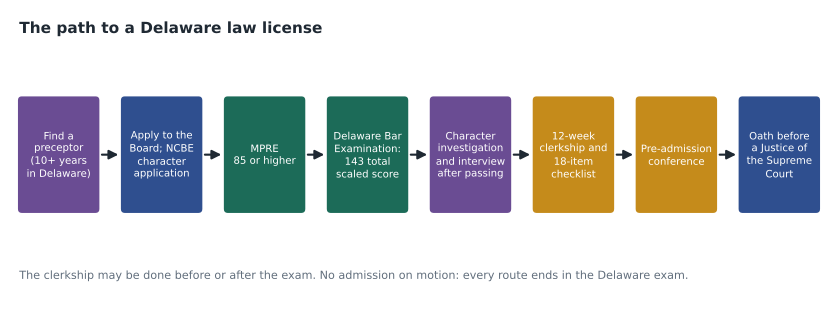
The requirements in one list
Rule 52(a) lists what every applicant must prove to the Board, and the burden is high: the applicant must show each qualification by clear and convincing evidence. In summary, an applicant must:
Be at least 21 years old and of good moral character and reputation, with the qualities needed to practice law.
Have a preceptor, a member of the Delaware Bar admitted for at least ten years, who vouches for the applicant.
Have completed the pre-legal education needed for law school admission and graduated with a JD or equivalent from a law school on the American Bar Association (ABA) approved list at the time of the degree, unless the Board grants a waiver.
Pass the Multistate Professional Responsibility Examination (MPRE) with the score the Board sets, which is 85.
Pass the Delaware Bar Examination.
Complete about 12 weeks of substantially full-time clerkship service in Delaware under a Delaware lawyer, and complete the Board's checklist of legal tasks.
Attend the pre-admission program, pay the required fee and then take the oath.
Marchetti points out that two items on the list, the preceptor and the clerkship, are unusual. Most states ask only for education, a character review, the MPRE and an exam. Delaware wants every new lawyer to have spent real time inside a Delaware legal workplace and to have a senior Delaware lawyer willing to stand behind them.
The exam in brief
The Delaware Bar Examination is given twice a year, on the last Tuesday and Wednesday of February and July. Tuesday is the written day: four Delaware essay questions in the morning and two Multistate Performance Test (MPT) tasks in the afternoon. Wednesday is the Multistate Bar Examination (MBE), NCBE's 200-question multiple-choice test. The written scores are scaled to the MBE and combined with it into a total score on a 200-point scale, and a total of 143 passes. Lesson 4 explains the format and scoring in detail.
| Feature | Delaware (February 2027 exam) |
|---|---|
| Exam | Delaware Bar Examination: four Delaware essays and two MPTs (Tuesday), MBE (Wednesday) |
| Passing score | 143 on the 200-point scale (lowered from 145 in 2023) |
| MPRE | Scaled score of 85 |
| Dates | February 23 and 24, 2027 |
| Filing | Early deadline in early November, final deadline in early December; check the Board for exact dates and fees |
| Score transfer | None: Delaware accepts no transferred MBE or UBE scores |
| Admission on motion | Not available; every applicant sits the exam |
| Next change | NextGen bar exam from February 2028, with a half-day Delaware essay component |
What makes Delaware different
Candidates who prepared elsewhere usually notice six differences, and each gets its own lesson.
Delaware writes its own essays. The exam uses the national MBE and MPT but not the Multistate Essay Examination. The four essays are written by the Board and test Delaware law, including subjects the MBE barely touches, such as business entities, equity, and wills and trusts.
Delaware has never adopted the UBE. Because the essays are Delaware's own, Delaware does not produce a portable UBE score, and it accepts none from elsewhere. A lawyer licensed for twenty years in Pennsylvania who wants to practice in Delaware sits the same exam as a new graduate.
Delaware requires a clerkship and a checklist. The clerkship, once 21 weeks long, became 12 weeks in 2023. The checklist asks the applicant to observe or take part in practical tasks, such as court proceedings and real estate settlements, chosen from a list the Board publishes.
Delaware requires a preceptor. The preceptor is a sponsor and mentor, a Delaware lawyer of at least ten years' standing who certifies the applicant's character and progress. Applicants who do not know a Delaware lawyer can be matched through a preceptor bank.
Delaware's courts and statutes dominate American business law. More than half of US public companies are incorporated in Delaware, and the Court of Chancery decides the leading cases on corporate fiduciary duties. That body of law shows up on the essays and in early practice, and it changed significantly in 2025 and 2026, as Lessons 8 and 9 explain.
Delaware is changing its exam. The Supreme Court approved the NextGen bar exam on April 7, 2025. The first Delaware NextGen exam will be in February 2028, with a half-day Delaware essay component of four essays.
Tamsin's starting point
Marchetti asks Tamsin three questions at the end of the first call. Has she taken the MPRE? Yes, in March 2026, with a score comfortably above 85. Has she filed her application? Not yet, and the early deadline for February 2027 has already passed, so she will pay the higher final-deadline fee. Has her clerkship started? Partly. Her summer at the firm may count, because a clerkship may start any time after law school matriculation, but she needs her preceptor to confirm how many qualifying weeks she has and which checklist items she has already completed.
'Good news and bad news,' Marchetti says. 'The good news is that you already know Wilmington, you have a firm that will sign off on your clerkship, and you've passed the MPRE. The bad news is that you're behind on paperwork, and Delaware cares about paperwork. Let's fix that this week and then spend the winter on the essays.'
Worked problem
Building Tamsin's admission timeline
Tamsin wants to be admitted as soon as possible after the February 23-24, 2027 exam. Using the requirements in this lesson, put her remaining steps in order.
Show solution
- Confirm her preceptor, a partner at her firm admitted in Delaware for more than ten years, and file the application with the Board before the final deadline in early December 2026.
- Complete the NCBE character and fitness application that the Board uses, with full disclosure.
- Count qualifying clerkship weeks and plan the rest, along with the remaining checklist items, around her work schedule.
- Sit the exam in February 2027; results come several weeks later.
- If she passes: character investigation and interview with an assigned Board member, completion of the clerkship and checklist, the mandatory pre-admission conference and a June admission ceremony.
Answer: The exam is one step among many. Delaware applicants who pass can still be delayed by an unfinished clerkship, an incomplete checklist or a missed form, and every requirement must be met by December 31 of the year after the exam.
Why Delaware keeps its own system
Tamsin asks the obvious question: why does a state of about a million people run an admission system so different from its neighbors? Marchetti gives three reasons that come up repeatedly in the Board's and the court's own explanations.
First, the Delaware Bar is small and close-knit, and its courts expect lawyers to know local practice from the first day. The clerkship and checklist were designed so that a new lawyer has already sat through a Family Court hearing, watched a real estate settlement and seen how a Court of Chancery matter is filed before handling one alone.
Second, Delaware law is a national product. Corporations, alternative entities and trusts from around the country choose Delaware law, and the lawyers who practice it carry the state's reputation. The court has long treated admission as a quality control point for that reputation.
Third, the system is not frozen. In 2023 the Supreme Court approved the most significant reforms in decades: a second exam each year, half as many essays, a shorter clerkship, a more flexible checklist, lower late fees and a slightly lower passing score. In 2025 it approved NextGen. The Chief Justice described the 2023 package as a modernization rather than a lowering of standards, and the same theme runs through the NextGen decision: keep what is distinctive about Delaware, drop what is merely burdensome.
'So the short version,' Tamsin says, 'is that Delaware wants me to learn Delaware before it lets me in.' Marchetti agrees, then adds a practical point. Because the exam has no portable score, a Delaware candidate who might later want to practice in another state should look at that state's rules separately. Passing in Delaware does not create a UBE score anyone else can accept.
How this course is organized
The twelve lessons follow the order in which a Delaware candidate meets each issue. Lesson 2 covers eligibility, education, the preceptor, applications, deadlines and fees. Lesson 3 covers character and fitness, the MPRE, the clerkship and the checklist. Lesson 4 explains the exam's format and scoring. Lesson 5 tells the story of the 2023 reforms and the coming move to NextGen. Lesson 6 maps the Delaware essay subjects and shows how Delaware law appears. Lessons 7 through 10 teach the Delaware law that matters most on the essays and in early practice: the courts and civil procedure, corporate and alternative entity law, equity and fiduciary litigation in the Court of Chancery, and Delaware trusts, wills and estates. Lesson 11 covers the absence of admission on motion, the pre-admission conference and life after admission. Lesson 12 is a capstone with original practice essays and an exam-week plan.
Each lesson ends with a short quiz, and the course ends with a final exam. The quizzes test the facts and rules in the lessons, not general bar review, which the core courses in this program cover. If you are taking the Delaware exam, pair this course with MBE Review I and II for the multiple-choice day and with the essay and performance test courses for method.
Common mistakes
MistakeAssuming a UBE score from another state can be transferred to Delaware.
InsteadDelaware has never given the UBE and accepts no transferred UBE or MBE scores.
MistakeThinking an experienced lawyer from another state can be admitted on motion.
InsteadDelaware has no admission on motion; every applicant must pass the Delaware Bar Examination.
MistakeLeaving the clerkship and checklist until after the exam.
InsteadThey take planning; clerkship time can begin after law school matriculation and must be finished before admission.
MistakeTreating the preceptor as a formality.
InsteadThe preceptor must be a Delaware lawyer of at least ten years' standing who vouches for the applicant and files certificates with the Board.
Where to find the official word
Marchetti ends the first call with a short reading list. The Board of Bar Examiners' pages on the Delaware Courts website hold the current rules, forms, deadlines, FAQs and prior exam questions. Supreme Court Rule 52 and the related admission rules are published with the court's rules. NCBE's jurisdiction page for Delaware summarizes fees, deadlines and score policies. When two sources disagree, the Board's current instructions for your exam control, and an email to the Board is better than a guess.
Summary and key terms
- The Supreme Court of Delaware admits lawyers under Supreme Court Rule 52; the Board of Bar Examiners runs the process under its Board Rules.
- Applicants must prove each qualification by clear and convincing evidence: character, a preceptor, education, the MPRE (85), the exam, a 12-week clerkship and checklist, and the pre-admission program.
- The exam has a written day (four Delaware essays and two MPTs) and an MBE day, with a passing total of 143 on a 200-point scale.
- Delaware has no admission on motion and accepts no transferred scores.
- NextGen begins in Delaware in February 2028, with a half-day Delaware essay component.
- Board of Bar Examiners
- The body appointed by the Delaware Supreme Court to examine applicants, investigate character and certify those qualified for admission.
- Preceptor
- A Delaware lawyer admitted for at least ten years who sponsors and vouches for a bar applicant.
- Clerkship
- About 12 weeks of substantially full-time legal work in Delaware under a Delaware lawyer, required before admission.
- Clerkship checklist
- The Board's list of practical legal tasks an applicant must observe or complete, certified by the applicant and preceptor.
- Rule 52
- The Delaware Supreme Court rule that sets the qualifications for admission to the Bar.
Practice problems
Work each problem on paper first, then reveal the answer to check.
Who administers the oath of admission in Delaware?
Show answer
Only a Justice of the Supreme Court of Delaware.
What standard of proof does an applicant face under Rule 52?
Show answer
Clear and convincing evidence for each qualification.
Why can't a Pennsylvania lawyer with twenty years of practice be admitted in Delaware without an exam?
Show answer
Delaware has no admission on motion and accepts no transferred scores; every applicant sits the Delaware Bar Examination.
Lesson quiz · 5 questions
Score 60% or more to complete this lesson.
Create a free account to save your progress, take quizzes and earn a certificate.