
BAR-208 · Lesson 5 of 12 · 18 min
From the 2023 reforms to NextGen in February 2028
▶ Video coming soon A video version of this lesson is on the way.
Tamsin's mother, who works for the state, mentioned at dinner that a lawyer friend of hers had taken the Delaware bar exam in the 1990s and described it as 'eight essays, a summer of clerking and a year's wait if you failed.' Tamsin brings that up on the next call. Marchetti says the description was accurate for a long time, and that understanding how much changed, and how recently, is useful for two reasons. It explains why older advice is often wrong, and it explains where the exam is going next.
The exam before 2023
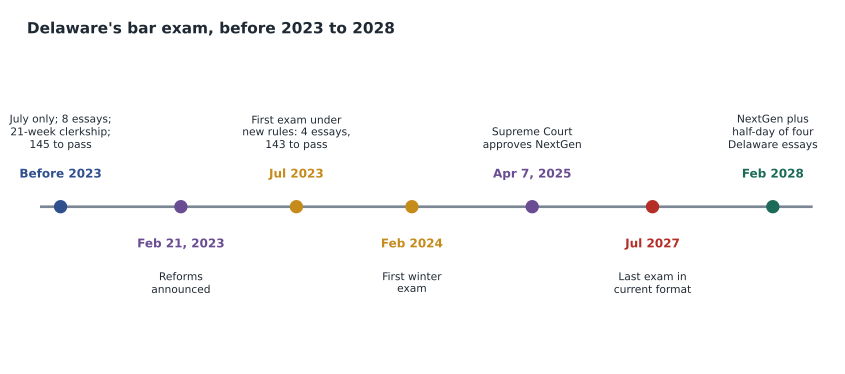
For decades the Delaware Bar Examination was given once a year, in July. The written portion had eight Delaware essays drawn from 14 areas of law, alongside the MPT and the MBE. The passing score was 145. Applicants had to complete a clerkship of 21 weeks and a mandatory checklist of 25 items. Late filing fees were steep: 1,400 dollars for law graduates and 1,600 dollars for lawyers admitted elsewhere.
The once-a-year schedule had a real cost. A candidate who failed in July waited a full year for another attempt, often while working in a Delaware office in a non-lawyer role. Combined with the long clerkship, the system was more demanding than any neighboring state's.
The 2023 reforms
On February 21, 2023, the Supreme Court and the Board announced a package of changes, effective for the July 2023 exam, with the first February exam in 2024. The announcement described them as the product of a two-year comprehensive review by the Board, informed by judges, practicing lawyers and testing and psychometric experts, and by the recommendations of a steering committee's strategic plan on diversity in the bench and bar.
| Item | Before 2023 | After the reforms |
|---|---|---|
| Passing score | 145 | 143 |
| Exams per year | One (July) | Two (February added from 2024) |
| Delaware essays | Eight | Four |
| Essay subject areas | 14 | 10 |
| Clerkship | 21 weeks | 12 weeks |
| Checklist | 25 mandatory items | 18 items chosen from about 30 |
| Late fee, law graduate | 1,400 dollars | 900 dollars |
| Late fee, lawyer admitted elsewhere | 1,600 dollars | 1,000 dollars |
| Character application | Delaware form | Compiled with NCBE |
The reasons. The court gave several. Delaware wanted to modernize its process to look more like other states', to remain competitive in attracting legal talent, and to reduce barriers that did not measure readiness to practice. The Chief Justice described the package as a modernization of the process rather than a lowering of standards. The added February exam addressed the frustration of waiting a year to retake. The shorter clerkship and flexible checklist kept the practical training while making it easier to fit around a job.
The debate. The changes drew attention beyond Delaware, partly because the announcement connected them to the court's diversity goals and partly because of the lower passing score. Critics described the score change as lowering the bar; the court and the Board pointed to the psychometric review and to the fact that 143 remained within the range used by other jurisdictions. For a candidate, the debate matters less than the result: the current rules are the 2023 rules, and advice written before them is usually out of date.
The decision to adopt NextGen
On April 7, 2025, the Supreme Court approved the Board's recommendation to adopt the NextGen bar exam developed by NCBE, beginning with the February 2028 administration. The exam will still be given in February and July.
NextGen replaces the MBE and the MPT, which NCBE plans to stop offering after July 2028. It is a one-and-a-half-day exam that combines multiple-choice questions, short written answers in integrated question sets and performance tasks. It tests foundational legal concepts in eight subjects, including contract law, constitutional law, civil procedure, criminal law, evidence, real property, torts and business associations, and foundational lawyering skills such as legal research, legal writing, client counseling and advising, and negotiation and dispute resolution. The core course on NextGen in this program explains the format and scoring in detail.
The Delaware component. Delaware will keep a Delaware-specific part of the exam. The court's announcement describes a half-day essay portion of four Delaware essays, and NCBE's announcement places that component on the afternoon of the second day. So a Delaware NextGen candidate will sit NCBE's one and a half days plus Delaware's half day of essays.
What is not yet known. As of November 2026, NCBE's summary of Delaware's rules lists the NextGen passing score as to be announced, and also lists as to be announced whether Delaware will accept NextGen scores transferred from other jurisdictions. Because the Delaware essays remain part of the exam, a transferred score alone would not satisfy the requirement in the way it might elsewhere. Watch the Board's announcements for both answers.
| Feature | Current exam (through July 2027) | NextGen exam (from February 2028) |
|---|---|---|
| National part | MBE and two MPTs | NextGen: multiple-choice, integrated sets and performance tasks |
| Delaware part | Four essays, Tuesday morning | Four essays, a half day (afternoon of day two) |
| Length | Two full days | About two days in total |
| Scale and passing score | 200-point scale; 143 passes | NextGen scale; Delaware passing score to be announced |
| Score transfer | None accepted | To be announced |
Planning around the change
For most candidates reading this course the transition is a planning question. The current format applies through the July 2027 exam. February 2028 is Delaware's first NextGen exam.
Marchetti walks Tamsin through the scenarios. If Tamsin passes in February 2027, the change does not affect her. If she does not, she can retake in July 2027 under the same format she prepared for. If she needed a third attempt, it would be on NextGen in February 2028, with a different national portion but the same kind of Delaware essays.
Law students should look at their graduation date. A student graduating in May 2027 can sit the July 2027 exam, the last in the current format. A student graduating in December 2027 or later will take NextGen. Bar-prep courses for NextGen are newer and changing quickly, so a candidate in the first NextGen group should lean on NCBE's own study aids and the Board's posted instructions.
Worked problem
Choosing an exam date near the transition
Marchetti gives Tamsin a hypothetical. Desmond graduates in May 2027 and has a Delaware clerkship lined up for June through August. He is weighing the July 2027 exam against waiting for February 2028. What should he consider?
Show solution
- July 2027 is the last exam in the familiar format, with abundant prep materials and past MBE-style questions.
- If he fails in July 2027, his retake in February 2028 would be on NextGen, a different national exam.
- His clerkship can run alongside bar study because the weeks need not be continuous and can extend past the exam.
- Waiting for February 2028 means preparing for NextGen with fewer commercial materials and an announced passing score that may arrive late.
Answer: For most May 2027 graduates, July 2027 makes sense, but a candidate who expects to need more time should plan for the possibility that a retake will be on the new exam.
What stays the same
Through all of these changes, several features of Delaware admission have not moved. Every applicant still sits an exam with Delaware essays. There is still no admission on motion. The preceptor, clerkship, checklist and pre-admission conference remain. The court still admits and the Board still examines. A candidate who understands those constants can adapt to any change in the national portion.
Common mistakes
MistakeRelying on advice that describes eight essays and a 21-week clerkship.
InsteadThose rules ended in 2023; the exam now has four essays and the clerkship is 12 weeks.
MistakeAssuming NextGen means Delaware is joining the UBE.
InsteadDelaware keeps a half-day of Delaware essays; whether it will accept transferred NextGen scores was still to be announced in November 2026.
MistakeThinking a July 2027 failure leads to a July-format retake.
InsteadFebruary 2028 is Delaware's first NextGen exam, so a retake after July 2027 is on NextGen.
MistakeTreating the NextGen passing score as known.
InsteadAs of November 2026 Delaware's NextGen passing score was listed as to be announced.
What NextGen means for the Delaware essays
Tamsin asks whether the Delaware essays will change when NextGen arrives. The court's announcement describes the Delaware component as four Delaware essays given in half a day, the same number as today. What the announcements do not say, as of November 2026, is whether the list of Delaware essay subjects in Board Rule 12 will change, how the Delaware essays will be weighted against the NextGen score, or how the Board will combine them into a pass or fail decision. Those details matter for candidates in 2028 and later, and the Board will publish them before the first NextGen administration.
Marchetti points out one likely effect. Today the MBE and MPT make up most of the score, and the Delaware essays are a quarter of it under the commonly described weighting. NextGen's integrated question sets and performance tasks test skills that overlap with the MPT, and its subjects include business associations, which the MBE does not test. A Delaware candidate in 2028 will therefore see business entity law on both the national and the Delaware portions of the exam.
How to follow the transition
Delaware candidates should watch three sources. The Board's website posts rules, instructions and announcements. NCBE's NextGen pages post the content scope, sample questions and study aids, and its jurisdiction pages track each state's decisions, including passing scores and transfer policies. The Delaware Supreme Court's press releases announce rule changes, such as the April 7, 2025 decision.
Candidates should also expect transitional rules. When NCBE stops offering the MBE and MPT after July 2028, every NextGen jurisdiction will have to decide how to treat candidates who took the old exam and want to retake, and how to treat old MBE scores. Delaware's general policy of not accepting transferred scores suggests it will rely on its own exam, but the details will come from the Board.
A short history worth remembering
Marchetti likes to give candidates a little history because it explains the culture of the Delaware Bar. Delaware's long clerkship, its preceptor system and its single annual exam grew out of a tradition in which new lawyers learned by working alongside senior Delaware lawyers before practicing alone. The 2023 reforms shortened and modernized that apprenticeship, and NextGen modernizes the national part of the exam, but the apprenticeship idea survives in the preceptor, the clerkship, the checklist and the Fundamentals courses that new lawyers take after admission. A candidate who understands that tradition will find the requirements less mysterious.
Advice for candidates who failed under the old format
Some readers of this course took the Delaware exam before 2023 and are returning to it. For them, the reforms are mostly good news: there are two exams a year, four essays instead of eight and a lower passing score. But they should rebuild their outlines from the current Board Rule 12, which lists ten areas instead of 14, and from current law, because corporate law in particular changed significantly in 2024 and 2025. Earlier clerkship time may still count toward the 12 weeks, but only the Board can say so, and they should ask before assuming.
Planning a first attempt around the transition
For candidates graduating in 2026 and 2027, the choice of exam date may decide which format they face on a retake. Tamsin's February 2027 sitting is under the current format, and so is July 2027. If she needed a retake after July 2027, the next sittings would be February 2028, which is NextGen, or later. Marchetti points out that this is a reason to prepare thoroughly for the first attempt rather than treating it as a trial run. A candidate who must move from the current format to NextGen will need new practice materials for the integrated question sets and performance tasks, though the Delaware essays will continue in a shorter form.
Candidates who expect to sit in 2028 or later should watch NCBE's NextGen site for the content scope and sample questions and the Board's site for the Delaware component's subjects and any new passing score. Until the Board announces those details, study plans should assume that Delaware law will still be tested in written essays and that the core subjects of Board Rule 12 remain the likely base.
Summary and key terms
- Before 2023 Delaware gave one July exam with eight essays from 14 areas, a 145 passing score, a 21-week clerkship and a 25-item checklist.
- The February 21, 2023 reforms added a February exam (from 2024), cut the essays to four and the subjects to ten, lowered the passing score to 143, shortened the clerkship to 12 weeks and made the checklist 18 of about 30 items.
- On April 7, 2025 the Supreme Court approved NextGen from February 2028, with a half-day Delaware component of four essays.
- July 2027 is the last exam in the current format.
- The NextGen passing score and score-transfer policy were still to be announced in November 2026.
- NextGen
- NCBE's new bar exam, replacing the MBE and MPT, first given in Delaware in February 2028.
- Delaware component
- The half-day of four Delaware essays that Delaware will keep alongside NextGen.
- 2023 reforms
- The package of changes announced February 21, 2023 that reshaped the Delaware exam and clerkship.
Practice problems
Work each problem on paper first, then reveal the answer to check.
Name three changes made by the 2023 reforms.
Show answer
Any three of: a February exam from 2024; four essays instead of eight; ten subject areas instead of 14; passing score 143 instead of 145; 12-week clerkship instead of 21; 18 of about 30 checklist items; lower late fees; an NCBE-compiled character application.
What is the Delaware component of the NextGen exam?
Show answer
A half day of four Delaware essays, placed on the afternoon of the second day.
Which is the last exam in Delaware's current format?
Show answer
July 2027.
Lesson quiz · 5 questions
Score 60% or more to complete this lesson.
Create a free account to save your progress, take quizzes and earn a certificate.