
BAR-208 · Lesson 12 of 12 · 16 min
Capstone: Delaware practice essays and an exam-day plan
▶ Video coming soon A video version of this lesson is on the way.
On Sunday, November 22, 2026, Tamsin sat at her kitchen table with a timer and two essays Marchetti had written for her, set exactly like the Tuesday morning session: 45 minutes each, typed, no notes. She emailed her answers that evening. This lesson gives both essays, a model answer and grading notes for each, a short third prompt to outline, and the exam-week plan Marchetti and Tamsin built for February 23 and 24, 2027.
Both essays are original and written for this course. They are not Board questions, and the facts are fictional. Try each one under time before reading the model answer.
Essay 1: business entities and equity (45 minutes)
Christiana Freight Inc. is a Delaware corporation whose stock trades on a national exchange. Rowan Hale owns 35 percent of its voting stock and is its chief executive officer. The board has seven directors: Hale, two other company officers who report to Hale, and four outside directors whom the board has determined are independent under the exchange's listing standards.
In June 2026, Hale proposed that Christiana buy a fleet of trucks from Hale Logistics LLC, a company Hale owns entirely, for 40 million dollars. The board formed a special committee of two outside directors, Imani Brooks and Theo Grant. The committee hired its own financial adviser, negotiated the price down to 36 million dollars and approved the purchase. The full board then approved it, with Hale abstaining. The proxy statement for the 2026 annual meeting described the transaction in detail, but no stockholder vote on it was sought.
Last month, a stockholder, Alma Ruiz, learned that Theo Grant's daughter is a senior employee of Hale Logistics, a fact the committee's minutes and the proxy statement do not mention. Ruiz wants to sue. She has not made a demand on the board.
Questions: (1) Is Hale a controlling stockholder of Christiana, and why does it matter? (2) Does the transaction qualify for the safe harbor in section 144 of the Delaware General Corporation Law? (3) If Ruiz sues derivatively in the Court of Chancery, what must she plead about demand, and what standard of review is likely to apply?
Model answer to Essay 1
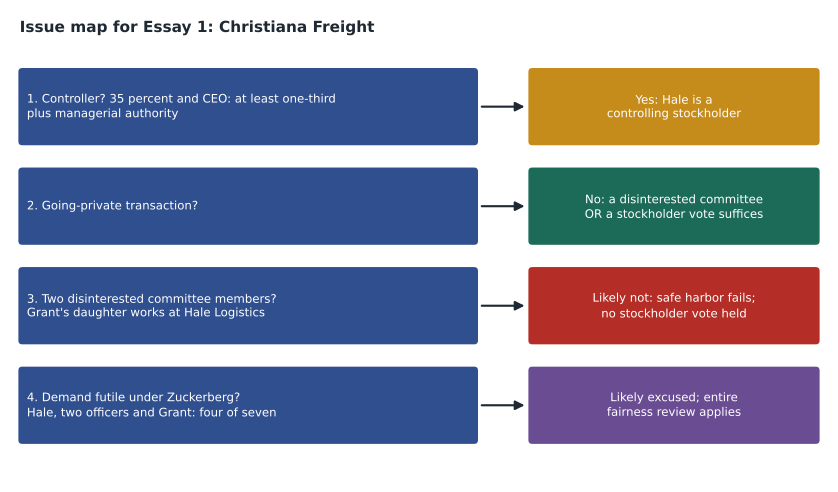
1. Controlling stockholder. Under section 144 as amended in March 2025, a controlling stockholder includes a person who holds at least one-third of the voting power in director elections and exercises managerial authority over the corporation's business. Hale holds 35 percent and is the chief executive officer, so he is a controlling stockholder. That matters because a transaction in which a controller receives a benefit not shared with other stockholders is reviewed for entire fairness unless a statutory safe harbor applies, and because the controller can be liable for breaches of the duty of loyalty.
2. The safe harbor. The truck purchase is a controller transaction but not a going-private transaction. Under amended section 144, it is protected from equitable relief and damages if it was approved by a committee of at least two directors the board determined to be disinterested, with the material facts disclosed to them, or by a majority of votes cast by disinterested stockholders. Here a two-director committee approved the deal, and no stockholder vote was held, so everything depends on the committee.
Brooks and Grant are presumed disinterested because the board found them independent under the exchange's standards. The presumption can be rebutted only with substantial and particularized facts showing a material interest in the transaction or a material relationship with someone who has one. Grant's daughter's senior position at Hale Logistics, the counterparty, is a specific fact suggesting a material relationship with the controller's company. If it is material, Grant is not disinterested, the committee had only one disinterested member, and the statutory requirement of at least two disinterested directors fails. The undisclosed relationship also raises a disclosure problem.
If the safe harbor fails, the transaction is reviewed for entire fairness: the defendants must show fair dealing and fair price. The negotiated price reduction and independent adviser help on price, but the undisclosed conflict undermines fair dealing.
3. Demand and the standard of review. A derivative plaintiff must comply with Court of Chancery Rule 23.1 by making a demand or pleading with particularity why demand is futile. Under United Food and Commercial Workers Union v. Zuckerberg (2021), the court asks, director by director, whether each director received a material personal benefit, faces a substantial likelihood of liability, or lacks independence from someone who did. Hale received the benefit. The two officers who report to Hale likely lack independence from him. Grant likely lacks independence because of his daughter's role. That is four of seven directors, more than half, so demand is likely excused. Because the safe harbor likely fails, entire fairness is the likely standard, and Delaware's reasonable conceivability pleading standard helps Ruiz survive a motion to dismiss.
Grading notes. A strong answer identifies the one-third-plus-managerial-authority test, distinguishes going-private from other controller transactions, counts disinterested committee members, uses the exchange-independence presumption and its rebuttal standard, and applies the Zuckerberg test director by director. Answers that apply the old MFW dual-approval requirement to this non-going-private transaction lose points.
Essay 2: wills, trusts and procedure (45 minutes)
Marguerite Okafor, a widow living in Lewes, Delaware, died in August 2026. Her typed will, signed in 2019, was witnessed by her two neighbors and leaves her house to her son, Felix, and everything else to her daughter, June. In 2021 Marguerite transferred her brokerage account to the Okafor Family Trust, an irrevocable trust with a Delaware trust company as trustee, governed by Delaware law, with a spendthrift clause. Marguerite was the discretionary beneficiary during her life, and the trust names an investment adviser, her longtime broker in Pennsylvania, whose investment directions the trustee must follow. The broker directed the trustee to hold a concentrated position in one stock, which fell sharply in 2024.
Felix claims his mother was pressured into the 2019 will by June. Separately, a contractor who obtained a judgment against Marguerite in 2025 for unpaid work done in 2023 wants to collect from the trust, and June wants to know whether the trustee is liable for the 2024 losses.
Questions: (1) Where and how can Felix challenge the will, and what must he show? (2) Can the contractor reach the trust assets? (3) Is the trustee liable for the investment losses?
Model answer to Essay 2
1. Challenging the will. The will appears validly executed: it is in writing, signed by Marguerite and attested by two witnesses, satisfying 12 Del. C. section 202. Probate begins with the Register of Wills in Sussex County, and a challenge, called a caveat, is heard by the Court of Chancery. Felix must prove undue influence: broadly, that June exerted influence that overcame Marguerite's free will and produced a will that reflects June's wishes rather than Marguerite's. Delaware courts look at factors such as a susceptible testator, opportunity, a disposition to exert influence and a result showing its effect, and they may shift the burden where a confidential relationship and active participation in preparing the will exist. On these facts Felix has an allegation, not proof; he will need evidence of June's role in the will's preparation and Marguerite's condition in 2019.
2. The contractor. The 2021 transfer to an irrevocable, Delaware-law trust with a Delaware trust company as trustee and a spendthrift clause appears to be a qualified disposition under 12 Del. C. section 3570, even though Marguerite was a beneficiary. The contractor's claim arose from work done in 2023, after the 2021 transfer, so he is a later creditor. Under section 3572 he must have sued within four years after the transfer and must prove by clear and convincing evidence that the transfer was made with actual intent to defraud him, in the Court of Chancery. Nothing suggests Marguerite intended in 2021 to defraud a contractor she hired two years later, and the four-year period ran in 2025. The section 3573 exceptions do not apply: the claim is neither a family support claim nor a tort claim for harm before the transfer. The contractor likely cannot reach the trust.
3. The trustee. The trust is a directed trust. Under 12 Del. C. section 3313, an adviser with the power to direct investments is a fiduciary, and a trustee that follows the adviser's direction is generally liable only for its own wilful misconduct. Following the broker's direction to hold the stock, without more, is not wilful misconduct. June's claim, if any, is against the investment adviser as a fiduciary, not the trustee.
Grading notes. A strong answer cites section 202, sends the caveat to Chancery, states the undue influence elements, identifies the qualified disposition and the later-creditor rule with its four-year period, actual intent and clear and convincing burden, rules out the section 3573 exceptions and applies the directed trust standard. Answers that apply general spendthrift law without the Act, or that hold the trustee to a prudent investor standard despite section 3313, lose points.
A third prompt to outline (15 minutes)
Outline only. Hypothetical: A homeowner in Dover sues her neighbor in the Court of Chancery for an injunction ordering removal of a fence built two feet onto her land, plus damages for a damaged garden. The neighbor moves to dismiss, arguing that the case belongs in Superior Court and that the claim is untimely because the fence went up five years ago. List the issues: equity jurisdiction for an injunction to remove an encroachment; the clean-up doctrine for the garden damages; laches guided by the analogous limitations period, and whether the homeowner's delay was unreasonable and prejudicial; transfer under 10 Del. C. section 1902 if Chancery lacked jurisdiction; and the reasonable conceivability standard on the motion to dismiss.
The exam-week plan
Marchetti and Tamsin turn the last part of the call into a plan, written down so Tamsin does not have to think about logistics in February.
| When | What |
|---|---|
| January 2027 | Two timed Delaware essays a week from posted Board questions; one MPT every week; MBE sets on Saturdays |
| Early February | Laptop software registration and any mock exam by the Board's deadline; confirm test site and admission ticket |
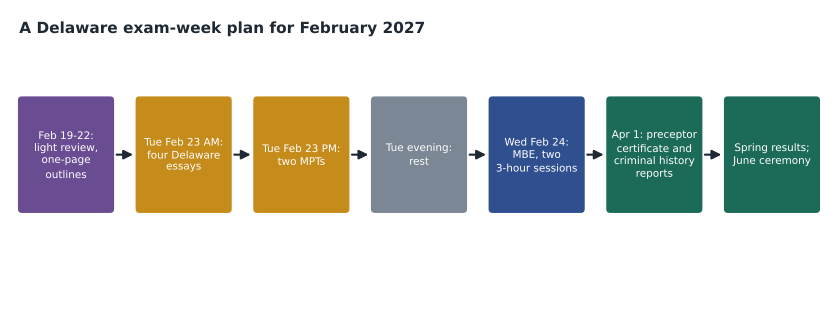
| Feb. 19-22 | Light review only: one-page outlines for business entities, equity, wills and trusts, and civil procedure; no new material |
| Tue. Feb. 23, morning | Four Delaware essays: read each call first, eight-minute outline, 45 minutes each, headed answers |
| Tue. Feb. 23, afternoon | Two MPTs: read the task memo first, half the time reading and organizing |
| Tue. evening | Rest; a short list of MBE traps only |
| Wed. Feb. 24 | MBE: 100 questions each session, about 1.8 minutes per question, flag and move on |
| After the exam | Preceptor certificate and criminal history reports by April 1; finish clerkship and checklist; watch for results |
How Tamsin did. Marchetti graded both essays the next morning. Tamsin found the controller test and the committee problem in Essay 1 but forgot to discuss demand futility director by director, and she nailed the qualified disposition analysis in Essay 2 but spent too long on undue influence. 'You'd pass with these,' Marchetti wrote. 'Now make them faster.'
Common mistakes
MistakeApplying MFW to a non-going-private controller transaction after 2025.
InsteadUse amended section 144: a disinterested committee of at least two or a disinterested stockholder vote.
MistakeCounting a committee member as disinterested despite a close family tie to the counterparty.
InsteadSpecific facts like a child's senior role at the counterparty can rebut the presumption of disinterest.
MistakeHolding a directed trustee to a prudent investor standard.
InsteadUnder 12 Del. C. section 3313 a trustee following an adviser's direction is generally liable only for wilful misconduct.
MistakeLeaving post-exam paperwork until results arrive.
InsteadPreceptor certificates and criminal history reports are due April 1 after a February exam.
Self-grading checklist
Before comparing your answers with the models, grade them against this list. Did you answer every numbered question? Did you state the Delaware rule, with the statute or case where you know it? Did you use the specific facts, such as the 35 percent stake, the two-person committee, the 2021 transfer date and the 2023 work date? Did you reach a conclusion on each issue? Did you finish within 45 minutes? Score one point for each yes, per issue, and compare across practice essays to see whether you are improving.
Tamsin's own scores on the November practice run were 8 of 10 on Essay 1, after missing the disclosure point, and 9 of 10 on Essay 2. Marchetti's last note to her is simple: keep the timing, keep the headings, and trust the work she has already done.
Summary and key terms
- Delaware essays reward a clear structure: identify the issues, state the Delaware rule, apply it to the facts and answer each part of the call.
- Business entities essays now turn on amended section 144: controller status, transaction type, disinterested committee or stockholder approval, and fallback to entire fairness.
- Wills and trusts essays draw on section 202, the Qualified Dispositions in Trust Act and the directed trust statute.
- Civil procedure and equity issues often combine Chancery jurisdiction, the clean-up doctrine, laches and section 1902 transfer.
- A written exam-week plan reduces stress and protects the post-exam deadlines.
- Issue map
- A short outline of the issues and conclusions in an essay, written before drafting.
- Undue influence
- Influence that overcomes a testator's free will and produces a will reflecting another person's wishes.
- Disinterested director
- A director with no material interest in a transaction and no material relationship with anyone who has one.
Practice problems
Work each problem on paper first, then reveal the answer to check.
In Essay 1, why does the safe harbor likely fail?
Show answer
Grant's daughter's senior role at the counterparty likely rebuts his disinterest, leaving fewer than two disinterested committee members, and no stockholder vote was held.
In Essay 2, why can't the contractor reach the trust?
Show answer
He is a later creditor who did not sue within four years of the transfer and cannot show actual intent to defraud him, and neither section 3573 exception applies.
What is due by April 1 after a February exam?
Show answer
The preceptor's first certificate and the criminal history reports.
Lesson quiz · 5 questions
Score 60% or more to complete this lesson.
Create a free account to save your progress, take quizzes and earn a certificate.