
BAR-208 · Lesson 3 of 12 · 18 min
Character and fitness, the MPRE and the clerkship
▶ Video coming soon A video version of this lesson is on the way.
Tamsin's third call starts with a confession. 'There's a thing I'm worried about,' she says. In college she was cited for underage possession of alcohol at a football game, paid a fine and heard nothing more. She did not mention it on her law school application because the form asked only about criminal convictions, and she was not sure whether the citation counted. Marchetti's answer is the same one she gives every candidate: the risk is almost never the old incident. The risk is not disclosing it.
The character and fitness standard
Rule 52(a) requires every applicant to show good moral character and reputation and the qualities needed to practice law, and to show it by clear and convincing evidence. The Board's character and fitness guidelines explain what that means in practice: honesty, financial responsibility, respect for the law and the rights of others, and the ability to meet obligations to clients, courts and opponents. The question is whether the applicant is fit to be trusted with other people's legal affairs today, not whether the applicant has a perfect past.
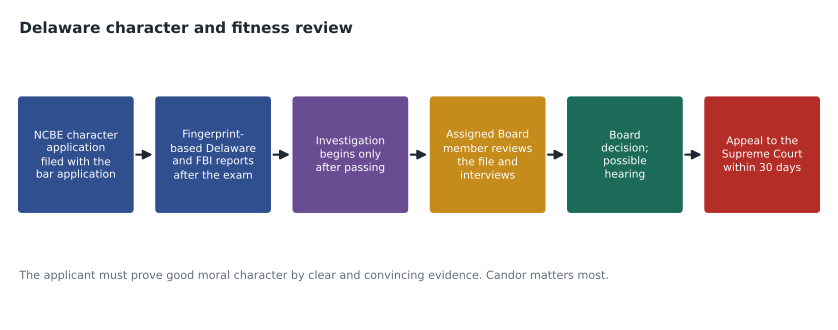
The application. Delaware applicants complete the NCBE Character and Fitness Application, which collects personal, academic, employment and financial history, criminal records, civil proceedings, military service, driving records and other information. The Board also requires fingerprint-based criminal history reports from Delaware and the FBI, obtained through the state's designated fingerprinting service and due on the same post-exam dates as the preceptor's first certificate.
The investigation. Delaware does something unusual: the full character investigation happens only for applicants who pass the exam, after results are posted. Each passing applicant is assigned to a member of the Board, who reviews the file and conducts a personal interview. The Board decides each case individually, and only after the investigation is complete.
What concerns the Board, and what helps
Boards across the country look at similar categories of conduct: dishonesty or misrepresentation, unlawful conduct, academic misconduct, neglect of financial obligations, mistreatment of others, and conduct that suggests the applicant cannot handle responsibility. They also consider the applicant's age at the time, how long ago it was, how serious it was, what the applicant has done since and whether the applicant has been candid.
Candor is the theme Marchetti returns to. An applicant who discloses an old citation, explains it plainly and shows how they have grown is in a strong position. An applicant who omits it and is found out by the background check has created a new and more serious problem, because the omission itself is evidence of a lack of candor at the very moment the applicant is being asked to be candid.
| Situation | Likely concern | What helps |
|---|---|---|
| Old minor citation, fully disclosed | Usually little | Honest explanation, no pattern, time passed |
| Past-due debts or collections | Financial responsibility | Payment plan, current accounts, explanation of circumstances |
| Academic discipline in law school | Honesty, integrity | Full disclosure, law school records, evidence of change |
| Omitted incident found by the Board | Candor, the most serious concern | Prevention: disclose everything the question asks |
| Treated mental health condition | Generally not, by itself | Boards focus on conduct, not diagnosis |
Tamsin's citation fits the first row, and she should disclose it exactly as the NCBE question asks, with dates and the outcome. She should also look back at her law school application: if a law school question did cover the citation and she answered no, she may need to amend that answer with the school. Marchetti tells her to read the law school question carefully before deciding; often the problem is smaller than the worry.
Appeals. If the Board denies certification, the applicant can seek review in the Supreme Court. Rule 52 requires an appeal within 30 days of the Board's action. The rule also says that grades on specific exam answers are not reviewable, which matters in Lesson 4.
The MPRE
Delaware requires a scaled score of 85 on the MPRE, the national professional responsibility exam that NCBE gives several times a year at Pearson VUE test centers. That is in the middle of the national range; most jurisdictions require between 75 and 86. The score must be reported to Delaware by NCBE, and Board Rule 8 sets the timing. Bar-prep summaries describe that window as a score earned within four years before the application or by December 31 of the year after the applicant passes the bar exam. Check the current rule if your score is old or not yet taken.
Because the MPRE is a separate test, many candidates take it during law school. Tamsin took it in March 2026 and scored well above 85. An applicant who has not yet taken it can still sit the bar exam, but cannot be admitted until a qualifying score arrives.
The clerkship
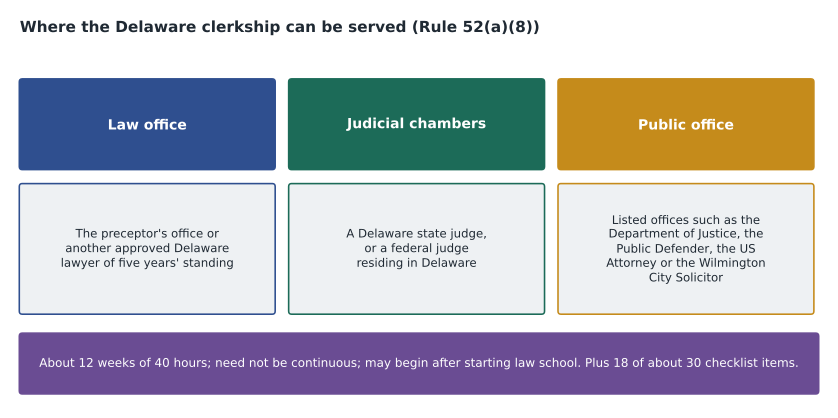
The clerkship is Delaware's most distinctive requirement. Rule 52(a)(8) requires about 12 weeks of substantially full-time service, where one week means a 40-hour work week. The weeks need not be continuous, but the clerkship cannot begin before the applicant matriculates at law school. Before 2023 it was 21 weeks; the court shortened it as part of the 2023 reforms.
Where it can be done. The rule allows three kinds of placement, all supervised by a member of the Delaware Bar:
In the preceptor's office, or with another Delaware lawyer of at least five years' standing whom the preceptor approves.
As a clerk to a Delaware state judge, or to a federal judge who resides in Delaware.
In listed public offices, such as the Delaware Department of Justice, the Public Defender, the United States Attorney for the District of Delaware or the Wilmington City Solicitor, or in a similar organization the Board approves, under a supervisor admitted at least five years.
Counting time. Because a week is defined as 40 hours, part-time work can be added up. Tamsin worked 10 weeks at her firm the summer after her second year, about 40 hours a week. If her preceptor approves that work as clerkship service, she already has roughly 10 of her 12 weeks and can finish the rest in the evenings and on days off before admission. A student who spends a summer at a Delaware public defender's office can similarly bank weeks long before the exam.
The checklist
Alongside the clerkship, the applicant must complete the Board's clerkship checklist, a list of practical legal activities. Since the 2023 reforms the applicant completes 18 items chosen from about 30 options, rather than a mandatory list of 25 items. The options cover the kinds of things a new Delaware lawyer should have seen: hearings and trials in different courts, a real estate settlement, filings in the Court of Chancery and Superior Court, matters in Family Court, research tasks and similar work. The applicant and the preceptor both certify the checklist.
The clerkship and checklist must both be finished before admission. They do not have to be finished before the exam, and many applicants complete the last items in the months after they pass.
Military service. Rule 52 has a specific exception for applicants called to active military duty after the exam who made a good-faith effort to finish the clerkship or the pre-admission program. The court may admit them conditionally, and admission becomes unconditional if the clerkship is completed within six months after release and the applicant attends the next pre-admission program.
Worked problem
Planning Tamsin's remaining clerkship and checklist
Tamsin has about 10 qualifying weeks from her summer at the firm and has completed 9 checklist items. She works full time at the firm until the exam. Plan the rest.
Show solution
- Ask Gregory Ashe, her preceptor, to confirm in writing that the summer counts and how many weeks it represents.
- Two more weeks: 80 hours of qualifying work, which her current full-time position should cover quickly once the preceptor approves it as clerkship time.
- Choose 9 more checklist items from the Board's options, favoring ones she can fit around work, such as observing a Family Court hearing and a Superior Court motion day.
- Track dates, hours and items in one spreadsheet so the certificates are easy to complete after the exam.
Answer: Because clerkship time can begin after matriculation and continue after the exam, a candidate who works in Delaware can often finish both requirements without taking extra time off.
Common mistakes
MistakeLeaving off an old citation because it seems trivial.
InsteadDisclose everything the NCBE question asks; an omission found later raises a far more serious candor issue.
MistakeAssuming the character investigation happens before the exam.
InsteadIn Delaware the full investigation and interview happen only for passing applicants.
MistakeCounting a part-time job by weeks rather than hours.
InsteadA clerkship week means 40 hours; part-time hours add up toward the 12 weeks.
MistakeStarting clerkship time before law school.
InsteadClerkship service cannot begin before matriculation at law school.
Preparing for the character interview
Because Delaware interviews every passing applicant, Marchetti spends time on what to expect. The interviewer is a member of the Board, usually a practicing lawyer, who has read the applicant's file. The interview is a conversation, not a cross-examination, but it is also a real assessment. The interviewer may ask about anything in the file, including items the applicant disclosed, gaps in employment, financial history and the applicant's plans for practice.
Marchetti's advice is practical. Reread your entire NCBE application before the interview so that you remember what you said. Bring documents for anything that needed explanation, such as proof that a debt was paid or a court record showing a case was dismissed. Answer questions directly and without minimizing; if something was your fault, say so and explain what you learned. Do not volunteer speculation or argue with the interviewer. If you realize during preparation that you left something out of the application, tell the Board in writing before the interview rather than waiting to be asked.
Tamsin's citation will probably take two minutes of the interview. She will describe what happened, note that she paid the fine, and point to the years since without incident. That is exactly how minor issues are meant to be handled.
Building the clerkship into a work schedule
Most Delaware applicants complete the clerkship while working, and the rule's design helps. Because a week is defined as 40 hours and the weeks need not be continuous, an applicant can combine a summer internship, part-time work during the school year, a post-graduation job and a few weeks after the exam. What matters is that each block of time is in an approved setting, under an approved supervisor, and documented.
Applicants who work outside Delaware face a harder problem. A New York associate who plans to join a Wilmington firm later must arrange qualifying weeks in Delaware, usually by negotiating time with the future employer or a Delaware public office. Marchetti recommends that such applicants start the conversation with their future firm early, because the firm's partners will also need to approve the work for clerkship credit.
Judicial clerks have a natural route. A law graduate who clerks for a Delaware state judge, or for a federal judge who resides in Delaware, satisfies the clerkship through that work, and the chambers often provide a wide range of checklist experiences as well.
Choosing checklist items
With 18 items to choose from about 30, applicants should pick items that teach something useful as well as items that fit their schedules. Marchetti suggests a balance: some court observations in different courts, some transactional items such as a real estate settlement, and some items in practice areas the applicant may never otherwise see, such as Family Court or criminal matters. Each item should be recorded with the date, the matter (described without confidential details) and the supervising lawyer, so that the preceptor can certify it confidently.
Disclosure: when in doubt, disclose
Marchetti repeats the rule every character and fitness adviser gives: disclose anything the question could reasonably cover. Old traffic matters, a dismissed charge, a late tax filing or a school disciplinary note are rarely disqualifying in themselves, but a failure to disclose them can become a candor problem, and candor is what the Board weighs most. Tamsin's application lists a speeding ticket from college and a small credit card balance she let go to collections in her second year of law school, which she has since paid. She attaches a short explanation and the payment record to each.
Summary and key terms
- Applicants must prove good moral character and fitness by clear and convincing evidence through the NCBE application and fingerprint-based Delaware and FBI reports.
- The full investigation, including a personal interview with an assigned Board member, happens only for passing applicants; appeals go to the Supreme Court within 30 days.
- Delaware requires an MPRE score of 85, with timing set by Board Rule 8.
- The clerkship is about 12 weeks of 40-hour service in Delaware, under a Delaware lawyer, in a private office, judicial chambers or listed public office; it may begin after matriculation.
- Applicants complete 18 checklist items chosen from about 30 options; both the clerkship and checklist must be done before admission.
- Character and fitness
- The review of an applicant's honesty, responsibility and conduct to decide fitness to practice law.
- Candor
- Full and honest disclosure on bar applications; lack of candor is itself a serious character concern.
- MPRE
- The Multistate Professional Responsibility Examination; Delaware requires a scaled score of 85.
- Clerkship week
- Forty hours of qualifying service under Rule 52(a)(8).
Practice problems
Work each problem on paper first, then reveal the answer to check.
When does Delaware conduct the personal character interview?
Show answer
After results are posted, and only for applicants who passed the exam.
Name the three kinds of clerkship placement Rule 52 allows.
Show answer
A Delaware lawyer's office (the preceptor or an approved lawyer of five years' standing), chambers of a Delaware state judge or a federal judge residing in Delaware, or a listed public office.
How many checklist items does an applicant complete since 2023?
Show answer
18 items chosen from about 30 options.
Lesson quiz · 5 questions
Score 60% or more to complete this lesson.
Create a free account to save your progress, take quizzes and earn a certificate.